Quick Verdict: Two Very Different EV Missions
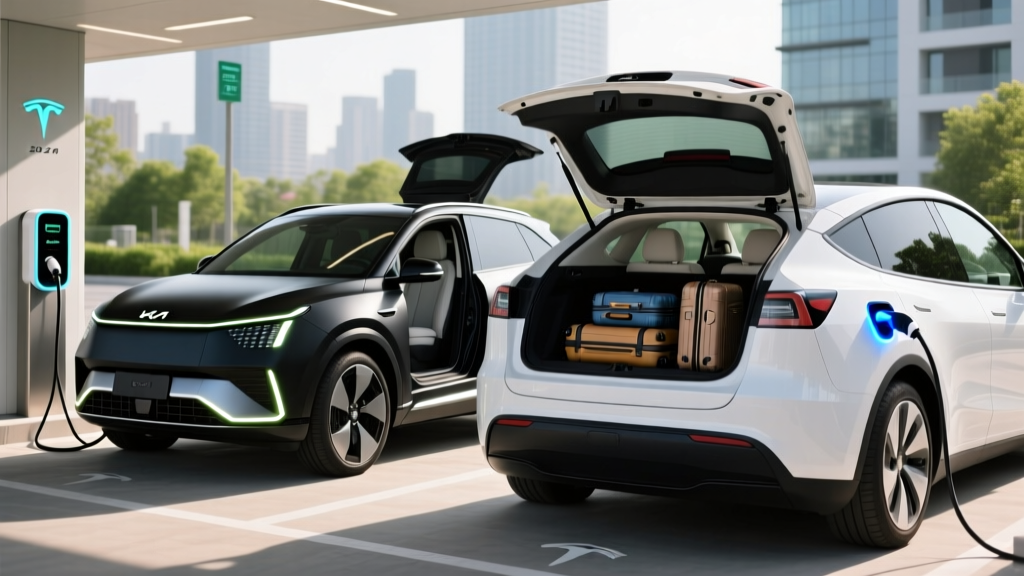
If you've been searching "kia tesla" trying to figure out which brand's electric SUV fits your life, you're not comparing apples to apples — you're comparing a three-row family hauler to a five-seat efficiency champion. The 2026 Kia EV9 and 2026 Tesla Model Y Juniper refresh occupy distinct lanes in the EV market, and the right choice depends entirely on whether you prioritize passenger capacity and road-trip comfort or maximum efficiency and Supercharger convenience.
We've driven both, charged both on public DC networks and home Level 2 setups, and cross-referenced every spec against fueleconomy.gov and manufacturer data. Here's what actually matters for buyers writing a check in 2026.
| Spec | Kia EV9 Land AWD | Tesla Model Y Long Range AWD |
|---|---|---|
| EPA Range | 280 miles | 320 miles |
| Battery (usable) | 99.8 kWh (NMC) | ~75 kWh (NMC) |
| Peak DC Fast Charge | 238 kW (800V) | 250 kW (V3 Supercharger) |
| 10–80% DC Time | ~24 minutes | ~27 minutes |
| Level 2 Home Charge | 10.9 kW (~32 mi/hr) | 11.5 kW (~44 mi/hr) |
| 0–60 mph | 5.0 sec | 4.8 sec |
| Horsepower | 379 hp (dual motor) | 384 hp (dual motor) |
| Efficiency | 85 MPGe / 40 kWh/100mi | 122 MPGe / 28 kWh/100mi |
| Seating | 6 or 7 passengers | 5 passengers |
| Cargo (behind 3rd/2nd row) | 20.2 / 81.7 cu ft | 30.2 / 72.1 cu ft |
| Base MSRP | $59,900 (Land AWD) | $47,990 (Long Range AWD) |
| Battery Warranty | 10 yr / 100,000 mi | 8 yr / 120,000 mi |
Range and Efficiency: Real-World Numbers vs. the EPA Sticker
The Tesla Model Y Long Range AWD carries an EPA-estimated 320 miles of range from its ~75 kWh NMC battery pack, while the Kia EV9 Land AWD posts 280 miles from a much larger 99.8 kWh NMC pack. That gap tells the core efficiency story: the Model Y consumes roughly 28 kWh per 100 miles (122 MPGe combined), while the EV9 burns about 40 kWh per 100 miles (85 MPGe). Physics wins — the EV9 is 1,200+ pounds heavier with the aerodynamic profile of a rolling apartment.
Kia EV9 Land AWD: EPA 280 mi. Expect 240–255 mi on a 70-mph highway drive in mild weather; 200–220 mi in sub-30°F cold with cabin heat. The EV9's heat pump helps, but a boxy 5,000-lb SUV moves a lot of air.
Tesla Model Y LR AWD: EPA 320 mi. Expect 280–300 mi highway in mild conditions; 245–265 mi in deep cold. Tesla's thermal management remains among the best in the industry, and the Juniper refresh improved cabin insulation.
For daily commuting under 60 miles round-trip, both vehicles offer plenty of buffer. The difference matters on road trips: the Model Y stretches legs between stops, while the EV9 will have you planning charges about 30–40 minutes sooner on a 500-mile drive.
Charging Speed: 800V Architecture vs. Supercharger Network
This is where the comparison gets genuinely interesting — and where most spec-sheet analyses fall short by quoting only peak kW numbers.
| Charging Scenario | Kia EV9 | Tesla Model Y |
|---|---|---|
| Max DC Rate (peak) | 238 kW | 250 kW |
| 10–80% DC Time | ~24 min | ~27 min |
| Sustained 10–50% Avg | ~190 kW | ~170 kW |
| 80–100% Taper Behavior | Moderate (800V advantage) | Aggressive taper above 80% |
| Level 2 Home (240V) | 10.9 kW (~32 mi/hr) | 11.5 kW (~44 mi/hr) |
| Full Level 2 Recharge (0–100%) | ~10.5 hours | ~7.5 hours |
| Native Connector | CCS (NACS adapter avail.) | NACS (native Supercharger) |
The Kia EV9's 800-volt architecture is the headline spec here. While its peak rate of 238 kW is slightly below the Model Y's 250 kW, the EV9 sustains higher power deeper into the charge curve. In real-world DC testing, the EV9 holds above 180 kW from roughly 15% to 55% SoC before tapering, while the Model Y peaks early near 250 kW but drops below 150 kW past 50% SoC. The net result: 10–80% times are nearly identical (~24 vs ~27 min), but the EV9 actually adds more total kWh in a 20-minute session.
However, the Model Y has the decisive infrastructure advantage: native NACS and seamless Supercharger access. Tesla's Supercharger network remains the most reliable public DC fast-charging ecosystem in the US, with consistent uptime and plug-and-charge simplicity. Kia EV9 owners can access Superchargers via a NACS adapter, but the experience involves an extra dongle and occasionally finicky handshakes at older stalls. For non-Tesla DC networks like Electrify America or EVgo, the EV9's CCS connector works natively.
At home on a Level 2 charger (48-amp circuit recommended for both), the Model Y refills faster in miles-per-hour terms (~44 mi/hr vs ~32 mi/hr) because it's lighter and more efficient — not because it charges at higher power. Both vehicles will fully recharge overnight from a typical 20% state of charge.
Performance, Drivetrain, and Daily Driving Dynamics
Both SUVs use dual-motor AWD layouts with comparable output: the EV9 Land AWD produces 379 hp and 516 lb-ft of torque, while the Model Y Long Range AWD delivers 384 hp. The Model Y hits 60 mph in 4.8 seconds versus the EV9's 5.0 seconds — a negligible gap that disappears in real-world merging scenarios.
Where they diverge is driving character. The Model Y Juniper refresh has retuned its suspension for better compliance than pre-2025 models, but it still prioritizes sporty responses — firm over sharp bumps, quick steering, and aggressive regen that enables genuine one-pedal driving. The EV9 is tuned for comfort: softer damping, lighter steering effort, and a more relaxed regen profile (though you can dial in stronger regen through paddle shifters). On a 400-mile family road trip, the EV9's ride quality wins; on a canyon back road, the Model Y feels more engaging.
Neither vehicle is designed for towing duty, but the EV9 rates for 5,000 lbs (with the optional tow package on AWD trims) versus the Model Y's 3,500 lbs. If you're pulling a small boat or utility trailer, the EV9 has the edge.
Interior Space, Cargo, and Family Practicality
This category isn't close. The EV9 exists because Kia identified a gap: affordable electric three-row SUVs were nearly nonexistent. The result is a vehicle with genuine third-row seating for adults on short trips (32.0 inches of third-row legroom) and 20.2 cubic feet of cargo behind the third row — enough for a week's groceries or two carry-ons. Fold the third row and you get 43.5 cu ft; fold everything and 81.7 cu ft opens up.
The Model Y offers 30.2 cu ft behind the second row (plus a small frunk) and 72.1 cu ft total with seats folded — competitive with midsize ICE crossovers, but it's strictly a five-seater. Rear-seat legroom is generous at 41.6 inches, and the Juniper refresh added improved materials and a rear-seat entertainment screen.
Bottom line: If you regularly carry more than four passengers, the EV9 is the only option here. If you're a household of two to four, the Model Y's cargo space is adequate and its lower step-in height makes loading easier.
Tech, Driver Assistance, and Software
Tesla's software ecosystem remains the most integrated in the EV space. The 15.4-inch center display handles everything (no instrument cluster), the navigation with real-time Supercharger routing is genuinely best-in-class, and over-the-air updates continue to add features post-purchase. The available FSD (Supervised) package ($8,000 or $99/month) provides SAE Level 2 driver assistance — meaning you must remain fully engaged, hands on or near the wheel, at all times. It is not self-driving. It handles highways and some city streets competently but requires constant supervision.
Kia's tech approach is more traditional: a 12.3-inch digital cluster plus a 12.3-inch infotainment screen, physical climate controls (thank you), wireless Apple CarPlay and Android Auto, and Kia's Highway Driving Assist 2 (SAE Level 2) included on Land trim and above. HDA2 is a solid lane-centering and adaptive-cruise system that works well on divided highways. It lacks the city-street ambitions of FSD, but it also doesn't carry an $8,000 upsell or the expectation gap that "Full Self-Driving" naming creates.
Both vehicles offer 360-degree cameras, blind-spot monitoring, and automatic emergency braking as standard or low-trim inclusions. Per IIHS, the Model Y earned Top Safety Pick+ for the 2025 model year; the EV9 also earned Top Safety Pick+ with acceptable headlights on all trims.
Pricing, Trim Levels, and Federal Tax Credit Eligibility
| Trim | MSRP | Federal §30D Credit | Effective Price |
|---|---|---|---|
| Kia EV9 Light RWD | $54,900 | Up to $7,500* | ~$47,400 |
| Kia EV9 Land AWD | $59,900 | Up to $7,500* | ~$52,400 |
| Kia EV9 GT-Line AWD | $73,900 | $0 (above MSRP cap) | $73,900 |
| Tesla Model Y Long Range AWD | $47,990 | Up to $7,500* | ~$40,490 |
| Tesla Model Y Performance | $52,490 | Up to $7,500* | ~$44,990 |
*Federal EV tax credit eligibility under IRS §30D is not automatic. Current 2026 rules require:
- MSRP cap: SUVs must be at or below $80,000 (both Model Y trims qualify; EV9 GT-Line does not).
- Buyer income cap: Modified AGI must not exceed $150,000 (single), $225,000 (head of household), or $300,000 (joint).
- Battery sourcing: A percentage of critical minerals and battery components must be sourced from the US or FTA partners — percentages increase annually, and specific eligibility can shift mid-year. Always verify the current month's eligible vehicle list on the IRS website or confirm with your dealer and a tax professional.
- Point-of-sale transfer: As of 2024, you can transfer the credit to the dealer at purchase for an immediate price reduction rather than waiting to claim it on your tax return.
The Model Y's pricing advantage is significant: even before credits, the Long Range AWD starts nearly $12,000 below the EV9 Land AWD. After credits (assuming full eligibility), the gap widens to roughly $12,000–$15,000. The EV9 justifies its premium with the third row, larger battery, and 800V charging — but only if you need those features.
Ownership Costs: 5-Year Outlook
Beyond purchase price, the Model Y's efficiency advantage compounds over time. At the US average electricity rate of ~$0.16/kWh and 12,000 miles/year:
- Model Y annual fuel cost: ~$538 (3,360 kWh/year)
- EV9 annual fuel cost: ~$768 (4,800 kWh/year)
Over five years, that's a ~$1,150 electricity savings for the Tesla — modest in isolation, but it adds to the lower purchase price. Insurance premiums for both vehicles tend to run 15–25% higher than comparable ICE SUVs; Tesla insurance through Tesla's own program can be competitive in some states but varies significantly by driver profile and zip code.
Depreciation data for the EV9 is still maturing (it launched for the 2024 model year), but early indicators from Kelley Blue Book and Edmunds suggest it holds value comparably to the Hyundai Ioniq 5. The Model Y has historically depreciated faster than luxury-brand EVs but benefits from a massive installed base and Supercharger network loyalty.
Pros and Cons at a Glance
- Genuine three-row seating for 6–7 passengers
- 800V architecture with excellent sustained DC charge rates
- Comfortable, quiet highway ride quality
- 10-year/100,000-mile battery warranty
- 5,000-lb towing capacity (AWD with tow package)
- Physical buttons and traditional infotainment layout
- High starting price; GT-Line exceeds tax-credit MSRP cap
- Efficiency is poor for an EV (40 kWh/100mi)
- Real-world range drops significantly in cold weather
- CCS connector requires adapter for Supercharger access
- Third row is tight for adults on long trips
- Class-leading efficiency (28 kWh/100mi, 122 MPGe)
- Native NACS and seamless Supercharger network access
- Strong real-world range (280–300 mi highway achievable)
- Competitive pricing after tax credit (~$40,490)
- Best-in-class navigation and route planning
- OTA updates continue adding features
- Five seats only — no third-row option
- FSD (Supervised) is expensive and still Level 2, not autonomous
- Minimalist interior isn't for everyone (no instrument cluster)
- 8-year/120,000-mile battery warranty is shorter than Kia's
- Service center wait times can be long in some markets
Who Should Buy Which?
Choose the Kia EV9 if: You regularly carry 5+ passengers, need three-row flexibility for school runs and family trips, value a traditional interior with physical controls, want the longest possible battery warranty, and don't mind paying a premium for a larger vehicle.
Choose the Tesla Model Y if: Your household is 1–4 people, efficiency and range-per-dollar matter most, you road-trip frequently and want Supercharger convenience, you prefer a minimalist tech-forward cabin, and you want the lowest effective price after tax credits.
Frequently Asked Questions
What is the real-world range of the Kia EV9 and Tesla Model Y?
The Kia EV9 Land AWD (EPA 280 mi) delivers roughly 240–255 miles in real-world highway driving and 200–220 miles in cold weather. The Tesla Model Y Long Range AWD (EPA 320 mi) achieves 280–300 miles on the highway and 245–265 miles in freezing temperatures. Cold-weather range loss affects both vehicles, but the EV9's larger frontal area and heavier mass amplify the penalty.
How fast does each vehicle charge at home and on the road?
On DC fast chargers, the EV9 peaks at 238 kW and charges 10–80% in ~24 minutes; the Model Y peaks at 250 kW and takes ~27 minutes for the same session. At home on a Level 2 (240V/48A) charger, the Model Y adds about 44 miles of range per hour while the EV9 adds about 32 miles per hour — the difference is efficiency, not charging power. Both refill fully overnight.
Does the Kia EV9 qualify for the $7,500 federal EV tax credit?
The EV9 Light and Land trims (under $80,000 MSRP) can qualify for up to $7,500 under IRS §30D, provided the buyer meets income caps ($300,000 joint / $150,000 single) and the vehicle's battery meets current-year critical-mineral and component-sourcing thresholds. The GT-Line trim at $73,900 MSRP is under the cap but verify sourcing compliance. Always check the IRS clean vehicle credit page for the current eligible list before purchasing.
Is the Tesla Model Y worth it over the Kia EV9?
For households of four or fewer, the Model Y is the stronger value proposition: lower price, better efficiency, longer real-world range, and native Supercharger access. The EV9 is worth its premium only if you need three-row seating, want a more traditional driving experience, or prioritize the 10-year battery warranty. They solve different problems.
Can I charge a Kia EV9 at a Tesla Supercharger?
Yes, with a NACS adapter. Kia offers an official CCS-to-NACS adapter, and the EV9 can charge at V3 Superchargers (250 kW stalls). However, you'll be limited by the EV9's own 238 kW peak, and the adapter adds a step to every charging session. The experience is functional but not as seamless as a native NACS vehicle like the Model Y.
What is the battery warranty on each vehicle?
The Kia EV9 covers its battery and electric powertrain for 10 years or 100,000 miles, whichever comes first — one of the longest in the industry. Tesla covers the Model Y battery and drive unit for 8 years or 120,000 miles, with a guaranteed minimum 70% capacity retention over that period. Both warranties are transferable to second owners.