Quick Verdict: The EV9 Is a True 3-Row Electric SUV
The Kia EV9 remains one of the few mainstream three-row electric SUVs on the market in 2026, and its cargo versatility is a primary reason buyers cross-shop it against the Tesla Model X and Rivian R1S. With up to 81.7 cubic feet of maximum cargo volume and a usable third row that actually fits adults, the EV9 bridges the gap between family hauler and long-distance EV road-tripper. But cargo space alone doesn't make an EV worth buying — range, charging speed, and pricing all factor into the equation. Here's the full breakdown.
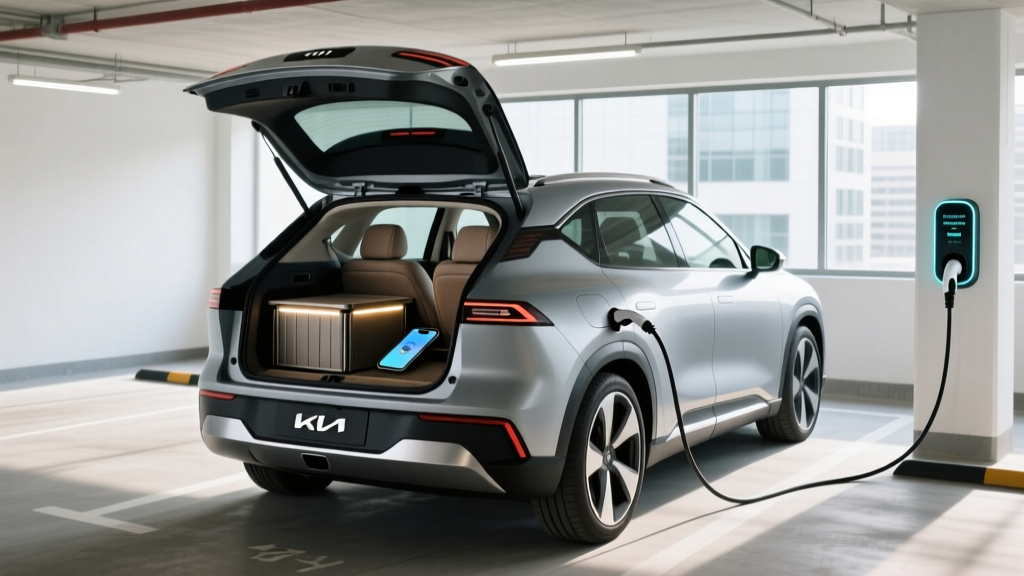
Kia EV9 Trunk Space and Cargo Dimensions
The search for Kia EV9 trunk space usually comes from buyers comparing it against midsize crossovers that claim three rows but offer almost nothing behind the third seat. The EV9's boxy, purpose-built EV platform (Hyundai Motor Group's E-GMP) delivers genuinely usable cargo numbers across all three seating configurations.
| Configuration | Cargo Volume (cu ft) | Real-World Notes |
|---|---|---|
| Behind 3rd row (all seats up) | 20.2 | Fits 2 large suitcases + a stroller; deeper load floor than most 3-row SUVs |
| Behind 2nd row (3rd row folded) | 43.5 | Enough for a week's groceries for a family of 5, or 4+ large duffels |
| Behind 1st row (all rear seats folded) | 81.7 | Near-flat load floor; fits a queen mattress or full camping setup |
| Front trunk (frunk) | 1.8 (AWD) / 3.2 (RWD) | Small — fits a charging cable bag or a laptop backpack, not a suitcase |
The 20.2 cubic feet behind the third row is a standout figure. For context, the Toyota Highlander Hybrid offers 16.1 cu ft in the same configuration, and the Tesla Model X provides approximately 26.1 cu ft (though the Model X starts at roughly $30,000 more). The EV9's squared-off tailgate design maximizes vertical space, meaning you can stack items higher without blocking the rear window.
One practical note: the second-row captain's chairs (available on higher trims) reduce pass-through cargo flexibility compared to the bench seat option. If you regularly haul long items like skis or lumber with only one passenger up front, the bench configuration is the better pick.
Range and Efficiency: EPA Numbers vs. Reality
EPA Estimate: Up to 304 miles (Light Long Range RWD) / 270 miles (AWD trims)
Real-World Expectation: 250–275 miles highway in mild weather; 200–230 miles in sub-freezing conditions
The 2026 Kia EV9 uses a 99.8 kWh usable battery pack (NMC chemistry — nickel manganese cobalt) across its Long Range and AWD trims. The base Light Standard Range model, which was discontinued after 2024, is no longer available new, so all current EV9 trims carry the larger pack.
On the EPA's official fuel economy site, the EV9 Light Long Range RWD achieves a combined 89 MPGe (35 kWh/100mi), while the AWD Land and GT-Line trims drop to 83 MPGe (41 kWh/100mi) due to the added weight and drag of the dual-motor setup.
In real-world highway driving at 70–75 mph, expect to consume roughly 38–42 kWh/100mi depending on temperature and terrain. Cold weather (below 32°F) typically reduces range by 15–25% in the EV9, consistent with other large NMC-pack EVs. The heat pump, standard on all trims, mitigates some of this loss during cabin heating but doesn't eliminate it. If your commute is primarily city driving with frequent regenerative braking opportunities, you'll see numbers closer to — or even slightly above — the EPA sticker.
Charging Speed: DC Fast, Level 2, and the 800V Advantage
The EV9 retains Hyundai Motor Group's 800V electrical architecture, which enables some of the fastest DC charging in the three-row SUV segment. Here's the full charging picture:
| Charging Level | Power / Rate | Time / Speed | Connector |
|---|---|---|---|
| DC Fast Charge (peak) | 239 kW | 10–80% in ~24 minutes | NACS (Tesla Supercharger compatible via adapter or native on 2025+ models) |
| DC Fast Charge (sustained avg) | ~170 kW (10-80%) | Charge curve tapers significantly above 80% | NACS / CCS1 (adapter) |
| Level 2 (home/public AC) | 10.9 kW (48A) | ~9 hours for 10–100%; ~32 miles of range per hour | J1772 / NACS |
| Level 1 (120V outlet) | ~1.4 kW | ~3–4 miles of range per hour | Standard household |
The 239 kW peak figure is impressive on paper, but as with all EVs, the charge curve matters more than the peak. The EV9 sustains above 200 kW from roughly 10% to 45% state of charge, then tapers to 150–170 kW through 65%, and drops further to under 100 kW past 80%. The 10–80% time of approximately 24 minutes assumes a preconditioned battery and a capable 350 kW charger (like Electrify America or Tesla V4 Superchargers). On a 150 kW station, plan for 35–40 minutes for the same session.
For home charging, the 10.9 kW onboard charger means a full overnight replenishment on a 48-amp Level 2 circuit. Budget roughly $600–$1,200 for a quality Level 2 home station (Emporia, ChargePoint, or Wallbox) and $800–$2,500 for electrician installation depending on your panel capacity and run length — a 200-amp panel is usually sufficient, but older homes may need an upgrade.
Performance and Drivetrain
| Trim | Drivetrain | Horsepower | Torque (lb-ft) | 0–60 mph |
|---|---|---|---|---|
| Light Long Range | RWD (single motor) | 215 hp | 258 | 7.7 sec |
| Wind / Land | AWD (dual motor) | 379 hp | 436 | 5.0 sec |
| GT-Line | AWD (dual motor) | 501 hp (boost mode) | 479 | 4.5 sec |
Even the base RWD model feels adequate around town — electric torque delivery masks the 215 hp figure. But if you're carrying a full cabin of passengers and cargo up mountain grades, the AWD dual-motor trims are the better choice. The GT-Line's 501 hp with boost mode engaged makes it genuinely quick for a 5,300-pound SUV, though activating boost drains range noticeably.
Towing capacity is rated at 5,000 pounds for AWD trims and 2,000 pounds for RWD — adequate for a small boat or utility trailer, but don't expect to pull a large camper. Towing cuts range roughly in half at highway speeds, so plan charging stops accordingly.
Pricing, Trims, and Federal Tax Credit Eligibility
| Trim | Base MSRP | Est. After §30D Credit* | Key Features |
|---|---|---|---|
| Light Long Range (RWD) | $56,395 | ~$48,895 | 304-mi range, 12.3" dual displays, Highway Driving Assist 2 |
| Wind (AWD) | $61,395 | ~$53,895 | Dual motor, heated/ventilated front seats, power liftgate |
| Land (AWD) | $66,895 | ~$59,395 | 2nd-row captain's chairs, premium audio, surround-view monitor |
| GT-Line (AWD) | $73,395 | ~$65,895 | 501 hp boost, 21" wheels, GT-Line styling, remote smart parking |
*Federal tax credit estimates assume eligibility under IRS §30D rules. Actual credit varies based on buyer income, vehicle MSRP caps, battery component sourcing, and point-of-sale transfer availability. Confirm with a tax professional.
The Kia EV9 qualifies for the federal clean vehicle credit under current §30D rules, but eligibility is not automatic for every buyer. Key requirements include:
- MSRP cap: The EV9 is classified as an SUV/van, so the MSRP cap is $80,000 — all trims fall under this threshold.
- Buyer income limits: Modified adjusted gross income must not exceed $300,000 (joint), $225,000 (head of household), or $150,000 (single).
- Battery sourcing: A percentage of critical minerals and battery components must be sourced from the U.S. or free-trade-agreement countries. Kia has worked to localize battery supply, but the exact credit amount ($3,750 or $7,500) depends on the specific VIN's compliance with current-year sourcing thresholds.
- Point-of-sale transfer: Eligible buyers can transfer the credit to the dealer at purchase, reducing the upfront price rather than waiting for a tax refund.
Some states offer additional rebates or tax incentives on top of the federal credit. Check your state energy office or the AFDC state law database for local programs.
Interior, Tech, and Driver Assistance
The EV9's cabin is dominated by a curved panoramic display combining a 12.3-inch digital instrument cluster and a 12.3-inch infotainment touchscreen. Wireless Apple CarPlay and Android Auto are standard across all trims. The infotainment system is responsive, though Kia's decision to integrate some climate controls into the touchscreen draws complaints from buyers who prefer physical buttons.
Driver assistance comes via Kia's Highway Driving Assist 2 (HDA2), a Level 2 SAE system that combines adaptive cruise control with lane centering. It works well on divided highways but requires continuous driver supervision — this is not a hands-free system like GM's Super Cruise or Ford's BlueCruise. Keep your hands on the wheel.
Available features worth noting: digital key (phone-as-key), vehicle-to-load (V2L) power output (up to 3.6 kW — enough to run appliances during a power outage or power a campsite), and remote smart parking assist on the GT-Line, which moves the vehicle in and out of tight spaces while you stand outside.
Passenger space is generous across all three rows:
- First row legroom: 41.5 inches
- Second row legroom: 42.8 inches (class-leading)
- Third row legroom: 32.0 inches — fits adults on shorter trips, tight for anyone over 5'10" on long hauls
Battery Warranty and Long-Term Ownership
Kia covers the EV9's battery pack and electric powertrain with a 10-year / 100,000-mile warranty, one of the longest in the industry. The battery warranty guarantees that capacity will not fall below 70% of original capacity during the coverage period. Based on data from Hyundai Motor Group's E-GMP platform vehicles (Ioniq 5, EV6) now accumulating high mileage in real-world use, NMC degradation has been modest — typically 8–12% loss over the first 60,000 miles.
The general vehicle warranty covers 5 years / 60,000 miles bumper-to-bumper, and roadside assistance runs 5 years / unlimited miles. For a family SUV that will likely see 12,000–15,000 miles annually, this coverage provides solid peace of mind through the first decade of ownership.
If you're concerned about battery longevity, the EV9's thermal management system (liquid-cooled with active preconditioning) helps protect the pack during fast charging and extreme temperatures. Preconditioning the battery before a DC fast charge session — which the navigation system does automatically when you route to a charger — is critical for maintaining long-term health.
Pros, Cons, and Who Should Buy the EV9
- Best-in-class cargo space behind 3rd row (20.2 cu ft)
- 800V architecture enables 239 kW DC fast charging
- 10-yr/100,000-mi battery warranty
- Genuinely usable third row for adults
- V2L capability (3.6 kW output)
- Federal tax credit eligible on most trims
- Frunk is tiny (1.8 cu ft on AWD)
- Real-world highway range drops to ~250 mi on AWD trims
- Cold-weather range loss of 15–25%
- GT-Line is quick but expensive at $73K+
- HDA2 is not hands-free — less advanced than Super Cruise
- Towing significantly cuts range
- Families of 4–6 who need a genuine third row plus cargo room for strollers, sports gear, and groceries.
- Home-charging owners with a Level 2 setup who can wake up to a full 300-mile battery daily.
- Road trippers willing to plan 20–25 minute charging stops every 220–250 miles on the highway.
- Outdoor enthusiasts who value V2L for camping and need 5,000-lb towing for a small trailer.
Look elsewhere if: you need hands-free highway driving (consider the Cadillac Lyriq with Super Cruise), prioritize maximum range over seating (the Tesla Model S or Lucid Air go 400+ miles but have no third row), or want a frunk large enough for serious gear storage.
Frequently Asked Questions
What is the real-world range of the Kia EV9?
The EPA rates the EV9 at up to 304 miles (RWD) and 270 miles (AWD). In real-world highway driving at 70 mph in mild weather, expect 250–275 miles for AWD trims. In freezing temperatures, that drops to 200–230 miles. City driving with regenerative braking can push you closer to the EPA number.
How fast does the Kia EV9 charge?
On a 350 kW DC fast charger with a preconditioned battery, the EV9 peaks at 239 kW and charges from 10–80% in approximately 24 minutes. On a 150 kW charger, plan for 35–40 minutes. Home Level 2 charging at 10.9 kW adds about 32 miles per hour, fully replenishing the pack in roughly 9 hours.
Does the Kia EV9 qualify for the federal EV tax credit?
Yes, the EV9 is eligible under IRS §30D rules, but the actual credit amount ($3,750 or $7,500) depends on battery sourcing compliance for your specific VIN, your income (must be under $300K joint / $150K single), and the vehicle's MSRP (all trims are under the $80K SUV cap). The credit can be transferred to the dealer at point of sale. Consult a tax professional and verify on IRS.gov.
How much trunk space does the Kia EV9 have?
The EV9 offers 20.2 cubic feet behind the third row, 43.5 cu ft with the third row folded, and 81.7 cu ft with all rear seats down. The frunk adds 1.8 cu ft (AWD) or 3.2 cu ft (RWD). The 20.2 cu ft behind the third row is among the largest in the three-row electric SUV segment.
Is the Kia EV9 worth buying over the Tesla Model X or Rivian R1S?
The EV9's advantage is value — it undercuts the Model X by over $30,000 and the R1S by roughly $15,000 while offering competitive cargo space and a strong warranty. The Model X offers more range and Supercharger access (though NACS compatibility is closing that gap), and the R1S delivers superior off-road capability and a more premium interior. If budget and cargo practicality are your top priorities, the EV9 is the strongest pick in the segment.
What is the Kia EV9's battery warranty?
Kia provides a 10-year / 100,000-mile battery and powertrain warranty, guaranteeing the battery will retain at least 70% of its original capacity during the coverage period. The bumper-to-bumper warranty covers 5 years / 60,000 miles.