Quick Verdict: Which 2026 Kia EV9 Trim Level Fits Your Garage?
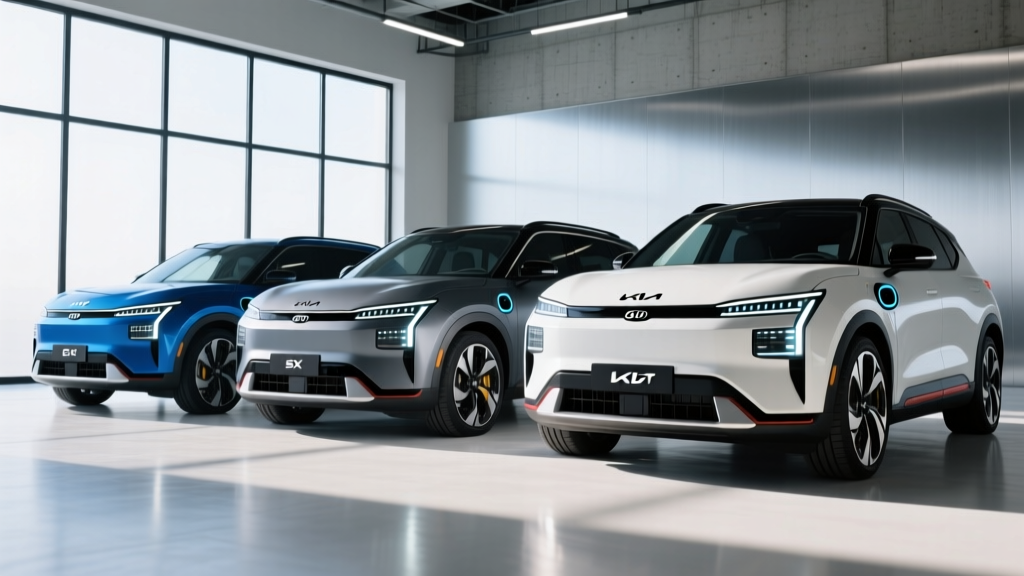
The Kia EV9 remains one of the only mainstream three-row electric SUVs on the market, and the 2026 model year brings subtle but meaningful updates across the lineup. With five distinct trim levels spanning from the entry-level Light RWD at roughly $56,000 to the fully loaded GT-Line AWD pushing past $75,000, choosing the right EV9 trim level comes down to three questions: Do you need all-wheel drive? How much range matters to you? And how many of Kia's premium features justify the upcharge?
After spending time with multiple configurations, our recommendation lands on the Wind AWD as the sweet spot — you get dual-motor traction, 282 miles of EPA range, and the core tech suite without stepping into Land or GT-Line pricing territory. But every trim has a distinct use case, and this guide walks through each one with exact numbers.
| Trim | Drivetrain | Battery (kWh) | EPA Range | HP / lb-ft | 0-60 mph | Base MSRP |
|---|---|---|---|---|---|---|
| Light RWD | RWD | 76.1 (usable) | 230 mi | 215 / 258 | 7.9s | $56,395 |
| Light Long Range RWD | RWD | 99.8 (usable) | 304 mi | 201 / 258 | 8.2s | $60,595 |
| Wind RWD | RWD | 99.8 (usable) | 304 mi | 201 / 258 | 8.2s | $63,395 |
| Wind AWD | Dual-motor AWD | 99.8 (usable) | 282 mi | 379 / 516 | 5.0s | $66,395 |
| Land AWD | Dual-motor AWD | 99.8 (usable) | 280 mi | 379 / 516 | 5.0s | $71,395 |
| GT-Line AWD | Dual-motor AWD | 99.8 (usable) | 270 mi | 379 / 516 | 4.7s | $75,495 |
Note: MSRP figures exclude the $1,395 destination charge. Pricing reflects 2026 model-year MSRPs and is subject to change.
Range and Efficiency: Real-World Numbers vs. the EPA Sticker
The EV9's battery comes in two sizes. The Light RWD uses a 76.1 kWh usable pack, while every other trim steps up to the 99.8 kWh usable battery. Both are NMC (nickel-manganese-cobalt) chemistry — Kia has not adopted LFP for the EV9, prioritizing energy density to move this 5,600+ lb SUV.
On the EPA cycle, the Long Range RWD trims achieve up to 304 miles. But EPA estimates assume a mix of city and highway driving at moderate temperatures. Real-world results diverge depending on how and where you drive.
EPA Combined: 282–304 miles (AWD/RWD Long Range)
Highway (75 mph sustained): Expect ~230–255 miles from AWD trims, ~250–270 miles from RWD Long Range
Cold weather (below 32°F): Plan for 20–30% range reduction, bringing AWD trims to ~195–225 miles effective
Efficiency: 87 MPGe combined (Wind AWD); approximately 39 kWh/100 mi
The EV9's boxy shape creates meaningful aerodynamic drag at highway speeds. Around town, regenerative braking helps recover energy, making city driving more efficient than highway cruising — the opposite of a gas car.
The smaller 76.1 kWh pack in the Light RWD yields a 230-mile EPA estimate. For a family hauler, that range is tight if your daily driving exceeds 80 miles round-trip or if you live in a cold climate. We'd only recommend the Light RWD for warm-climate commuters with reliable home charging and a second vehicle for road trips.
Charging Speed: DC Fast Charging and Home Level 2
The EV9 is built on Hyundai Motor Group's E-GMP platform with an 800-volt architecture, which enables fast DC charging speeds that still stand out in this segment. Here's what the numbers look like across charging levels:
| Charging Level | Power / Rate | What You Get | Notes |
|---|---|---|---|
| Level 1 (120V) | ~1.4 kW | ~4 miles per hour | Emergency/top-up only; a full charge takes days |
| Level 2 (240V, 48A) | 11.5 kW (onboard charger) | ~32 miles per hour | Full charge in ~9 hrs (99.8 kWh pack) |
| DC Fast Charge (peak) | Up to 236 kW | 10–80% in ~24 minutes | Requires 350 kW-class station; speed tapers above 80% |
The 236 kW peak charge rate is impressive, but like every EV, the EV9 doesn't sustain peak speed for the entire session. The charge curve holds strong from roughly 10% to 55% SoC, then progressively tapers. Expect the 10–80% session to take about 24 minutes at a Electrify America or EVgo 350 kW stall — but only if you precondition the battery by navigating to the charger in the EV9's infotainment system. Without preconditioning, cold-soaked batteries can charge at half the peak rate.
For home charging, the 11.5 kW onboard charger is competitive. A full overnight charge on a Level 2 home station is realistic for even the largest pack. Budget roughly $500–$1,200 for a quality Level 2 wallbox and $800–$2,500 for professional installation depending on your electrical panel's capacity. If your home has a 200-amp panel with spare capacity, installation stays on the lower end; a panel upgrade can push total costs past $4,000.
One practical note: the EV9 uses the CCS1 connector for DC fast charging. With Kia's adoption of the NACS (Tesla-style) port expected on future models, current EV9 owners will need a CCS-to-NACS adapter to access Tesla Superchargers — Kia has confirmed adapter compatibility, but always verify fitment with your specific model year.
EV9 Trim Levels: What You Get at Each Price Point
Light RWD — $56,395
The entry trim includes the 76.1 kWh battery, 215 hp, 19-inch wheels, dual 12.3-inch displays (instrument cluster and infotainment), wireless Apple CarPlay/Android Auto, heated front seats, and Kia's full Highway Driving Assist 2 (HDA2) suite. You also get three rows of seating, though the third row is best suited for children. The Light RWD is a strong value if your commutes are short and you don't need AWD.
Light Long Range RWD — $60,595
For $4,200 more, you get the 99.8 kWh battery and 304 miles of EPA range. This is the range-maximizing choice if AWD isn't necessary. The trade-off is slightly slower acceleration (8.2 seconds to 60 mph vs. 7.9) due to the added battery weight.
Wind RWD — $63,395
The Wind adds 20-inch wheels, a power tilt/slide panoramic sunroof, heated and ventilated front seats, a heated steering wheel, and a hands-free power liftgate. It keeps the Long Range battery and RWD layout. This trim is ideal for warm-climate buyers who want premium comfort without AWD.
Wind AWD — $66,395
Our recommended trim. Adding the dual-motor AWD powertrain brings 379 hp, a 5.0-second 0-60 time, and 282 miles of range. You give up 22 miles of EPA range vs. Wind RWD, but gain confident traction in rain, snow, and on mountain grades. The Wind AWD also unlocks a 5,000-lb towing capacity (vs. 2,000 lbs for RWD trims).
Land AWD — $71,395
The Land adds second-row captain's chairs (reducing seating from seven to six), a 12.3-inch dual panoramic display upgrade, premium SynTex leatherette with heated and ventilated second-row seats, a 14-speaker Meridian audio system, and a digital rearview mirror. Range drops slightly to 280 miles due to the added equipment weight. This is the luxury-oriented family trim.
GT-Line AWD — $75,495
The top-of-line GT-Line brings unique exterior styling, 21-inch wheels, GT-Line badging, a head-up display, a digital key, remote smart parking assist, and enhanced interior materials. Range drops to 270 miles — the larger wheels and increased rolling resistance cost you roughly 10 miles vs. the Land. The GT-Line also drops the 0-60 time to 4.7 seconds thanks to a sport-tuned torque distribution map.
Federal Tax Credit and Real Purchase Cost
The 2026 Kia EV9 is assembled in West Point, Georgia, which is a critical factor for federal §30D tax credit eligibility. However, qualifying for the full $7,500 credit depends on several buyer-specific and vehicle-specific requirements:
- MSRP Cap: The EV9 must have an MSRP at or below $80,000 (SUV/van/pickup threshold). All current EV9 trims qualify.
- Buyer Income Cap: Modified AGI must not exceed $150,000 (single), $225,000 (head of household), or $300,000 (joint filers).
- Battery Sourcing: At least 80% of critical minerals and 100% of battery components must be sourced from the U.S. or FTA partners to receive the full $7,500. Partial credits ($3,750) may apply if only one requirement is met. Kia has confirmed North American battery sourcing for U.S.-built EV9s, but verify your VIN on fueleconomy.gov before purchasing.
- Point-of-Sale Transfer: As of 2024, the credit can be transferred to the dealer at purchase, reducing your out-of-pocket cost immediately rather than waiting until tax filing.
Always consult a tax professional and verify eligibility on irs.gov before relying on credit amounts.
| Trim | MSRP + Destination | Est. After $7,500 Credit | Est. After $3,750 Credit |
|---|---|---|---|
| Light RWD | $57,790 | $50,290 | $54,040 |
| Light Long Range RWD | $61,990 | $54,490 | $58,240 |
| Wind RWD | $64,790 | $57,290 | $61,040 |
| Wind AWD | $67,790 | $60,290 | $64,040 |
| Land AWD | $72,790 | $65,290 | $69,040 |
| GT-Line AWD | $76,890 | $69,390 | $73,140 |
Many states also offer additional EV incentives — California's CVRP, Colorado's state credit, and various utility rebates can stack on top. Check your state's energy office or utility provider for current programs, as these vary widely by jurisdiction and change frequently.
Interior Space, Cargo, and Livability
The EV9's defining advantage is its three-row interior in a segment where most EVs top out at two rows. Here are the concrete dimensions that matter for family buyers:
- Cargo behind 3rd row: 20.2 cu ft — enough for a couple of carry-ons or a week of groceries
- Cargo behind 2nd row (3rd row folded): 43.5 cu ft — competitive with midsize SUVs
- Max cargo (2nd and 3rd rows folded): 81.7 cu ft — approaches minivan territory
- Front legroom: 41.5 inches
- 2nd-row legroom: 42.8 inches (generous; captain's chairs on Land/GT-Line reduce seating to six)
- 3rd-row legroom: 32.0 inches — tight for adults on long trips, fine for kids
The available Vehicle-to-Load (V2L) feature on Wind trims and above lets you power external devices — a campsite, power tools, or even a small appliance during an outage — using the EV9's battery. This is a genuine differentiator for outdoor-oriented families.
Tech, Safety, and Driver Assistance
Every EV9 trim includes Kia's Highway Driving Assist 2 (HDA2), which provides adaptive cruise control with stop-and-go, lane centering, and lane-change assist. This is a Level 2 driver-assist system per SAE classification — you must keep your hands on the wheel and eyes on the road at all times. It is not autonomous driving.
HDA2 performs well on clearly marked highways but can struggle with faded lane lines, construction zones, and aggressive cut-ins. The system will issue a hands-on warning if it detects no steering input for approximately 30 seconds. It does not navigate intersections, stoplights, or unmapped roads autonomously.
The infotainment system runs on dual 12.3-inch displays (standard on all trims) with wireless Apple CarPlay and Android Auto. The Land and GT-Line add a wider panoramic curved display. Over-the-air (OTA) updates keep the software current, and Kia's connected services include remote climate preconditioning, charge scheduling, and vehicle location — all manageable through the Kia Access app.
The EV9 earned a TOP SAFETY PICK+ rating from IIHS and a 5-star overall rating from NHTSA, making it one of the safest vehicles in the three-row SUV category regardless of powertrain.
How the EV9 Compares to Key Competitors
The EV9's competitive set is narrow — there simply aren't many three-row electric SUVs to cross-shop. Here's how it stacks up:
- Vs. Rivian R1S: The R1S offers more off-road capability, a quad-motor option, and up to ~410 miles of range (Max Pack). But it starts around $80,000 and has a longer build wait. The EV9 is more affordable, charges faster on the E-GMP platform, and has better third-row space. Choose the R1S for adventure; choose the EV9 for daily family duty.
- Vs. Tesla Model X: The Model X offers falcon-wing doors, more range (up to ~348 mi), and access to the Supercharger network natively. But it starts above $80,000 (ineligible for the federal credit on most trims), and the third row is even tighter than the EV9's. The EV9 is the more practical family choice at a lower price.
- Vs. Hyundai Ioniq 9 (upcoming): Hyundai's platform-mate is expected to share the E-GMP architecture and similar battery options. If you're not in a rush, it's worth waiting for pricing and design reveals. But the EV9 is available now with proven real-world data.
Choose the EV9 Wind AWD if: You need AWD, want 280+ miles of range, tow occasionally, and prefer not to pay Land/GT-Line premiums.
Choose the EV9 Light Long Range RWD if: You live in a warm climate, don't need AWD, and want to maximize range per dollar.
Choose the EV9 Land AWD if: You want second-row captain's chairs, premium audio, and don't mind paying $5,000 more for luxury touches.
Look elsewhere if: You need 350+ miles of range, frequent off-road capability, or require a usable third row for full-size adults.
Warranty and Long-Term Ownership
Kia backs the EV9 with one of the strongest warranty packages in the segment:
- Battery & Drive Unit: 10 years / 100,000 miles (whichever comes first)
- Limited Vehicle Warranty: 5 years / 60,000 miles
- Powertrain Warranty: 10 years / 100,000 miles
- Roadside Assistance: 5 years / 60,000 miles
Kia guarantees that the high-voltage battery will retain at least 70% of its original capacity during the 10-year/100,000-mile warranty period. Based on NMC degradation data from the E-GMP platform's existing vehicles (Ioniq 5, EV6), owners typically see 5–8% degradation over the first 50,000 miles before the curve flattens. Reaching 70% capacity within the warranty period would be unusual under normal use.
Insurance costs for the EV9 tend to run 15–25% higher than a comparable gas-powered three-row SUV, primarily due to higher repair costs for EV-specific components and the vehicle's premium price. Get a quote from your insurer before committing.
Pros and Cons of the 2026 Kia EV9
- Genuine three-row seating in an EV — a rare combination
- 800V architecture enables 236 kW DC fast charging
- Strong federal tax credit eligibility (U.S.-built)
- 5,000-lb towing capacity on AWD trims
- Excellent safety ratings (IIHS TSP+, NHTSA 5-star)
- V2L capability for camping and backup power
- 10-year/100,000-mile battery warranty
- Real-world highway range drops significantly below EPA estimates
- Third row is tight — 32 inches of legroom suits kids only
- Cold-weather range loss is pronounced (20–30%)
- CCS1 connector requires an adapter for Tesla Superchargers
- Higher insurance premiums than gas equivalents
- Boxy design creates wind noise at highway speeds
- Base Light RWD's 230-mile range is limiting for a family SUV
Frequently Asked Questions
What is the real-world range of the Kia EV9?
The EPA rates the Long Range RWD trims at 304 miles and the Wind AWD at 282 miles. In real-world highway driving at 75 mph, expect roughly 230–255 miles from AWD trims and 250–270 miles from RWD Long Range models. In freezing temperatures, plan for a 20–30% reduction, bringing effective AWD range to around 195–225 miles.
How fast does the EV9 charge at home and on the road?
On a Level 2 home charger (240V, 48A), the EV9 charges at up to 11.5 kW, adding roughly 32 miles per hour — a full overnight charge for any trim. On a 350 kW DC fast charger with battery preconditioning, it peaks at 236 kW and charges from 10–80% in approximately 24 minutes, though the rate tapers significantly above 80% SoC.
How much does the EV9 cost after the federal tax credit?
If you qualify for the full $7,500 §30D credit (income within limits, battery sourcing verified), the Wind AWD drops from roughly $67,790 to about $60,290. If only the partial $3,750 credit applies, the same trim lands near $64,040. State and utility incentives may stack on top.
Does the 2026 Kia EV9 qualify for the $7,500 federal EV tax credit?
The EV9 is U.S.-built and its MSRP falls below the $80,000 SUV cap, making it potentially eligible. However, you must also meet income caps ($150K single / $300K joint) and the vehicle must meet battery critical-mineral and component sourcing thresholds. Verify your specific VIN on fueleconomy.gov and consult a tax professional before relying on the credit.
Is the Kia EV9 worth buying over the Rivian R1S or Tesla Model X?
For families prioritizing value, interior space, and daily usability, the EV9 is the strongest choice. It's more affordable than both competitors, charges faster than the Model X on non-Tesla networks, and offers a better third row than either. Choose the R1S if you need serious off-road capability or 400+ mile range (Max Pack). Choose the Model X if Supercharger network access and maximum range are non-negotiable.
Can the EV9 tow, and how does towing affect range?
AWD trims are rated for 5,000 lbs of towing capacity; RWD trims are limited to 2,000 lbs. When towing near maximum capacity, expect range to drop by 35–50%. A Wind AWD rated at 282 miles EPA could realistically deliver 140–180 miles while towing a loaded trailer. Plan charging stops accordingly.
What's the best EV9 trim level for a family?
The Wind AWD at $66,395 offers the best balance of range (282 mi), power (379 hp), AWD traction, towing capability (5,000 lbs), and features without the Land/GT-Line premium. If you want second-row captain's chairs for child seats, the Land AWD is worth the $5,000 step up.