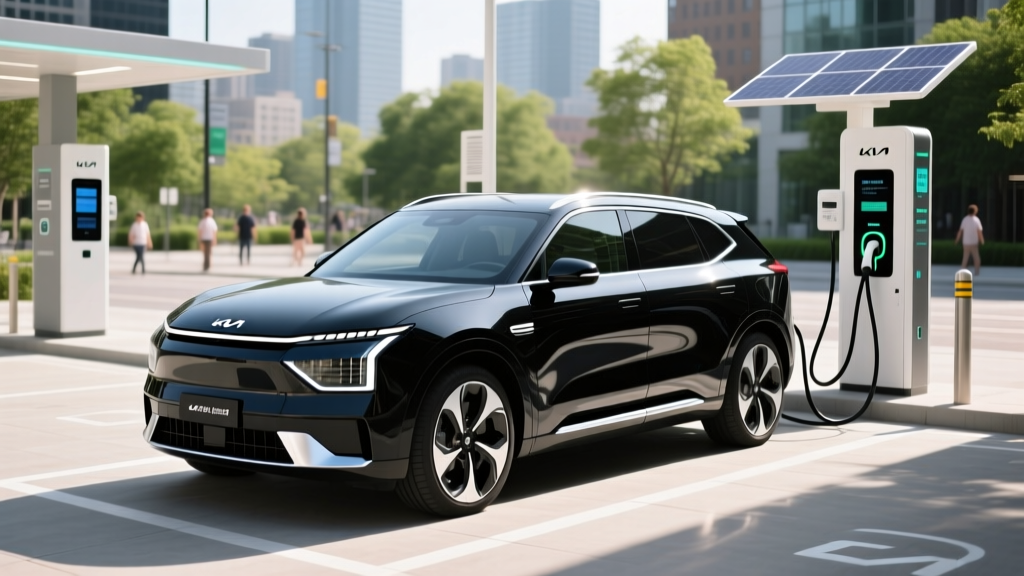
The three-row Kia EV9 is one of the most capable electric SUVs on the market, but its $54,900 starting MSRP makes understanding every available rebate and incentive essential. If you're searching for the latest Kia EV9 rebate information, the answer involves a complex web of federal tax credits, state-level programs, and utility incentives — all of which have shifted significantly for the 2026 model year.
This guide cuts through the confusion with exact numbers: what the EV9 actually costs to own over five years, whether it qualifies for the full $7,500 federal credit under current IRS §30D rules, and where the real savings (and hidden costs) lie compared to a gas-powered three-row SUV like the Kia Telluride.
Does the 2026 Kia EV9 Qualify for the Federal Tax Credit?
The short answer: it depends on your income, the specific trim you buy, and Kia's battery-sourcing compliance at the time of purchase. The federal EV tax credit under IRS §30D offers up to $7,500, but it is not a universal rebate. It is a tax credit with strict eligibility gates.
§30D Federal Tax Credit Requirements (2026)
- Buyer income cap: Modified AGI must not exceed $150,000 (single), $225,000 (head of household), or $300,000 (married filing jointly)
- MSRP cap: Vehicle base MSRP must be ≤ $80,000 for SUVs/pickups/vans (the EV9 qualifies as an SUV)
- Battery sourcing: Two independent requirements — critical minerals (up to $3,750) and battery component manufacturing (up to $3,750). Both must be met for the full $7,500
- Point-of-sale transfer: As of 2024+, you can transfer the credit to the dealer at purchase, reducing your out-of-pocket cost immediately rather than waiting for tax filing
- Final assembly: Vehicle must undergo final assembly in North America (the EV9 is assembled in West Point, Georgia)
- Foreign entity of concern (FEOC): Battery components and critical minerals cannot be sourced from prohibited entities — this is where many vehicles lose partial or full eligibility
For the 2026 model year, the Kia EV9's eligibility for the full $7,500 has been inconsistent across trims and production batches. The GT-Line and Land AWD trims, which push MSRP toward $73,000–$76,000 with options, remain under the $80,000 SUV cap, but buyers must verify the specific VIN's battery-sourcing compliance on the fueleconomy.gov tax credit lookup before signing paperwork. Kia's Georgia assembly satisfies the final-assembly requirement, but critical-mineral and battery-component sourcing compliance can shift quarter to quarter.
Practical advice: Ask the dealer for the VIN-specific credit eligibility report before committing. Do not assume the full $7,500 — some EV9 builds have qualified for only $3,750 (meeting one of the two battery requirements but not both).
2026 Kia EV9: Key Specs at a Glance
| Spec | EV9 Light (RWD) | EV9 Wind/Land (AWD) | EV9 GT-Line (AWD) |
|---|---|---|---|
| Base MSRP | $54,900 | $59,900 | $73,900 |
| Battery (usable) | 76.1 kWh (NMC) | 99.8 kWh (NMC) | 99.8 kWh (NMC) |
| EPA Range | 230 mi | 280 mi | 270 mi |
| Real-World Range (highway/cold) | ~185–200 mi | ~230–250 mi | ~220–240 mi |
| Peak DC Fast Charge | ~170 kW | ~210 kW | ~210 kW |
| 10–80% DC Charge Time | ~24 min | ~24 min | ~24 min |
| Level 2 Charge Rate | 10.9 kW | 10.9 kW | 10.9 kW |
| Horsepower | 215 hp | 379 hp | 379 hp |
| 0–60 mph | 7.7 sec | 4.5 sec | 4.5 sec |
| MPGe (combined) | 88 MPGe | 83 MPGe | 83 MPGe |
| Battery Warranty | 10 years / 100,000 miles | ||
Real-World Range Reality Check
The EPA rates the AWD EV9 with the 99.8 kWh pack at 280 miles. In real-world highway driving at 70 mph with moderate climate use, expect 230–250 miles. In sub-30°F winter conditions, that drops to roughly 195–215 miles due to cabin heating demand and reduced battery efficiency. The EV9's heat pump (standard on AWD trims) mitigates some cold-weather loss, but the large, boxy SUV shape works against efficiency at sustained highway speeds.
5-Year Total Cost of Ownership: EV9 vs. Gas SUV
To understand the true financial picture, we modeled five years of ownership for the EV9 Land AWD ($59,900 MSRP) against the Kia Telluride SX ($46,500 MSRP) — a natural gas-powered cross-shop. Both driven 12,000 miles/year.
| Cost Category | Kia EV9 Land AWD | Kia Telluride SX (Gas) |
|---|---|---|
| Purchase Price (MSRP) | $59,900 | $46,500 |
| Federal Tax Credit (§30D) | −$7,500 (if eligible) | $0 |
| Effective Purchase Price | $52,400 | $46,500 |
| Fuel/Energy (5 yrs, 60k mi) | $4,320 (home L2, $0.15/kWh) | $10,800 ($3.60/gal, 22 MPG) |
| Maintenance (5 yrs) | $1,200 | $3,800 |
| Insurance (5 yrs) | $12,500 | $9,200 |
| Estimated Depreciation (5 yrs) | $26,200 (50%) | $18,600 (40%) |
| 5-Year Total Cost | $70,220 | $69,700 |
The math shows near-parity over five years, but with important caveats. The EV9's higher insurance and steeper depreciation offset most of its fuel and maintenance savings. The federal tax credit is what makes the EV9 competitive — without it, the five-year gap widens to roughly $13,000 in favor of the Telluride.
Charging Cost vs. Gas: The Per-Mile Math
| Scenario | EV9 Cost/Mile | Telluride Cost/Mile |
|---|---|---|
| Home Level 2 ($0.15/kWh / $3.60/gal) | $0.051 | $0.164 |
| Public DC Fast ($0.45/kWh avg) | $0.153 | $0.164 |
| Blended (80% home / 20% DCFC) | $0.071 | $0.164 |
The EV9's efficiency of roughly 2.9–3.4 kWh/mile (depending on conditions) means home charging at the national average of $0.15/kWh costs about 5 cents per mile — roughly a third of what the Telluride burns in gasoline. Even at public DC fast chargers averaging $0.45/kWh, the EV9 nearly matches gas costs per mile.
The critical variable is home charging access. If you rely primarily on public charging at premium rates ($0.40–$0.60/kWh at some Electrify America or EVgo stations), your per-mile energy cost can equal or exceed gasoline. The EV9's 99.8 kWh battery also means each full charge from empty costs $15 at home but $45+ at a public DC charger.
State, Local, and Utility Incentives Beyond the Federal Credit
Your Location Changes the Math Significantly
Federal credits are uniform, but state and utility incentives vary dramatically. These stack on top of the §30D credit and can meaningfully reduce your net cost. Always verify current availability with your state energy office and local utility, as programs exhaust funding or change terms annually.
Examples of additional incentives that may apply to an EV9 purchase (as of early 2026):
- California CVRP: Up to $7,000 for income-eligible buyers (stacks with federal credit)
- Colorado state credit: $5,000 for vehicles under $80,000 MSRP, with an additional $2,500 for income-qualified buyers
- New York Drive Clean Rebate: Up to $2,000 at point of sale (subject to funding availability)
- Utility rebates: Many utilities offer $500–$1,500 for EV purchase plus $250–$500 for home Level 2 charger installation (check with your local provider — PG&E, ConEd, Xcel Energy, and others have active programs)
- Home charger tax credits: The federal Alternative Fuel Vehicle Refueling Property Credit (30C) offers up to $1,000 for home charger installation, but only in eligible census tracts
For a Colorado buyer eligible for both the $7,500 federal credit and the $5,000 state credit, a $59,900 EV9 Land AWD drops to an effective $47,400 — suddenly making it cheaper than the Telluride on day one.
Maintenance Savings: Where EVs Quietly Win
| Maintenance Item | EV9 (5 yrs / 60k mi) | Telluride (5 yrs / 60k mi) |
|---|---|---|
| Oil Changes | $0 | $600 (every 7,500 mi) |
| Brake Pads/Rotors | $0–$200 (regen extends life) | $800–$1,200 |
| Transmission Fluid | $0 | $300 |
| Tire Rotation/Replacement | $1,000 (heavier vehicle, faster tire wear) | $800 |
| Cabin Air Filter | $200 | $200 |
| Total Estimated | $1,200 | $3,800 |
The EV9 saves roughly $2,600 in maintenance over five years. Regenerative braking dramatically extends brake pad life — many EV owners report original pads lasting 80,000+ miles. The tradeoff: the EV9's heavier curb weight (5,200–5,600 lbs depending on trim) accelerates tire wear, and replacement tires for the 20- or 21-inch wheels on higher trims can run $300–$400 per corner.
Insurance Cost Reality: The Expense Buyers Overlook
EV insurance premiums typically run 15–30% higher than comparable gas vehicles. For the EV9, expect annual premiums of $2,200–$2,800 depending on your state, driving record, and coverage level — compared to $1,600–$2,000 for the Telluride.
Why the premium? Several factors:
- Higher repair costs: EV battery packs and specialized electronics require certified technicians and OEM parts
- Total-loss threshold: Even minor battery enclosure damage can trigger a total-loss declaration
- Vehicle price: Insurers base premiums partly on replacement cost, and the EV9's MSRP is higher
- Limited actuarial data: Insurers are still building long-term loss data for newer EV models
Shop quotes from EV-friendly insurers (GEICO, Progressive, and State Farm have competitive EV rates in most states) before purchasing. The insurance gap narrows on lower trims — the EV9 Light RWD at $54,900 insures for less than a fully loaded GT-Line.
Depreciation and Resale Value: The Honest Picture
EV depreciation has been steeper than gas vehicles over the past several years, driven by rapid technology advancement, aggressive price competition (especially from Tesla), and consumer uncertainty about long-term battery health. The EV9 is relatively new, so long-term resale data is limited, but industry projections from sources like Kelley Blue Book and iSeeCars suggest large EV SUVs retain roughly 45–55% of value after five years.
For our $59,900 EV9 Land AWD, that means approximately $27,000–$33,000 in depreciation over five years — compared to $18,000–$22,000 for the Telluride, which holds value well thanks to strong used-market demand for three-row gas SUVs.
Factors working in the EV9's favor: Kia's 10-year/100,000-mile battery warranty provides used-buyer confidence, and the three-row EV segment remains thin on options. Factors working against it: the 800V architecture and rapid charging improvements in competitors could make today's EV9 feel dated by 2030.
Putting It All Together: Is the EV9 Rebate Worth It?
Buy the EV9 If:
- You qualify for the full $7,500 federal credit (and ideally stack state incentives)
- You have reliable home Level 2 charging access
- You need three rows and want an EV (the competitive set is tiny — Rivian R1S, Tesla Model X)
- You drive 10,000–15,000 miles/year, maximizing fuel savings
- You plan to keep the vehicle 5–7 years, riding out the depreciation curve
Consider the Telluride (or Wait) If:
- You exceed the §30D income caps or the EV9's VIN doesn't qualify for the full credit
- You lack home charging and would rely on public DC fast charging
- You plan to sell or trade within 3 years (depreciation will hurt more)
- You regularly tow more than 3,500 lbs (EV range drops 30–50% under heavy towing loads)
Frequently Asked Questions
Can I get the Kia EV9 rebate as a point-of-sale discount?
Yes. Under current §30D rules, you can transfer the federal tax credit to the dealer at the time of purchase, reducing your down payment or purchase price by up to $7,500 immediately. This works regardless of your tax liability — you do not need to owe $7,500 in taxes to benefit. However, you must still meet all income and eligibility requirements, and the dealer must be registered with the IRS Energy Credits Online portal.
Does the Kia EV9 GT-Line qualify for the tax credit?
The GT-Line's MSRP of approximately $73,900 falls under the $80,000 SUV cap, so it is not excluded by price. However, as with all trims, battery-sourcing compliance determines whether you receive $3,750 or $7,500. Verify the specific VIN on fueleconomy.gov before purchasing.
How much does it cost to charge a Kia EV9 at home?
A full charge of the 99.8 kWh battery from 10% to 100% at the national average electricity rate of $0.15/kWh costs approximately $13.50 and provides roughly 250 real-world miles. For 12,000 miles of annual driving, expect about $720–$900 in home electricity costs — versus $1,900–$2,300 in gasoline for the Telluride.
Will the EV9 battery need replacement during ownership?
Unlikely. Kia warrants the battery for 10 years/100,000 miles with a capacity-retention threshold (typically 70% of original capacity). NMC batteries in modern thermal-management systems like the EV9's typically degrade 1–2% per year under normal use. After 5 years and 60,000 miles, expect roughly 90–93% of original capacity remaining.
Do state EV rebates stack with the federal credit?
In most cases, yes. State incentives like California's CVRP, Colorado's state credit, and various utility rebates are independent programs that stack with the federal §30D credit. However, some state programs have income limits or vehicle-price caps that differ from federal rules. Check your state energy office for current program details and funding availability.