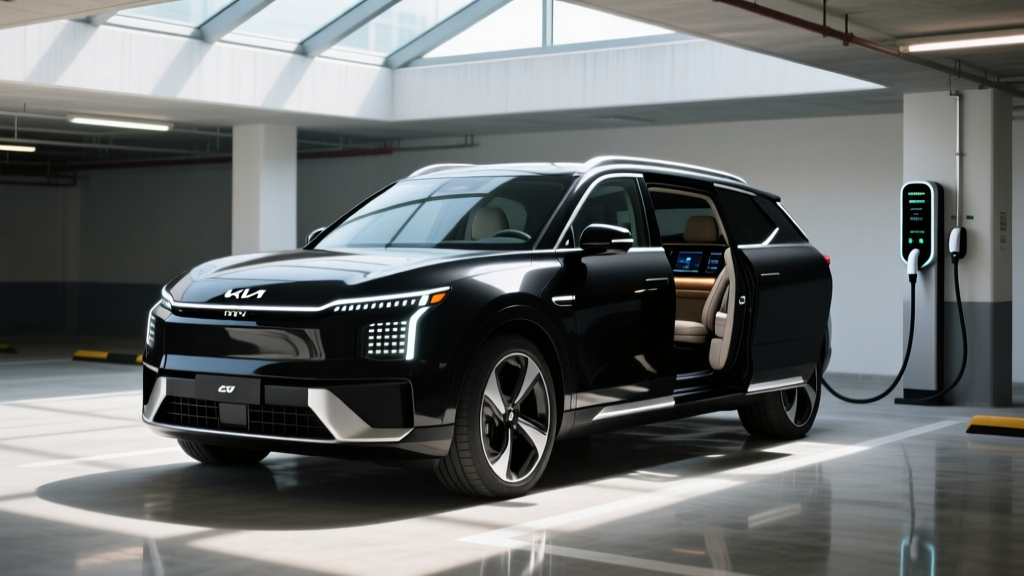
The Kia EV9 remains one of the only mainstream three-row electric SUVs on the market, and for many families, leasing has become the most financially rational way to get into one. A Kia EV9 lease can sidestep the steepest part of the EV depreciation curve, lock in predictable monthly payments, and — thanks to a critical IRS loophole — potentially capture the full $7,500 federal tax credit even when a purchase would not qualify. But the math only works if you understand the real numbers: what electricity actually costs per mile, how EV insurance premiums compare, and what happens at lease-end.
This guide runs the full ownership-cost analysis for the 2026 Kia EV9, using current EPA data, IRS §30D rules, and real-world charging costs. Whether you're weighing a Light RWD base model at $54,900 MSRP or a fully loaded GT-Line AWD near $73,000, the numbers below will tell you whether leasing or buying makes more sense for your budget.
2026 Kia EV9: Quick Spec Reference
Before we get into costs, here are the figures that drive every calculation below. The EV9 rides on Hyundai Motor Group's E-GMP platform with an 800-volt architecture, enabling some of the fastest DC charging in the three-row SUV segment.
| Spec | Light (RWD) | Wind/Land (AWD) | GT-Line (AWD) |
|---|---|---|---|
| Base MSRP | $54,900 | $59,900 – $65,400 | $69,900 – $72,900 |
| Battery (usable) | 76.1 kWh (NMC) | 99.8 kWh (NMC) | 99.8 kWh (NMC) |
| EPA Range | 230 mi | 280 – 304 mi | 270 – 280 mi |
| Real-World Range* | ~190 – 210 mi | ~235 – 265 mi | ~225 – 250 mi |
| Efficiency (MPGe) | 93 MPGe | 85 – 89 MPGe | 83 – 85 MPGe |
| Peak DC Charge Rate | ~170 kW | ~236 kW | ~236 kW |
| 10 – 80% DC Fast Charge | ~24 min | ~20 min | ~20 min |
| Level 2 Charge (11 kW) | ~7.5 hrs | ~9.5 hrs | ~9.5 hrs |
| Horsepower | 215 hp | 379 hp | 379 hp |
| 0 – 60 mph | 7.8 sec | 5.0 sec | 4.7 sec |
| Towing Capacity | 2,000 lb | 4,500 lb | 4,500 lb |
| Battery Warranty | 10 years / 100,000 miles | ||
The Lease-vs-Buy Decision: Why the EV9 Lease Loophole Matters
Under current IRS §30D rules, the federal EV tax credit has strict requirements around vehicle MSRP, buyer income, and battery-component sourcing. Many EV9 trims — particularly the GT-Line AWD above $69,900 — exceed the MSRP cap for the purchase credit, and some buyers exceed the adjusted gross income (AGI) limits.
However, the commercial clean vehicle credit (§45W) applies differently to leases. When you lease a vehicle, the lessor (the leasing company) is technically the buyer. The lessor can claim the up-to-$7,500 credit and pass the savings to you as a capitalized-cost reduction — effectively lowering your monthly payment. This is commonly called the "lease loophole," and it applies regardless of your personal income, the vehicle's MSRP, or battery-sourcing requirements, though individual lessors set their own pass-through policies.
Federal Tax Credit Eligibility: Buying the EV9 Outright
If you're considering buying rather than leasing, here's the full eligibility checklist for the §30D Clean Vehicle Credit as of 2026. These rules have tightened significantly since the Inflation Reduction Act took effect, and they change periodically.
- Credit amount: Up to $7,500 ($3,750 for critical minerals + $3,750 for battery components)
- MSRP cap: Vans, SUVs, and pickup trucks — $80,000 max MSRP (most EV9 trims qualify on purchase)
- Buyer AGI limits: $300,000 (married filing jointly), $225,000 (head of household), $150,000 (single)
- Battery sourcing: Increasing percentages of critical minerals and battery components must be sourced from the U.S. or free-trade-agreement partners; non-compliant vehicles receive reduced or zero credit
- Foreign Entity of Concern (FEOC) restriction: Vehicles with battery components from certain foreign entities are ineligible
- Point-of-sale transfer: You can transfer the credit to the dealer at purchase for an immediate price reduction, or claim it on your tax return
- Assembly requirement: Final assembly must occur in North America (the EV9 sold in the U.S. is assembled in Georgia)
For the latest rules and vehicle eligibility lists, check the IRS Clean Vehicle Credit page and the fueleconomy.gov tax credit tool. The Kia EV9's U.S. assembly and evolving battery supply chain mean eligibility for the full $7,500 on purchase can shift — verify before signing.
5-Year Total Cost of Ownership: EV9 vs. Gas Three-Row SUV
To make the EV9's economics concrete, we compared it against a typical gas-powered three-row SUV — the 2026 Kia Telluride (AWD, ~21 MPG combined) — over 5 years and 75,000 miles. The EV9 model used is the Wind AWD at $63,900 MSRP, which is the volume trim and qualifies for the full credit on purchase (assuming eligibility).
| Cost Category | Kia EV9 Wind AWD | Kia Telluride AWD (Gas) |
|---|---|---|
| Net Purchase Price (after credit) | $56,400 | $43,500 |
| Fuel / Electricity (75,000 mi) | $5,250 | $12,500 |
| Maintenance | $1,800 | $4,500 |
| Insurance (5 years) | $12,500 | $9,500 |
| Estimated Depreciation | $22,500 | $14,000 |
| Total 5-Year Cost | $98,450 | $84,000 |
| Cost Per Mile | $1.31/mi | $1.12/mi |
Charging vs. Gas: The Per-Mile Cost Reality
The single largest ongoing savings with the EV9 is fuel cost — but the exact number depends heavily on how you charge.
| Charging Method | Cost per kWh | Cost per Mile | Cost for 75,000 mi |
|---|---|---|---|
| Home Level 2 (national avg) | $0.16 | $0.054 | $4,050 |
| Home with EV time-of-use rate | $0.10 | $0.034 | $2,550 |
| Public DC fast charging (avg) | $0.42 | $0.143 | $10,725 |
| Tesla Supercharger (NACS adapter) | $0.30 | $0.102 | $7,650 |
At the national home-charging average, the EV9 costs roughly $0.05 per mile to fuel. The Telluride at 21 MPG and $3.50/gallon costs $0.167 per mile. That's a $0.11/mile savings — or about $8,250 over 75,000 miles — but only if most of your charging happens at home.
If you rely primarily on public DC fast charging, the math inverts: at $0.42/kWh, the EV9 costs nearly as much per mile as the gas Telluride. This is why home Level 2 charging access is essentially a prerequisite for the EV9's economic case. A 240V/48A home charger installation typically costs $800 – $2,500 depending on panel capacity and run length, which should be factored into your first-year budget.
Maintenance Savings: Where the EV9 Pulls Ahead
EVs have far fewer moving parts than internal-combustion vehicles, and the EV9 is no exception. There are no oil changes, no spark plugs, no timing belts, no transmission fluid, and no exhaust system. Regenerative braking significantly reduces brake-pad wear — many EV owners report original brake pads lasting 80,000+ miles.
| Service Item | Kia EV9 | Gas 3-Row SUV |
|---|---|---|
| Oil changes | $0 | $750 – $1,200 |
| Brake pads/rotors | $0 – $300 | $800 – $1,500 |
| Transmission fluid | $0 | $200 – $400 |
| Coolant / filters | $150 | $400 – $600 |
| Tire rotation/replacement | $1,200 – $1,600 | $1,000 – $1,400 |
| Cabin air filter / wipers | $200 | $200 |
| Total Estimated | $1,550 – $2,250 | $3,350 – $5,300 |
One important caveat: the EV9 is a heavy vehicle (5,400 – 5,800 lb depending on trim), and that weight plus instant torque accelerates tire wear. Budget for tire replacement earlier than you might with a lighter vehicle. Expect to rotate tires every 5,000 – 7,500 miles and plan for a full set replacement around 35,000 – 50,000 miles. EV-rated touring tires for the EV9's 20- or 21-inch wheels typically run $250 – $350 each.
Insurance Cost: The Expense EV Owners Often Overlook
EV insurance premiums are typically 15 – 30% higher than comparable gas vehicles. For the EV9, expect annual premiums in the $2,200 – $2,800 range depending on your state, driving record, and coverage levels — compared to $1,700 – $2,100 for a Telluride.
The reasons are structural, not arbitrary:
- Higher repair costs: EV battery packs and power electronics are expensive to replace after collision damage. Even minor rear-end impacts can total a battery enclosure.
- Specialized labor: High-voltage system repairs require certified technicians, which limits shop options and raises labor rates.
- Vehicle cost: The EV9's higher MSRP means higher comprehensive and collision payouts.
- Parts availability: EV-specific components (battery modules, inverters, charge ports) often have longer lead times than conventional parts.
Shop quotes from EV-friendly insurers (Geico, Progressive, and State Farm all offer competitive EV rates in most states). Some insurers offer specific EV discounts or green-vehicle endorsements that can offset the premium gap by $100 – $300/year.
Depreciation and Resale Value: The Leasing Advantage
EV depreciation has been a sore point since 2022, when Tesla's aggressive price cuts cascaded through the used-EV market. Mainstream EVs currently lose 40 – 55% of their value over five years, compared to 30 – 40% for popular gas SUVs like the Telluride.
For the EV9, early indicators suggest:
- Year 1 depreciation: ~15 – 20% (typical for new EVs driven off-lot)
- Year 3 residual value: ~50 – 55% of MSRP
- Year 5 residual value: ~40 – 48% of MSRP
This is where the EV9 lease becomes strategically advantageous. In a lease, the residual value is the leasing company's problem, not yours. You pay for the depreciation during the lease term (typically 36 months), and at lease-end, you simply return the vehicle. If EV resale values continue to soften, you're insulated. If they recover, you have the option to purchase at the predetermined residual price.
A typical 36-month EV9 Wind AWD lease in 2026 might look like this:
- MSRP: $63,900
- Lease cash / credit applied: $7,500 (via §45W lessor credit pass-through)
- Adjusted capitalized cost: ~$56,400
- 36-month residual (55%): ~$35,145
- Depreciation to cover: ~$21,255
- Estimated monthly payment (with money factor ~0.0025): $680 – $750/month before taxes and fees
Actual lease terms vary by dealer, lessor, region, and credit tier. Always negotiate the capitalized cost as you would a purchase price — the lease payment is derived from it.
State, Local, and Utility Incentives
Beyond the federal credit, many states and utilities offer additional incentives that can stack:
- California: Up to $2,000 – $7,000 via the Clean Vehicle Rebate Project (CVRP) for income-qualified buyers, plus potential HOV lane access
- Colorado: Up to $5,000 state tax credit for new EVs (varies by vehicle price and battery size)
- New York: Up to $2,000 point-of-sale rebate via the Drive Clean Rebate program
- Utility rebates: Many utilities offer $250 – $1,000 rebates for home Level 2 charger installation, plus time-of-use electricity rates that can cut charging costs by 30 – 50%
- Local incentives: Some municipalities offer free public parking, reduced registration fees, or toll discounts for EVs
Check the Alternative Fuels Data Center for a state-by-state incentive database, and contact your local utility about EV-specific rate plans and charger rebates.
Lease vs. Buy Decision Framework
Choose an EV9 lease if:
- Your income exceeds the §30D AGI limits, but you can capture the credit via the §45W lease pass-through
- You want to avoid EV depreciation risk over 3 – 4 years
- You typically drive under 12,000 – 15,000 miles/year (lease mileage limits apply)
- You prefer predictable monthly costs and plan to upgrade to newer EV tech regularly
- The GT-Line trim you want exceeds the $80,000 MSRP purchase cap (it doesn't for the EV9, but the principle applies)
Choose to buy the EV9 if:
- You qualify for the full $7,500 §30D credit and plan to keep the vehicle 5+ years
- You drive high annual miles (20,000+), which makes lease overage penalties costly
- You want to build equity and eventually have no car payment
- You can charge at home and want to maximize long-term fuel savings
- You plan to tow frequently (lease agreements may restrict or complicate towing-heavy use)
Frequently Asked Questions
How much does it really cost to own a Kia EV9 over 5 years?
Based on our analysis of the Wind AWD trim, expect approximately $98,000 – $102,000 over 5 years and 75,000 miles when including net purchase price, electricity, insurance, maintenance, and depreciation. That works out to roughly $1.31 per mile. The EV9 costs more upfront than a gas equivalent but saves $7,000 – $9,000 in fuel and maintenance over five years. The gap narrows or widens depending on your electricity costs, insurance rate, and how the EV resale market evolves.
Do I qualify for the $7,500 federal EV tax credit on the EV9?
For a purchase, you must meet three tests: your AGI must be below $300,000 (joint) / $150,000 (single), the vehicle MSRP must be at or below $80,000 for SUVs (most EV9 trims qualify), and the battery must meet critical-mineral and component-sourcing thresholds that tighten each year. For a lease, the §45W commercial credit may apply without these restrictions, but the lessor controls whether the savings pass through to you. Always verify current eligibility at irs.gov and confirm with your dealer.
How much do I save on fuel and maintenance with the EV9?
Charging at home at $0.16/kWh, the EV9 costs about $0.054 per mile to fuel — roughly $8,250 less than a 21-MPG gas SUV over 75,000 miles. Maintenance savings add another $1,500 – $3,000 over five years thanks to the elimination of oil changes, reduced brake wear from regenerative braking, and fewer serviceable components. Combined, fuel and maintenance savings typically total $9,500 – $11,500 over five years.
Are EVs more expensive to insure than gas cars?
Yes, typically 15 – 30% more. For the EV9, expect $2,200 – $2,800 per year versus $1,700 – $2,100 for a gas three-row SUV. Higher repair costs for battery and power-electronics damage, specialized labor requirements, and the EV9's higher MSRP all contribute. Shop multiple insurers and ask about EV-specific discounts.
How well does the Kia EV9 hold its value?
Current projections suggest the EV9 will retain 40 – 48% of its MSRP after five years — below the Telluride's 60 – 65% but in line with mainstream EVs. Battery health is less of a concern than market pricing: Kia's 10-year/100,000-mile battery warranty provides long-term coverage, and the 99.8 kWh NMC pack is oversized enough that typical degradation (10 – 15% over 5 years) still leaves substantial usable range. Leasing transfers the residual-value risk to the lessor, which is why many EV9 buyers choose that path.
Can I charge the EV9 on Tesla Superchargers?
Yes. Kia has adopted the NACS (North American Charging Standard) connector for the EV9. With the appropriate adapter (or native NACS port on newer builds), the EV9 can access Tesla's Supercharger network, which adds over 25,000 DC fast-charging stalls to your routing options. The EV9's 800V architecture allows it to take advantage of V3 and V4 Superchargers at strong charge rates.