Why the Kia EV9 Lease Math Is More Complicated Than the Sticker Price
If you've searched for Kia EV9 lease deals lately, you've probably seen eye-catching monthly payments advertised — sometimes under $500/month for a three-row electric SUV with up to 304 miles of EPA range. But the real question isn't what the monthly payment looks like. It's what the EV9 actually costs to own over five years once you factor in electricity, insurance, maintenance, depreciation, and whether you can capture the federal tax credit through a lease structure.
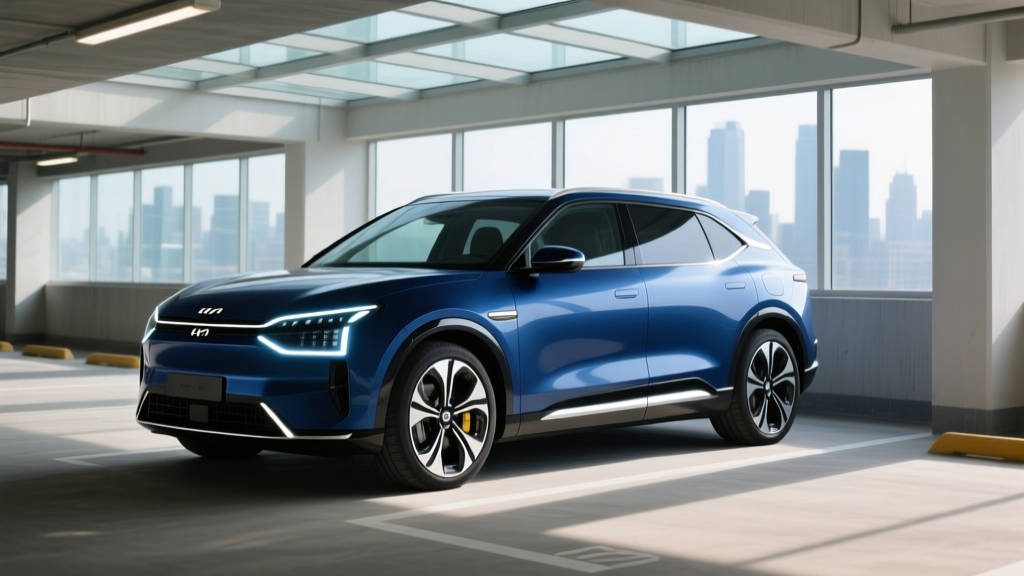
The 2026 Kia EV9 starts at $54,900 MSRP for the Light RWD trim and climbs to $73,900 for the GT-Line AWD. It's a large, heavy, tech-dense vehicle — and those characteristics drive ownership costs in ways that differ meaningfully from a gas-powered Telluride. Let's run the real numbers.
Battery: 76.1 kWh (Light RWD, LFP) / 100.0 kWh (AWD trims, NMC)
EPA Range: 230 mi (Light RWD) to 304 mi (Wind RWD) — expect ~250-270 mi real-world highway in the Wind RWD; 190-210 mi in freezing temps
Peak DC Fast Charge: 210 kW (10-80% in ~24 minutes on a 350 kW station)
Level 2 Charge Rate: 10.9 kW onboard
0-60 mph: 8.2 sec (RWD) / 5.0 sec (AWD, 379 HP)
EPA Efficiency: 88 MPGe combined (Wind RWD) / 83 MPGe (Land AWD)
Warranty: 10 years/100,000 miles battery & powertrain
The Federal Tax Credit Loophole That Makes EV9 Leases Attractive
Here's where Kia EV9 lease deals get interesting — and where most shoppers get confused. Under IRS §30D rules, the EV9 faces a problem if you buy it outright: its MSRP exceeds the $80,000 cap for SUVs on higher trims, and the battery sourcing/critical-mineral requirements may limit the credit to $3,750 or $0 depending on the model year and supply-chain shifts.
However, when you lease an EV9, the credit flows to the leasing company (the legal owner) under the separate §45W commercial clean vehicle credit. Many captive finance arms — including Kia Finance America — pass some or all of that $7,500 through as a lease cash incentive, reducing your capitalized cost. This is the so-called "lease loophole," and it's the primary reason EV9 lease deals can undercut purchase deals on a monthly basis.
- MSRP Cap (purchase only): ≤$80,000 for SUVs/vans/pickups; ≤$55,000 for sedans
- Buyer Income Caps (purchase only): $300K joint / $225K head-of-household / $150K single MAGI
- Battery Sourcing: Critical minerals and battery components must meet escalating domestic/free-trade-partner thresholds — check fueleconomy.gov for current EV9 eligibility
- Point-of-Sale Transfer: Purchase credits can be applied at the dealer to reduce down payment (if eligible)
- Lease Path (§45W): No income cap, no MSRP cap — credit goes to lessor, who may pass savings to lessee
- Caveat: Lease pass-through is NOT guaranteed — confirm the exact lease cash amount with your dealer before signing
5-Year Total Cost of Ownership: EV9 vs. Gas Telluride
To evaluate whether those Kia EV9 lease deals actually save money, we need a full 5-year/75,000-mile cost model. Below, we compare the EV9 Wind RWD (EPA 304 mi, 100 kWh battery) against the closest gas analog, the Kia Telluride SX AWD (~21 MPG combined).
| Category | EV9 Wind RWD | Telluride SX AWD |
|---|---|---|
| Net Lease/Purchase Cost (after incentives) | $32,400* | $38,500 |
| Energy/Fuel (75K mi) | $5,250 | $9,820 |
| Maintenance | $1,800 | $4,200 |
| Insurance (5-yr avg) | $13,500 | $10,250 |
| Depreciation (est.) | $22,000 | $16,500 |
| Total 5-Year Cost | $74,950 | $79,270 |
*Assumes $7,500 lease cash applied. Actual lease cost varies by term, money factor, residual, and dealer. Lease-end disposition or purchase option not included.
The EV9 wins on energy and maintenance but loses ground on insurance and depreciation. Your personal result depends heavily on local electricity rates, driving patterns, and whether you can charge at home overnight at residential rates.
Charging vs. Gas: The Per-Mile Math That Actually Matters
Generic claims that "EVs are cheaper to fuel" don't help you budget. Let's calculate exact cost-per-mile figures using the EV9 Wind RWD's EPA efficiency of 34 kWh/100 miles (or roughly 2.94 mi/kWh).
| Scenario | Rate | $/Mile | $/15,000 mi/yr |
|---|---|---|---|
| Home Level 2 (nat'l avg $0.16/kWh) | $0.16/kWh | $0.054 | $816 |
| Home with EV utility rate ($0.09/kWh off-peak) | $0.09/kWh | $0.031 | $459 |
| Public DC Fast Charge (avg $0.48/kWh) | $0.48/kWh | $0.163 | $2,448 |
| Telluride Gas (21 MPG, $3.50/gal) | $3.50/gal | $0.167 | $2,500 |
| Telluride Gas ($4.20/gal — CA/West Coast) | $4.20/gal | $0.200 | $3,000 |
The takeaway: home charging is dramatically cheaper than gas, but exclusive reliance on DC fast charging nearly eliminates the fuel-cost advantage. If your lease includes 80%+ home charging, expect annual fuel savings of $1,500-$2,000 versus the Telluride. If you're apartment-dwelling and dependent on public chargers, that gap shrinks to a few hundred dollars — or disappears entirely.
Maintenance Savings: Where EVs Quietly Win
The EV9's electric powertrain eliminates most routine maintenance that gas SUV owners take for granted. Here's what disappears and what remains:
| Service Item | EV9 Cost | Gas SUV Cost |
|---|---|---|
| Oil Changes | $0 | $1,050 (15 changes) |
| Transmission Fluid | $0 | $300 |
| Brake Pads (regen extends life) | $400 | $1,200 |
| Cabin Air Filter | $200 | $200 |
| Tire Rotation/Replacement | $1,200* | $900 |
| Coolant/Other Fluids | $150 | $350 |
| Total | ~$1,950 | ~$4,000 |
*EV9 tires wear faster due to high vehicle weight (~5,000 lbs) and instant torque. Budget for one set of replacement tires during a 5-year lease cycle.
Net maintenance savings of roughly $2,000-$2,400 over five years are realistic, but not as dramatic as some EV advocates claim. The heavier EV9 also eats tires faster than a gas Telluride, partially offsetting the brake-pad savings from regenerative braking.
Insurance Reality: The Line Item That Surprises EV Lessees
EV insurance premiums run 15-30% higher than equivalent gas vehicles, and the EV9 is no exception. According to industry data, the average EV9 annual premium lands between $2,400-$3,000 depending on your state, driving record, and coverage levels — compared to roughly $1,800-$2,200 for a Telluride.
The reasons are structural, not arbitrary:
- Higher repair costs: EV9 body panels, battery enclosure, and sensor arrays (LiDAR, radar, cameras) are expensive to replace after collisions
- Specialized labor: High-voltage system repairs require certified EV technicians, limiting shop competition
- Total-loss thresholds: Battery damage often triggers total-loss declarations at lower collision speeds than gas vehicles
- Vehicle price: A $55K-$74K SUV carries higher comprehensive/collision exposure regardless of powertrain
Before signing any EV9 lease, get a binding insurance quote for the exact trim and your ZIP code. In some states, the insurance premium differential alone can erase your fuel savings.
Depreciation and Resale Value: The EV Market's Moving Target
EV depreciation has been volatile since 2022. Early adopters who bought at peak pricing saw 40-50% value loss within two years as Tesla price cuts rippled through the used market and battery technology improved rapidly. For the EV9 specifically, several factors shape its residual outlook:
- Lease residuals: Kia Finance typically sets 36-month residuals at 52-58% of MSRP for the EV9, meaning you're paying for roughly $25,000-$30,000 of depreciation during a standard lease
- Three-row demand: The EV9 occupies a niche with few electric competitors (Rivian R1S is pricier; no other mainstream 3-row EVs match its price point), which supports used demand
- Battery warranty: Kia's 10-year/100,000-mile battery warranty provides downstream confidence for second owners
- Tech obsolescence risk: 800V architecture and NACS charging access keep the EV9 current, but faster-charging competitors arriving in 2027-2028 could pressure residuals
If you lease, depreciation is the leasing company's problem at turn-in (assuming you stay within mileage limits and avoid excess wear). If you purchase with intent to sell at year 5, budget for 50-60% total depreciation — slightly worse than a Telluride's historical 40-45%.
State, Local, and Utility Incentives That Stack on Top
Beyond the federal credit, dozens of state, local, and utility incentives can further reduce EV9 ownership costs. These change frequently and vary by ZIP code. Always verify current programs through your state energy office, utility provider, and the AFDC state incentive database.
- California: Up to $2,000 CVRP rebate (income-dependent) + utility rebates up to $1,500 for home charger installation
- Colorado: $5,000 state tax credit for EVs with MSRP under $80K (EV9 Light and Wind trims may qualify)
- New York: Drive Clean Rebate up to $2,000 (point-of-sale)
- Utility programs: Many utilities offer $300-$1,000 rebates for Level 2 charger purchase, plus time-of-use rates that cut charging costs 40-60%
- HOV lane access: Available in CA, CO, FL, GA, MD, NJ, NY, VA, and others — a non-monetary benefit worth real time savings
Verdict: Who Should Lease the EV9 (And Who Shouldn't)
Lease the EV9 if: You can charge at home at residential rates, your household income exceeds the §30D caps (making the lease loophole your only credit path), you drive 12,000-15,000 miles/year (high enough to capture fuel savings, low enough to stay in lease limits), and you want a three-row EV without long-term depreciation risk.
Skip the EV9 lease if: You lack home charging access and would rely on $0.40-$0.50/kWh public DC fast chargers, your insurance quotes come in above $3,200/year, you regularly tow over 2,500 lbs (range drops 30-40% under load), or you plan to keep the vehicle 8+ years (purchase becomes more economical once you capture the full ownership cycle).
Frequently Asked Questions
How much does it really cost to own a Kia EV9 over 5 years?
Based on our analysis, expect approximately $74,000-$76,000 over 5 years/75,000 miles for the EV9 Wind RWD when leased with $7,500 in lease cash applied. This includes energy, insurance, maintenance, and depreciation. A comparable gas Telluride costs roughly $79,000-$81,000, giving the EV9 a modest $3,000-$5,000 advantage — but only if you charge primarily at home.
Do I qualify for the federal tax credit on the EV9?
If you purchase, eligibility depends on your MAGI (≤$300K joint/≤$150K single), the trim's MSRP (≤$80K for SUVs), and battery-sourcing compliance — which for the 2026 EV9 may limit the credit to $3,750 or $0 depending on supply-chain shifts. If you lease, the lessor claims the credit under §45W with no income or MSRP cap, and may pass savings to you as lease cash. Confirm the exact pass-through amount with your dealer before signing.
How much do I save on fuel and maintenance vs. a gas SUV?
Home-charging EV9 owners save $1,500-$2,000/year on fuel versus a 21-MPG gas SUV at $3.50/gallon. Maintenance savings add another $400-$500/year from eliminated oil changes and reduced brake wear. Total annual operating savings: roughly $1,900-$2,500 — but this assumes home charging at $0.10-$0.16/kWh. Public-charging-dependent owners may save very little.
Are EVs more expensive to insure?
Yes. Expect EV9 insurance premiums 15-30% higher than a gas Telluride — roughly $2,400-$3,000/year vs. $1,800-$2,200. Higher repair costs, specialized labor, battery replacement risk, and the EV9's higher MSRP all contribute. Always get a pre-lease insurance quote.
How well does the Kia EV9 hold its value?
EV depreciation remains elevated versus gas vehicles. Expect the EV9 to retain roughly 40-50% of MSRP after 5 years, compared to 55-60% for a Telluride. However, if you lease, residual risk belongs to the lessor. Kia's 10-year/100,000-mile battery warranty supports long-term used value, and the EV9's lack of direct three-row EV competitors at its price point provides some residual support.