The Kia EV9 Lease Deal: Why the Numbers Keep Shifting
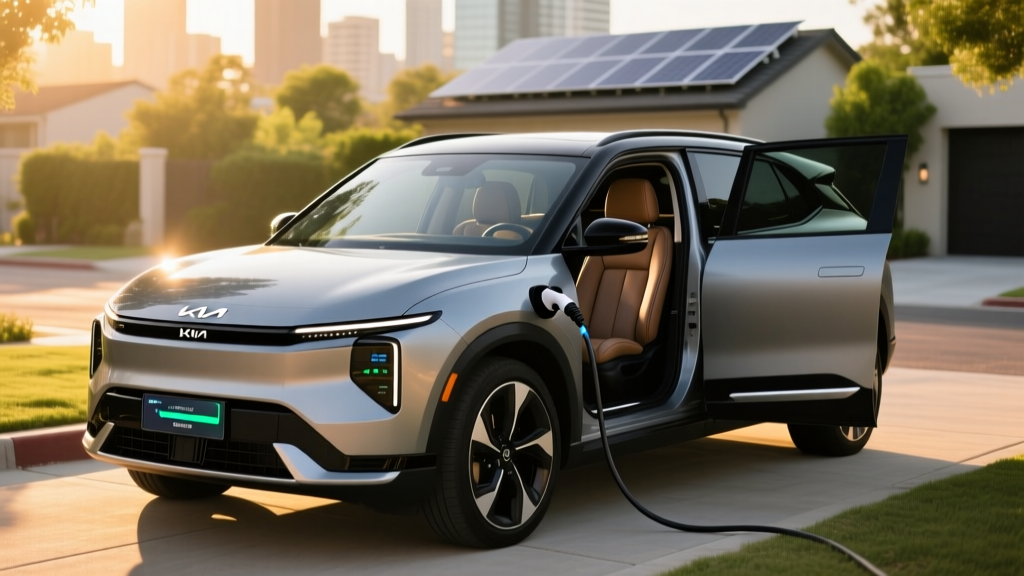
If you've been hunting for a three-row electric SUV that doesn't cost six figures, the Kia EV9 likely sits at the top of your shortlist. With an EPA-estimated range of up to 304 miles (Light trim RWD), a 99.8 kWh usable battery, and seating for seven, it fills a gap that almost no other mainstream EV addresses. But the sticker price — starting at $54,900 for the 2026 Light RWD and climbing past $73,000 for the GT-Line AWD — pushes most buyers toward leasing rather than buying outright.
A Kia EV9 lease deal can look compelling on paper, especially when the federal EV lease credit (the "loophole" credit under §45W, applied by the lessor and typically passed through as a capitalized-cost reduction) factors in. But leases carry their own math: money factors, residual values, mileage penalties, and disposition fees. This guide dissects the full 5-year ownership picture — whether you lease or buy — so you can decide which path actually saves you money.
EPA: 304 miles (Light RWD) / 270 miles (GT-Line AWD). Real-world highway at 70 mph: ~250–270 miles. Cold-weather (below 30°F): expect 20–30% reduction, dropping the AWD model to roughly 190–215 miles effective range. Source: fueleconomy.gov.
5-Year Total Cost of Ownership: EV9 vs. Gas SUV Baseline
To understand whether a Kia EV9 lease deal makes financial sense, we need to compare total cost of ownership (TCO) against a comparable three-row gas SUV. We'll use the 2026 Kia Telluride SX AWD (~$48,000 MSRP, 22 MPG combined) as the baseline.
| Cost Category | Kia EV9 Light RWD | Kia Telluride SX AWD |
|---|---|---|
| Purchase Price (after incentives) | $47,400 (after $7,500 §30D) | $48,000 |
| Fuel / Charging (75,000 mi) | $5,625 (home L2, $0.15/kWh) | $11,932 (gas, $3.50/gal, 22 MPG) |
| Maintenance | $1,800 | $4,500 |
| Insurance (5-year avg) | $11,500 | $8,750 |
| Depreciation (est.) | $23,700 (50%) | $19,200 (40%) |
| Total 5-Year Cost | $90,025 | $92,382 |
Key assumptions: 15,000 miles/year, 90% home charging at $0.15/kWh, 10% public DC fast charging at $0.45/kWh, EV9 efficiency of 3.0 mi/kWh (89 MPGe combined per EPA). Insurance based on national EV average premiums. Depreciation estimated from current EV resale trends.
The EV9 comes out roughly $2,357 ahead over five years — but only if you qualify for the full $7,500 federal credit and charge primarily at home. If you're reliant on public DC fast charging, your fuel cost climbs to approximately $8,400 over 75,000 miles, narrowing the gap significantly.
Federal Tax Credit: Do You Actually Qualify?
The §30D Clean Vehicle Credit offers up to $7,500 for qualifying new EV purchases — but "up to" is the operative phrase. The rules have tightened considerably since the Inflation Reduction Act, and eligibility depends on your income, the vehicle's MSRP, and battery sourcing requirements.
- Income caps: AGI ≤ $300,000 (joint), ≤ $225,000 (head of household), ≤ $150,000 (single). You qualify based on the year of delivery or the prior year — whichever works in your favor.
- MSRP cap: SUVs/pickups/vans ≤ $80,000. All EV9 trims currently fall under this cap.
- Battery sourcing: $3,750 requires critical minerals from the US or FTA partners; $3,750 requires battery components manufactured in North America. Both halves must be met for the full $7,500.
- Point-of-sale transfer: You can transfer the credit to the dealer at purchase, reducing your out-of-pocket cost immediately — you don't need to wait until tax filing.
- Lease loophole (§45W): If you lease, the credit goes to the lessor (Kia Finance), not you. Many lessors pass it through as a cap-cost reduction (~$7,500 off), but this is not legally required. Confirm in writing before signing.
Source: IRS Clean Vehicle Tax Credits. Rules are subject to change — always verify at the point of purchase.
For the Kia EV9, the battery is sourced from SK On cells manufactured in Georgia (SK Battery America). As of early 2026, the EV9 qualifies for the full $7,500 when purchased. For leases, most Kia dealers apply the $7,500 as a cap-cost reduction, which lowers your monthly payment by roughly $105–$125/month on a 36-month term.
Lease vs. Buy: The Credit Makes the Difference
When you buy, the $7,500 credit reduces your tax liability (or your purchase price via point-of-sale transfer). When you lease, you benefit only if the lessor passes it through. Here's how the monthly math compares:
- Purchase (EV9 Light RWD): $54,900 MSRP – $7,500 credit = $47,400 net. Financed at 6.5% over 72 months ≈ $798/month (before tax, title, insurance).
- Lease (36 months, 10K mi/yr): Typical money factor ~0.00250, residual ~52%, with $7,500 cap-cost reduction ≈ $599–$649/month (varies by dealer and region). No equity at end of term, plus ~$400 disposition fee.
The lease deal looks cheaper monthly, but you build no equity and face mileage overage charges ($0.20–$0.25/mile). If you drive 15,000 miles/year, the purchase route typically wins on a pure-cost basis.
Charging Cost vs. Gas: The Per-Mile Math
This is where the EV9 earns its keep — provided you have access to affordable home charging.
| Scenario | Kia EV9 (3.0 mi/kWh) | Kia Telluride (22 MPG) |
|---|---|---|
| Home L2 ($0.15/kWh) | $0.050/mile | — |
| Public DCFC ($0.45/kWh) | $0.150/mile | — |
| Gas ($3.50/gallon) | — | $0.159/mile |
| Gas ($4.00/gallon) | — | $0.182/mile |
At home charging rates, the EV9 costs roughly one-third what the Telluride costs per mile. But at public DC fast charger rates, the EV9 is essentially at parity with gas. This is why home charging access is the single biggest variable in EV economics. If you can't install a Level 2 charger at home, the fuel-cost advantage largely evaporates.
The EV9 supports up to 240 kW peak DC fast charging on 800V architecture, achieving 10–80% in approximately 24 minutes at a compatible charger. However, the charge curve tapers significantly above 80% — expect a full 10–100% session to take closer to 40 minutes. The battery is a 99.8 kWh (usable) NMC pack from SK On.
Maintenance Savings: Where EVs Genuinely Win
EVs have far fewer moving parts than internal combustion vehicles. No oil changes, no spark plugs, no timing belts, no transmission fluid flushes. Regenerative braking also dramatically reduces brake pad wear.
| Service Item | EV9 (BEV) | Telluride (Gas) |
|---|---|---|
| Oil changes | $0 | $750 (10 changes) |
| Brake pads (front) | $0 (regen preserves) | $400 |
| Transmission fluid | $0 | $200 |
| Cabin air filter | $150 | $150 |
| Tire rotation/replacement | $1,200 (heavier wear) | $1,000 |
| Coolant/other | $300 | $600 |
| Total (5 yr) | $1,650 | $3,100 |
Net maintenance savings: approximately $1,450 over five years. Note that EVs tend to wear tires faster due to instant torque and higher curb weight (the EV9 weighs 4,800–5,100 lbs depending on trim). Budget for a tire replacement around year 4.
Insurance Reality: The Hidden EV Cost
EV insurance premiums run 15–25% higher than comparable gas vehicles, according to industry data. The reasons are straightforward:
- Higher repair costs: Battery packs are expensive to replace if damaged, and EV-specific body repair requires certified technicians.
- Higher vehicle value: The EV9's MSRP is higher than most gas three-row SUVs, increasing comprehensive/collision premiums.
- Parts availability: EV-specific components (inverters, onboard chargers) have longer lead times, increasing rental-car and labor costs for insurers.
Expect to pay $2,100–$2,500/year for full coverage on an EV9, compared to $1,600–$1,900/year for a Telluride. That's roughly $2,750 more over five years — a number that partially offsets fuel and maintenance savings.
Shop quotes from at least three insurers before committing. Some carriers (Geico, Progressive, State Farm) now offer EV-specific discounts of 5–10%.
Depreciation and Resale Value: The EV Wildcard
EV depreciation has been volatile. In 2023–2024, aggressive price cuts from Tesla and a flood of off-lease EVs caused resale values to drop 25–35% in a single year for some models. The EV9, as a newer entry, hasn't had enough time to establish a long-term resale pattern.
Current projections for a 2026 EV9 Light RWD (purchased at ~$47,400 after credit):
- Year 3 resale: ~$26,000–$29,000 (45–50% retained)
- Year 5 resale: ~$21,000–$24,000 (40–45% retained)
By comparison, the Telluride historically retains 55–60% at year 5. The EV's depreciation penalty is roughly $3,000–$5,000 more over five years.
This is where leasing gains appeal: you transfer the depreciation risk to the lessor. If EV resale values continue to soften, a lease insulates you from that loss. The tradeoff is that you never own the asset.
State, Local, and Utility Incentives
- California (CVRP): Up to $2,000 rebate for income-qualified buyers (program funding varies).
- Colorado: Up to $5,000 state tax credit for new EVs (income-dependent).
- New York (Drive Clean Plus): Up to $2,000 point-of-sale rebate (income caps apply).
- Utility rebates: Many utilities offer $250–$1,000 for Level 2 home charger installation (e.g., PG&E, ConEdison, Xcel Energy).
- HOV lane access: Available in CA, CO, FL, GA, MD, NJ, NY, and others — a non-monetary benefit worth considering.
Check afdc.energy.gov for a state-by-state incentive database.
Lease Deal Verdict: Who Should Sign and Who Should Walk
- You drive under 12,000 miles/year (avoids overage penalties).
- You want to transfer depreciation risk to the lessor.
- You plan to upgrade to a newer EV in 3 years.
- The dealer confirms the $7,500 cap-cost reduction in writing.
- You drive 15,000+ miles/year.
- You qualify for the full $7,500 §30D credit and can apply it point-of-sale.
- You have reliable home Level 2 charging access.
- You plan to keep the vehicle 5+ years.
Frequently Asked Questions
How much does it really cost to own a Kia EV9 over 5 years?
Approximately $90,000 total (purchase after credit, fuel, insurance, maintenance, depreciation) for a Light RWD model driven 15,000 miles/year with primarily home charging. This is roughly $2,000–$3,000 less than a comparable gas three-row SUV, though savings depend heavily on your electricity rates, insurance premiums, and whether you qualify for the full federal credit.
Do I qualify for the $7,500 federal EV tax credit on the Kia EV9?
You qualify if your AGI is within limits ($150K single / $300K joint), the EV9 MSRP is under $80,000 (all trims qualify), and the battery meets critical-mineral and component sourcing requirements. The EV9's SK On Georgia-built cells currently satisfy these rules. You can transfer the credit to the dealer at point of sale. Always verify current rules at IRS.gov before purchasing.
How much do I save on fuel and maintenance with the EV9?
Fuel savings: approximately $6,300 over 5 years / 75,000 miles (home charging at $0.15/kWh vs. gas at $3.50/gal). Maintenance savings: approximately $1,450 over 5 years (no oil changes, reduced brake wear). Combined savings: ~$7,750, though this is partially offset by higher insurance costs (~$2,750 more over 5 years).
Are EVs more expensive to insure than gas vehicles?
Yes, typically 15–25% more expensive. For the EV9, expect $2,100–$2,500/year for full coverage vs. $1,600–$1,900/year for a comparable gas SUV. Higher repair costs, battery replacement risk, and vehicle value drive the premium difference. Shop multiple insurers and ask about EV-specific discounts.
How well does the Kia EV9 hold its value?
Current projections estimate 40–45% value retention at 5 years, compared to 55–60% for the gas Telluride. EV depreciation has been volatile due to rapid technology advances and price competition. Leasing transfers this risk to the lessor. The EV9's 10-year/100,000-mile battery warranty provides some long-term value support.
What's the real-world range of the Kia EV9?
The EPA rates the Light RWD at 304 miles and GT-Line AWD at 270 miles. In real-world highway driving at 70 mph, expect 250–270 miles (RWD) or 220–240 miles (AWD). In cold weather below 30°F, range drops 20–30%. The 99.8 kWh NMC battery and 800V architecture support up to 240 kW DC fast charging (10–80% in ~24 minutes).