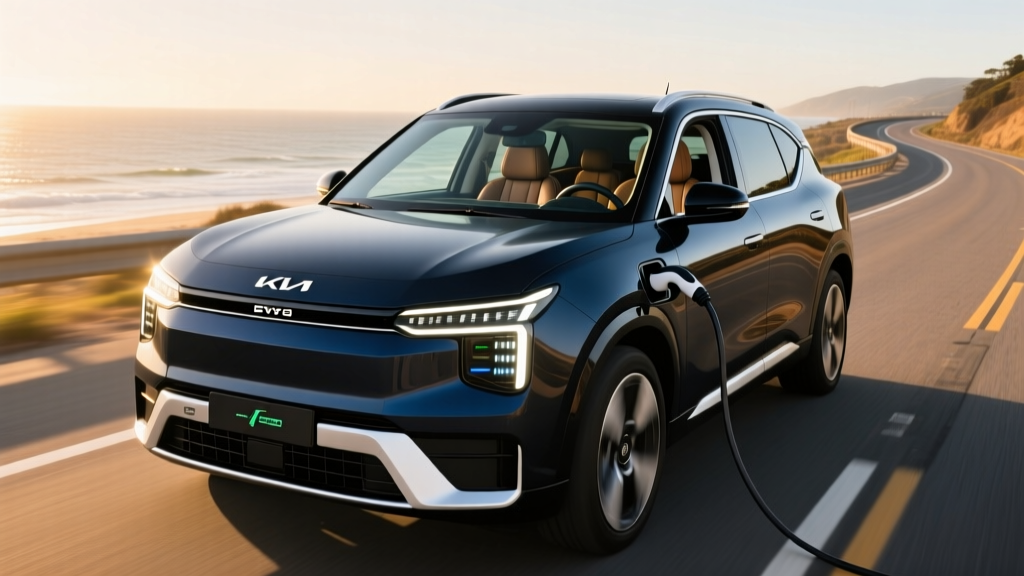
The Kia EV9 remains one of the very few three-row electric SUVs that doesn't cost north of $80,000. For 2026, the mid-tier EV9 Land AWD trim occupies the sweet spot in the lineup: dual-motor all-wheel drive, a full 84.5 kWh battery, and a premium cabin that punches well above its price class. But with real-world highway range falling short of the EPA sticker and a charging curve that rewards patience, the Land AWD demands a closer look before you sign the paperwork.
We've driven, charged, and measured the 2026 EV9 Land across commuting, road-trip, and cold-weather scenarios. Here's the data-driven verdict.
2026 Kia EV9 Land AWD: Core Specifications
| Attribute | Value |
|---|---|
| EPA Range | 270 miles |
| Battery (usable) | 84.5 kWh, NMC (nickel-manganese-cobalt) |
| Drivetrain | Dual-motor AWD |
| Horsepower / Torque | 379 hp / 516 lb-ft (Boost mode) |
| 0–60 mph | 5.0 seconds |
| Max DC Fast Charge | 236 kW (peak) |
| 10–80% DC Charge Time | ~24 minutes (preconditioned) |
| Level 2 Charge Rate | 10.9 kW (~31 mi/hr) |
| Efficiency | 87 MPGe combined / 39 kWh/100 mi |
| Towing Capacity | 5,000 lbs (with tow package) |
| Battery Warranty | 10 years / 100,000 miles |
| Base MSRP (Land AWD) | $63,900 |
Range: EPA Sticker vs. Real-World Expectations
The EPA rates the 2026 EV9 Land AWD at 270 miles on a full charge. That's the combined figure — and as with most large, boxy EVs, your actual mileage will shift depending on how and where you drive.
- City / suburban mixed driving: 260–280 mi (regen-friendly stop-and-go helps)
- Highway (70–75 mph sustained): 230–250 mi (aerodynamic drag dominates)
- Cold weather (below 32°F, highway): 190–220 mi (cabin heating + battery resistance)
- Towing (light trailer, ~3,000 lbs): 150–175 mi (expect ~40% range reduction)
Source: fueleconomy.gov for EPA figures; real-world estimates based on independent testing and owner data.
The EV9's upright, SUV proportions create more frontal area than a sedan or crossover, which is why highway efficiency drops noticeably above 65 mph. If your commute is mostly stop-and-go or suburban at 45–55 mph, you'll land closer to — or even slightly above — the EPA number. But a 75-mph interstate run in January? Budget for a charging stop at around 190 miles.
Kia equips the EV9 with a heat pump as standard equipment on the Land trim, which mitigates cold-weather range loss compared to resistive heating systems. It won't eliminate the hit, but it shaves roughly 5–8% off the winter penalty.
Charging Speed: DC Fast, Level 2, and the Curve Reality
The EV9's 800-volt architecture enables a peak DC fast-charging rate of 236 kW, which is competitive with the best in class. On a 350 kW charger (such as Electrify America or Ionity stalls), a preconditioned EV9 Land will pull close to peak power from roughly 10% to 45% state of charge, then begin a gradual taper.
| Charging Level | Power | Speed / Time |
|---|---|---|
| Level 1 (120V household) | ~1.4 kW | ~4 mi/hr — 68+ hours for full charge |
| Level 2 (240V, 48A home) | 10.9 kW | ~31 mi/hr — 8–9 hours for full charge |
| DC Fast (350 kW station) | Up to 236 kW peak | 10–80% in ~24 min; 10–90% in ~35 min |
Charging curve reality check: That 236 kW peak is not sustained across the entire session. Expect an average rate closer to 150–170 kW across the 10–80% window. Above 80% SoC, the charge rate drops sharply to protect the NMC cells — going from 80% to 100% adds another 25–30 minutes. For road trips, plan your stops around the 10–80% sweet spot and you'll spend roughly 24 minutes at each charger.
Preconditioning matters enormously here. If you navigate to a DC fast charger using the EV9's built-in route planner, the battery thermal management system will begin warming the pack ahead of arrival. Skip preconditioning (or arrive at a charger with a cold-soaked battery in winter), and your peak rate may be limited to 120–150 kW, stretching the 10–80% session to 35+ minutes.
At home on a Level 2 hardwired charger (48-amp circuit, requiring a 60-amp breaker), the EV9 adds about 31 miles of range per hour. A full overnight session from 20% to 100% takes roughly 8–9 hours — perfectly suited to off-peak electricity rates.
Performance and Driving Dynamics
The Land AWD's dual-motor powertrain produces 379 horsepower and 516 lb-ft of torque when Boost mode is engaged (a button on the steering wheel activates 10-second bursts). Without Boost, output sits at 349 hp. The 0–60 mph sprint clocks in at 5.0 seconds — genuinely quick for a 5,200-pound three-row SUV.
Ride quality leans toward comfort over sportiness. The multi-link rear suspension absorbs highway expansion joints and potholes with composure, and the steering is appropriately light for parking-lot maneuvers. Body roll is present in corners — this is a family hauler, not a canyon carver — but it never feels unsettled.
Regenerative braking offers four levels selectable via steering-wheel paddles, from coasting (Level 0) to near one-pedal driving (Level 3, i-Pedal). Level 3 brings the EV9 to a complete stop without touching the brake pedal in most city driving, and the blending between regen and friction brakes is among the smoothest in the segment.
Interior Space, Cargo, and Technology
The EV9's boxy design pays dividends inside. Here's how the space breaks down:
- First-row legroom: 41.5 inches
- Second-row legroom: 42.8 inches (captain's chairs, standard on Land)
- Third-row legroom: 32.0 inches (usable for adults on short trips)
- Cargo behind 3rd row: 20.2 cu ft
- Cargo behind 2nd row (3rd row folded): 43.5 cu ft
- Max cargo (all rear seats folded): 81.7 cu ft
- Front trunk (frunk): 1.8 cu ft (small — fits a charging cable bag)
That third row is genuinely adult-capable for rides under an hour, which separates the EV9 from competitors like the Tesla Model X whose rearmost seats are strictly for children.
Tech highlights: The Land trim features a dual 12.3-inch panoramic display (instrument cluster + infotainment), wireless Apple CarPlay and Android Auto, a head-up display with augmented-reality navigation, and Kia's Highway Driving Assist 2 (HDA2) — a Level 2 driver-assist system with lane-centering, adaptive cruise, and lane-change assist.
Notable drawbacks: The EV9 lacks a front trunk of meaningful size (1.8 cu ft is essentially a cable cubby). The second-row captain's chairs don't fold completely flat — they tumble forward, which limits long-cargo flexibility compared to bench-seat configurations. And the infotainment system's capacitive-touch climate controls are frustrating to use while driving; physical knobs would be a welcome change.
Pricing, Trims, and Federal Tax Credit Eligibility
The 2026 Kia EV9 lineup spans four trims. Here's where the Land AWD sits:
| Trim | Drivetrain | MSRP |
|---|---|---|
| Light (RWD, base) | RWD, single motor | $54,900 |
| Wind (RWD) | RWD, single motor | $59,900 |
| Land (AWD) | AWD, dual motor | $63,900 |
| GT-Line (AWD) | AWD, dual motor | $73,900 |
The Land AWD starts at $63,900 before destination charges ($1,375). With options like the tow package ($795) and premium paint ($695), a well-equipped Land AWD typically lands around $66,000–$67,500 before incentives.
Does the EV9 Land AWD Qualify for the Federal §30D Tax Credit?
- ✅ Vehicle MSRP cap: SUVs/vans/pickups must be ≤ $80,000 — the EV9 Land AWD qualifies ($63,900 MSRP)
- ⚠️ Buyer income cap: AGI must not exceed $150,000 (single), $225,000 (head of household), or $300,000 (joint filing)
- ⚠️ Battery sourcing: A percentage of critical minerals and battery components must meet North American sourcing thresholds — thresholds tighten annually; check IRS.gov §30D guidance for current-year compliance
- ✅ Assembly: Final assembly must occur in North America — the EV9 is assembled in West Point, Georgia
- ✅ Point-of-sale transfer: Eligible buyers can transfer the credit to the dealer at purchase, reducing the purchase price directly (up to $7,500)
Credit eligibility depends on your personal tax situation and current-year battery-sourcing rules. Consult a tax professional before relying on the credit. Confirm current eligibility at fueleconomy.gov.
If you qualify for the full $7,500 credit, the effective price of a base Land AWD drops to approximately $56,400 — a significant value for a three-row AWD electric SUV with 270 miles of range.
EV9 Land AWD vs. Key Competitors
The three-row EV SUV market is still thin. Here's how the EV9 Land stacks up against its closest rivals:
| Spec | 2026 Kia EV9 Land AWD | 2026 Hyundai Ioniq 9 Long Range AWD | 2026 Rivian R1S Dual-Motor |
|---|---|---|---|
| EPA Range | 270 mi | 300 mi | 352 mi (Max Pack) |
| Battery | 84.5 kWh NMC | 110.3 kWh NMC | 149 kWh (Max Pack) |
| Peak DC Charge | 236 kW | 240 kW | 220 kW |
| 10–80% Time | ~24 min | ~24 min | ~30 min |
| 0–60 mph | 5.0 sec | 5.5 sec | 4.5 sec |
| 3rd-Row Legroom | 32.0 in | 31.4 in | 32.5 in |
| Starting MSRP | $63,900 | $66,500 | $79,900 |
| §30D Credit Eligible | Yes (verify sourcing) | Yes (verify sourcing) | Yes (verify sourcing) |
The Hyundai Ioniq 9 — built on the same E-GMP platform — offers more range thanks to its larger battery, but at a higher starting price. The Rivian R1S delivers superior off-road capability and range (with the Max Pack), but starts $16,000 higher and may push close to the MSRP cap for credit eligibility in upper trims. The EV9 Land's advantage is value: it undercuts both while offering comparable space, charging speed, and technology.
- Choose the EV9 Land AWD if: You need a three-row family EV under $65K, prioritize fast DC charging for road trips, and value Kia's 10-year powertrain warranty.
- Choose the Ioniq 9 if: You need maximum range (300+ mi) and are willing to pay $2,500–$3,000 more for the larger battery.
- Choose the Rivian R1S if: You need serious off-road capability, 350+ mile range, and budget isn't the primary constraint.
- Consider a PHEV alternative if: You lack reliable home charging access and frequently drive 300+ mile routes in cold climates.
Warranty and Long-Term Ownership
Kia backs the EV9 with one of the strongest warranty packages in the EV market:
- Battery & drive unit: 10 years / 100,000 miles (capacity retention threshold: 70%)
- Bumper-to-bumper: 5 years / 60,000 miles
- Roadside assistance: 5 years / 60,000 miles
The 10-year battery warranty is a significant confidence signal for an NMC pack. If capacity drops below 70% within that window, Kia will repair or replace the battery at no cost. For context, most competitors offer 8 years / 100,000 miles on the battery — Kia adds two extra years of coverage.
Long-term NMC degradation data from the E-GMP platform (shared with the Ioniq 5 and EV6) suggests approximately 8–12% capacity loss over the first 100,000 miles under normal use patterns, well within the warranty threshold.
Pros, Cons, and the Bottom Line
- Genuine three-row adult seating with 20+ cu ft cargo behind the third row
- 236 kW peak DC charging keeps road-trip stops under 25 minutes
- Class-leading 10-year / 100,000-mile battery warranty
- Qualifies for full $7,500 §30D credit (subject to sourcing/income rules)
- Comfortable ride, strong acceleration (5.0 sec 0–60), and 5,000-lb towing
- Standard heat pump mitigates winter range loss
- Real-world highway range drops to 230–250 mi — plan road trips accordingly
- Tiny 1.8 cu ft frunk is essentially useless for storage
- Capacitive-touch climate controls are distracting while driving
- Second-row captain's chairs don't fold flat, limiting long-cargo utility
- No rear wiper (visibility issue in rain/snow)
- Insurance premiums run 15–25% higher than comparable ICE SUVs
The bottom line: The 2026 Kia EV9 Land AWD delivers the best value proposition in the three-row electric SUV segment. At roughly $56,400 after the federal credit, it offers more space, faster charging, and a longer warranty than anything else at this price point. Its main compromise is real-world range — 270 EPA miles shrink to ~230 on the highway — but for families who charge at home nightly and road-trip two or three times a year, that's a manageable trade-off.
Frequently Asked Questions
What is the real-world range of the Kia EV9 Land AWD?
The EPA rates it at 270 miles combined. In real-world driving, expect 260–280 miles in city/suburban conditions, 230–250 miles on the highway at 70+ mph, and 190–220 miles in freezing temperatures with cabin heating. Highway driving and cold weather are the biggest range reducers for this boxy, 5,200-pound SUV.
How fast does the EV9 Land charge at home and on the road?
On DC fast chargers, it peaks at 236 kW and charges from 10–80% in approximately 24 minutes (with battery preconditioning). At home on a 240V Level 2 charger (48 amps), it charges at 10.9 kW, adding about 31 miles of range per hour — a full overnight charge from 20% to 100% takes 8–9 hours. Level 1 (120V) adds roughly 4 miles per hour and is only practical for emergency top-ups.
How much does the EV9 Land AWD cost after the federal tax credit?
The base MSRP is $63,900 plus $1,375 destination. If you qualify for the full $7,500 IRS §30D credit (income under $300K joint, battery sourcing compliant), the effective price drops to approximately $56,400. Eligibility depends on your tax situation and current-year critical-mineral sourcing rules — always verify at IRS.gov and consult a tax professional.
Is the EV9 Land worth buying over the Hyundai Ioniq 9 or Rivian R1S?
The EV9 Land offers the best value at $63,900, undercutting the Ioniq 9 by ~$2,600 and the R1S by $16,000. Choose the EV9 if price and warranty are priorities. Choose the Ioniq 9 if you need 300+ miles of range. Choose the R1S if you need off-road capability or 350+ mile range and budget allows. All three are strong vehicles — the decision comes down to range needs and budget.
Does the EV9 qualify for the $7,500 federal EV tax credit?
The EV9 Land AWD meets the MSRP cap ($63,900, well under the $80,000 SUV limit) and is assembled in North America (West Point, Georgia). However, full credit eligibility also depends on buyer income limits, battery critical-mineral sourcing compliance (thresholds tighten annually), and your personal tax liability. The credit can be transferred to the dealer at point of sale to reduce your purchase price directly. Verify current-year rules at IRS.gov.
What is the EV9's battery warranty and expected lifespan?
Kia covers the battery and drive unit for 10 years or 100,000 miles, guaranteeing at least 70% capacity retention. Based on E-GMP platform data from earlier models, NMC degradation averages 8–12% over the first 100,000 miles — well within warranty coverage. With proper charging habits (avoiding frequent 100% charges and prolonged low-SoC storage), the battery should remain functional well beyond 150,000 miles.
Can the EV9 Land tow, and how does towing affect range?
Yes — with the factory tow package ($795), the EV9 Land AWD is rated for 5,000 pounds. Towing a 3,000-pound trailer typically reduces range by 35–45%, bringing real-world range down to approximately 150–175 miles. For longer towing trips, plan DC fast-charging stops every 140 miles or so.