The Kia EV9's ICCU Problem, Explained
If you've been researching the three-row Kia EV9 and encountered search threads about EV9 ICCU failure, you're not alone. The Integrated Charging Control Unit — the component that manages power flow between the high-voltage battery, the 12V electrical system, and the DC fast-charging port — has emerged as one of the most discussed reliability concerns among early EV9 owners. This article breaks down what the ICCU does, what failure looks like, how Kia has responded, and whether the issue should alter your buying decision. We'll also cover the EV9's full spec sheet so you can weigh this risk against the vehicle's considerable strengths.
What Is the ICCU and Why Does It Matter?
The ICCU (Integrated Charging Control Unit) replaces what older EVs handled with separate components: an onboard charger (OBC) for AC-to-DC conversion, a DC-DC converter to maintain the 12V battery, and charge-port management logic. In the EV9, Kia consolidated these into a single module. When it works, you get faster Level 2 charging, reliable 12V battery maintenance, and seamless DC fast-charge handshakes. When it fails, the consequences cascade.
- 12V battery repeatedly dying despite the vehicle being "off"
- DC fast charging initiating then immediately stopping or throttling to under 30 kW
- Dashboard warnings: "Check Electric Vehicle System," "High-Voltage Battery System Warning"
- Vehicle refusing to enter READY-to-drive mode
- Intermittent failure to recognize a plugged-in charge cable
- In severe cases, complete loss of propulsion requiring a tow
Not every EV9 exhibits these symptoms. Forum reports and NHTSA filings suggest the issue is concentrated in 2025 model-year units built before mid-2025, though Kia has not issued a blanket recall as of early 2026. Instead, dealers have been performing ICCU replacements under the EV9's powertrain warranty on a case-by-case basis. If you're experiencing any of the above, document everything and schedule a dealer diagnostic immediately — the repair falls under the 5-year/60,000-mile basic warranty or the 10-year/100,000-mile powertrain warranty depending on the failure mode.
2026 Kia EV9: Full Specifications at a Glance
| Spec | Light (RWD) | Wind/Land (AWD) | GT-Line (AWD) |
|---|---|---|---|
| EPA Range | 304 miles | 280 miles | 270 miles |
| Battery (usable) | 76.1 kWh (NMC) | 99.8 kWh (NMC) | 99.8 kWh (NMC) |
| Horsepower | 215 hp | 379 hp | 379 hp (Boost: 400 hp) |
| 0-60 mph | 7.8 sec | 5.0 sec | 4.7 sec (w/ Boost) |
| Max DC Fast Charge | 236 kW (800V) | 236 kW (800V) | 236 kW (800V) |
| 10-80% DCFC Time | ~20 min | ~24 min | ~24 min |
| Level 2 Onboard Charger | 10.9 kW | 10.9 kW | 10.9 kW |
| MPGe (combined) | 87 MPGe | 83 MPGe | 82 MPGe |
| Towing Capacity | 2,000 lbs | 5,000 lbs | 5,000 lbs |
| Base MSRP | $56,995 | $61,995 | $73,995 |
Real-World Range: What the EPA Number Doesn't Tell You
EPA sticker: 280 miles | Real-world highway (70 mph): ~235-250 miles | Cold weather (below 32°F, highway): ~190-210 miles | City/regenerative driving: ~275-290 miles
The EV9's 800V architecture and aerodynamic efficiency (drag coefficient ~0.28) help it punch above its weight on the EPA cycle, but physics still governs real-world results. At sustained highway speeds of 70-75 mph, expect to lose roughly 10-15% from the EPA figure in mild weather. In freezing temperatures, the EV9's heat pump helps, but large-battery EVs still shed 20-30% of range when cabin heating and battery conditioning compete for energy. If your commute is 60 miles round-trip or less, even the worst-case winter range leaves a comfortable buffer. Road-trippers should plan charging stops at the 180-200 mile mark in winter to avoid tapering into single-digit state-of-charge territory.
Charging Speed: 800V Architecture Done Right
| Level | Power | Delivery | Notes |
|---|---|---|---|
| Level 1 (120V) | ~1.4 kW | ~4 miles/hour | Emergency/trickle only; full charge in 70+ hours |
| Level 2 (240V, 48A) | 10.9 kW | ~32 miles/hour | Full charge overnight in ~9 hours |
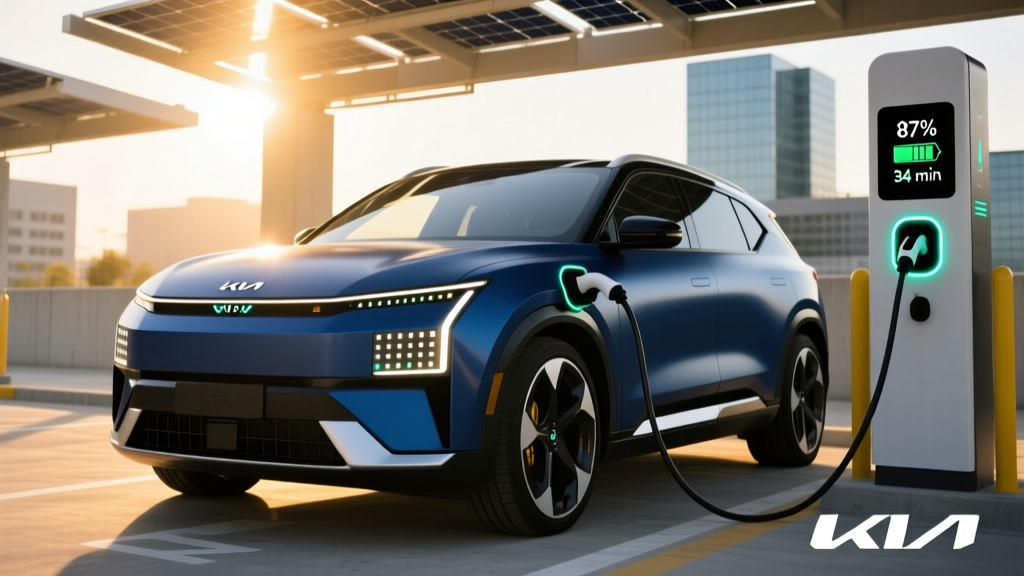
| DC Fast (800V, peak) | 236 kW | 10-80% in ~20-24 min | Peak sustained to ~55% SoC, then tapers |
| DC Fast (50 kW station) | 50 kW | 10-80% in ~90 min | Common at older ChargePoint/EVgo sites |
The EV9's 800V platform is its charging superpower. At a 350 kW-capable Electrify America or Tesla Supercharger (with NACS adapter, included on 2026 models), the EV9 sustains over 200 kW through roughly 55% state-of-charge before stepping down. This means the 10-80% time is genuinely achievable in the real world — not just a lab figure. However, this is also where ICCU issues can surface: if the unit is degraded, you may see the EV9 throttle to 30-50 kW even at a 350 kW stall, or fail to initiate a session entirely. Preconditioning the battery via the nav-routed charge-stop feature is essential for hitting peak speeds in cool weather.
Important for home charging: The 10.9 kW onboard charger requires a 240V/48A circuit (60A breaker) to reach full speed. A standard 240V/32A NEMA 14-50 outlet will deliver roughly 7.7 kW (~23 miles/hour). Budget $800-$2,500 for a licensed electrician to install a hardwired Level 2 station, depending on panel capacity and conduit run length.
Pricing, Tax Credits, and Total Cost
| Trim | MSRP | §30D Credit Eligibility | Effective Price |
|---|---|---|---|
| Light (RWD) | $56,995 | Eligible (under $80K SUV cap) | As low as $49,495* |
| Wind (AWD) | $61,995 | Eligible (under $80K SUV cap) | As low as $54,495* |
| Land (AWD) | $66,995 | Eligible (under $80K SUV cap) | As low as $59,495* |
| GT-Line (AWD) | $73,995 | Eligible (under $80K SUV cap) | As low as $66,495* |
*Assumes buyer qualifies for the full $7,500 federal tax credit under IRS §30D. Eligibility depends on: (1) buyer AGI under $150K single / $300K joint, (2) vehicle MSRP under $80,000 for SUVs, (3) battery critical-mineral and component sourcing requirements that change annually. The credit can be transferred to the dealer as a point-of-sale discount starting in 2024. Verify current-year sourcing compliance at fueleconomy.gov before purchasing.
Even without the full credit, the EV9's operating costs undercut comparable ICE three-row SUVs. At $0.14/kWh (national average home rate), fueling costs roughly $0.045/mile. A Kia Telluride at 23 MPG combined and $3.40/gallon burns $0.148/mile — a savings of over $1,500/year at 15,000 miles. Factor in zero oil changes and reduced brake wear from regenerative braking, and the EV9's higher sticker price narrows within 3-4 years for most households.
Space, Tech, and Daily Livability
The EV9's dimensions are genuinely truck-like: 197.2 inches long, 117.1-inch wheelbase, with 159.3 cubic feet of max cargo volume (both rows folded). Third-row legroom is 32.0 inches — tight for adults on long trips but fine for children. Behind the third row, you get 20.2 cu ft of cargo, enough for a week's groceries or two carry-on bags. The frunk (front trunk) adds 1.8 cu ft on AWD models — best used for charging cables.
Tech highlights:
- Dual 12.3-inch displays (instrument + infotainment) with wireless Apple CarPlay/Android Auto
- Highway Driving Assist 2 (Level 2 ADAS): adaptive cruise + lane centering + auto lane change on highways
- Vehicle-to-Load (V2L) via interior and exterior outlets — power a campsite or tailgate (up to 3.6 kW)
- Digital Key 2 (phone-as-key via UWB)
- Over-the-air updates for powertrain calibration, infotainment, and ICCU firmware patches
- Remote Smart Parking Assist (summon-style tight-space maneuvering)
Notable drawbacks: The EV9's upright styling creates noticeable wind noise above 70 mph. The third row is best for kids. The base Light trim's 76.1 kWh battery limits range to 304 miles with RWD only — AWD requires stepping up to the 99.8 kWh pack. And as detailed above, the ICCU remains a watch-item for reliability.
Warranty Coverage: Your ICCU Safety Net
Kia's warranty structure provides meaningful protection against ICCU-related repairs:
- Basic warranty: 5 years / 60,000 miles (covers ICCU as an electronic component)
- Powertrain warranty: 10 years / 100,000 miles (original owner; covers high-voltage battery, drive motors)
- Battery capacity warranty: 10 years / 100,000 miles (maintains ≥70% state-of-health)
- Roadside assistance: 5 years / 60,000 miles (covers towing if ICCU failure strands you)
The ICCU sits in a gray zone between "basic electrical" and "powertrain" — dealers have generally covered replacements under the 5/60k basic warranty. If you're buying a used 2025 EV9 with higher mileage, verify whether the ICCU has already been replaced under warranty and whether the replacement unit carries its own parts warranty (typically 12 months/12,000 miles for dealer-installed parts).
EV9 vs. Competitors: Does the ICCU Issue Change the Calculus?
- You need three usable rows and best-in-class 800V charging speed
- 5,000-lb towing capacity matters (AWD trims)
- You value V2L capability for camping or emergency power
- You're comfortable monitoring ICCU health and leveraging Kia's strong warranty
- Off-road capability and 400+ mile range (Max Pack) are priorities
- You accept a higher price ($80K+ before credits) and no third-row ICCU equivalent concern
- Supercharger network access without adapters is non-negotiable
- You prioritize software polish and falcon-wing novelty over interior material quality
- You can wait — the platform-mate may incorporate ICCU hardware revisions based on EV9 field data
The EV9 remains the only mainstream-priced electric three-row SUV with 800V charging and 5,000-lb towing. The ICCU issue is real but appears concentrated in early production. If you're buying new in 2026, request written confirmation from your dealer that any ICCU-related failures will be covered under warranty, and consider purchasing during a model year where Kia has confirmed a revised ICCU part number.
Frequently Asked Questions
Is there an official Kia recall for EV9 ICCU failure?
As of early 2026, Kia has not issued a formal NHTSA recall specifically for ICCU failure across all EV9 VINs. However, Technical Service Bulletins (TSBs) have been circulated to dealers for diagnostic and replacement procedures. Check NHTSA.gov with your specific VIN for the latest recall status, as these are updated continuously.
How much does an out-of-warranty ICCU replacement cost?
Dealer-quoted ICCU replacement (part + labor) ranges from $1,800 to $3,200 depending on region. The part itself is roughly $1,200-$1,600. Most affected vehicles fall within the 5-year/60,000-mile basic warranty window, so out-of-pocket cost should be $0 for original owners who report the issue promptly.
Does ICCU failure affect the high-voltage battery's health?
Indirectly, yes. A failing ICCU can allow the 12V battery to drain completely, which in some cases prevents proper battery thermal management system operation while parked. Repeated 12V deaths can also corrupt battery management system (BMS) logs. It's not a direct traction-battery failure, but unresolved ICCU issues should not be ignored for months.
Can I still DC fast-charge with a degraded ICCU?
You may be able to, but at significantly reduced speeds. Owners report being limited to 30-50 kW even at 350 kW stalls. This turns a 20-minute 10-80% session into a 70-90 minute ordeal. If you rely on public fast-charging for road trips, treat ICCU symptoms as a priority repair.
What's the real-world range of the Kia EV9?
The AWD EV9 (99.8 kWh) is EPA-rated at 280 miles. Expect 235-250 miles in real-world highway driving at 70 mph in mild weather, and 190-210 miles in freezing conditions. The RWD Light trim achieves 304 EPA miles but sacrifices AWD and towing capacity.
Does the 2026 EV9 qualify for the $7,500 federal tax credit?
All EV9 trims fall under the $80,000 MSRP cap for SUVs under IRS §30D. However, buyer income limits ($150K single / $300K joint AGI) and battery-sourcing requirements apply. The sourcing rules tighten each year — verify 2026 compliance at fueleconomy.gov before signing paperwork. The credit can be applied as a point-of-sale reduction through a participating dealer.