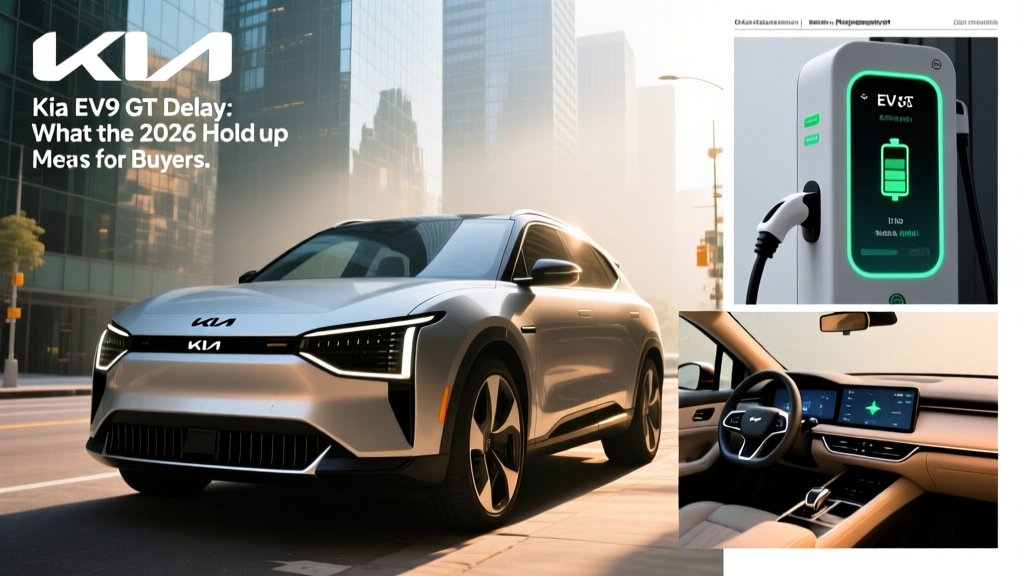
The Kia EV9 GT was supposed to be the headline act of Kia's electric lineup — a 500-plus-horsepower, three-row performance SUV aimed squarely at the Tesla Model X Plaid and Rivian R1S. But a series of production and supply-chain setbacks have pushed the EV9 GT's U.S. launch well past its originally anticipated window. If you've been tracking the Kia EV9 GT delay, here's everything confirmed (and estimated) as of early 2026, including real-world range projections, charging performance, pricing, and whether it's worth waiting for.
Why the Kia EV9 GT Is Delayed
Kia originally signaled a 2024–2025 global rollout for the EV9 GT alongside the standard EV9 lineup. The regular EV9 (Light, Wind, Land, and GT-Line trims) arrived on time for the 2024 model year. But the GT variant — which requires a more powerful dual-motor setup, upgraded battery thermal management, and revised suspension tuning — has faced compounding delays:
- Battery cell allocation: Kia's SK On supplier has prioritized volume cells for the standard EV9 and other Hyundai Motor Group EVs over the GT's higher-output pack.
- Platform recalibration: The E-GMP platform needed software and cooling upgrades to handle sustained high-power output without excessive thermal throttling — a lesson learned from early Hyundai Ioniq 5 N testing.
- Regulatory certification: EPA range and efficiency testing for the GT's specific powertrain configuration is still underway as of early 2026.
Kia has not provided a firm new on-sale date. Industry sources point to late 2026 as a U.S. launch window, likely as a 2027 model year vehicle. We'll update this article when Kia confirms order books.
Projected Specs: Range, Battery, and Efficiency
| Spec | Estimate / Confirmed Preview |
|---|---|
| Battery (usable) | ~99.8 kWh, NMC lithium-ion |
| EPA Range (est.) | ~270–290 miles (preliminary) |
| Drivetrain | Dual-motor AWD |
| Horsepower | ~501 hp (target) |
| 0–60 mph | ~4.5 seconds (target) |
| Max DC Fast Charge | ~210 kW (peak, 800V architecture) |
| 10–80% DC Charge | ~24 minutes (preliminary) |
| Level 2 Home Charge | 10.9 kW (~32 mi/hr) |
| Efficiency (est.) | ~79 MPGe / 42 kWh/100 mi |
| Towing Capacity | ~5,000 lbs (est., with trailer prep) |
| Seating | 6- or 7-passenger (2nd-row bench or captains) |
The standard EV9 Land AWD uses the same ~99.8 kWh NMC pack and is EPA-rated at 280 miles. The GT's more aggressive motor mapping, wider tires, and sport-tuned suspension will reduce efficiency — hence our preliminary estimate of 270–290 miles EPA.
Charging Performance: DC Fast and Home Level 2
The EV9 GT will use Hyundai Motor Group's 800V E-GMP architecture, the same platform underpinning the Ioniq 5, Ioniq 6, and standard EV9. This is significant because 800V systems sustain higher charge rates longer than 400V competitors.
| Level | Power | Miles Added per Hour | Notes |
|---|---|---|---|
| Level 1 (120V) | ~1.4 kW | ~3–4 mi/hr | Emergency/top-up only |
| Level 2 (240V, 48A) | 10.9 kW | ~32 mi/hr | Full charge in ~10 hours |
| DC Fast (CCS/NACS) | Peak ~210 kW | ~170+ mi in 15 min | 10–80% in ~24 min; tapers above 80% |
Charging-curve reality check: The ~210 kW peak will only be sustained roughly between 10–55% state of charge. Expect the rate to taper to ~120 kW by 70% and below 60 kW past 85%. This is normal for large NMC packs — the 10–80% time of ~24 minutes is competitive but not class-leading. On a road trip, plan for 20–25 minute stops at 150+ kW chargers.
Kia has been transitioning to the NACS (Tesla-style) connector for new models starting in 2025. The EV9 GT will likely ship with a native NACS port, granting access to Tesla Superchargers without an adapter. If you're a current CCS-equipped EV9 owner, Kia has offered adapter programs — expect similar for the GT.
Performance and Driving Dynamics
The GT badge means serious output. Kia has targeted ~501 horsepower from the dual-motor AWD system, which would slot the EV9 GT between the standard EV9 AWD (379 hp) and the Hyundai Ioniq 5 N (641 hp in N Grin Shift mode). The 0–60 mph target of approximately 4.5 seconds is quick for a 5,200+ lb three-row SUV, though it trails the Tesla Model X Plaid (2.5 sec) and is comparable to the Rivian R1S Dual-Motor (4.5 sec).
Expect the GT to include:
- Sport-tuned adaptive damping suspension
- Larger front brake calipers with enhanced regen blending
- Torque vectoring via individual motor control
- Drive modes including a dedicated GT mode with aggressive throttle and steering mapping
- Enhanced cooling for sustained performance (critical for track or mountain driving)
One practical note: the GT's performance hardware will likely sacrifice a small amount of ride comfort versus the EV9 Land, which already delivers a composed, quiet ride. If highway cruising comfort is your priority over acceleration, the EV9 GT-Line AWD (379 hp, 0–60 in ~5.0 sec) may be the smarter buy.
Pricing, Tax Credits, and Total Cost
Kia has not published MSRP for the EV9 GT. Based on the current EV9 lineup and GT positioning, here's our pricing estimate:
| Trim (2025/2026) | MSRP (approx.) | §30D Federal Credit | Effective Price |
|---|---|---|---|
| EV9 Light RWD | $56,395 | Up to $7,500* | ~$48,895 |
| EV9 Wind AWD | $61,395 | Up to $7,500* | ~$53,895 |
| EV9 Land AWD | $66,895 | Up to $7,500* | ~$59,395 |
| EV9 GT-Line AWD | $70,895 | Up to $7,500* | ~$63,395 |
| EV9 GT (est.) | ~$73,000–$78,000 | Up to $7,500* | ~$65,500–$70,500 |
*Federal §30D tax credit eligibility depends on multiple factors. See IRS guidelines. Key requirements include:
- MSRP cap: SUVs/vans/pickups must be ≤$80,000 MSRP. The EV9 GT's estimated price should clear this, but a fully loaded configuration could push close to the limit.
- Buyer income cap: Modified AGI must not exceed $150,000 (single), $225,000 (head of household), or $300,000 (joint).
- Battery sourcing: Critical minerals and battery components must meet phased-in percentage thresholds from U.S. free-trade partners. Kia/SK On's supply chain compliance will need to be confirmed at launch.
- Point-of-sale transfer: Eligible buyers can apply the credit as a dealer discount at purchase rather than waiting for tax filing.
Bottom line on cost: Even with the full $7,500 credit, the EV9 GT will likely land in the $65,000–$70,000 range. That positions it against the Rivian R1S Dual-Motor (~$75,900 before credit) and well below the Tesla Model X (~$81,630 before credit). However, the EV9 GT-Line AWD at ~$63,000 after credit offers 90% of the utility with 75% of the power — a compelling alternative if you don't need 500 hp.
Interior, Cargo, and Technology
The EV9 GT will share the standard EV9's cabin architecture, which is one of the strongest three-row EV interiors available:
- Cargo volume: ~20.2 cu ft behind 3rd row / 43.5 cu ft behind 2nd row / 81.7 cu ft max (2nd and 3rd folded)
- Front headroom: ~40.0 in | 2nd-row legroom: ~42.8 in (bench) | 3rd-row legroom: ~32.0 in
- Frunk: ~1.8 cu ft (AWD models — smaller than RWD due to front motor)
- Towing: Up to 5,000 lbs with factory tow package (est. for GT)
Standard tech will likely include:
- Dual 12.3-inch displays (instrument cluster + infotainment) in a single curved panel
- Wireless Apple CarPlay and Android Auto
- Highway Driving Assist 2 (HDA2) — SAE Level 2 driver assistance with lane-centering and adaptive cruise
- Remote Smart Parking Assist (vehicle parks itself in tight spaces while you stand outside)
- Vehicle-to-load (V2L) capability — power devices or a campsite from the traction battery
- Digital Key 2 (phone-as-key via NFC/UWB)
Pros and Cons: The Honest Assessment
✓ Pros
- 500+ hp in a genuine three-row SUV — rare in this price range
- 800V architecture enables competitive DC fast charging
- Class-leading interior space and cargo versatility
- Native NACS access to Tesla Supercharger network (likely)
- Kia's 10-year/100,000-mile powertrain warranty
- V2L capability for camping and backup power
✗ Cons
- Still not on sale — no firm delivery date as of early 2026
- Range will be modest (~270–290 mi) for a 100 kWh pack due to GT performance hardware
- Real-world highway/cold range drops to 200–260 mi
- Charging curve tapers significantly above 80% SoC
- Premium pricing may push close to $80K MSRP cap for tax credit
- Third row is tight for adults on long trips
Should You Wait or Buy Now?
- Wait for the EV9 GT if: You need 500+ hp, plan to tow near 5,000 lbs, want a three-row performance SUV under $80K, and can wait until late 2026 or 2027 for delivery.
- Buy the EV9 GT-Line AWD now if: 379 hp is plenty, you want the same interior and cargo space today, and you value immediate availability and confirmed tax-credit eligibility.
- Consider the Rivian R1S if: You need confirmed availability now, want up to 410 miles of range (Max Pack), and don't mind a smaller third row.
- Consider the Tesla Model X if: Performance is paramount (Plaid: 2.5 sec 0–60), you're deep in the Tesla ecosystem, and budget is not the primary constraint.
Warranty Coverage
Kia backs the EV9 lineup with one of the strongest warranty packages in the EV segment:
- Battery: 10 years / 100,000 miles (capacity retention threshold typically ≥70%)
- Powertrain: 10 years / 100,000 miles
- Bumper-to-bumper: 5 years / 60,000 miles
- Roadside assistance: 5 years / 60,000 miles
This is a meaningful advantage over Tesla (8 yr/120,000 mi battery, 4 yr/50,000 mi basic) and comparable to Hyundai and Rivian. For a $70K+ vehicle, the 10-year coverage provides genuine long-term peace of mind on the most expensive component.
Frequently Asked Questions
When will the Kia EV9 GT actually be available?
As of early 2026, Kia has not confirmed a specific on-sale date. Industry reporting suggests late 2026 as a 2027 model year launch. Order books have not opened in the U.S.
What is the real-world range of the EV9 GT?
The EPA figure is not yet certified. Based on the standard EV9 AWD's 280-mile EPA rating and the GT's higher-output motors, expect ~270–290 miles EPA. Real-world highway driving at 70+ mph will likely yield 230–260 miles; cold weather (below 30°F) could drop that to 200–220 miles.
Does the Kia EV9 GT qualify for the $7,500 federal tax credit?
It should, provided the MSRP stays at or below the $80,000 SUV cap, the buyer meets income thresholds, and Kia/SK On's battery sourcing satisfies current-year IRS §30D requirements. Final eligibility cannot be confirmed until the vehicle is on sale and the IRS updates its qualified vehicle list.
How fast does the EV9 GT charge?
Estimated peak DC fast-charge rate is ~210 kW via the 800V E-GMP platform, with a 10–80% time of approximately 24 minutes. Home Level 2 charging at 10.9 kW adds roughly 32 miles of range per hour, fully recharging the ~100 kWh battery in about 10 hours.
Is the EV9 GT worth waiting for vs. buying the GT-Line?
If 379 hp and a 5.0-second 0–60 time meet your needs, the GT-Line AWD is available now, costs ~$10,000–$15,000 less (est.), and delivers nearly identical interior space and tech. The GT is worth the wait only if you specifically want 500+ hp performance in a three-row SUV and can tolerate the uncertain timeline.