Kia EV9 Ground Clearance and Off-Road Capability
The 2026 Kia EV9 offers 7.8 inches of ground clearance across all trims, placing it squarely in the mid-pack for three-row electric SUVs. For comparison, the Rivian R1S clears 14.9 inches in its max off-road mode, while the Tesla Model X sits at 8.2 inches. The EV9's clearance is adequate for gravel driveways, mild forest service roads, and the occasional snow-covered street, but it was never designed for technical trails.
What matters more for most buyers is the EV9's approach and departure angles — 20.0° and 25.4° respectively — which let you navigate steep driveway transitions without scraping the front bumper. The available all-wheel-drive (AWD) trims add a torque-vectoring rear motor that aids traction on loose surfaces, though the standard all-season tires limit true off-road ambition. If you're planning overlanding expeditions, look elsewhere. If you need a three-row electric family hauler that handles a dirt road to the campsite, the EV9's ground clearance does the job.
Range, Efficiency, and Real-World Expectations
The EV9 lineup splits into two battery configurations. The base Light RWD uses a 76.1 kWh (usable) battery, while the Light Long Range RWD and all AWD trims step up to a 99.8 kWh usable pack. Both use NMC (nickel-manganese-cobalt) chemistry, prioritizing energy density over the cycle-life longevity of LFP cells.
| Trim | Battery (kWh usable) | EPA Range (mi) | MPGe (combined) | kWh/100 mi |
|---|---|---|---|---|
| Light RWD | 76.1 | 230 | 88 | 38 |
| Light Long Range RWD | 99.8 | 304 | 89 | 38 |
| Wind / Land AWD | 99.8 | 270–282 | 85–87 | 39–40 |
| GT-Line AWD | 99.8 | 270 | 85 | 40 |
Real-World Range Reality: The EPA's 304-mile estimate for the Long Range RWD holds up in moderate city and suburban driving, but expect ~250–265 miles on the highway at 70–75 mph, where aerodynamic drag punishes this boxy SUV. In cold weather (below 30°F), plan for a 20–30% range reduction — roughly 185–215 miles from the Long Range AWD trims — unless you precondition the battery while plugged in. Source: EPA fueleconomy.gov.
Efficiency hovers around 38–40 kWh/100 miles, which is reasonable for a 5,000+ lb three-row SUV but noticeably less efficient than a sedan like the Hyundai Ioniq 6 (25 kWh/100 mi). The heat pump, standard on all trims, helps mitigate cold-weather energy loss for cabin heating.
Charging Speed: DC Fast and Home Level 2
Kia equips the EV9 with an 800-volt electrical architecture — the same platform shared with the Hyundai Ioniq 5 and Genesis Electrified GV70 — enabling some of the fastest DC charging in its class.
| Charging Level | Power / Rate | Time / Gain |
|---|---|---|
| Level 1 (120V outlet) | ~1.2 kW | ~3–4 miles per hour |
| Level 2 (240V, 48A home charger) | ~10.9 kW | ~30–34 miles per hour; full charge in ~10 hrs (99.8 kWh) |
| DC Fast Charge (peak) | 210 kW (Long Range) / 160 kW (Light RWD) | 10–80% in ~24 min (Long Range), ~27 min (Light RWD) |
The 210 kW peak rate on the 99.8 kWh battery is impressive, but as with all EVs, the charge curve tapers significantly above 80% SoC. Expect the last 20% to take as long as the first 60%. On a road trip, the practical strategy is to charge from 10–80% and move on — that's where the 24-minute claim holds. At Electrify America or Tesla Supercharger (NACS) stations delivering 150+ kW, you'll see sustained rates of ~170–190 kW between 10–55% SoC before tapering begins.
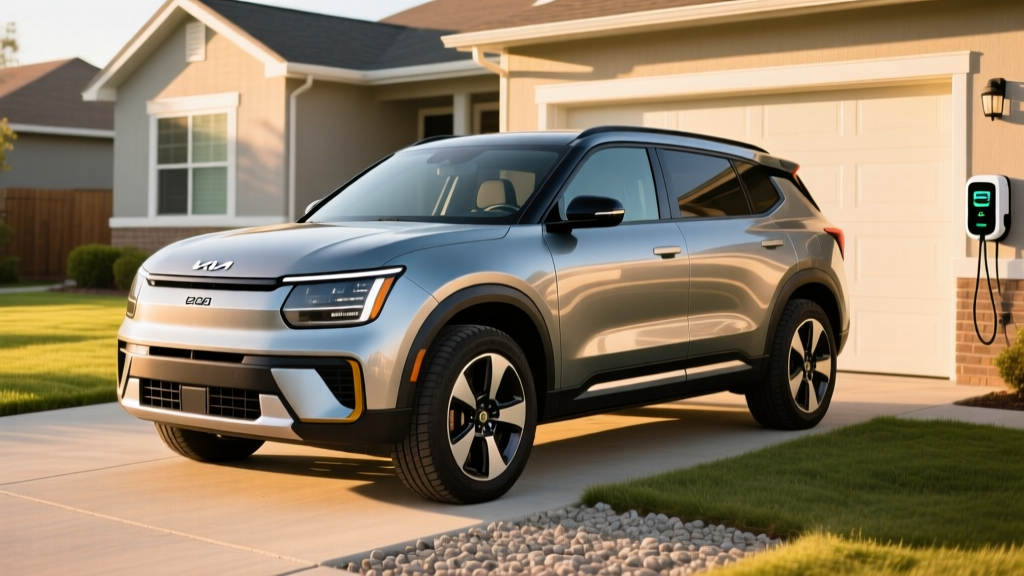
For home charging, Kia includes a portable Level 2 cord with the NACS connector standard on the 2026 EV9 (Kia transitioned to NACS beginning with 2025 models, granting direct access to Tesla's Supercharger network with no adapter). A 48-amp home wall connector on a 60-amp circuit delivers ~30 miles of range per hour — enough to fully replenish even the Long Range battery overnight.
Performance and Drivetrain
The EV9 isn't a performance SUV, but the AWD trims deliver genuinely quick acceleration for a vehicle this size.
| Trim | Drivetrain | Horsepower | Torque (lb-ft) | 0–60 mph |
|---|---|---|---|---|
| Light RWD | Rear-motor RWD | 215 hp | 258 | 7.8 sec |
| Light Long Range RWD | Rear-motor RWD | 201 hp | 258 | 8.2 sec |
| Wind / Land AWD | Dual-motor AWD | 379 hp | 436 | 5.0 sec |
| GT-Line AWD | Dual-motor AWD | 379 hp | 516 (boost mode) | 4.5 sec |
The dual-motor AWD trims feel effortlessly quick in daily driving, with instant torque that makes merging and passing effortless. The GT-Line's 4.5-second 0–60 time is genuinely fast for a 5,100-lb SUV. Ride quality is composed, and the multi-link rear suspension absorbs bumps well, though the 20- and 21-inch wheels on upper trims transmit more road imperfections than the 19-inch rubber on the Wind trim.
Pricing, Trims, and Federal Tax Credit Eligibility
The 2026 EV9 starts at $55,995 (Light RWD, including destination) and climbs to roughly $74,995 for the GT-Line AWD. Here's the trim breakdown:
| Trim | Base MSRP | Est. After §30D Credit* |
|---|---|---|
| Light RWD | $55,995 | $48,495 |
| Light Long Range RWD | $59,495 | $51,995 |
| Wind AWD | $64,495 | $56,995 |
| Land AWD | $69,995 | $62,495 |
| GT-Line AWD | $74,995 | $67,495 |
*Federal tax credit caveats: The $7,500 figure above assumes full eligibility under IRS §30D rules. To qualify, your modified adjusted gross income must fall below $150,000 (single) or $300,000 (joint filing). The EV9 qualifies as an SUV under the MSRP cap of $80,000, so all trims clear that threshold. However, battery component and critical mineral sourcing requirements may reduce the credit to $3,750 or disqualify it entirely depending on the current-year supply-chain compliance. The credit can now be transferred to the dealer as a point-of-sale discount. Always verify eligibility with your tax professional before purchasing.
Kia also assembles the EV9 at its West Point, Georgia plant — a factor that supports domestic-sourcing credit requirements and helps keep it competitive against imported rivals.
Interior Space, Cargo, and Family Practicality
The EV9's three-row layout is where it earns its keep as a family SUV. Second-row legroom is generous at 42.8 inches, and the available captain's chairs with power-recline and relaxation mode rival luxury minivans. Third-row legroom sits at 32.0 inches — usable for children and shorter adults on trips under an hour, but tight for full-size passengers on long drives.
| Configuration | Cargo Volume (cu ft) |
|---|---|
| Behind third row | 20.2 |
| Second row folded | 43.5 |
| All rows folded | 81.7 |
| Front trunk (frunk) | 1.8 (AWD) / 3.2 (RWD) |
Behind the third row, 20.2 cubic feet is enough for a couple of carry-ons or a week's groceries — but not both simultaneously. Fold the third row and you unlock 43.5 cu ft, which handles most family hauling duties. The small frunk is mostly useful for charging cables.
Tech highlights include a standard 12.3-inch digital cluster and 12.3-inch infotainment display running Kia's latest Connect system with wireless Apple CarPlay and Android Auto. Available features include a head-up display, digital side mirrors (on GT-Line), and Highway Driving Assist 2 — Kia's SAE Level 2 driver-assist system that handles adaptive cruise and lane-centering on highways. The driver must remain engaged at all times; this is not autonomous driving.
Warranty and Long-Term Ownership
Kia backs the EV9 with one of the strongest warranties in the industry:
- Basic warranty: 5 years / 60,000 miles
- Powertrain warranty: 10 years / 100,000 miles
- Battery warranty: 10 years / 100,000 miles (capacity retention guaranteed above 70% State of Health)
The 70% SoH threshold is standard across the industry, though some buyers wish for a stricter 80% guarantee. In practice, NMC batteries in thermally managed systems like the EV9's typically retain 85–92% capacity after 100,000 miles based on data from similar Kia/Hyundai platforms. The 10-year/100,000-mile battery coverage provides strong peace of mind for second-owner resale value.
Pros
- Genuine three-row usability with comfortable second-row captain's chairs
- 800V architecture delivers 10–80% DC fast charging in ~24 minutes
- NACS connector provides direct Tesla Supercharger network access
- Class-leading 10-year/100,000-mile battery and powertrain warranty
- Strong dual-motor AWD performance (0–60 in 4.5–5.0 sec)
- Georgia-built, supporting domestic sourcing for tax credit eligibility
Cons
- 7.8 inches of ground clearance limits off-road capability vs Rivian R1S
- Third-row legroom (32.0 in) is tight for adults on long trips
- Cargo behind third row (20.2 cu ft) is modest for a full-size SUV
- Real-world highway range drops to ~250 mi on AWD trims at 75 mph
- No LFP battery option for buyers prioritizing cycle longevity
- Base Light RWD trim at $55,995 is expensive before incentives
Who Should Buy the Kia EV9?
Choose the EV9 if: You need a three-row electric SUV for family commuting, school runs, and weekend road trips under 250 miles. You value fast 800V charging, NACS Supercharger access, and Kia's industry-leading warranty. You primarily drive on paved roads and don't need serious off-road capability.
Look elsewhere if: You regularly need to carry six adults and their luggage simultaneously (consider the minivan-style Kia Carnival hybrid). You want more than 8 inches of ground clearance for trail use (Rivian R1S). You want maximum range above 320 miles (Tesla Model X at 335 mi EPA). You need LFP battery chemistry for maximum cycle life and daily 100% charging tolerance.
Frequently Asked Questions
What is the Kia EV9's ground clearance?
The 2026 Kia EV9 has 7.8 inches of ground clearance across all trims. This is adequate for light gravel and snow but not designed for serious off-roading. The Rivian R1S offers up to 14.9 inches in its adjustable air suspension's max mode.
What is the real-world range of the Kia EV9?
The EPA rates the Long Range RWD at 304 miles and AWD trims at 270–282 miles. In real-world highway driving at 70–75 mph, expect roughly 250–265 miles from the Long Range models and 220–240 miles from AWD trims. Cold weather (below 30°F) can reduce range by 20–30% without preconditioning.
How fast does the Kia EV9 charge?
The Long Range EV9 peaks at 210 kW on a DC fast charger, reaching 10–80% in approximately 24 minutes. The Light RWD peaks at 160 kW with a ~27-minute 10–80% time. At home on a Level 2 (240V/48A) charger, expect ~30 miles of range per hour, or a full overnight charge in about 10 hours for the 99.8 kWh battery.
Does the Kia EV9 qualify for the federal EV tax credit?
The EV9 may qualify for up to $7,500 under IRS §30D, but eligibility depends on your income (under $300,000 joint / $150,000 single), the vehicle's MSRP (all trims fall under the $80,000 SUV cap), and current-year battery component and critical mineral sourcing rules. Georgia assembly supports domestic sourcing. Verify with the IRS and a tax professional before purchasing.
Is the Kia EV9 worth buying vs competitors?
Against the Tesla Model X, the EV9 is more affordable ($56K vs $80K+) and offers a longer warranty, though the Model X has more range (335 mi EPA) and cargo space. Against the Rivian R1S, the EV9 is less capable off-road and lacks an LFP option, but costs significantly less and charges faster via its 800V architecture. For most families who don't need hardcore off-roading, the EV9 offers the best value in the three-row electric SUV segment.
Can the Kia EV9 tow?
Yes. AWD trims are rated to tow up to 5,000 pounds when properly equipped, which covers most small boat trailers and utility trailers. RWD trims are rated at 2,000 pounds. Towing significantly reduces range — expect roughly a 40–50% reduction at highway speeds with a loaded trailer.
What battery chemistry does the Kia EV9 use?
All EV9 trims use NMC (nickel-manganese-cobalt) lithium-ion cells. NMC offers higher energy density than LFP, which is critical for fitting 99.8 kWh of usable capacity into the EV9's platform. The trade-off is slightly less cycle-life longevity compared to LFP, though Kia's 10-year/100,000-mile battery warranty mitigates this concern.