The EV9 Frunk Question — And Everything Else You Need to Know
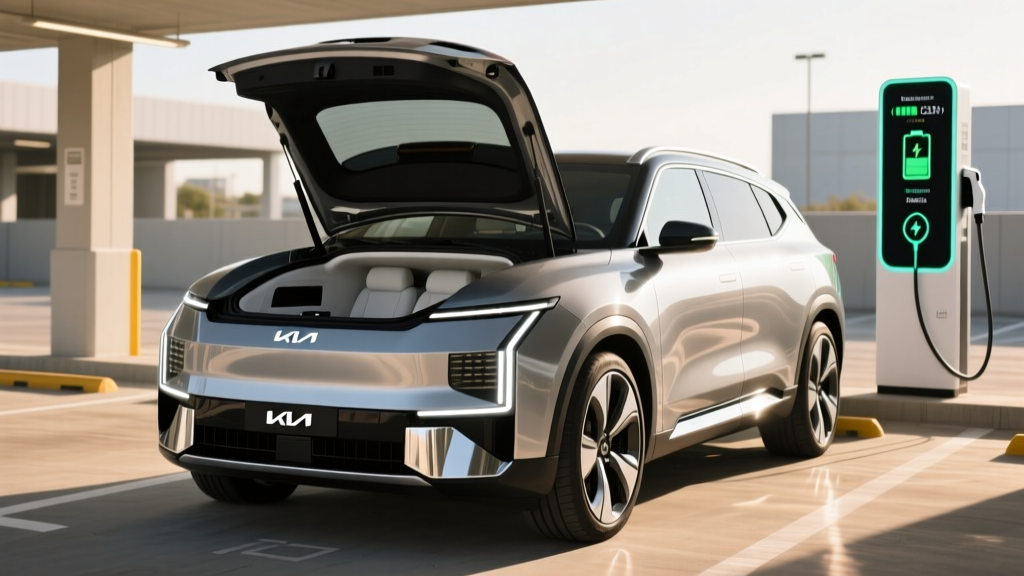
If you've been searching for answers on the Kia EV9 frunk, here's the short answer: the EV9 does not have a traditional front trunk. Kia engineers used the space beneath the hood for HVAC components, power electronics, and the washer-fluid reservoir, leaving no sealed cargo compartment up front. It's a notable omission in a class where the Rivian R1S, Ford Explorer EV, and even the Hyundai Ioniq 9 offer some form of front storage. But the EV9 makes up for it with a massive rear cargo area and three-row practicality that few electric SUVs can match.
This review covers the 2026 Kia EV9 in full — range, charging speed, battery chemistry, pricing after federal tax credits, and whether it still holds up as the default three-row electric family hauler.
| Spec | Light RWD (Base) | Land AWD | GT-Line AWD |
|---|---|---|---|
| EPA Range | 304 mi | 280 mi | 270 mi |
| Battery (usable) | 76.1 kWh (Light) / 99.8 kWh (Light Long Range) | 99.8 kWh | 99.8 kWh |
| Chemistry | NMC (Light base: LFP on 76.1 kWh) | NMC | NMC |
| Peak DC Charge Rate | ~170 kW (76.1 kWh) / 236 kW (99.8 kWh) | 236 kW | 236 kW |
| 10–80% DC Time | ~24 min (99.8 kWh) | ~24 min | ~24 min |
| Level 2 (11 kW onboard) | ~28 mi/hr | ~28 mi/hr | ~28 mi/hr |
| Horsepower | 215 hp (76.1) / 201 hp (99.8 RWD) | 379 hp | 379 hp (w/ boost: 412 hp) |
| 0–60 mph | 8.2 sec (est.) | 5.0 sec | 4.5 sec (boost) |
| Drivetrain | RWD single motor | Dual-motor AWD | Dual-motor AWD |
| MPGe (combined) | 88 MPGe (Light LR) | 85 MPGe | 83 MPGe |
| kWh/100 mi | 38 | 40 | 41 |
| Base MSRP | $54,900 | $63,900 | $73,900 |
| Towing Capacity | 2,000 lb | 5,000 lb | 5,000 lb |
| Battery Warranty | 10 years / 100,000 miles | ||
Range and Efficiency: Real-World Numbers Behind the EPA Sticker
The most-equipped-for-distance version is the Light Long Range RWD with the 99.8 kWh NMC battery, rated at 304 miles EPA. Dual-motor AWD trims drop to 270–280 miles. Those are competitive figures for a 4,700-pound three-row SUV.
- Mild-weather city/suburban: 290–310 mi (Light LR RWD) — regenerative braking in stop-and-go traffic helps you meet or slightly beat the EPA sticker.
- Highway (70–75 mph sustained): 240–265 mi — the EV9's boxy aerodynamics (Cd ~0.28) penalize it at speed more than a sleeker crossover like the Ioniq 5.
- Cold weather (below 32°F): 210–240 mi — expect a 20–30% reduction. The EV9 uses a heat pump on higher trims (standard on Land and GT-Line), which mitigates cabin-heating losses but doesn't eliminate cold-weather chemistry slowdown.
- Towing (5,000 lb trailer): 140–170 mi — towing roughly halves range. Plan charging stops accordingly.
Source: EPA fueleconomy.gov
Efficiency lands at roughly 38–41 kWh per 100 miles depending on trim. That's thirstier than a Tesla Model X (35 kWh/100 mi) but expected given the EV9's upright profile and weight. For context, at a national average electricity price of $0.17/kWh, 100 miles of driving costs about $6.50–$7.00 — roughly half what the same distance costs in a 22-MPG gas SUV at $3.50/gallon.
Charging Speed: DC Fast Charge and Home Level 2 Breakdown
The 99.8 kWh battery versions (Light Long Range, Land, GT-Line) support up to 236 kW peak DC fast charging via the standard NACS connector, which now gives native access to the Tesla Supercharger network alongside Electrify America, EVgo, and other CCS-to-NACS-adapted stations. The smaller 76.1 kWh Light RWD base battery tops out around 170 kW.
Peak rate is not sustained rate. The EV9's charge curve holds above 200 kW from roughly 10% to 50% state of charge, then tapers progressively. The 10–80% time of approximately 24 minutes is measured under ideal conditions (battery preconditioned, warm ambient temperature, a station capable of delivering 350 kW). In practice at a 150 kW Electrify America stall, expect 30–35 minutes for the same 10–80% session.
| Level | Power | Miles Added per Hour | Notes |
|---|---|---|---|
| Level 1 (120V household) | ~1.4 kW | ~4–5 mi/hr | Emergency/trickle only; full charge takes 3+ days |
| Level 2 (240V, 48A) | 11.5 kW | ~28 mi/hr | Full charge in ~9 hours (99.8 kWh battery); overnight-ready |
| DC Fast Charge (99.8 kWh) | Up to 236 kW peak | ~145 mi in 15 min (peak) | 10–80% in ~24 min (ideal); tapers hard above 80% |
| DC Fast Charge (76.1 kWh) | Up to 170 kW peak | ~110 mi in 15 min (peak) | 10–80% in ~27 min |
Home charging setup: The EV9's 11 kW onboard charger means you'll want a 48-amp hardwired Level 2 wallbox (like a ChargePoint Home Flex or Tesla Wall Connector) on a 60-amp circuit to extract the full rate. A standard 40-amp NEMA 14-50 outlet delivers about 9.6 kW (~24 mi/hr), which still covers most overnight needs. Expect $500–$1,500 for a professional Level 2 installation depending on panel proximity and whether your home needs a service upgrade to 200 amps.
Performance and Drivetrain
The dual-motor AWD EV9 (Land and GT-Line) produces 379 horsepower and hits 60 mph in about 5.0 seconds. The GT-Line with the optional Boost package bumps output to 412 hp and drops the 0–60 to 4.5 seconds — genuinely quick for a vehicle with a third row. The base Light RWD with the 76.1 kWh LFP battery is more sedate at 215 hp and an estimated 8.2-second 0–60, which is adequate for commuting but noticeable when merging onto fast highways.
Ride quality is composed, aided by the EV9's multi-link rear suspension and well-damped adaptive dampers on the GT-Line. The steering is light and numb — this is a family cruiser, not a canyon carver. Brake feel is progressive, and the regenerative braking system (adjustable via paddle shifters from Level 0 to Level 3) can bring you to near-stops in one-pedal mode, though it doesn't quite hold the vehicle stationary at 0 mph like some competitors.
Cargo Space, Interior, and the Frunk Situation
Let's address the EV9 frunk directly: there isn't one. The front hood covers a packed electronics bay. If front cargo is a dealbreaker, the Rivian R1S (11 cu ft frunk) or the Ford F-150 Lightning are your alternatives.
Where the EV9 excels is rear cargo:
- Behind third row: 20.2 cu ft — enough for a week of groceries or two carry-on bags per passenger.
- Third row folded: 43.5 cu ft — competitive with midsize ICE SUVs.
- All rear rows folded: 81.7 cu ft — near-flat load floor, suitable for furniture or camping gear.
Passenger space is generous across all three rows. The second row offers 42.8 inches of legroom (bench) or 39.5 inches (captain's chairs with a walk-through gap), and the third row fits adults up to about 5'8" comfortably on shorter trips with 32.0 inches of legroom. Headroom is excellent throughout thanks to the boxy roofline.
The interior materials are solid but not luxury-grade — recycled fabric and vegan leather on most trims, with real leather reserved for the GT-Line. The dual 12.3-inch panoramic display runs Kia's latest ccNC infotainment with wireless Apple CarPlay and Android Auto. Physical climate controls remain, which is a win over the touch-capacitive-only trend.
Pricing, Trims, and Federal Tax Credit Eligibility
The 2026 Kia EV9 lineup spans five trims:
- Light RWD (76.1 kWh LFP): $54,900
- Light Long Range RWD (99.8 kWh): $57,900
- Wind AWD: $61,900
- Land AWD: $63,900
- GT-Line AWD: $73,900
| Trim | MSRP | Est. §30D Credit | Effective Price |
|---|---|---|---|
| Light RWD | $54,900 | Up to $7,500* | ~$47,400 |
| Light Long Range RWD | $57,900 | Up to $7,500* | ~$50,400 |
| Wind AWD | $61,900 | Up to $7,500* | ~$54,400 |
| Land AWD | $63,900 | Up to $7,500* | ~$56,400 |
| GT-Line AWD | $73,900 | $0 (exceeds MSRP cap) | $73,900 |
*Credit eligibility depends on buyer income, battery critical-mineral sourcing, and MSRP caps. See IRS rules below.
Federal tax credit rules (IRS §30D, 2026): The EV9 qualifies for up to $7,500 if you meet all of the following, per IRS guidelines:
- MSRP cap: The vehicle must have an MSRP at or below $80,000 for SUVs. All EV9 trims qualify on sticker, but the GT-Line's destination and options can push it close to the limit — verify the final MSRP on the window sticker.
- Buyer income cap: Modified adjusted gross income must not exceed $150,000 (single), $225,000 (head of household), or $300,000 (married filing jointly).
- Battery sourcing: The $7,500 credit splits into two halves — $3,750 for critical minerals and $3,750 for battery component assembly. Kia sources NMC cells from SK On (with Georgia-based battery manufacturing), which has historically met the component requirement. Critical-mineral sourcing depends on the supply chain at time of manufacture and may yield a partial ($3,750) or full ($7,500) credit. Check the DOE/EPA credit lookup tool for your specific VIN.
- Point-of-sale transfer: You can transfer the credit to the dealer at purchase for an immediate price reduction, rather than waiting to claim it on your tax return.
Driver Assistance and Technology
The EV9 comes standard with Kia's Highway Driving Assist 2 (HDA2), a SAE Level 2 driver-assistance system that combines adaptive cruise control with lane-centering on marked highways. It's competent for long road trips — the steering inputs are smooth, and the system handles gentle curves well. However, it requires continuous driver supervision: hands on the wheel, eyes on the road. This is not a hands-free system like GM's Super Cruise or Ford's BlueCruise.
Kia HDA2 is an SAE Level 2 system. The driver is fully responsible for vehicle operation at all times. It does not handle stoplights, stop signs, construction zones, or unmapped roads. Do not confuse Level 2 driver-assist with autonomous driving (Level 4+), which is only available in limited robotaxi services like Waymo.
Available tech highlights include a 12.3-inch heads-up display with augmented-reality navigation prompts, a digital key (NFC + UWB), remote smart parking assist (the EV9 can pull itself in and out of tight spaces via keyfob), and vehicle-to-load (V2L) capability that lets you power devices or appliances from the traction battery via a standard 120V outlet adapter — rated at up to 3.6 kW, enough to run a space heater, power tools at a campsite, or keep a refrigerator going during an outage.
Who Should Buy the Kia EV9 — And Who Shouldn't
- Best-in-class three-row space and 81.7 cu ft max cargo
- 236 kW DC fast charging (99.8 kWh trims) — 10–80% in ~24 min
- NACS connector = native Tesla Supercharger access
- 10-year/100,000-mile battery warranty (best in mainstream market)
- V2L capability for camping and emergency power
- 5,000-lb towing on AWD trims
- No front trunk (frunk) — a gap vs. Rivian R1S and F-150 Lightning
- Highway range drops significantly (~240 mi) due to boxy aero
- Base Light RWD (LFP, 76.1 kWh) is slow and limited in range
- No hands-free driving mode (HDA2 requires hands on wheel)
- GT-Line pushes $74K+ and may lose full tax credit at high option levels
Buy the EV9 if: You need a genuine three-row electric SUV with adult-usable third-row seating, you charge primarily at home, and you value Kia's 10-year battery warranty. The Land AWD at ~$56,400 after the estimated tax credit is the value sweet spot — you get AWD, the 99.8 kWh battery, heat pump, and premium features without GT-Line pricing.
Look elsewhere if: Front cargo storage is essential (Rivian R1S), you want hands-free highway driving (GM Super Cruise in the Cadillac Escalade IQ), or you need maximum range for frequent 300+ mile road trips without stopping (Tesla Model X at 348 mi EPA, though at a significantly higher price).
Frequently Asked Questions
Does the Kia EV9 have a frunk?
No. The 2026 Kia EV9 does not have a front trunk. The under-hood space is occupied by power electronics, the HVAC compressor, and the 12V auxiliary battery. If a frunk is a priority, consider the Rivian R1S or Ford F-150 Lightning.
What is the real-world range of the Kia EV9?
The EPA rates the Light Long Range RWD at 304 miles. In real-world mixed driving, expect 270–290 miles in mild weather, 240–265 miles on sustained highway trips, and 210–240 miles in freezing temperatures. AWD trims lose roughly 25–30 miles from those figures.
How fast does the EV9 charge at home and on the road?
On a Level 2 home charger (48A/11.5 kW), the EV9 gains about 28 miles of range per hour, fully charging overnight in roughly 9 hours. On a DC fast charger, the 99.8 kWh battery peaks at 236 kW and reaches 10–80% in about 24 minutes under ideal conditions.
Does the Kia EV9 qualify for the $7,500 federal tax credit?
Most trims qualify for up to $7,500 under IRS §30D, provided the buyer meets income caps ($300K joint / $150K single) and the vehicle's battery sourcing satisfies critical-mineral and component requirements. The GT-Line's MSRP stays under the $80,000 SUV cap, but high option packages could push it close. Always verify with the DOE lookup tool and consult a tax professional.
Is the Kia EV9 worth buying over the Tesla Model X or Rivian R1S?
The EV9 offers the best combination of price, warranty, and three-row practicality in the mainstream electric SUV segment. The Model X has more range (348 mi EPA) and Supercharger-native infrastructure but starts above $80K and is ineligible for the federal credit. The Rivian R1S has a frunk, superior off-road capability, and a more premium interior, but starts around $75K. For buyers prioritizing value and family space under $65K after incentives, the EV9 Land AWD is the segment benchmark.
What is the EV9's battery warranty?
Kia covers the EV9's high-voltage battery for 10 years or 100,000 miles (whichever comes first), with a capacity retention threshold of 70%. If the battery degrades below 70% of original capacity within that period, Kia will repair or replace it. The basic vehicle warranty is 5 years / 60,000 miles.