Kia EV9 Financing: What Buyers Need to Know in 2026
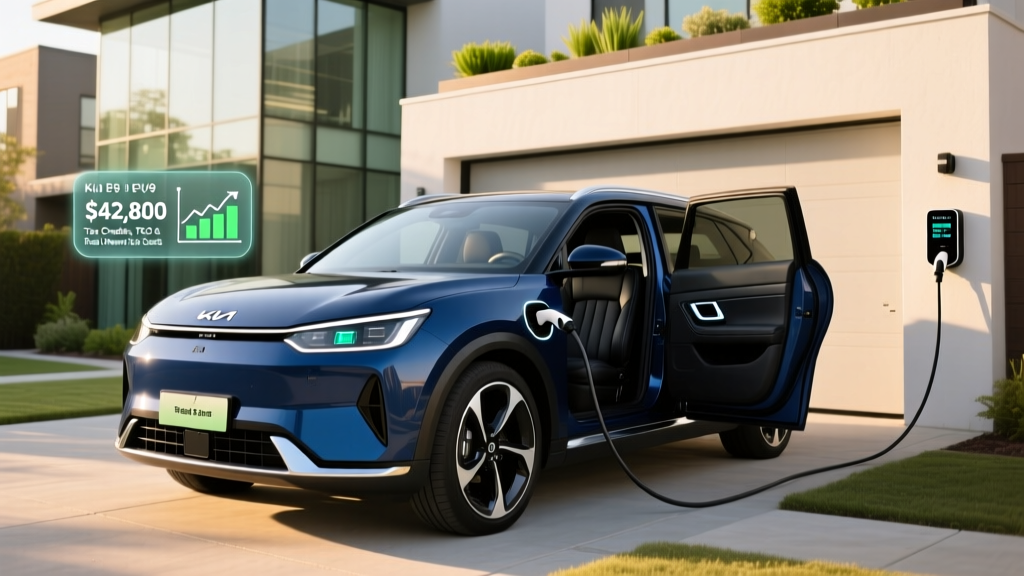
The three-row Kia EV9 remains one of the few mainstream electric SUVs offering genuine seating for seven, a 100.0 kWh battery pack (NMC chemistry), and DC fast charging that peaks at 210 kW. But with a base MSRP starting around $54,900 for the 2026 Light RWD trim and climbing past $73,000 for the GT-Line AWD, structuring your purchase matters as much as the sticker price. This guide breaks down Kia EV9 financing from every angle that affects your wallet: the federal tax credit under IRS §30D, real-world fuel and maintenance savings, the insurance premium reality, and five-year depreciation trends.
| Spec | Light RWD | Wind AWD | GT-Line AWD |
|---|---|---|---|
| Base MSRP | $54,900 | $63,900 | $73,900 |
| EPA Range | 304 mi | 280 mi | 270 mi |
| Battery (usable) | 100.0 kWh (NMC) | 100.0 kWh (NMC) | 100.0 kWh (NMC) |
| Peak DC Fast Charge | 210 kW | 210 kW | 210 kW |
| 10–80% DC Time | ~24 min | ~24 min | ~24 min |
| Level 2 Charge Rate | 10.9 kW | 10.9 kW | 10.9 kW |
| Horsepower | 215 hp | 379 hp | 379 hp |
| 0–60 mph | 7.8 sec | 5.0 sec | 4.7 sec |
| MPGe (combined) | 88 MPGe | 85 MPGe | 83 MPGe |
| Battery/Powertrain Warranty | 10 years / 100,000 miles | ||
Sources: EPA / fueleconomy.gov, Kia USA.
Federal Tax Credit: Does the EV9 Qualify Under §30D?
The Clean Vehicle Credit (IRS §30D) offers up to $7,500 for qualifying new EVs, but eligibility is far from automatic. The Kia EV9 is assembled in West Point, Georgia, which satisfies the North American final-assembly requirement. However, whether you receive the full $7,500, a partial $3,750, or nothing at all depends on your income, the trim's MSRP, and the battery's critical-mineral and component sourcing — rules that the IRS has tightened progressively through 2025 and into 2026.
§30D Eligibility Checklist (2026 Rules)
- MSRP Cap: SUVs/pickups/vans must be at or below $80,000. The EV9 Wind AWD ($63,900) and GT-Line AWD ($73,900) qualify on MSRP. Fully loaded GT-Line with packages may approach the cap — verify the window sticker.
- Buyer Income Limits (Modified AGI): $300,000 joint filers / $225,000 head of household / $150,000 single. You can use the lesser of your current-year or prior-year MAGI.
- Critical Minerals Requirement ($3,750): A specified percentage of critical minerals must be sourced from the U.S. or a free-trade-agreement partner. Kia has worked to localize supply chains, but the exact qualifying percentage shifts with IRS guidance — confirm at irs.gov or the dealer's point-of-sale system.
- Battery Components Requirement ($3,750): A specified percentage of battery components must be manufactured or assembled in North America. Additionally, vehicles with battery components from a "foreign entity of concern" (FEOC) are disqualified.
- Point-of-Sale Transfer: Since 2024, you can transfer the credit to the dealer at purchase, reducing your out-of-pocket cost immediately rather than waiting to claim it on your tax return. This effectively lowers your financed amount — a meaningful advantage for Kia EV9 financing.
Practical impact on financing: If you qualify for the full $7,500 and transfer it at the point of sale on a $63,900 EV9 Wind AWD, your effective capitalized cost drops to $56,400. On a 60-month loan at 6.5% APR, that's a monthly payment reduction of roughly $147 compared to financing the full MSRP. Always confirm your specific credit amount with a tax professional before signing.
5-Year Total Cost of Ownership: EV9 vs. Gas Three-Row SUV
To understand the real economics of Kia EV9 ownership, we modeled five years and 75,000 miles against a comparable gasoline three-row SUV averaging 22 MPG combined (similar to a mid-trim Hyundai Palisade or Kia Telluride). We used national averages for electricity and gasoline, standard maintenance schedules, and current insurance data.
| Category | Kia EV9 Wind AWD | Gas 3-Row SUV (22 MPG) |
|---|---|---|
| Purchase Price (after $7,500 credit) | $56,400 | $44,000 |
| Fuel / Energy (75,000 mi) | $6,820 | $11,250 |
| Maintenance | $1,800 | $4,200 |
| Insurance (5 years) | $12,500 | $9,800 |
| Estimated Depreciation | $25,400 | $17,600 |
| Total 5-Year Cost | $102,920 | $86,850 |
| Cost Per Mile | $1.37/mi | $1.16/mi |
Assumptions: Electricity at $0.16/kWh national average (home charging) blended with 20% public DC fast charging at $0.40/kWh; gasoline at $3.30/gallon; EV9 efficiency at 34 kWh/100 mi (real-world mixed driving). Insurance based on national EV average premiums. Depreciation based on current EV resale trends. Your actual numbers will vary with local utility rates, driving patterns, and state incentives.
The EV9's higher purchase price and steeper depreciation keep its five-year total above a gas equivalent, even after the tax credit. However, the gap narrows significantly if you charge primarily at home on cheap utility rates, qualify for state rebates, or keep the vehicle beyond five years — where the EV's lower operating costs compound.
Charging vs. Gasoline: Real Cost-Per-Mile Math
The EV9's energy consumption averages roughly 34 kWh per 100 miles in mixed real-world driving (EPA combined is slightly more optimistic at around 85 MPGe for AWD trims). Here's how that translates to dollars:
| Scenario | EV9 Cost/Mile | Gas SUV (22 MPG) Cost/Mile |
|---|---|---|
| Home charging at $0.12/kWh | $0.041 | $0.150 |
| Home charging at $0.16/kWh (nat'l avg) | $0.054 | $0.150 |
| Home charging at $0.22/kWh (CA peak) | $0.075 | $0.150 |
| Public DC fast charging at $0.40/kWh | $0.136 | $0.150 |
| Public DC fast charging at $0.55/kWh (premium networks) | $0.187 | $0.150 |
The takeaway: Home charging is where the EV9 delivers dramatic savings — roughly one-third the cost per mile of gasoline. But if you rely exclusively on premium public DC fast chargers, you may actually pay more per mile than a gas SUV. Kia EV9 ownership economics strongly favor buyers with reliable Level 2 home charging. If you're in an apartment without charging access, run these numbers carefully before committing.
For a 100.0 kWh battery charged from 10% to 90% at home ($0.16/kWh), expect to pay roughly $12.80 for about 240 real-world miles. That same distance in the gas SUV at $3.30/gallon costs about $36.
Maintenance Savings: Where the EV9 Keeps Money in Your Pocket
Electric vehicles eliminate several recurring maintenance items that gas vehicles require. The EV9's single-speed reduction gear, lack of exhaust system, and regenerative braking (which reduces mechanical brake wear significantly) contribute to lower scheduled maintenance costs.
| Service Item | Kia EV9 | Gas 3-Row SUV |
|---|---|---|
| Oil Changes | $0 (none required) | $600–$900 (5–7 changes) |
| Transmission Fluid | $0 (sealed unit) | $200–$350 |
| Brake Pads/Rotors | $0–$200 (regen extends life) | $600–$1,000 |
| Engine Air Filter | $0 (no combustion engine) | $100–$150 |
| Coolant Service | $150 (battery thermal mgmt) | $200–$300 |
| Cabin Air Filter | $100–$150 | $100–$150 |
| Tire Rotation/Replacement | $1,200–$1,600 (heavier vehicle, more tire wear) | $900–$1,200 |
| Total Estimated | $1,550–$2,100 | $2,700–$4,050 |
Net maintenance savings over five years: roughly $1,500 to $2,400. One caveat — the EV9's heavier curb weight (approximately 5,500 lbs for AWD trims) and instant torque can accelerate tire wear. Budget for tire replacement sooner than you might on a lighter vehicle. Kia's 10-year/100,000-mile battery and powertrain warranty covers the traction battery against defects and excessive degradation (typically below 70% capacity retention), reducing long-term risk.
Insurance Reality: The Line Item That Catches EV Buyers Off Guard
EV insurance premiums are typically 15% to 30% higher than comparable gas vehicles, and the EV9 is no exception. Several factors drive this:
- Higher repair costs: EV-specific components (battery pack, power electronics) are expensive to replace after collision damage.
- Specialized labor: High-voltage system repairs require certified technicians, limiting shop options and raising labor rates.
- Vehicle value: The EV9's higher MSRP means higher comprehensive and collision payouts.
- Total-loss thresholds: Battery damage in even minor collisions can push repair costs above total-loss thresholds.
Expect annual premiums in the $2,200 to $2,800 range for the EV9 Wind AWD, depending on your state, driving record, and coverage levels — compared to roughly $1,700 to $2,200 for a gas Telluride. Shop quotes from multiple insurers before purchase; some carriers now offer EV-specific policies with bundled home-charger coverage that can partially offset the premium gap.
Depreciation and Resale Value Trends
EV depreciation has been volatile. Early adopter models saw steep drops as battery technology advanced rapidly and used-EV demand fluctuated with gas prices and credit availability. The EV9, as a relatively new nameplate with strong demand in the three-row electric SUV segment, has held value better than some early EVs, but still depreciates faster than equivalent gas SUVs in percentage terms.
Current estimates suggest the EV9 retains approximately 52% to 56% of its MSRP after five years / 75,000 miles, compared to 58% to 62% for a gas Telluride in similar condition. On a $63,900 Wind AWD, that translates to roughly $28,100 to $30,700 in depreciation. Key variables include battery health (the 10-year warranty provides buyer confidence), market supply of used EV9s, and whether federal credit availability for used EVs (§25E, up to $4,000) sustains secondhand demand.
If you plan to keep the EV9 for eight to ten years — well within the battery warranty period — depreciation becomes less relevant, and the cumulative fuel and maintenance savings increasingly offset the higher initial cost.
State, Local, and Utility Incentives
Important: State, local, and utility incentives vary dramatically by jurisdiction and change frequently. The figures below are illustrative examples — always verify current programs through your state energy office, utility provider, and AFDC.energy.gov.
- California (CVRP): Up to $7,000 for income-qualified buyers (program funding varies).
- Colorado: State tax credit up to $5,000 for new EVs, stackable with federal.
- New York (Drive Clean Rebate): Up to $2,000 point-of-sale rebate.
- Utility rebates: Many utilities offer $250 to $1,000 for Level 2 home charger purchase/installation, plus discounted off-peak electricity rates (e.g., PG&E EV rate plans, ConEdison SmartCharge).
- HOV lane access: Several states grant single-occupant carpool lane access to EVs — a significant time savings in metro areas like Los Angeles, Washington D.C., and Miami.
These incentives can meaningfully change the Kia EV9 financing equation. A buyer stacking the $7,500 federal credit, a $5,000 state credit, and a $500 utility charger rebate effectively reduces their net cost by $13,000 — narrowing the gap with a gas SUV substantially.
Kia EV9 Financing FAQ
How much does it really cost to own a Kia EV9 over 5 years?
Our model shows approximately $103,000 over five years and 75,000 miles for the Wind AWD (after the $7,500 federal credit), compared to roughly $87,000 for a comparable gas three-row SUV. The EV9 saves significantly on fuel ($4,400+ less) and maintenance ($2,000+ less), but higher insurance, purchase price, and depreciation keep the five-year total above a gas equivalent. The gap narrows with home charging, state incentives, and longer ownership periods.
Do I qualify for the federal EV tax credit on the Kia EV9?
Possibly — it depends on your modified adjusted gross income (under $300K joint / $150K single), the trim's MSRP (must be ≤$80,000 for SUVs), and whether the battery meets current critical-mineral and component-sourcing requirements under IRS §30D. The EV9 qualifies on assembly (Georgia) and most trims on MSRP. The credit amount ($3,750 or $7,500) depends on sourcing compliance, which the IRS updates periodically. Verify at irs.gov or through your dealer's point-of-sale system, and consult a tax professional for your specific situation.
How much do I save on fuel and maintenance with the EV9?
Over five years and 75,000 miles, expect to save roughly $4,400 on energy (with predominantly home charging) and $1,500 to $2,400 on maintenance compared to a 22 MPG gas SUV. Combined savings of $6,000 to $7,000. If you rely heavily on premium public DC fast charging, fuel savings shrink considerably.
Are EVs like the EV9 more expensive to insure?
Yes — typically 15% to 30% more than a comparable gas vehicle. Expect $2,200 to $2,800 annually for the EV9, driven by higher repair costs, specialized labor requirements, and the vehicle's higher MSRP. Always get insurance quotes before finalizing your purchase.
How well does the Kia EV9 hold its value?
Current estimates project 52% to 56% value retention after five years, which is lower than a gas Telluride (58%–62%) but competitive within the EV segment. Kia's 10-year/100,000-mile battery warranty supports resale confidence. Long-term retention will depend on battery health data, market supply, and whether used-EV tax credits (§25E) continue to support secondhand demand.
What's the real-world range of the EV9 vs. the EPA sticker?
The EPA rates the Wind AWD at 280 miles, but expect roughly 240 to 260 miles in mixed highway driving, and as low as 200 to 220 miles in cold weather (below 30°F) or sustained 75+ mph highway use. The 100.0 kWh battery and 210 kW peak DC charging (10–80% in about 24 minutes) help mitigate range limitations on road trips.