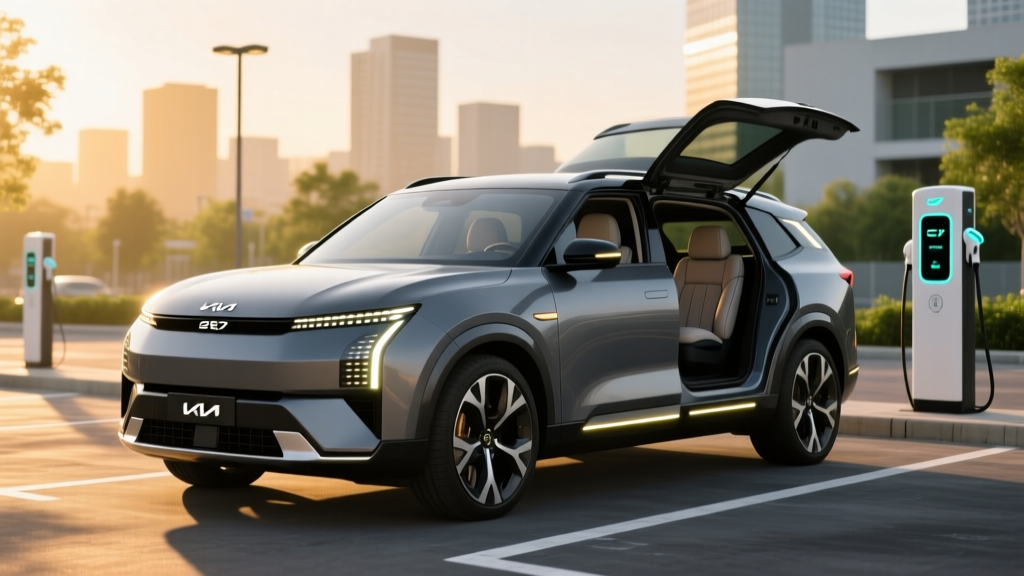
If you're researching EV9 dimensions before signing the paperwork, you're asking the right question. The Kia EV9 is one of the only mainstream three-row electric SUVs on the market, and its physical size dictates everything from garage fitment to third-row usability to highway efficiency. This review walks through every critical measurement, pairs EPA range figures with real-world expectations, and breaks down the 2026 charging, pricing, and tax-credit landscape so you know exactly what you're getting.
Kia EV9 Dimensions and Exterior Footprint
The EV9 rides on Hyundai Motor Group's E-GMP platform, stretched to full-size proportions. Here's how the tape measure reads across trims:
| Measurement | Light / Air / Wind (RWD) | Land / GT-Line (AWD) |
|---|---|---|
| Wheelbase | 122.0 in | 122.0 in |
| Overall Length | 197.4 in | 197.4 in |
| Overall Width (no mirrors) | 77.9 in | 77.9 in |
| Overall Height | 70.1 in | 69.7 in (with roof rails) |
| Ground Clearance | 7.8 in | 7.8 in |
| Curb Weight | ~4,900 lb | ~5,300 lb |
| Headroom (1st / 2nd / 3rd row) | 40.5 / 39.0 / 37.0 in | 40.5 / 39.0 / 37.0 in |
| Legroom (1st / 2nd / 3rd row) | 41.4 / 42.8 / 32.0 in | 41.4 / 42.8 / 32.0 in |
| Cargo Behind 3rd Row | 20.2 cu ft | 20.2 cu ft |
| Cargo Behind 2nd Row | 43.5 cu ft | 43.5 cu ft |
| Max Cargo (all rows folded) | 81.7 cu ft | 81.7 cu ft |
Garage check: At 197.4 inches long and 77.9 inches wide, the EV9 fits a standard two-car garage (typically 20 ft deep), but you'll want at least 22 feet of depth if you plan to walk behind it with the hatch open. The 70.1-inch height clears most 7-foot residential garage doors, though SUVs with optional roof boxes or racks will need measurement verification.
Third-row reality: With 32.0 inches of legroom, the EV9's third row accommodates children and teens comfortably, and adults for short trips. It is not minivan-spacious back there — if you regularly carry six adults, test-sit before buying. Behind that third row, 20.2 cu ft of cargo space holds roughly four carry-on suitcases or a week of groceries for a family of five.
Battery, Range, and Efficiency
The EV9 uses two battery configurations depending on drivetrain:
| Trim Group | Battery (Usable kWh) | Chemistry | Drivetrain | EPA Range | MPGe (City/Hwy/Combined) |
|---|---|---|---|---|---|
| Light (base RWD) | 76.1 kWh | NMC 811 | RWD | 230 mi | 111 / 88 / 100 |
| Wind / Land / GT-Line (AWD) | 99.8 kWh | NMC 811 | Dual-motor AWD | 270–280 mi | 97 / 79 / 89 |
The EPA sticker says 270–280 miles for the larger AWD battery, but real-world results depend heavily on conditions:
- Highway driving (70–75 mph, mild weather): Expect ~230–250 miles. The EV9's boxy profile (drag coefficient ~0.28 Cd) costs efficiency at speed.
- City / suburban mixed driving: Closer to the 280-mile EPA figure, sometimes slightly above with strong regenerative braking use.
- Cold weather (below 32°F): Plan for 15–25% range reduction. A 280-mile EV9 may deliver 210–230 miles in freezing temperatures, even with the standard heat pump engaged.
- Towing (3,500-lb max rating): Range drops roughly 40–50% when towing near maximum. Budget ~140 miles per charge on a towing day.
Source: EPA Fuel Economy – Kia EV9
The EV9 uses NMC (nickel-manganese-cobalt) lithium-ion chemistry, not LFP. NMC offers higher energy density — essential for fitting ~100 kWh into a passenger SUV — but it is more sensitive to sustained high states of charge. For daily driving, set the charge limit to 80% and reserve 100% for road-trip days.
Charging Speed: DC Fast and Level 2
The EV9 supports 800V architecture (a major advantage shared with the Hyundai Ioniq 5 and Genesis Electrified GV70), enabling ultra-fast DC charging on compatible stations.
| Charging Level | Max Rate | Speed / Time |
|---|---|---|
| Level 1 (120V household outlet) | ~1.4 kW | ~3–4 miles per hour |
| Level 2 (240V home / public AC) | 10.9 kW (onboard charger) | ~32–36 miles per hour; full charge in ~9–10 hours (99.8 kWh battery) |
| DC Fast Charge (CCS / NACS adapter) | ~236 kW peak | 10–80% in ~24 minutes on a 350 kW station |
Charging curve reality: The "~236 kW peak" figure is just that — a peak. On a 350 kW Electrify America or Tesla Supercharger (with the included NACS adapter on 2025+ models), the EV9 holds above 200 kW from roughly 10–55% state of charge, then tapers progressively. From 80–100%, charging slows dramatically to protect the NMC cells. Plan your road-trip stops around 10–80% sessions for the fastest turnaround.
Home charging note: A 10.9 kW Level 2 onboard charger means a standard 48-amp home wall connector (like the ChargePoint Home Flex or Emporia Level 2) on a 60-amp circuit will recharge the EV9 overnight. If you're upgrading from a NEMA 14-50 outlet (which delivers ~7.7 kW), expect roughly 40% faster top-ups with a hardwired wall unit. Consult a licensed electrician for panel-load calculations — a 200-amp home panel is usually sufficient, but older 100-amp panels may need an upgrade ($1,500–$3,000).
Performance and Drivetrain
| Spec | RWD (Light) | AWD (Wind/Land/GT-Line) |
|---|---|---|
| Horsepower | 215 hp | 379 hp |
| Torque | 258 lb-ft | 443 lb-ft (516 lb-ft w/ boost) |
| 0–60 mph | 7.7 sec | 4.5 sec |
| Top Speed | 115 mph | 124 mph |
| Max Towing Capacity | 2,000 lb | 3,500 lb |
The AWD dual-motor EV9 is genuinely quick for a 5,300-pound SUV. The GT-Line's boost mode unlocks 516 lb-ft of torque for short bursts, making highway merges and on-ramps effortless. The RWD model is adequate for commuting and school runs, but its 7.7-second 0–60 time feels leisurely when the vehicle is fully loaded with passengers and cargo.
Braking feel is progressive, and the multi-level regenerative braking system (adjustable via steering-wheel paddles) allows near-one-pedal driving in its highest setting. The EV9 does not come to a complete stop with regen alone, so you'll still use the friction brake at the final creep.
Pricing, Trims, and Federal Tax Credit
| Trim | Base MSRP | Est. §30D Credit* | Effective Price* |
|---|---|---|---|
| Light (RWD) | ~$56,395 | $0–$7,500 | ~$48,895–$56,395 |
| Wind (AWD) | ~$61,395 | $0–$7,500 | ~$53,895–$61,395 |
| Land (AWD) | ~$66,895 | $0–$7,500 | ~$59,395–$66,895 |
| GT-Line (AWD) | ~$73,395 | $0–$7,500 | ~$65,895–$73,395 |
*Federal tax credit eligibility under IRS §30D is subject to multiple requirements that change frequently. As of the 2026 tax year, verify current rules at IRS.gov.
- MSRP Cap: SUVs must have an MSRP ≤ $80,000. All EV9 trims currently qualify.
- Buyer Income Cap: Modified AGI ≤ $300,000 (joint), $225,000 (head of household), $150,000 (single).
- Battery Sourcing: Critical minerals and battery components must meet escalating domestic-content thresholds. Kia has shifted significant battery sourcing to meet these requirements, but the exact credit amount ($3,750 or $7,500) depends on the VIN's supply chain. Confirm with your dealer and a tax professional before purchase.
- Point-of-Sale Transfer: You can transfer the credit to the dealer at purchase, reducing your out-of-pocket cost immediately rather than waiting for a tax refund.
- Manufacturing Location: The EV9 is assembled in West Point, Georgia (since late 2024), which satisfies the North American final-assembly requirement.
Tech, Safety, and Driver Assistance
The EV9 comes standard with Kia's Highway Driving Assist 2 (HDA2), a Level 2 driver-assist system combining adaptive cruise control with stop-and-go, lane-centering, and lane-change assist. The available Highway Driving Pilot on GT-Line trims adds hands-off capability on pre-mapped highway sections (SAE Level 2+ — you must remain alert and ready to take over at all times).
All EV9 driver-assist features are SAE Level 2. This means the system controls steering and acceleration simultaneously, but the driver must continuously supervise, keep hands near the wheel (or eyes on the road for hands-off variants), and intervene immediately when prompted. This is not autonomous driving. Only Level 4 services like Waymo operate without a human driver.
Infotainment: Dual 12.3-inch displays (instrument cluster and center touchscreen) run Kia's latest ccNC interface with wireless Apple CarPlay and Android Auto, over-the-air updates, and a fingerprint-authenticated driver profile system. The available head-up display with augmented-reality navigation overlays is a standout on higher trims.
Safety: The EV9 earned the IIHS Top Safety Pick+ award with Good ratings across all crash-test categories, and a 5-star overall NHTSA rating. Standard equipment includes front, side, curtain, and center airbags, plus rear-occupant alert and safe-exit assist.
Source: IIHS – Kia EV9 Safety Ratings
Warranty and Ownership Costs
| Component | Coverage |
|---|---|
| Basic / Bumper-to-Bumper | 5 years / 60,000 miles |
| Powertrain | 10 years / 100,000 miles |
| Battery | 10 years / 100,000 miles (capacity retention ≥ 70%) |
| Roadside Assistance | 5 years / 60,000 miles |
| Complimentary Maintenance | None (some dealers offer first-service free) |
Kia's 10-year/100,000-mile battery warranty is among the best in the industry. The 70% capacity-retention threshold is standard — if your battery degrades below 70% of original capacity within the warranty period, Kia will repair or replace it. In practice, NMC batteries in thermally managed systems like the EV9's typically retain 85–90% capacity after 100,000 miles based on fleet data from similar E-GMP vehicles.
Insurance: Expect premiums 15–25% higher than a comparable gas-powered Kia Telluride, reflecting the EV9's higher repair costs and purchase price. Average annual premiums range from $2,200–$3,100 depending on state, driving record, and coverage level.
Pros, Cons, and Verdict
Pros
- Genuine three-row usability in an electric SUV — rare in the segment
- 800V architecture enables ~24-minute 10–80% DC fast charging
- 3,500-lb towing capacity (AWD) with integrated tow mode
- IIHS Top Safety Pick+ and 5-star NHTSA rating
- 10-year / 100,000-mile battery and powertrain warranty
- Georgia-built — qualifies for §30D North American assembly requirement
- Available hands-off Highway Driving Pilot on mapped highways
Cons
- 230-mile EPA range on base RWD trim is short for a vehicle this size
- Third-row legroom (32.0 in) is tight for adults on longer trips
- MSRP starting at ~$56,000 — expensive before incentives
- Insurance premiums significantly higher than gas alternatives
- Boxy shape reduces highway efficiency — real-world range falls short of EPA at 75 mph
- CCS-to-NACS adapter required for Tesla Supercharger access on early build dates
- Choose the EV9 if: You need three rows, want 800V fast charging, can charge at home overnight, and your daily driving stays within ~180 miles round-trip (leaving buffer for cold weather and highway use).
- Look elsewhere if: You regularly tow heavy loads over long distances, you need adult-sized third-row seating daily (consider a minivan), or you lack reliable home charging access and your area has sparse DC fast-charging infrastructure.
- Key competitors: Rivian R1S (more off-road capable, pricier), Tesla Model X (more range, polarizing design, panel-gap concerns), Hyundai Ioniq 9 (similar platform, slightly different packaging).
Frequently Asked Questions
What is the real-world range of the Kia EV9?
The AWD EV9 with the 99.8 kWh battery carries an EPA rating of 270–280 miles. In real-world highway driving at 70–75 mph, expect 230–250 miles. In freezing weather, plan for 210–230 miles. The base RWD model's 230-mile EPA rating translates to roughly 190–200 miles highway in mild conditions.
How fast does the EV9 charge?
On a 350 kW DC fast charger, the EV9 charges from 10–80% in approximately 24 minutes, peaking at ~236 kW. At home on a 240V Level 2 charger (10.9 kW), a full charge takes about 9–10 hours for the large battery. A standard 120V outlet adds only 3–4 miles per hour — fine for overnight top-ups, not for daily replenishment.
Does the Kia EV9 qualify for the federal EV tax credit?
The EV9 is assembled in Georgia and all trims fall under the $80,000 SUV MSRP cap, so it meets the assembly and price requirements. Full $7,500 credit eligibility depends on battery-sourcing rules and your income (≤ $300,000 joint AGI). Confirm your VIN's credit amount with your dealer and review current IRS guidance at IRS.gov.
Is the EV9 worth it versus the Rivian R1S or Tesla Model X?
The EV9 is the value pick: lower MSRP, 10-year warranty, and mainstream dealer support. The R1S offers superior off-road capability and a more premium interior at a $20,000+ premium. The Model X delivers longer range (~330+ miles EPA) and the Supercharger network natively, but at a higher price and with Tesla's variable build quality. For most families who want a practical daily driver with occasional road-trip ability, the EV9 is the strongest all-around value.
What EV9 dimensions matter for my garage?
At 197.4 inches long, 77.9 inches wide, and 70.1 inches tall, the EV9 fits a standard two-car garage. Verify your garage depth (22+ feet recommended) and door height (7+ feet). If you have a compact single-car garage, the EV9 will be a very tight fit — measure before ordering.
How much cargo space does the EV9 have?
Behind the third row: 20.2 cu ft. Behind the second row (third row folded): 43.5 cu ft. With both rear rows folded: 81.7 cu ft. The front trunk (frunk) on AWD models adds a small 1.8 cu ft — enough for charging cables, not luggage.