Quick Verdict: The 3-Row EV That Actually Fits Your Life
The Kia EV9 remains one of the few mainstream three-row electric SUVs that balances usable range, fast charging, and practical family space without crossing into luxury pricing. For 2026, Kia continues the EV9 across Light, Wind, Land, and GT-Line trims with both rear-wheel-drive (RWD) and all-wheel-drive (AWD) configurations. Whether you're researching the EV9 for its cabin dimensions, its 800-volt charging architecture, or simply trying to decide which exterior paint option suits your driveway, this profile covers every spec that matters.
Before we get to the full color palette and trim breakdown, here's what you need to know: the EV9 Long Range RWD delivers an EPA-estimated 304 miles of range, DC fast-charges from 10–80% in roughly 24 minutes at its 236 kW peak, and starts at $54,900 before any federal or state incentives. It's a compelling package — but not without trade-offs we'll detail below.
2026 Kia EV9 Exterior Colors & Interior Palettes by Trim
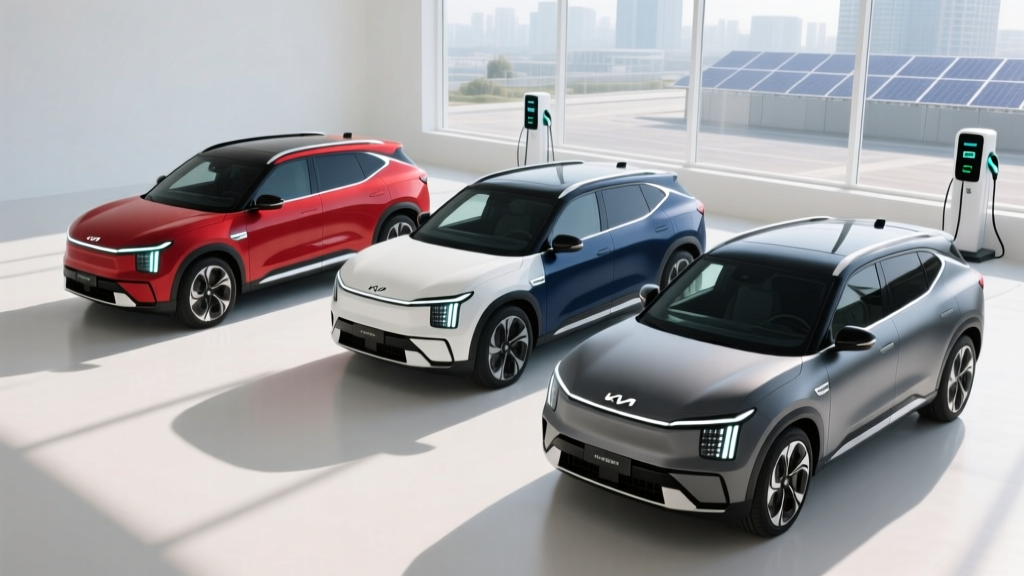
The EV9's boxy, geometric design language means color choice has an outsized impact on how the vehicle reads on the road. Kia offers a range of exterior paints for 2026, with availability varying by trim level:
| Exterior Color | Available Trims | Finish Type |
|---|---|---|
| Panthera Metal | All trims | Metallic (dark graphite) |
| Snow White Pearl | All trims | Pearl tri-coat |
| Ivory Silver | Wind, Land, GT-Line | Metallic |
| Flare Red | GT-Line only | Premium metallic |
| Midnight Lake Blue | Wind, Land | Metallic |
| Storm Gray | All trims | Metallic |
| Ocean Blue Matte | GT-Line (premium option) | Satin matte |
Interior palette options include Black (standard on most trims), Gray/Black two-tone (Wind and Land), and a Light Gray/Brown premium option on the Land and GT-Line. The GT-Line adds exclusive contrast stitching and suede-like seat bolsters. Note that the matte Ocean Blue exterior is a premium-cost option and requires hand-wash care — automatic brush washes will damage the finish.
Range, Battery & Efficiency: What the EPA Says vs. Reality
| Spec | EV9 Long Range RWD | EV9 AWD | EV9 GT-Line AWD |
|---|---|---|---|
| EPA Range | 304 mi | 280 mi | 270 mi |
| Battery (usable) | 99.8 kWh | 99.8 kWh | 99.8 kWh |
| Chemistry | NMC (nickel-manganese-cobalt) | NMC | NMC |
| Efficiency | 89 MPGe / 36 kWh/100mi | 85 MPGe / 38 kWh/100mi | 83 MPGe / 39 kWh/100mi |
The 99.8 kWh NMC battery pack is shared across all trims. Kia uses an 800-volt electrical architecture (borrowed from the Hyundai Motor Group's E-GMP platform), which is the key enabler for the EV9's class-leading DC charge speeds. NMC chemistry offers higher energy density than LFP, which matters in a vehicle this size — but it also means Kia recommends keeping state-of-charge between 20–80% for daily use to maximize long-term battery health.
Charging Speed: DC Fast, Level 2 & Home Setup
| Charging Level | Max Rate | Speed / Time |
|---|---|---|
| Level 1 (120V) | 1.4 kW | ~3–4 mi/hr (50+ hrs for full charge) |
| Level 2 (240V, 48A) | 10.9 kW | ~28–30 mi/hr (~10 hrs 10–90%) |
| DC Fast Charge | 236 kW peak | 10–80% in ~24 min (on 350 kW station) |
Charging-curve reality check: The 236 kW peak rate is only sustained from roughly 10–40% state-of-charge. Above 60%, the rate tapers progressively — you'll see ~120 kW at 70% and ~50 kW above 85%. This is normal behavior for large NMC packs managing thermal load, but it means the last 20% takes nearly as long as the first 60%. Plan road-trip stops around 10–80% charges for optimal speed.
For home Level 2 charging, you'll need a 240V/60A circuit to get the full 10.9 kW (48A continuous). If your electrical panel maxes out at 200A with limited spare capacity, a 40A circuit (9.6 kW) is a practical fallback — expect ~25 mi/hr of charge added. Budget $800–$2,500 for a licensed electrician to install a Level 2 home station, depending on panel proximity and whether a service upgrade is needed.
Performance & Drivetrain: RWD Efficiency or AWD Grip
| Spec | RWD Long Range | AWD (Wind/Land) | GT-Line AWD |
|---|---|---|---|
| Horsepower | 215 hp | 379 hp | 379 hp (boost: 430 hp) |
| Torque | 258 lb-ft | 516 lb-ft | 516 lb-ft (boost: 516+) |
| 0–60 mph | 7.7 sec | 5.0 sec | 4.5 sec |
| Drivetrain | Rear motor, RWD | Dual motor, AWD | Dual motor, AWD |
| Towing Capacity | 2,000 lbs | 5,000 lbs | 5,000 lbs |
The RWD Long Range is the efficiency play — adequate for commuting and highway merging, with the payoff of 304 EPA miles. The dual-motor AWD transforms the EV9 into a genuinely quick family hauler: 5.0 seconds to 60 mph in a 5,000-pound three-row SUV is genuinely impressive. The GT-Line adds a boost mode for short bursts of extra output.
Towing is where AWD earns its keep. The 5,000-lb rating handles small campers and boat trailers, though expect range to drop 30–50% when towing at highway speeds. If you tow frequently, the Rivian R1S or a plug-in hybrid SUV may be more practical.
Pricing, Trims & Federal Tax Credit Eligibility
| Trim | Base MSRP | Key Additions |
|---|---|---|
| Light RWD | $54,900 | Base 99.8 kWh pack, 19" wheels, 12.3" dual displays |
| Wind RWD | $59,900 | Heated/ventilated front seats, power liftgate, 20" wheels |
| Land AWD | $65,900 | AWD, 21" wheels, premium audio, second-row captain's chairs available |
| GT-Line AWD | $73,900 | Sport styling, boost mode, head-up display, digital mirrors available |
Federal tax credit (§30D) eligibility for 2026: The Kia EV9 is assembled in West Point, Georgia, which qualifies it for the IRS §30D federal tax credit — up to $7,500 — provided you meet all requirements:
- MSRP cap: SUVs/vans must have an MSRP at or below $80,000. All EV9 trims qualify (GT-Line starts at $73,900; a fully optioned GT-Line may approach but should not exceed the cap).
- Income cap: Modified AGI must not exceed $300,000 (married filing jointly), $225,000 (head of household), or $150,000 (single).
- Battery sourcing: A percentage of critical minerals and battery components must meet North American sourcing thresholds that increase annually. For 2026, confirm the EV9's specific battery-sourcing compliance at the point of sale — Kia dealers should have this documentation.
- Point-of-sale transfer: You can transfer the credit to the dealer at purchase for an immediate price reduction, rather than waiting to claim it on your tax return.
Always verify current-year eligibility with your tax professional and the dealer before signing — sourcing rules tighten annually and can shift mid-year.
Interior Space, Cargo & Family Practicality
| Dimension | Measurement |
|---|---|
| Passenger capacity | 6 (captain's chairs) or 7 (bench 2nd row) |
| Front headroom | 40.6 in |
| 2nd-row legroom | 42.4 in |
| 3rd-row legroom | 32.0 in |
| Cargo (behind 3rd row) | 20.2 cu ft |
| Cargo (3rd row folded) | 43.5 cu ft |
| Cargo (all rear seats folded) | 81.7 cu ft |
| Frunk (front trunk) | 3.2 cu ft (RWD) / 1.8 cu ft (AWD) |
The EV9's second-row legroom is exceptional — adults can sit behind adults comfortably. The third row fits children and smaller adults for short trips; it's tighter than a Telluride's third row but competitive with the Tesla Model X. Cargo space behind the third row is modest at 20.2 cu ft — enough for a few grocery bags or two carry-ons, but a family road trip will require the third row folded or a roof box.
The frunk is small, particularly on AWD models where the front motor consumes space. It's useful for charging cables and small items, not luggage.
Tech, Driver Assists & Standout Features
The EV9's tech suite is comprehensive across all trims:
- Infotainment: Dual 12.3-inch displays (instrument cluster + center touchscreen), wireless Apple CarPlay and Android Auto, over-the-air (OTA) update capability
- Driver assistance (Kia Highway Driving Assist 2): Adaptive cruise with stop-and-go, lane-centering, lane-change assist, navigation-based speed adjustment — this is an SAE Level 2 system requiring continuous driver supervision
- Digital side mirrors: Available on GT-Line, replacing traditional mirrors with camera-based displays (reduces drag, takes adjustment)
- Vehicle-to-load (V2L): Powers external devices up to 3.6 kW via an adapter — useful for camping, tailgating, or emergency backup
- Remote Smart Parking Assist: Moves the vehicle in/out of tight spots via key fob while you stand outside
Pros, Cons & Who Should Buy the EV9
- Class-leading 236 kW DC fast charging (800V architecture)
- 304-mi EPA range on RWD is competitive for a 3-row SUV
- Spacious 2nd row with genuine adult legroom
- V2L capability for off-grid power
- US-assembled, federal tax credit eligible (subject to sourcing/income)
- 10-year/100,000-mile powertrain & battery warranty
- Third row is tight for adults on longer trips
- 20.2 cu ft cargo behind 3rd row is modest
- AWD trims drop range to 270–280 mi EPA
- No LFP battery option (requires 20–80% daily SoC discipline)
- Frunk is small, especially on AWD
- Premium trims push past $75,000
Who the EV9 suits best: Families who need three rows but don't want a minivan, commuters with home Level 2 charging who want fast DC road-trip capability, and buyers who want a mainstream-brand SUV with strong warranty coverage. If you need maximum third-row space or frequent towing, look at the Rivian R1S or a PHEV like the Kia Sorento Plug-In Hybrid.
Warranty & Ownership Costs
| Coverage | Term |
|---|---|
| Basic (bumper-to-bumper) | 5 years / 60,000 miles |
| Powertrain | 10 years / 100,000 miles |
| Battery (capacity retention) | 10 years / 100,000 miles (below 70% SoH triggers replacement) |
Kia's 10-year battery warranty with a 70% state-of-health threshold is among the strongest in the segment. For context, NMC batteries in large-pack EVs like the EV9 typically degrade 1–2% per year under normal use — meaning you'd expect roughly 85–90% capacity at 100,000 miles. The warranty provides a strong backstop.
Insurance premiums for the EV9 run 10–20% higher than a comparably priced gas SUV, according to industry averages. Get quotes before purchasing — your zip code and driving record will determine the actual delta.
Frequently Asked Questions
What is the real-world range of the Kia EV9?
The RWD Long Range achieves an EPA-estimated 304 miles. In real-world highway driving at 70+ mph, expect 250–270 miles. In sub-freezing temperatures, plan for 210–240 miles. AWD trims deliver 270–280 EPA miles, with real-world highway range closer to 220–250 miles.
How fast does the EV9 charge?
On a 350 kW DC fast charger, the EV9 peaks at 236 kW and charges from 10–80% in approximately 24 minutes. At home on a Level 2 (240V/48A) station, it adds about 28–30 miles of range per hour, fully replenishing overnight. Level 1 (120V) is impractical for daily use at only 3–4 miles per hour.
Does the Kia EV9 qualify for the federal EV tax credit?
Yes — the EV9 is assembled in Georgia and qualifies for up to $7,500 under IRS §30D, provided the buyer meets income caps ($300K joint / $150K single), the trim MSRP stays under $80,000, and battery-sourcing requirements are met for the model year. Verify with your dealer and tax professional at point of sale, as sourcing rules evolve annually.
Is the Kia EV9 worth buying vs. the Tesla Model X or Rivian R1S?
The EV9's advantage is price-to-space ratio and charging speed. The Model X offers more range and Supercharger access but starts significantly higher. The Rivian R1S is more capable off-road and has a more usable third row but costs more and charges slower. If you want the best value in a 3-row electric SUV with fast road-trip charging, the EV9 is a top pick.
What Kia EV9 colors are exclusive to the GT-Line?
Flare Red (premium metallic) and Ocean Blue Matte (satin finish) are GT-Line exclusives for 2026. All other colors — Panthera Metal, Snow White Pearl, Ivory Silver, Storm Gray, and Midnight Lake Blue — are available on Wind and Land trims as well.
How much does it cost to charge the EV9 at home?
At the US average electricity rate of ~$0.16/kWh, fully charging the 99.8 kWh battery costs roughly $16. That's approximately $0.05–0.06 per mile — compared to $0.12–0.15/mile for a gas SUV getting 22 MPG at $3.30/gallon. Over 15,000 miles/year, home charging saves roughly $1,000–$1,400 annually versus gasoline.