Quick Verdict: The EV9 With Captain Seats Is the Family EV to Beat
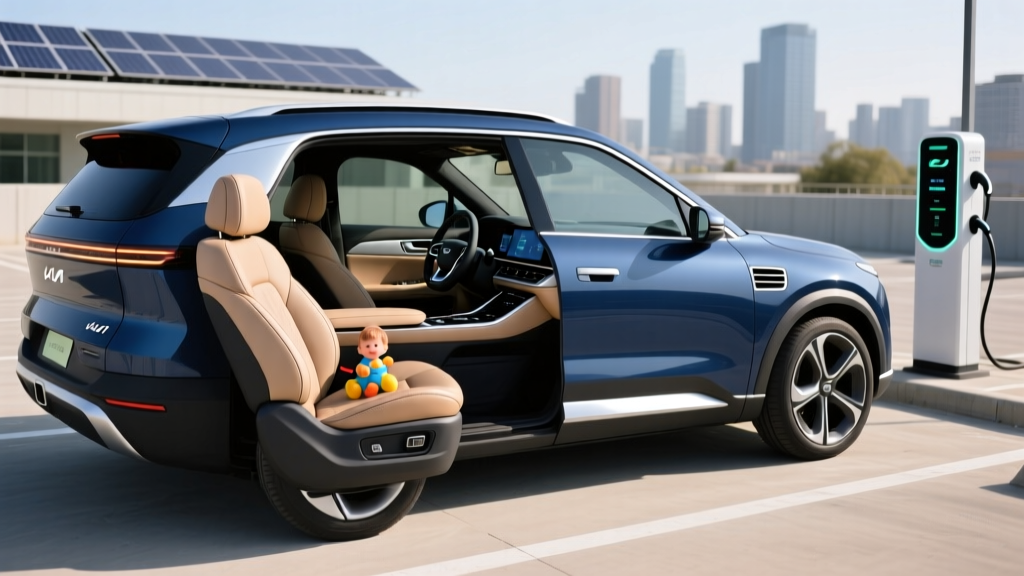
The three-row electric SUV segment is no longer a one-horse race, but the 2026 Kia EV9 remains the benchmark when second-row comfort is a priority. Available on the GT-Line and GT-Line Prestige trims, the Kia EV9 captain seats configuration swaps the standard 7-passenger bench for a 6-passenger layout with individual heated and ventilated second-row chairs, a center pass-through, and available power-recline functionality. For families who regularly haul four or five people and value easy third-row access, this is the configuration to spec.
Underneath, the EV9 is built on Hyundai Motor Group's E-GMP platform with an 800-volt architecture that enables some of the fastest DC fast-charging speeds in its class. The trade-offs are real — highway range falls short of the EPA sticker, and the price climbs quickly past $70,000 — but as a complete package of space, charging speed, and technology, the EV9 with captain seats is hard to fault.
Range, Battery, and Real-World Efficiency
The 2026 Kia EV9 is offered with two battery configurations across its trim lineup:
| Trim | Drivetrain | Battery (usable) | Chemistry | EPA Range | MPGe (combined) | kWh/100 mi |
|---|---|---|---|---|---|---|
| Light / Wind (RWD) | Rear-wheel drive | 76.1 kWh | NMC | 230 mi (Light) / 304 mi (Wind) | 89–91 MPGe | 36–37 |
| Land / GT-Line (AWD) | Dual-motor AWD | 99.8 kWh | NMC | 280 mi | 85 MPGe | 39 |
| GT-Line Prestige (AWD) | Dual-motor AWD | 99.8 kWh | NMC | 270 mi | 83 MPGe | 40 |
Source: fueleconomy.gov, EPA estimates.
The EPA rates the EV9 Wind RWD at 304 miles, but expect real-world highway driving (70–80 mph) to yield 240–265 miles in moderate temperatures. The heavier AWD GT-Line trims — the ones with captain seats — deliver closer to 220–245 miles on the highway. In cold weather (below 32°F), plan for a 20–30% range reduction, dropping usable range to roughly 175–200 miles on AWD models. City driving with regenerative braking recovers more energy, often meeting or slightly exceeding EPA figures. The EV9's heat pump (standard on all trims) helps mitigate cold-weather HVAC losses, but physics still applies to a 5,000-lb box-shaped SUV.
The 99.8 kWh (usable) battery in AWD trims uses nickel-manganese-cobalt (NMC) chemistry, chosen for its higher energy density compared to LFP — necessary to push a vehicle this large past 270 miles. NMC batteries benefit from the 20–80% daily charging window for longevity, though Kia's battery management system includes a generous buffer to protect against degradation.
Charging Speed: 800V Architecture Pays Off
The EV9's 800-volt electrical architecture is its ace for road-trip practicality. Here is what charging looks like across all three levels:
| Level | Power | Connector | Speed / Time |
|---|---|---|---|
| Level 1 (120V household) | ~1.4 kW | NACS (native) | ~3–4 mi/hr |
| Level 2 (240V home) | 10.9 kW (onboard charger) | NACS (native) | ~27–30 mi/hr; 0–100% in ~9.5 hr |
| DC Fast Charge | Peak 210 kW (AWD) / 180 kW (RWD) | NACS (native) | 10–80% in ~24 min (AWD) |
Starting with the 2025 model year, Kia transitioned the EV9 to the North American Charging Standard (NACS) port, giving native access to Tesla Superchargers without an adapter. This is a significant advantage for road trips, as the Supercharger network remains the most reliable public DC infrastructure in the U.S.
Charging curve reality: The EV9 AWD peaks near 210 kW between roughly 10–35% state of charge, then tapers progressively. From 50–80%, expect sustained rates closer to 100–130 kW. The advertised 24-minute 10–80% time assumes a capable 350 kW station and battery preconditioning (triggered automatically when you navigate to a charger via the EV9's built-in route planner). Without preconditioning — for example, at a walk-up charger on a cold morning — add 5–10 minutes to that figure.
At home on a 48-amp Level 2 circuit (the most common residential installation), the EV9's 10.9 kW onboard charger adds roughly 28 miles of range per hour. An overnight charge from 20–80% takes about 5.5 hours — easily manageable on a standard overnight schedule.
Performance and Drivetrain
| Specification | RWD (Light/Wind) | AWD (Land/GT-Line) |
|---|---|---|
| Horsepower | 215 hp | 379 hp (440 hp w/ boost) |
| Torque | 258 lb-ft | 516 lb-ft (w/ boost) |
| 0–60 mph | 7.7 sec | 4.5 sec (w/ boost) |
| Towing capacity | 2,000 lbs | 5,000 lbs |
| Drivetrain | Single motor, rear | Dual motor, AWD |
The AWD dual-motor EV9 is genuinely quick. The GT-Line's boost function (activated via a steering wheel button for 10-second bursts) drops the 0–60 time to 4.5 seconds — remarkable for a three-row SUV weighing over 5,300 pounds. More importantly for daily driving, the instant torque makes merging and passing effortless without needing to plan ahead.
Ride quality leans firm, which keeps body roll controlled in corners but transmits some harshness over broken pavement. The steering is precise but light — this is a family hauler, not a sports sedan, and that's appropriate. The 5,000-lb towing capacity on AWD models is competitive with the Rivian R1S and significantly ahead of most electric crossovers.
Interior Space, Captain Seats, and Cargo
The captain seats configuration is available on the GT-Line and GT-Line Prestige trims and reduces seating from seven to six. Here's what you get:
- Second-row captain's chairs: Individually heated and ventilated, with available power-recline (Prestige trim). Each seat slides fore/aft independently.
- Center pass-through: A walk-through gap between the captain seats makes third-row access dramatically easier than climbing over a fold-down bench — a real advantage when kids are in car seats in the second row.
- Relaxation mode: First-row seats recline into a near-flat position with leg rests (Prestige trim) for charging-stop comfort.
| Measurement | Specification |
|---|---|
| Headroom (1st / 2nd / 3rd row) | 40.0 / 39.0 / 37.2 in |
| Legroom (1st / 2nd / 3rd row) | 41.5 / 42.8 / 32.0 in |
| Cargo (behind 3rd row) | 20.2 cu ft |
| Cargo (behind 2nd row) | 43.5 cu ft |
| Cargo (all rows folded) | 81.7 cu ft |
| Frunk (front trunk) | 1.8 cu ft (AWD) / 3.2 cu ft (RWD) |
Third-row legroom at 32.0 inches is adequate for children and shorter adults on trips under an hour but will feel cramped for taller passengers on long drives. The 20.2 cu ft behind the third row is enough for a few grocery bags or a couple of carry-ons — for a family road trip with all six seats occupied, a roof box or cargo trailer may be necessary. With the third row folded, 43.5 cu ft is generous for daily hauling.
Pricing, Trims, and Federal Tax Credit
| Trim | Seating | MSRP (incl. destination) | Captain Seats? |
|---|---|---|---|
| Light RWD | 7-passenger | $56,395 | No |
| Wind RWD | 7-passenger | $60,595 | No |
| Land AWD | 7-passenger | $65,395 | No |
| GT-Line AWD | 6 (captain seats) or 7 | $70,595 | Available |
| GT-Line Prestige AWD | 6 (captain seats) or 7 | $75,395 | Available |
The Kia EV9 is assembled in West Point, Georgia, which is a positive for §30D eligibility. However, the full $7,500 credit depends on meeting both critical-mineral and battery-component sourcing requirements set by the IRS. As of 2026, buyers must also meet income caps ($150,000 single / $300,000 married filing jointly) and the vehicle MSRP must not exceed $80,000 for SUVs — all EV9 trims clear this cap.
The credit can now be transferred to the dealer at the point of sale as an instant discount, rather than waiting to claim it on your tax return. Confirm current battery-sourcing compliance with your dealer and consult IRS.gov §30D guidance before purchasing, as component-sourcing rules tighten annually. A tax professional can verify your personal eligibility.
With the full $7,500 credit applied, a GT-Line AWD with captain seats drops from $70,595 to an effective $63,095 — competitive with a similarly equipped Toyota Grand Highlander Hybrid, though the EV9 offers faster charging and zero tailpipe emissions.
Tech, Safety, and Driver Assistance
The EV9 comes loaded with Kia's latest technology suite:
- Infotainment: Dual 12.3-inch displays (instrument cluster + touchscreen) with wireless Apple CarPlay and Android Auto. The GT-Line Prestige adds a head-up display with augmented-reality navigation.
- Highway Driving Assist 2 (HDA2): Kia's Level 2 driver-assistance system combines adaptive cruise control with lane-centering and automatic lane-change assist. It works well on divided highways but requires hands-on-wheel engagement at all times — this is not autonomous driving.
- Digital Key 2: Use your smartphone or smartwatch to lock, unlock, and start the vehicle. Shareable with family members.
- Remote Smart Parking Assist: The EV9 can park or unpark itself from tight spaces while you stand outside using the key fob — useful in narrow garage situations.
- V2L (Vehicle-to-Load): A built-in 120V outlet (1.9 kW output) in the second row can power laptops, small appliances, or campsite equipment.
Highway Driving Assist 2 is an SAE Level 2 system. The driver must remain attentive, keep hands on the wheel, and be prepared to take over instantly. It does not handle construction zones, unmapped roads, or severe weather autonomously. Never treat it as a substitute for active driving.
The EV9 earned top marks from NHTSA (5-star overall) and was named an IIHS Top Safety Pick+ when equipped with the optional front-center airbag.
Warranty and Long-Term Ownership
| Coverage Type | Duration / Mileage |
|---|---|
| Basic (bumper-to-bumper) | 5 years / 60,000 miles |
| Powertrain | 10 years / 100,000 miles |
| EV Battery | 10 years / 100,000 miles (below 70% capacity) |
| Roadside Assistance | 5 years / 60,000 miles |
Kia's 10-year/100,000-mile battery warranty covers capacity loss below 70% state of health — one of the longest in the industry. Based on data from the E-GMP platform's earlier vehicles (Ioniq 5, EV6), degradation has been modest: most owners report 3–5% loss over the first 50,000 miles, well within the warranty threshold. A full battery replacement outside warranty is estimated at $15,000–$22,000 depending on the pack size, though this cost is expected to decline as the supply chain matures.
Pros and Cons
Pros
- 800V architecture enables 10–80% DC charging in ~24 minutes
- Native NACS port — direct Supercharger access
- Second-row captain seats with heat, ventilation, and power-recline
- 5,000-lb towing capacity on AWD trims
- 10-year / 100,000-mile battery and powertrain warranty
- Spacious cabin with 81.7 cu ft max cargo
- Strong safety ratings (NHTSA 5-star, IIHS TSP+)
Cons
- Real-world highway range falls 15–20% below EPA on AWD trims
- Captain seats limited to GT-Line trims ($70K+ starting)
- Third-row legroom is tight for adults on long trips
- Firm ride quality over rough surfaces
- Small frunk (1.8 cu ft on AWD)
- Infotainment learning curve with touch-capacitive climate controls
- §30D credit eligibility depends on evolving battery-sourcing rules
Who Should Buy the EV9 With Captain Seats?
- You regularly carry 4–5 passengers and want premium second-row comfort
- Easy third-row access matters (car seats in row two, kids or adults in row three)
- You take road trips and value 24-minute fast-charging stops
- You need 5,000-lb towing for a boat or small trailer
- Home Level 2 charging is available to you
- You need maximum range — the Rivian R1S (Large Pack) offers 352 miles EPA
- Budget is under $60,000 — captain seats push the EV9 above $70K before credits
- You frequently fill all six or seven seats with adults — the third row is best for children
Frequently Asked Questions
What is the real-world range of the Kia EV9 with captain seats?
The GT-Line AWD (the trim with available captain seats) is EPA-rated at 280 miles. In real-world highway driving at 70–80 mph, expect 220–245 miles. Cold weather (below freezing) can reduce this to 175–200 miles. City driving with regenerative braking often meets or slightly exceeds the EPA figure.
How fast does the EV9 charge at home and on the road?
On a home Level 2 charger (240V, 48A), the EV9 charges at up to 10.9 kW, adding about 28 miles per hour — a full overnight charge is easy. On a DC fast charger, the AWD model peaks at 210 kW and charges from 10–80% in approximately 24 minutes with battery preconditioning active.
Does the Kia EV9 qualify for the $7,500 federal tax credit?
The EV9 is assembled in Georgia, meeting the North American assembly requirement. All trims are under the $80,000 SUV MSRP cap. However, the full $7,500 credit depends on current-year critical-mineral and battery-component sourcing rules, which tighten annually. Buyer income caps also apply ($150K single / $300K joint). Verify eligibility on IRS.gov and with a tax professional before purchase.
Is the EV9 worth it versus the Rivian R1S or Tesla Model X?
The EV9 undercuts both on price — a GT-Line AWD starts at $70,595 versus $80,000+ for comparable R1S and Model X configurations. It charges faster than the Model X and offers a more traditional SUV layout than the R1S. The Rivian wins on range (352 mi with Large Pack) and off-road capability. The Model X wins on performance and Supercharger-native ecosystem (though the EV9 now has NACS). For most families prioritizing value, warranty, and second-row comfort, the EV9 is the strongest choice.
Can I get captain seats on a lower trim like the Land?
No. As of the 2026 model year, captain seats are exclusive to the GT-Line and GT-Line Prestige trims. The Light, Wind, and Land trims come with a second-row bench and 7-passenger seating only.
How much does it cost to charge the EV9 at home?
At the U.S. average residential electricity rate of ~$0.16/kWh, fully charging the 99.8 kWh AWD battery from 0–100% costs approximately $16.00. A typical 20–80% daily charge costs about $9.60. Compared to a gas three-row SUV averaging 22 MPG at $3.50/gallon, the EV9 saves roughly $1,200–$1,800 annually in fuel costs for a driver covering 15,000 miles per year.