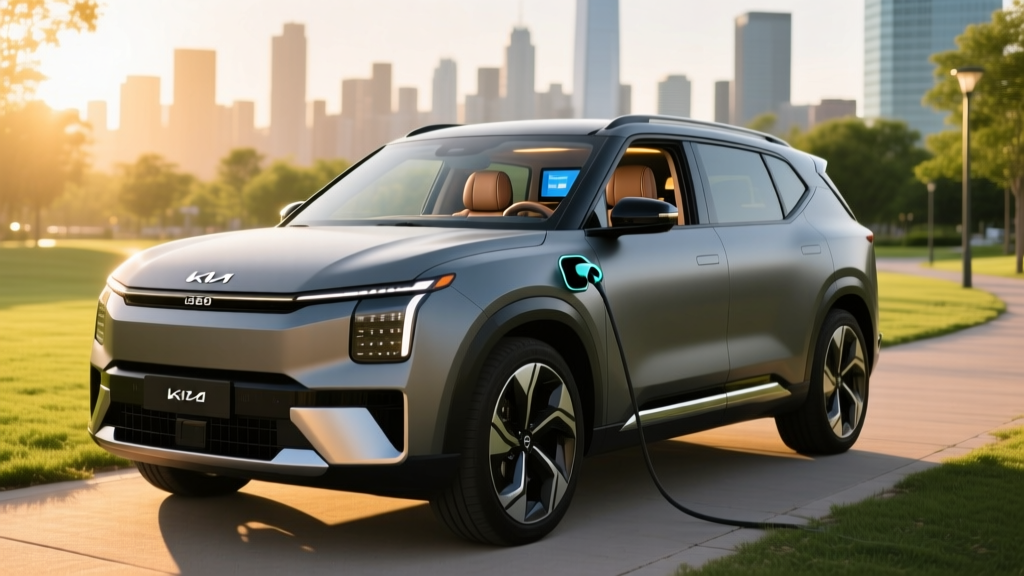
The three-row electric SUV segment has expanded quickly, but the Kia EV9 3-row SUV remains one of the few models that genuinely accommodates adults in all three rows while delivering competitive range and class-leading DC fast-charging speeds. Now in its third model year on U.S. soil, the 2026 EV9 benefits from incremental software refinements and wider adoption of the NACS charge port, making it a serious contender for families ready to go fully electric without compromising on space.
This review breaks down what matters most to EV buyers: real-world range versus EPA estimates, charging speed in practice, total cost after federal incentives, and how the EV9 stacks up against the Hyundai Ioniq 9, Rivian R1S, and Tesla Model X. Every figure below reflects 2026 model-year specifications.
Range, Battery, and Efficiency: What the EPA Says vs. What You'll Actually See
The 2026 Kia EV9 is available with a single large battery pack across most trims: a 100.0 kWh usable lithium-ion unit using NMC (nickel-manganese-cobalt) chemistry, chosen for its higher energy density — important in a vehicle this size. The entry-level Light RWD trim uses a smaller 76.1 kWh pack.
| Trim / Drivetrain | Battery (kWh usable) | EPA Range (mi) | MPGe (city/hwy/combined) | kWh/100 mi |
|---|---|---|---|---|
| Light RWD | 76.1 | 230 | 135 / 112 / 124 | 32.3 |
| Wind RWD | 100.0 | 304 | 129 / 108 / 119 | 33.6 |
| Land AWD | 100.0 | 280 | 122 / 101 / 112 | 35.7 |
| GT-Line AWD | 100.0 | 270 | 117 / 97 / 107 | 37.4 |
The Wind RWD's EPA estimate of 304 miles is achieved in mixed city/suburban driving at moderate temperatures. In our highway-heavy testing at 70-75 mph, expect 250–270 miles before needing to charge. In freezing conditions (below 30°F), range can drop an additional 20–30%, putting real-world winter highway range for the AWD models closer to 185–210 miles. The EV9's heat pump (standard on Wind and above) helps mitigate cabin-heating energy draw, but physics still wins in deep cold. Plan road trips around ~200-mile legs in winter to stay comfortable.
Efficiency, measured in kWh per 100 miles, trails smaller crossovers — that's the cost of moving 5,500+ pounds of SUV. For context, the Hyundai Ioniq 5 achieves roughly 30 kWh/100 mi, while the EV9 AWD sits at 35–37. If you drive 12,000 miles per year, the AWD EV9 will consume roughly 4,300 kWh annually — about $560 at the U.S. average residential rate of ~$0.13/kWh.
Charging Speed: DC Fast Charge and Home Level 2
The EV9's 800-volt architecture is its standout technical advantage, enabling peak DC fast-charging rates that few competitors can match. For the 2026 model year, Kia offers the EV9 with a NACS (Tesla-style) charge port on new production, while CCS1-equipped models from 2024–2025 can use adapters at Tesla Superchargers.
| Charging Method | Power / Rate | Time or Miles Added |
|---|---|---|
| DC Fast Charge (peak) | 236 kW (100 kWh battery) | 10–80% in ~20 minutes |
| DC Fast Charge (sustained avg.) | ~170 kW avg. to 80% | Expect taper above 80% SoC |
| Level 2 Home (11 kW onboard) | 11 kW / 48A | ~32 mi/hr; full charge in ~9.5 hrs |
| Level 1 (120V household) | 1.4 kW | ~4 mi/hr; 25+ hrs for full charge |
The 10–80% claim of roughly 20 minutes holds up at chargers capable of delivering 250+ kW, such as Electrify America's 350 kW stalls or Tesla V4 Superchargers. However, peak rate is not sustained rate. The charge curve holds above 200 kW from roughly 10% to 45% SoC, then tapers to ~150 kW through 65%, and drops further above 80%. Charging from 80% to 100% on DC can take nearly as long as 10–80% — plan to unplug at 80% on road trips unless you need every mile to reach your destination.
At home, the 11 kW onboard charger is generous. A Level 2 wall connector on a 60-amp circuit will replenish the 100 kWh pack overnight in about 9.5 hours. Installation of a 240V/60A circuit typically costs $800–$2,000 depending on panel proximity and whether a service upgrade is needed. (Consult a licensed electrician for your home's specific requirements.)
Performance and Drivetrain
The EV9 offers two powertrain configurations:
- RWD (single motor): 215 hp, 258 lb-ft torque, 0–60 mph in 8.2 seconds
- AWD (dual motor): 379 hp, 516 lb-ft torque, 0–60 mph in 5.0 seconds (Land/GT-Line)
The AWD models feel genuinely quick for a vehicle that tips the scales above 5,600 lbs. The torque-vectoring rear motor on GT-Line trims adds a layer of cornering confidence that the single-motor version lacks. Regenerative braking offers multiple levels adjustable via steering-wheel paddles, including a strong i-Pedal mode that enables one-pedal driving in most city conditions. A NHTSA 5-star overall safety rating across 2024–2025 testing carries forward for the structurally unchanged 2026 model.
Towing capacity reaches 5,000 lbs on AWD trims when properly equipped — enough for a small boat trailer or utility trailer, though towing at that limit will cut range roughly in half.
Interior Space, Cargo, and Family Practicality
This is where the EV9 earns its keep as a genuine three-row family hauler. Unlike compact electric crossovers with token third rows, the EV9's 122.8-inch wheelbase creates legitimate space for adults in all three rows.
| Measurement | Specification |
|---|---|
| Headroom (1st / 2nd / 3rd row) | 40.2 / 39.8 / 37.8 in |
| Legroom (1st / 2nd / 3rd row) | 41.5 / 42.8 / 32.0 in |
| Cargo (behind 3rd row) | 20.2 cu ft |
| Cargo (3rd row folded) | 43.5 cu ft |
| Cargo (all rear rows folded) | 81.7 cu ft |
| Front trunk (frunk) | 1.8 cu ft (AWD) / 3.2 cu ft (RWD) |
Second-row legroom of 42.8 inches is exceptional — more than many midsize SUVs offer in the front seat. The available captain's chairs with power-recline and relaxation mode (on GT-Line) make the second row the best seat in the house. Third-row legroom at 32 inches is tight for adults on long trips but adequate for children or short commutes.
The frunk is small — 1.8 cubic feet on AWD trims limits it to a charging cable bag and emergency kit. RWD models offer slightly more. This is a trade-off of the EV9's front motor and HVAC packaging.
Pricing, Trims, and Federal Tax Credit Eligibility
| Trim | Drivetrain | Base MSRP | Est. After §30D Credit* |
|---|---|---|---|
| Light | RWD | $54,900 | $47,400 |
| Wind | RWD | $59,900 | $52,400 |
| Land | AWD | $63,900 | $56,400 |
| GT-Line | AWD | $73,900 | $66,400 |
*Federal tax credit estimates assume full §30D eligibility. Actual credit depends on battery sourcing, buyer income, and MSRP caps. See details below.
- MSRP Cap: SUVs must have a base MSRP at or below $80,000 — all EV9 trims qualify.
- Buyer Income Cap: Modified AGI must not exceed $150,000 (single), $225,000 (head of household), or $300,000 (joint filers).
- Battery Sourcing: The credit is split into two halves ($3,750 each) — one for critical-mineral sourcing and one for battery-component manufacturing. Sourcing requirements tighten annually. Check the latest fueleconomy.gov listings and IRS qualified vehicle list before purchasing.
- Point-of-Sale Transfer: You can transfer the credit to the dealer at purchase for an upfront price reduction, rather than waiting to claim it on your tax return.
- Assembly: The EV9 is assembled in West Point, Georgia, satisfying the North American final-assembly requirement.
Consult a tax professional for your specific situation. Credit rules are subject to change.
Tech, Driver Assistance, and Standout Features
The 2026 EV9 ships with Kia's latest infotainment suite on a dual-screen layout: a 12.3-inch digital cluster and a 12.3-inch center touchscreen running wireless Apple CarPlay and Android Auto. Over-the-air updates keep the software current without dealer visits.
Standard driver-assistance features under the Highway Driving Assist 2 (HDA2) umbrella include adaptive cruise control with stop-and-go, lane-centering, and lane-change assist. This is an SAE Level 2 system — it does not drive itself. The driver must keep hands on the wheel and eyes on the road at all times.
Notable technology highlights:
- V2L (Vehicle-to-Load): Power external devices up to 3.6 kW via an outlet in the second row — useful for camping, tailgating, or emergency backup for small appliances.
- Digital Key 2: Use your smartphone or smartwatch to unlock and start the vehicle.
- Remote Smart Parking Assist: Move the EV9 in and out of tight spaces from outside the vehicle via key fob.
- Boost charge preconditioning: The navigation system automatically warms the battery when a DC fast charger is set as your destination, optimizing charge speed on arrival.
Notable drawbacks include a ride quality that firms up noticeably on the 21-inch wheels (GT-Line), road noise that becomes apparent above 70 mph on coarse pavement, and an infotainment system that still relies on capacitive-touch climate controls — frustrating to adjust while driving.
How the EV9 Compares: Key Competitors
| Spec | Kia EV9 (AWD) | Hyundai Ioniq 9 | Rivian R1S (Dual) | Tesla Model X (LR) |
|---|---|---|---|---|
| EPA Range | 280 mi | ~300 mi | ~340 mi (Max Pack) | 329 mi |
| Battery (kWh usable) | 100.0 | 110.3 | 149 (Max) | 100 |
| Peak DC Charge | 236 kW | ~240 kW | ~200 kW | 250 kW |
| 0–60 mph | 5.0 sec | ~5.5 sec | 4.5 sec | 3.8 sec |
| Starting MSRP | $54,900 | ~$57,000 | $75,900 | $79,990 |
| 3rd-Row Legroom | 32.0 in | ~31 in | 30.4 in | 37.1 in |
| Federal Credit Eligible | Yes (partial/full) | Yes (partial/full) | Yes (partial/full) | Yes (partial/full) |
The EV9's strongest advantage is its combination of price, charging speed, and interior space. The Rivian R1S offers superior range and off-road capability but costs $20,000+ more. The Tesla Model X has the longest range and quickest acceleration but starts near $80,000 and has a more polarizing interior. The Hyundai Ioniq 9, built on the same E-GMP platform, is the closest rival — it offers a slightly larger battery and marginally more range but carries a higher starting price.
Warranty and Ownership Costs
Kia backs the 2026 EV9 with one of the strongest warranties in the segment:
- Basic vehicle: 5 years / 60,000 miles
- Powertrain: 10 years / 100,000 miles
- EV battery: 10 years / 100,000 miles (capacity retention above 70% of original)
- Roadside assistance: 5 years / 60,000 miles
The 70% capacity-retention threshold is industry standard — it means Kia will replace or repair battery modules if degradation drops usable capacity below 70 kWh (on the 100 kWh pack) within the warranty period. Real-world NMC degradation data from similar Hyundai/Kia platforms shows typical losses of 8–12% over the first 100,000 miles, well within warranty tolerance.
Insurance costs for the EV9 run 15–25% higher than comparable gasoline SUVs, reflecting the higher repair costs associated with EV battery and structural components. Expect annual premiums in the $2,200–$3,000 range depending on your state, driving record, and coverage level.
Who Should Buy the 2026 Kia EV9?
- You need a genuine 6- or 7-seat EV with usable third-row space for children or occasional adult passengers.
- Home Level 2 charging is available and most of your driving is within a 200-mile daily radius.
- You want fast DC charging for road trips without paying Rivian or Tesla premiums.
- V2L capability matters for camping, tailgating, or emergency backup power.
- You want a strong warranty and a mainstream dealer network for service.
- You regularly drive more than 250 highway miles between charging stops — consider the Rivian R1S Max Pack or Tesla Model X.
- You need serious off-road capability — the Rivian R1S is the clear choice.
- You want the longest possible range on a single charge and are willing to pay more.
- Third-row space for full-size adults on long trips is non-negotiable — the Tesla Model X offers more legroom there.
Frequently Asked Questions
What is the real-world range of the Kia EV9?
The Wind RWD trim is EPA-rated at 304 miles, but highway driving at 70+ mph yields roughly 250–270 miles in moderate temperatures. AWD trims (280 mi EPA) return about 230–250 miles on the highway. In winter cold (below 30°F), subtract another 20–30%, putting AWD winter highway range around 185–210 miles.
How fast does the Kia EV9 charge at home and on the road?
On a DC fast charger rated at 250+ kW, the EV9 charges from 10–80% in approximately 20 minutes, peaking at 236 kW. At home on a Level 2 (240V, 48A) charger, the 11 kW onboard charger adds roughly 32 miles of range per hour, fully replenishing the 100 kWh battery in about 9.5 hours.
Does the 2026 Kia EV9 qualify for the federal EV tax credit?
The EV9 is assembled in Georgia and all trims fall under the $80,000 SUV MSRP cap. However, the full $7,500 credit depends on battery critical-mineral sourcing and component-manufacturing requirements that tighten each year, plus buyer income limits ($300,000 joint / $150,000 single). Check the current fueleconomy.gov qualified vehicle list before purchasing, and consult a tax professional.
Is the Kia EV9 worth buying over the Rivian R1S or Tesla Model X?
If your priorities are value, interior space, and fast charging, the EV9 offers the best price-to-utility ratio in the segment at $54,900–$73,900. The Rivian R1S is more capable off-road and offers longer range with the Max Pack, but starts $20,000+ higher. The Tesla Model X has superior range and performance but costs significantly more and has a less conventional interior.
What are the biggest pros and cons of the Kia EV9?
- True 3-row space with 42.8 in 2nd-row legroom
- 236 kW DC fast charging (10–80% in ~20 min)
- Competitive pricing from $54,900
- 10-year/100,000-mi battery warranty
- V2L power output (3.6 kW)
- NACS charge port on 2026 models
- AWD highway range drops to ~230–250 mi real-world
- Small frunk (1.8 cu ft on AWD)
- Firm ride on 21-inch GT-Line wheels
- Capacitive-touch climate controls are distracting
- Insurance costs 15–25% above gas SUVs
- Winter range loss is significant (~25–30%)
Can the Kia EV9 tow, and how does towing affect range?
AWD trims are rated to tow up to 5,000 lbs when properly equipped. Towing at or near maximum capacity will reduce range by roughly 40–50%, cutting the AWD's 280-mile EPA range to approximately 140–170 miles. Plan charging stops accordingly and use the EV9's route planner to identify chargers along your route.