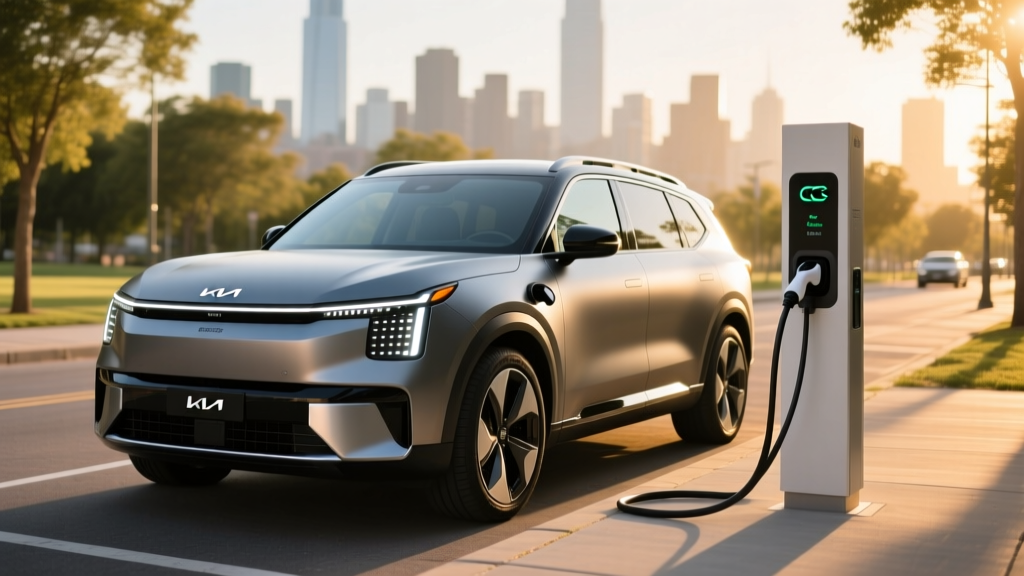
The Kia EV9 remains one of the very few mainstream electric vehicles that can genuinely seat seven adults and their luggage without compromise. For families who outgrew five-seat crossovers but refuse to default to a minivan or a three-row gas SUV, the EV9 occupies a near-monopoly position in the new-car market. This review breaks down the 2026 Kia EV9 3-row electric SUV with the exact numbers buyers need — real-world range expectations, charging-curve realities, tax-credit eligibility under current IRS §30D rules, and how it stacks up against the few competitors in its class.
Quick Verdict: The EV9 in 30 Seconds
The EV9 delivers EPA-estimated range up to 304 miles (Light RWD Long Range), 10–80% DC fast charging in roughly 20 minutes at a 350 kW station, and a cavernous 81.7 cu ft of cargo space with both rear rows folded. Pricing starts at $54,900 before incentives. Its biggest limitation is the same one every large EV faces: highway-range loss in cold weather can cut 20–25% off the sticker number. For families with home Level 2 charging access, it is the most practical electric three-row SUV on sale.
Range, Efficiency, and What to Expect in the Real World
| Trim / Drivetrain | Battery (kWh usable) | Chemistry | EPA Range (mi) | MPGe (combined) | kWh/100 mi |
|---|---|---|---|---|---|
| Light RWD (Standard Range) | 76.1 | NMC | 230 | 86 | 39 |
| Wind RWD Long Range | 100.0 | NMC | 304 | 89 | 37 |
| Land AWD Long Range | 100.0 | NMC | 282 | 85 | 39 |
| GT-Line AWD Long Range | 100.0 | NMC | 270 | 82 | 41 |
The 304-mile EPA figure for the Wind RWD applies to mixed city/highway driving in mild temperatures. In sustained 75-mph highway testing, expect 250–265 miles from the 100 kWh Long Range RWD trims. Add winter conditions (below 30°F) and that drops to roughly 210–230 miles due to battery-resistance losses and cabin heating demand. AWD trims with the larger 21-inch GT-Line wheels lose an additional 10–15 miles versus their EPA stickers on the highway. Plan road trips around 200-mile legs between DC fast-charger stops to keep a comfortable buffer.
The EV9 uses nickel-manganese-cobalt (NMC) chemistry in both battery packs. NMC offers higher energy density than LFP (lithium iron phosphate), which is why Kia can fit 100 kWh into this platform without excessive weight. The trade-off: NMC degrades slightly faster over time and prefers not to sit at 100% state of charge for extended periods. For daily driving, setting your charge limit to 80% via the infotainment system preserves long-term battery health — a practice Kia explicitly recommends in the owner's manual.
Charging Speed: DC Fast, Level 2, and the Charge Curve
| Charging Level | Max Power | Time / Rate | Connector |
|---|---|---|---|
| Level 1 (120V household) | ~1.4 kW | ~3 mi/hr | NACS (J1772 adapter) |
| Level 2 (240V home) | 10.9 kW | ~27 mi/hr (full in ~10 hr) | NACS |
| DC Fast Charge | 236 kW peak | 10–80% in ~20 min (350 kW station) | NACS (CCS1 adapter included) |
Starting with the 2025 model year, Kia adopted the North American Charging Standard (NACS) port on the EV9, granting access to Tesla Supercharger stations via Kia's included adapter. This is a major practical advantage: the Supercharger network remains the most reliable DC fast-charging infrastructure in the US, with far fewer out-of-service stalls than competing networks.
The 236 kW peak charge rate is strong, but like every EV, the EV9 does not sustain peak power across the entire session. The charge curve holds above 200 kW from roughly 10% to 45% state of charge, then tapers progressively. From 80% to 100%, charging slows dramatically to protect the battery — expect that final 20% to take as long as the 10–80% session. On road trips, charging to 80% and moving on is always the time-efficient strategy.
For home charging, the 10.9 kW onboard charger means a full charge from empty takes about 10 hours on a 48-amp Level 2 circuit. Most owners will plug in each evening and wake up with a full battery. A typical home Level 2 installation (240V, 48-amp hardwired charger on a 60-amp breaker) costs $800–$2,200 including equipment and licensed electrician labor, assuming your electrical panel has capacity. Older homes with 100-amp main panels may need a $1,500–$3,000 panel upgrade — get a quote from a licensed electrician before committing.
Performance, Drivetrain, and Towing
| Trim | Drivetrain | Horsepower | Torque (lb-ft) | 0–60 mph | Towing Capacity |
|---|---|---|---|---|---|
| Light / Wind (RWD) | Rear-Wheel Drive | 215 hp | 258 | 7.7 sec | 2,000 lb |
| Land / GT-Line (AWD) | Dual-Motor AWD | 379 hp | 516 | 4.5 sec | 5,000 lb |
The single-motor RWD models are adequate for commuting and highway merging but feel their weight (roughly 5,500 lb) around town. The dual-motor AWD transforms the character of the vehicle: 379 hp and 516 lb-ft of instant torque make a 5,500-lb three-row SUV feel genuinely quick. The GT-Line AWD hits 60 mph in 4.5 seconds — faster than many sports sedans from a decade ago.
Towing is where the AWD trims shine. A 5,000-lb towing capacity (with factory tow package) handles a small camper, boat trailer, or cargo trailer. However, towing at capacity will slash range by 40–50%. If you plan to tow frequently on longer trips, plan charging stops accordingly and keep expectations realistic: you'll likely see 140–170 miles of range while towing near the limit.
The EV9's ride quality is composed and comfortable, tuned more for family cruising than corner-carving. The available Highway Driving Assist 2 (HDA2) is a solid Level 2 driver-assistance system with lane-centering and adaptive cruise that works well on interstates, but it requires continuous driver supervision — this is not autonomous driving.
Interior Space, Cargo, and Tech
The EV9's boxy, upright design maximizes interior volume. Three rows of seats are genuinely usable — the third row accommodates adults on short trips and children comfortably on longer ones.
- Cargo behind 3rd row: 20.2 cu ft
- Cargo behind 2nd row (3rd row folded): 43.5 cu ft
- Max cargo (2nd & 3rd rows folded): 81.7 cu ft
- Front trunk (frunk): 1.8 cu ft (AWD) / 3.2 cu ft (RWD)
- 3rd-row legroom: 32.0 inches
- 2nd-row legroom: 42.8 inches
The dual 12.3-inch panoramic display handles infotainment and instrument cluster duties. Wireless Apple CarPlay and Android Auto are standard across all trims. Available features include a head-up display, digital key (phone-as-key), over-the-air software updates, and Vehicle-to-Load (V2L) capability — the EV9 can power external devices (camping gear, power tools, even a home circuit during an outage) at up to 3.6 kW through interior and exterior outlets.
One notable drawback: the EV9 relies heavily on touchscreen controls for climate and vehicle settings, with fewer physical buttons than some competitors. Fingerprints on the glossy center stack are a constant battle, and adjusting fan speed while driving takes more attention than a traditional knob.
Pricing, Trims, and Federal Tax Credit Eligibility
| Trim | MSRP | Est. After §30D Credit | Drivetrain |
|---|---|---|---|
| Light RWD (Standard Range) | $54,900 | ~$47,400* | RWD |
| Wind RWD Long Range | $59,900 | ~$52,400* | RWD |
| Land AWD Long Range | $65,900 | ~$58,400* | AWD |
| GT-Line AWD Long Range | $73,900 | ~$66,400* | AWD |
*Tax credit estimates assume full $7,500 eligibility under IRS §30D. Eligibility depends on buyer income limits, battery critical-mineral and component sourcing requirements, and MSRP caps. SUVs are capped at $80,000 MSRP — all EV9 trims qualify on price. Income caps are $150,000 (single), $225,000 (head of household), and $300,000 (joint). The credit can be transferred to the dealer at point of sale as an immediate price reduction. Always verify your eligibility with a tax professional before purchasing.
The EV9's MSRP cap compliance is straightforward: even the fully loaded GT-Line at $73,900 sits well below the $80,000 SUV ceiling. The more variable factor is battery sourcing. Kia has worked to shift critical-mineral supply chains to comply with §30D requirements, but the specific credit amount ($3,750 for minerals, $3,750 for components) can shift based on supply-chain changes. Check the fueleconomy.gov tax credit lookup for the most current eligibility status of your specific trim.
How the EV9 Compares to Key Rivals
The three-row electric SUV segment is small but growing. Here's how the EV9 stacks up:
| Spec | Kia EV9 Land AWD | Rivian R1S Dual-Motor | Tesla Model X LR |
|---|---|---|---|
| EPA Range | 282 mi | ~340 mi | ~335 mi |
| Battery (kWh) | 100.0 | ~128.9 | ~100 |
| DC Fast Charge (peak kW) | 236 kW | ~220 kW | 250 kW |
| 0–60 mph | 4.5 sec | 4.5 sec | 3.8 sec |
| Starting MSRP | $54,900 | $75,900 | $79,990 |
| Max Cargo (cu ft) | 81.7 | ~104 | ~88 |
| 3rd-Row Legroom | 32.0 in | ~28.5 in | ~32.7 in |
| Federal Tax Credit | Up to $7,500 | Up to $7,500 | Up to $7,500 |
The Rivian R1S offers more range and cargo volume but starts $21,000 higher and has a tighter third row. The Tesla Model X delivers the most range and Supercharger-native charging but is significantly more expensive, and its falcon-wing doors are a polarizing maintenance concern. The EV9's advantage is clear: it undercuts both on price while offering a more usable third row than the Rivian and a more conventional, service-friendly design than the Model X.
Warranty, Ownership Costs, and Long-Term Outlook
Kia backs the EV9 with one of the strongest warranties in the industry:
- Basic vehicle warranty: 5 years / 60,000 miles
- Powertrain warranty: 10 years / 100,000 miles
- Battery warranty: 10 years / 100,000 miles (covers capacity below 70% of original)
The 70% battery-capacity retention threshold is industry-standard. In practice, NMC batteries in liquid-cooled packs like the EV9's typically degrade 8–12% over the first 100,000 miles based on data from similar Hyundai Motor Group platforms (the EV9 shares the E-GMP architecture with the Ioniq 5 and EV6). Most owners will never approach the warranty claim threshold under normal use.
Insurance premiums for the EV9 run 15–25% higher than comparable gas-powered three-row SUVs, reflecting higher repair costs and parts pricing common to EVs. Get quotes from your insurer before purchasing. Maintenance costs, however, are substantially lower: no oil changes, no transmission fluid, no spark plugs, and regenerative braking extends pad life significantly. Expect annual maintenance of $200–$400 versus $600–$1,000 for a gas equivalent.
Pros, Cons, and Who Should Buy the EV9
- True 7-passenger seating with a usable third row
- Up to 304 mi EPA range (RWD Long Range)
- NACS port with Supercharger access
- 5,000-lb towing capacity (AWD)
- V2L capability for camping and backup power
- Class-leading 10-yr/100,000-mi battery warranty
- Significantly lower starting price than Rivian R1S or Tesla Model X
- Highway and cold-weather range loss of 20–25%
- Touchscreen-heavy controls, few physical buttons
- RWD trims limited to 2,000-lb towing
- Frunk is small (1.8 cu ft on AWD)
- Insurance costs higher than gas equivalents
- No LFP battery option for 100% daily charging convenience
- Choose the EV9 if: You need three rows for family duty, have home Level 2 charging, want Supercharger access for road trips, and prioritize value over maximum range.
- Look at the Rivian R1S if: You need serious off-road capability, maximum cargo volume, and can absorb a $20K+ price premium.
- Consider a PHEV minivan (e.g., Chrysler Pacifica Hybrid) if: You lack reliable home charging access and regularly take long road trips where DC charging infrastructure is sparse.
Frequently Asked Questions
What is the real-world range of the Kia EV9?
The EPA rates the best-case Wind RWD Long Range at 304 miles. In real-world highway driving at 70–75 mph, expect 250–265 miles. In cold weather (below 30°F), plan for 210–230 miles. AWD trims with larger wheels typically deliver 230–250 miles highway in mild weather.
How fast does the EV9 charge at home and on the road?
On a 240V Level 2 home charger, the EV9 charges at 10.9 kW, adding about 27 miles per hour — a full overnight charge. At a 350 kW DC fast charger, it peaks at 236 kW and reaches 10–80% in approximately 20 minutes, though the charge rate tapers significantly above 80%.
Does the 2026 Kia EV9 qualify for the federal EV tax credit?
Yes, the EV9 is eligible for up to $7,500 under IRS §30D, provided the buyer meets income caps ($150K single / $300K joint), the MSRP is under $80,000 (all trims qualify), and the battery meets critical-mineral and component-sourcing requirements for the current tax year. The credit can be applied as a point-of-sale rebate through the dealer. Verify current eligibility at fueleconomy.gov and consult a tax professional.
Is the Kia EV9 worth buying versus the Rivian R1S or Tesla Model X?
For most families, yes. The EV9 offers 80–90% of the capability of the Rivian R1S and Tesla Model X at 60–70% of the price. Its third row is more comfortable than the Rivian's, and it avoids the Model X's complexity and cost. If you need maximum range or off-road capability, the Rivian justifies its premium. For value and daily practicality, the EV9 wins.
Can the EV9 tow a trailer?
AWD trims (Land and GT-Line) with the factory tow package can tow up to 5,000 lb — enough for a small travel trailer or boat. RWD trims are limited to 2,000 lb. Towing near capacity will reduce range by roughly 40–50%, so plan charging stops carefully.
How long will the EV9 battery last?
Kia warranties the battery for 10 years / 100,000 miles against capacity loss below 70%. Real-world data from similar E-GMP platform vehicles suggests 8–12% degradation over 100,000 miles under normal use. With proper care (avoiding prolonged 100% charges, using DC fast charging judiciously), the battery should outlast 150,000+ miles with usable capacity.