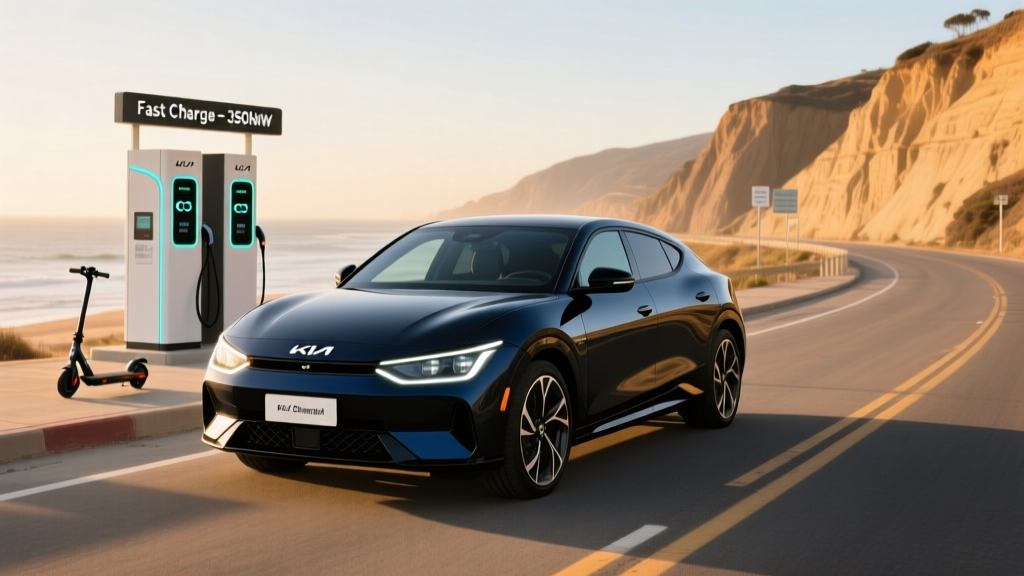
The Kia EV6 Wind occupies a specific niche in the midsize electric crossover segment: it's the volume trim that bundles dual-motor all-wheel drive, the larger 84.0 kWh battery, and a premium feature set without crossing into the GT's performance pricing. For 2026, Kia refreshed the EV6 with updated styling, a larger infotainment screen, and standard Tesla North American Charging Standard (NACS) compatibility — meaning access to the Supercharger network without an adapter.
This review breaks down the EV6 Wind's real-world range, charging behavior, ownership costs, and how it stacks up against the Hyundai Ioniq 5, Ford Mustang Mach-E, and Tesla Model Y. If you're cross-shopping midsize electric crossovers, the Wind is often the trim buyers actually drive home.
2026 Kia EV6 Wind at a Glance
| Spec | Value |
|---|---|
| EPA Range | 290 miles (AWD, 20" wheels) |
| Battery (usable) | 84.0 kWh, NMC (Nickel Manganese Cobalt) |
| Drivetrain | Dual-motor AWD |
| Horsepower / Torque | 320 hp / 446 lb-ft |
| 0–60 mph | 5.1 seconds |
| Max DC Fast Charge | 239 kW (peak) |
| 10–80% DC Fast Charge | ~18 minutes (optimal conditions) |
| Level 2 Charge Rate | 10.9 kW (~32 miles/hr) |
| EPA Efficiency | 117 MPGe combined (29 kWh/100 mi) |
| Cargo Volume | 24.4 cu ft (rear seats up) / 50.2 cu ft (folded) |
| Frunk | 0.7 cu ft |
| Rear Legroom | 39.4 inches |
| Base MSRP (Wind AWD) | $52,150 (incl. $1,350 destination) |
| Battery / Powertrain Warranty | 10 years / 100,000 miles |
| Basic Warranty | 5 years / 60,000 miles |
Range and Efficiency: EPA vs. the Real World
The 2026 EV6 Wind AWD carries an EPA-estimated 290 miles of range on its 84.0 kWh (usable) NMC battery pack. That figure applies to the Wind trim with standard 20-inch alloy wheels; stepping to smaller wheels on the lower Light trim nets slightly more, but the Wind is the popular choice and the one most buyers will actually own.
EPA 290 miles is a combined cycle. Expect ~250–265 miles on sustained highway driving at 70–75 mph, where aerodynamic drag reduces efficiency. In freezing temperatures (below 32°F), plan for 200–230 miles of usable range due to battery resistance and cabin heating load. City driving with frequent regenerative braking can exceed the EPA estimate, reaching 300+ miles in mild weather. The EV6's heat pump (standard on the Wind) mitigates cold-weather loss compared to EVs without one.
Efficiency lands at 117 MPGe combined, or roughly 29 kWh per 100 miles. That's competitive with the Ioniq 5 AWD (114 MPGe) and slightly behind the Model Y Long Range AWD (122 MPGe). On a cost-per-mile basis, home charging at the US average of $0.17/kWh works out to about $0.049 per mile — roughly one-third the cost of a 25 MPG gas car at $3.50/gallon.
Charging Speed: DC Fast and Level 2 Breakdown
The EV6's 800-volt electrical architecture remains its strongest practical advantage. Where most competitors use 400V systems that peak below 175 kW, the EV6 can accept up to 239 kW at a capable DC fast charger — and more importantly, it sustains high charge rates through a wide portion of the curve.
| Charging Level | Power / Rate | Miles Added per Hour | Notes |
|---|---|---|---|
| Level 1 (120V) | ~1.4 kW | ~4 mi/hr | Emergency/trickle only |
| Level 2 (240V, 48A) | 10.9 kW | ~32 mi/hr | Full charge in ~8.5 hours |
| DC Fast (peak) | 239 kW | — | Requires 350 kW-capable station |
| DC Fast 10–80% | — | — | ~18 min (optimal); ~22–25 min typical |
The 10–80% claim of 18 minutes is achievable at a 350 kW Electrify America or Tesla Supercharger V4 stall when the battery is preconditioned (the EV6 does this automatically when a DC fast charger is set as your navigation destination). In real-world conditions — battery not fully preconditioned, ambient temps below 50°F, or a station limited to 150 kW — expect 22–28 minutes for the same 10–80% session.
Above 80% state of charge, the charge curve tapers sharply to protect the NMC cells. An 80–100% top-up can take nearly as long as the 10–80% session. For road trips, the practical strategy is to charge to 80% and go.
For 2026, the EV6 ships with a native NACS charge port, granting direct access to Tesla's Supercharger network — over 25,000 stalls across North America — without the CCS-to-NACS adapter that earlier model years required. The CCS port is no longer standard, though legacy CCS chargers remain widely available via adapter (sold separately by Kia).
Performance and Driving Dynamics
The Wind's dual-motor AWD powertrain produces 320 horsepower and 446 lb-ft of torque, launching the EV6 to 60 mph in 5.1 seconds. That's quick enough for confident highway merging and genuinely fun off the line, without the tire-shredding excess of the GT trim (576 hp, 3.4 seconds).
Ride quality is firm but well-damped. Kia tuned the EV6's chassis with input from former BMW M engineers, and it shows: body roll is controlled, steering is precise if slightly numb, and the low center of gravity keeps things planted. The Wind rides on 20-inch wheels with 255/45R20 tires, which trades a small amount of ride comfort for sharper handling.
Regenerative braking offers four levels adjustable via steering-wheel paddles, including a full one-pedal-driving mode (i-Pedal) that brings the car to a complete stop without touching the brake pedal. The transition between regen and friction braking is smooth — a common weak point in some competitors.
Interior, Cargo, and Technology
The 2026 refresh brought a 12.3-inch merged panoramic display combining the instrument cluster and infotainment screen behind a single curved glass panel. Kia's latest infotainment software supports wireless Apple CarPlay and Android Auto, over-the-air updates, and a built-in EV route planner that factors in charging stops and battery preconditioning.
The Wind trim adds features over the base Light and GT-Line trims:
- Ventilated front seats with leatherette upholstery
- Heated steering wheel and rear seats
- Power-folding side mirrors with memory
- Highway Driving Assist 2 (HDA2) — adaptive cruise with lane-centering and lane-change assist
- Remote Smart Parking Assist (RSPA) — the car parks itself while you stand outside
- Head-up display with augmented-reality navigation
Cargo space is adequate if not class-leading: 24.4 cubic feet behind the rear seats and 50.2 cubic feet with the 60/40 split folded. The frunk is a modest 0.7 cubic feet — essentially a charging-cable cubby. Rear legroom at 39.4 inches is generous for two adults, though the sloping roofline cuts into headroom for passengers over 6 feet tall.
One notable drawback: the EV6 Wind does not offer a third-row seat. If you need three rows in a Kia EV, the larger EV9 is the answer. The EV6 also lacks a front trunk large enough for meaningful storage, and the absence of a rear wiper on the hatchback glass is a recurring complaint in rainy conditions.
Pricing, Trims, and Federal Tax Credit
The 2026 EV6 Wind AWD starts at $52,150 including destination. Add metallic paint ($495) and the Wind Technology Package ($1,500 — adds a surround-view monitor, blind-spot cameras, and parking collision avoidance) and a well-equipped Wind lands around $54,145.
| Trim | Drivetrain | MSRP (incl. destination) |
|---|---|---|
| Light | RWD | $43,550 |
| Light Long Range | RWD | $47,550 |
| Wind | AWD | $52,150 |
| GT-Line | AWD | $55,350 |
| GT | AWD (performance) | $62,750 |
The 2026 Kia EV6 is assembled in West Point, Georgia, and qualifies for the full $7,500 federal tax credit for eligible buyers under current IRS §30D rules. Eligibility requirements:
- MSRP cap: Vehicle must be under $80,000 (all EV6 trims qualify)
- Buyer income cap: AGI ≤ $150,000 (single) / $225,000 (head of household) / $300,000 (joint)
- Battery sourcing: Critical minerals and battery components must meet phased-in thresholds (Kia confirms EV6 compliance for 2026)
- Point-of-sale transfer: You can apply the $7,500 as an upfront discount at the dealer rather than waiting for a tax return
Rules are subject to change. Confirm eligibility with your dealer and a tax professional before purchase.
After the $7,500 credit, the effective price of a base Wind AWD drops to $44,650 — competitive with a similarly equipped Model Y Long Range and significantly less than the Ford Mach-E Premium AWD. Many states also offer additional rebates or utility charging incentives; check your state's programs for specifics.
How the EV6 Wind Stacks Up Against Rivals
The Wind competes directly with three benchmarks in the midsize EV crossover segment:
| Kia EV6 Wind AWD | Hyundai Ioniq 5 SEL AWD | Tesla Model Y LR AWD | Ford Mach-E Premium AWD | |
|---|---|---|---|---|
| EPA Range | 290 mi | 290 mi | 320 mi | 290 mi |
| Battery | 84.0 kWh NMC | 84.0 kWh NMC | ~78 kWh NMC | 91 kWh NMC |
| Peak DC Charge | 239 kW | 238 kW | 250 kW | 150 kW |
| 10–80% Time | ~18 min | ~18 min | ~22 min | ~36 min |
| 0–60 mph | 5.1 sec | 5.2 sec | 4.8 sec | 5.6 sec |
| Cargo (rear up) | 24.4 cu ft | 27.2 cu ft | 30.2 cu ft | 29.7 cu ft |
| Base MSRP (AWD) | $52,150 | $50,850 | $48,590 | $51,875 |
| After $7,500 Credit | $44,650 | $43,350 | $41,090 | $44,375 |
Where the EV6 Wind wins: DC fast-charge speed (tied with Ioniq 5, far ahead of the Mach-E), standard NACS access, 10-year battery warranty, and driving dynamics that feel more premium than the price suggests.
Where it falls short: Cargo volume trails the Model Y, Ioniq 5, and Mach-E meaningfully. The frunk is nearly useless. And the Model Y's Supercharger network advantage — while now shared via NACS — still comes with a more mature built-in route planner and lower starting price.
Ownership Costs and Warranty
Kia backs the EV6's battery and powertrain with a 10-year / 100,000-mile warranty, one of the longest in the segment. The warranty covers battery capacity loss below 70% of original capacity — a threshold consistent with Hyundai/Kia's NMC battery management strategy. Basic coverage runs 5 years / 60,000 miles, and roadside assistance is included for 5 years.
Over a 5-year ownership period, estimated costs look like this for the Wind AWD (15,000 miles/year, $0.17/kWh home charging, $3.50/gal gas equivalent):
| Category | Cost |
|---|---|
| Purchase (after $7,500 credit) | $44,650 |
| Electricity (75,000 mi) | $3,675 |
| Insurance (avg. 5 years) | $9,500 |
| Maintenance (tires, cabin filter, fluid top-offs) | $1,800 |
| Estimated Depreciation (5 yr) | ~$18,000 |
| Total 5-Year Cost | ~$77,625 |
Insurance for the EV6 runs higher than average for the segment — roughly $1,800–$2,000/year depending on your profile. Get quotes before committing, as this can shift the total-cost equation versus a Model Y, which some insurers rate more favorably.
Who Should Buy the Kia EV6 Wind?
Choose the EV6 Wind if:
- You want AWD and 290 miles of range without stepping to a performance trim
- Fast DC charging matters (road trips, apartment dwellers relying on public chargers)
- You value a long battery warranty and Kia's improving build quality
- You want native NACS / Supercharger access without an adapter
- You prioritize driving dynamics over maximum cargo space
Look elsewhere if:
- You need maximum cargo room (Model Y or Ioniq 5 offer 3–6 more cubic feet)
- You need a third row (consider the Kia EV9)
- You want the lowest entry price (Model Y LR starts ~$3,500 less)
- You tow frequently — the EV6's 2,700-lb tow rating is modest
Pros and Cons
- 239 kW peak DC fast charging — among the fastest in the segment
- Native NACS port for Supercharger access
- 10-year / 100,000-mile battery warranty
- Refined ride and handling for the price
- Strong standard safety tech (HDA2, blind-spot cameras)
- Heat pump standard — better cold-weather range retention
- Qualifies for full $7,500 federal tax credit
- Cargo volume (24.4 cu ft) trails key rivals
- Tiny 0.7 cu ft frunk — barely fits the charge cable
- No rear wiper on the hatch glass
- AWD required on the Wind trim (no RWD option = higher starting price)
- Insurance costs run above segment average
- 2,700-lb tow rating limits utility for trailer owners
- Rear headroom tight for tall passengers under the sloping roofline
Frequently Asked Questions
What is the real-world range of the Kia EV6 Wind?
The EPA rates the 2026 EV6 Wind AWD at 290 miles. In real-world highway driving at 70–75 mph, expect 250–265 miles. In freezing weather, that can drop to 200–230 miles. City driving with regenerative braking in mild weather can push past 300 miles.
How fast does the EV6 Wind charge at home and on the road?
On a Level 2 home charger (240V, 48A), the EV6 Wind charges at 10.9 kW, adding about 32 miles of range per hour — a full charge takes roughly 8.5 hours. On a 350 kW DC fast charger, it peaks at 239 kW and can go from 10–80% in about 18 minutes under optimal conditions, or 22–28 minutes in typical real-world use.
Does the 2026 Kia EV6 Wind qualify for the federal EV tax credit?
Yes. The EV6 is assembled in Georgia and meets current IRS §30D battery-sourcing requirements, qualifying for the full $7,500 credit. Buyer income must not exceed $150,000 (single) / $300,000 (joint), and the credit can be applied as a point-of-sale discount at the dealership. Always verify current rules with the IRS and your tax professional.
How much does the EV6 Wind cost after incentives?
The base MSRP is $52,150. After the $7,500 federal credit, the effective price is $44,650. Additional state rebates, utility incentives, or local programs may reduce the cost further — check your state's EV incentive database for specifics.
Is the Kia EV6 Wind worth buying over the Tesla Model Y or Hyundai Ioniq 5?
It depends on your priorities. The EV6 Wind matches or beats both on DC fast-charge speed and offers a longer battery warranty than either rival. The Model Y wins on cargo space, starting price, and software ecosystem. The Ioniq 5 is the closest sibling — nearly identical mechanically — with slightly more cargo room and a lower AWD starting price. If fast public charging and long-term warranty coverage matter most, the EV6 Wind is a strong pick. If cargo and price lead your checklist, compare the Model Y and Ioniq 5 carefully.
Does the EV6 Wind have a heat pump?
Yes. A heat pump is standard on the 2026 EV6 Wind, improving cold-weather efficiency by extracting ambient heat for cabin warming rather than relying solely on resistive heating. This typically reduces cold-weather range loss by 10–15% compared to EVs without one.
What connector does the 2026 EV6 Wind use?
The 2026 EV6 ships with a native NACS (North American Charging Standard) port, compatible with Tesla Superchargers and the growing number of NACS-equipped public chargers. For legacy CCS stations, Kia offers a NACS-to-CCS adapter sold separately.