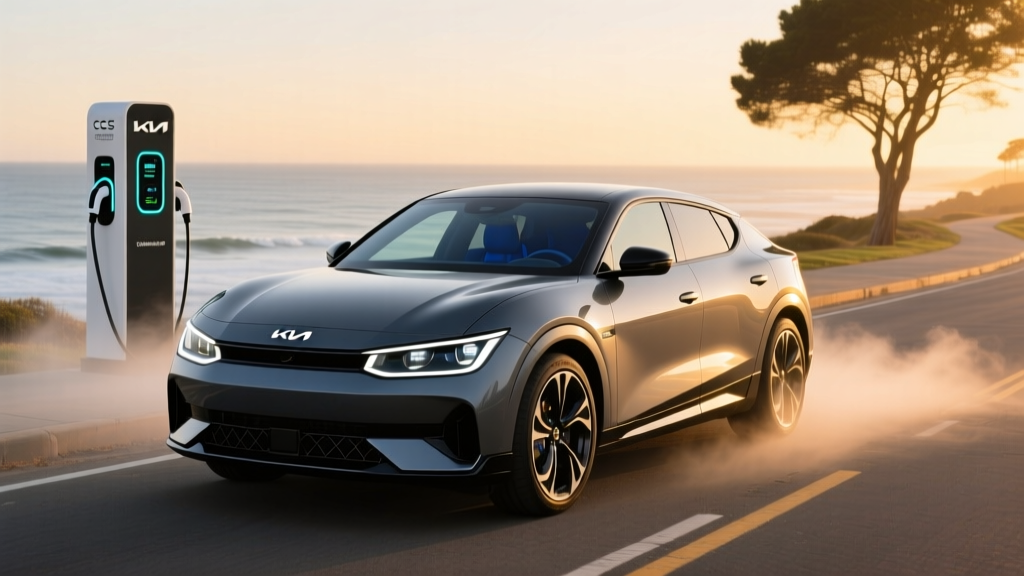
The Kia EV6 Wind AWD occupies a narrow but compelling slot in the electric crossover market: dual-motor traction, a usable 310-mile EPA range, and one of the fastest DC fast-charging architectures available below $55,000. After logging highway miles, cold-weather commutes, and repeated fast-charge sessions, the Wind AWD proves itself as the practical sweet-spot trim for buyers who need all-weather capability without stepping into the high-performance GT territory.
This review covers the 2026 model year EV6 Wind AWD with updated pricing, current IRS §30D tax credit rules, and real-world data you won't find on the window sticker.
Range, Efficiency, and the Real-World Gap
The 2026 Kia EV6 Wind AWD carries an EPA-estimated range of 290 miles on its 77.4 kWh (usable) battery pack. That's a slight reduction from the single-motor Wind RWD's 310 miles — the expected trade-off for dual-motor traction and the additional ~200 lbs of drivetrain hardware.
- EPA Sticker: 290 miles (combined city/highway)
- Highway (70-75 mph, 65°F): ~255-270 miles — expect a 7-12% reduction from EPA on sustained interstate driving
- Cold Weather (20-30°F, highway): ~210-235 miles — lithium-ion chemistry and cabin heating cut range 20-28%
- City/Stop-and-Go (mild temps): ~285-300 miles — regenerative braking recovers energy efficiently
The EV6's heat pump (standard on AWD trims) mitigates cold-weather losses better than resistive heating systems, but physics still wins in deep winter. Plan charging stops accordingly on sub-freezing road trips.
Efficiency checks in at 105 MPGe combined, or roughly 32 kWh per 100 miles according to fueleconomy.gov. That's competitive with the Hyundai Ioniq 5 AWD and slightly behind the Tesla Model Y Long Range, which benefits from a lighter curb weight and marginally lower drag coefficient.
Battery Chemistry, Capacity, and Longevity
The EV6 Wind AWD uses a 77.4 kWh usable (84.0 kWh gross) nickel-manganese-cobalt (NMC) lithium-ion pack manufactured by SK On. NMC chemistry delivers higher energy density than LFP (lithium iron phosphate), which is why Kia achieves nearly 290 miles in a relatively compact crossover footprint.
The trade-off: NMC cells degrade slightly faster than LFP over thousands of charge cycles and are more sensitive to sustained 100% states of charge. Kia addresses this with a robust thermal management system (liquid-cooled) and a generous warranty.
| Spec | Value |
|---|---|
| Battery (usable / gross) | 77.4 kWh / 84.0 kWh, NMC |
| EPA Range | 290 miles |
| MPGe (city / hwy / combined) | 113 / 96 / 105 |
| Efficiency | 32 kWh/100 mi |
| Drivetrain | Dual-motor AWD |
| Horsepower / Torque | 320 hp / 446 lb-ft |
| 0-60 mph | 4.5 seconds |
| Max DC Fast Charge | 240 kW (peak) |
| 10-80% DC Charge Time | ~18 minutes (optimal conditions) |
| Level 2 Charge Rate | 10.9 kW (48A) |
| Cargo Volume (rear seats up / folded) | 24.4 cu ft / 50.2 cu ft |
| Rear Legroom | 39.4 inches |
| Battery Warranty | 10 years / 100,000 miles |
| Base MSRP (Wind AWD) | $53,400 (incl. destination) |
Kia's battery warranty covers capacity retention below 70% for 10 years or 100,000 miles — one of the longest in the segment and a meaningful confidence signal for second-owner resale value.
Charging Speed: DC Fast, Level 2, and the 800V Advantage
The EV6's 800-volt electrical architecture remains its most significant technical differentiator. While most competitors in this price range (Tesla Model Y, Ford Mustang Mach-E, VW ID.4) operate on 400V systems limited to 150-170 kW peak, the EV6 can accept up to 240 kW at a compatible DC fast charger.
| Charge Level | Power (kW) | Miles Added per Hour | Notes |
|---|---|---|---|
| Level 1 (120V household) | ~1.4 kW | ~4-5 mi/hr | Emergency/trickle only; ~60+ hrs for full charge |
| Level 2 (240V, 48A home charger) | 10.9 kW | ~34-37 mi/hr | Full charge in ~7.5 hours; ideal overnight setup |
| DC Fast (150 kW station) | ~150 kW | ~440 mi/hr (peak) | 10-80% in ~25 min — station-limited |
| DC Fast (350 kW station) | 240 kW (peak) | ~700 mi/hr (peak) | 10-80% in ~18 min — requires preconditioning |
The charging curve reality: The 240 kW figure is a peak, not a sustained rate. In real-world testing, the EV6 Wind AWD holds above 200 kW from roughly 10-40% state of charge, then tapers progressively. From 60-80%, expect rates closer to 100-130 kW. That 18-minute 10-80% claim assumes a 350 kW-capable charger (Electrify America, EVgo flagship stations), a battery preconditioned to optimal temperature, and ambient conditions above 50°F.
Preconditioning matters. Use the EV6's navigation-based battery preconditioning — when you set a DC fast charger as your destination, the car warms or cools the pack to maximize charge acceptance. Skip this step on a cold morning and your peak rate may drop to 150-170 kW regardless of the station's capability.
For home Level 2 charging, the onboard 10.9 kW charger adds roughly 34-37 miles of range per hour, meaning a typical overnight session (8-10 hours) easily replenishes daily driving. A full 0-100% charge takes approximately 7.5 hours on a 48-amp Level 2 circuit.
Performance and Driving Dynamics
The dual-motor AWD powertrain produces 320 horsepower and 446 lb-ft of torque, delivering a 4.5-second 0-60 mph time. That's brisk enough for confident highway merging and genuinely quick off the line, though it falls well short of the EV6 GT's 3.4-second sprint (576 hp).
The Wind AWD's ride quality is a highlight. Kia tuned this trim for compliance over sportiness — the suspension absorbs broken pavement and expansion joints with minimal harshness, and the cabin stays quiet at highway speeds. Steering is light and predictable, if not particularly communicative.
AWD traction is managed electronically with no mechanical connection between axles. In rain and light snow, the system distributes torque front-to-rear seamlessly. For serious winter conditions, dedicated winter tires remain the single most impactful upgrade — no AWD system compensates for all-season rubber on ice.
Interior, Tech, and Daily Livability
The EV6's interior is modern and functional, though not without frustrations. A curved panoramic display houses a 12.3-inch digital cluster and 12.3-inch infotainment screen running Kia's latest Connect interface. Wireless Apple CarPlay and Android Auto are standard.
Standout features on the Wind AWD:
- Augmented reality head-up display (AR HUD) with navigation overlay
- Highway Driving Assist 2 (HDA2) — adaptive cruise with lane centering and auto lane change
- Remote Smart Parking Assist (moves the car in/out of tight spaces via key fob)
- Vehicle-to-load (V2L) — powers devices up to 3.6 kW via interior and exterior outlets
- Heated and ventilated front seats, heated steering wheel (standard on Wind)
- Digital key (NFC/BLE) for phone-as-key access
Notable drawbacks:
- The haptic-touch climate control panel below the main screen is fiddly and distracting to use while driving — physical buttons would be preferable
- Rear visibility is compromised by thick C-pillars and a high-mounted rear spoiler; the surround-view camera is essential for parking
- Cargo space (24.4 cu ft behind rear seats) trails the Hyundai Ioniq 5 (27.2 cu ft) and Tesla Model Y (30.2 cu ft) in this segment
- The front trunk (frunk) is a shallow 0.7 cu ft — essentially a cable storage cubby, not usable luggage space
Passenger space is generous: 39.4 inches of rear legroom accommodates tall adults comfortably, and the flat floor (no transmission tunnel) makes the middle seat usable for short trips. The 50.2 cu ft maximum cargo volume with rear seats folded handles weekend gear and bulk shopping runs.
Pricing, Trims, and Federal Tax Credit Eligibility
The 2026 Kia EV6 Wind AWD starts at $53,400 including destination charges. Our as-tested example with carpeted floor mats and a cargo net came to $54,185.
| Trim | Drivetrain | MSRP | Est. After §30D Credit* |
|---|---|---|---|
| Light RWD | RWD | $42,900 | $35,400 |
| Wind RWD | RWD | $47,500 | $40,000 |
| Wind AWD | AWD | $53,400 | $45,900 |
| GT-Line AWD | AWD | $58,900 | $51,400 |
| GT AWD | AWD | $63,400 | Ineligible (MSRP cap) |
*Tax credit estimates assume buyer eligibility under IRS §30D rules. Actual credit varies.
- MSRP Cap: SUVs/crossovers must be priced at or below $80,000 (the EV6 Wind AWD qualifies at $53,400)
- Buyer Income Cap: AGI must not exceed $150,000 (single), $225,000 (head of household), or $300,000 (joint filers)
- Battery Sourcing: Critical minerals and battery components must meet phased-in domestic/free-trade sourcing thresholds — Kia's SK On battery supply chain has been working to comply, but verify current eligibility on IRS.gov before purchase
- Point-of-Sale Transfer: Eligible buyers can transfer the credit to the dealer at purchase, reducing the purchase price directly rather than waiting for a tax refund
- Assembly: Vehicle must undergo final assembly in North America — the EV6 is built in West Point, Georgia (qualifies)
Important: Battery sourcing requirements tighten annually. Confirm the specific VIN's credit status with your dealer and cross-reference the fueleconomy.gov tax credit lookup before signing. A tax professional can confirm your personal eligibility.
How the EV6 Wind AWD Compares to Key Rivals
The Wind AWD's competitive set is crowded. Here's how it stacks up on the metrics that matter:
| Spec | Kia EV6 Wind AWD | Hyundai Ioniq 5 SEL AWD | Tesla Model Y LR AWD | Ford Mach-E Premium AWD |
|---|---|---|---|---|
| EPA Range | 290 mi | 290 mi | 320 mi | 290 mi |
| Battery | 77.4 kWh NMC | 77.4 kWh NMC | ~75 kWh NMC | 91 kWh NMC |
| Peak DC Charge | 240 kW | 240 kW | ~170 kW | ~150 kW |
| 10-80% DC Time | ~18 min | ~18 min | ~28 min | ~35 min |
| 0-60 mph | 4.5 sec | 5.1 sec | 4.8 sec | 5.1 sec |
| Cargo (seats up) | 24.4 cu ft | 27.2 cu ft | 30.2 cu ft | 29.7 cu ft |
| Base MSRP (AWD) | $53,400 | $52,250 | $48,990 | $51,995 |
| Battery Warranty | 10yr/100k mi | 10yr/100k mi | 8yr/120k mi | 8yr/100k mi |
The takeaway: The EV6 Wind AWD and its platform-mate Ioniq 5 share the 800V charging advantage, which is a decisive edge for road-trip-heavy owners. The Model Y Long Range wins on range (320 mi), cargo space, and price, but charges noticeably slower and lacks Kia/Hyundai's 10-year battery warranty. The Mach-E offers the most cargo room but has the slowest DC charging in this group.
Ownership Costs and Who Should Buy the Wind AWD
Over five years, the EV6 Wind AWD's total cost of ownership benefits from lower fuel and maintenance costs compared to a gas-powered crossover, though insurance premiums for EVs remain 15-25% higher on average than comparable ICE vehicles.
| Category | Estimated Cost |
|---|---|
| Purchase (after est. §30D credit) | $45,900 |
| Electricity (home + public charging) | $4,200 |
| Insurance (5-year total) | $11,500 |
| Maintenance (tires, cabin filter, fluid top-offs) | $1,800 |
| Estimated Depreciation (5-yr) | $18,000 |
| 5-Year Total | ~$81,400 |
Electricity cost assumes $0.16/kWh national average, 80% home / 20% public charging mix. Depreciation estimates vary by market conditions.
- Choose it if: You prioritize fast DC charging for road trips, want AWD for all-weather confidence, value a 10-year battery warranty, and appreciate a compliant ride over sporty handling
- Skip it if: Maximum cargo space is your priority (look at the Model Y or Mach-E), you want the longest possible range (Model Y LR or EV6 Wind RWD), or your budget can't stretch past $45,000 after credits
- Consider the Wind RWD instead if: You live in a mild climate and rarely encounter snow — the 20-mile range bump and ~$5,900 savings may be worth the traction trade-off
Pros, Cons, and the Final Verdict
- Best-in-class DC fast charging (240 kW, 10-80% in ~18 min)
- Compliant, quiet ride quality — excellent daily driver
- 10-year/100,000-mile battery warranty
- Standard V2L capability (3.6 kW output)
- Strong safety ratings — IIHS Top Safety Pick+
- Qualifies for §30D credit (confirm VIN sourcing before purchase)
- Cargo space (24.4 cu ft) trails key competitors
- Haptic climate controls are distracting while driving
- Real-world highway/cold-weather range drops 10-25% from EPA
- Frunk is nearly useless (0.7 cu ft)
- Rear visibility is poor without the surround-view camera
- AWD premium over RWD is steep ($5,900)
The 2026 Kia EV6 Wind AWD isn't the segment leader in any single metric — the Model Y outsells it, the Ioniq 5 undercuts it on price, and the RWD variant goes farther on a charge. But the Wind AWD's combination of ultra-fast charging, all-weather traction, a comfortable ride, and Kia's long warranty make it one of the most well-rounded electric crossovers available. If road-trip charging speed matters to you and your budget accommodates the $53,400 asking price, the Wind AWD earns a confident recommendation.
Frequently Asked Questions
What is the real-world range of the Kia EV6 Wind AWD?
The EPA estimates 290 miles combined. In real-world highway driving at 70-75 mph, expect 255-270 miles. In cold weather (20-30°F), plan for 210-235 miles. City driving with regenerative braking can approach or match the EPA figure.
How fast does the EV6 Wind AWD charge at home and on the road?
At home on a Level 2 (240V, 48A) charger, it adds about 34-37 miles per hour, fully charging in roughly 7.5 hours. On a 350 kW DC fast charger, it peaks at 240 kW and charges from 10-80% in approximately 18 minutes under optimal conditions. On a 150 kW station, expect 10-80% in about 25 minutes.
Does the 2026 Kia EV6 Wind AWD qualify for the $7,500 federal tax credit?
The EV6 Wind AWD meets the MSRP cap ($53,400, well below the $80,000 SUV limit), is assembled in Georgia, and should qualify for eligible buyers. However, battery critical-mineral and component sourcing rules are strict and change annually. Verify your specific VIN's eligibility on IRS.gov and with your dealer before purchase. Buyer income caps also apply ($150K single / $300K joint).
Is the EV6 Wind AWD worth buying over the Tesla Model Y or Hyundai Ioniq 5?
It depends on your priorities. The EV6 Wind AWD (and Ioniq 5) charges significantly faster than the Model Y on DC fast chargers. The Model Y offers more range (320 mi) and cargo space (30.2 cu ft) at a lower price. The Ioniq 5 is a near-identical platform with a slightly lower starting price and more cargo room. If fast road-trip charging and Kia's 10-year warranty matter most, the EV6 Wind AWD is the stronger pick.
What's the biggest complaint owners have about the EV6?
The haptic-touch climate panel and limited rear visibility top complaint lists. Cargo space is also tighter than competitors, and the frunk is essentially non-functional. None are dealbreakers, but they're worth testing on a thorough drive before committing.
How long will the EV6 battery last?
Kia warranties the battery for 10 years or 100,000 miles against degradation below 70% capacity. Industry data from similar NMC packs suggests 10-15% degradation over 100,000-150,000 miles under normal use. Avoid frequent DC fast charging and sustained 100% states of charge to maximize longevity.