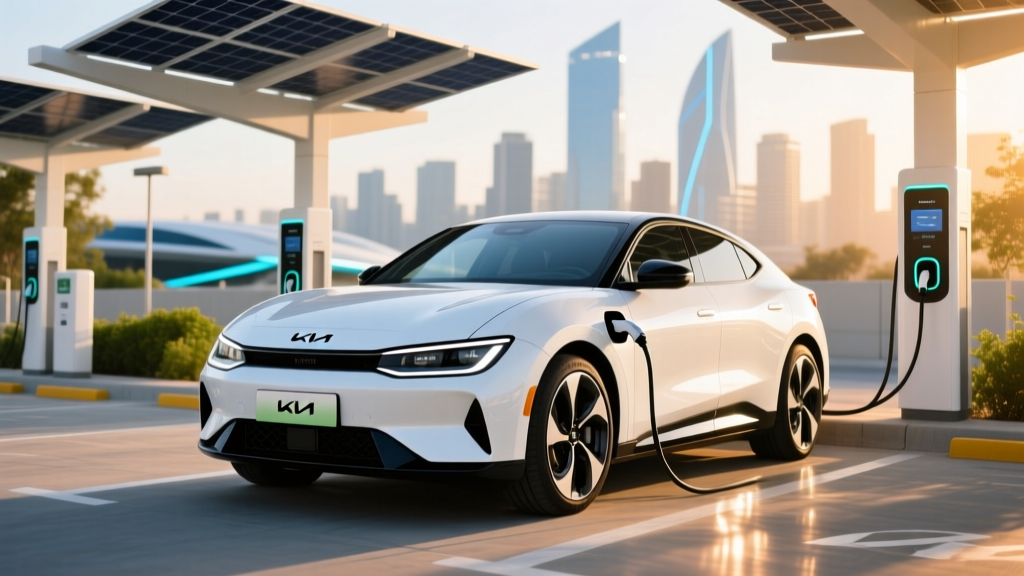
The Kia EV6 remains one of the most compelling electric crossovers on the market in 2026, blending 800-volt fast-charging architecture with a practical cabin and strong range. But before you sign the paperwork, you need to know exactly what incentives you qualify for — and what the EV6 actually costs to own over five years when you factor in electricity, insurance, maintenance, and depreciation.
This guide breaks down every Kia EV6 rebate available in 2026, walks through IRS §30D federal tax credit eligibility, and runs the numbers on total cost of ownership so you can decide whether the EV6 pencils out against a gas-powered crossover like the Toyota RAV4 or Honda CR-V.
2026 Kia EV6: Quick Specs & Pricing Overview
Before we get into incentives, here are the numbers that matter for the 2026 Kia EV6 lineup. Kia has streamlined trims for this model year, and pricing has shifted slightly as battery costs decline and competition intensifies.
| Spec | EV6 Light RWD | EV6 Wind AWD | EV6 GT-Line AWD | EV6 GT |
|---|---|---|---|---|
| Base MSRP | $42,600 | $48,200 | $53,500 | $61,600 |
| EPA Range | 310 mi | 282 mi | 282 mi | 231 mi |
| Battery (usable) | 77.4 kWh (NMC) | 77.4 kWh (NMC) | 77.4 kWh (NMC) | 77.4 kWh (NMC) |
| Peak DC Charge Rate | 240 kW | 240 kW | 240 kW | 350 kW |
| 10–80% DC Fast Charge | ~18 min | ~18 min | ~18 min | ~17 min |
| Level 2 Charge Rate | 10.9 kW | 10.9 kW | 10.9 kW | 10.9 kW |
| Horsepower | 167 hp | 320 hp | 320 hp | 576 hp |
| 0–60 mph | 7.2 sec | 4.5 sec | 4.5 sec | 3.4 sec |
| MPGe (combined) | 134 MPGe | 116 MPGe | 116 MPGe | 85 MPGe |
| §30D Credit Eligible? | Yes (if rules met) | Yes (if rules met) | Yes (if rules met) | No (MSRP cap) |
Federal Tax Credit: Does the Kia EV6 Qualify for §30D in 2026?
The federal EV tax credit under IRS §30D can reduce your tax burden by up to $7,500 — and as of 2024, it can be transferred to the dealer at point of sale, meaning you get the discount off the purchase price rather than waiting until you file taxes. However, qualifying for the full credit on a Kia EV6 depends on a stack of rules that trip up many buyers.
§30D Tax Credit Eligibility Checklist for the Kia EV6
- MSRP Cap: The EV6 must have an MSRP at or below $80,000 for SUVs/crossovers. The Light, Wind, and GT-Line trims all qualify. The EV6 GT ($61,600) technically fits under the cap, but confirm with your dealer as option packages can push pricing.
- Buyer Income Limits: Modified Adjusted Gross Income (MAGI) must not exceed $150,000 (single filer), $225,000 (head of household), or $300,000 (married filing jointly). If your income exceeds these in either the current or prior tax year, you are ineligible.
- Battery Component Sourcing: A percentage of battery components must be manufactured or assembled in North America. This threshold increases annually — verify current-year requirements on the IRS clean vehicle manufacturer list.
- Critical Minerals Requirement: A percentage of critical minerals in the battery must be sourced from the U.S. or a free-trade-agreement partner. The two halves of the credit ($3,750 for components + $3,750 for minerals) add up to the full $7,500.
- Foreign Entity of Concern (FEOC) Exclusion: Battery components and critical minerals cannot be sourced from a FEOC (primarily targeting Chinese supply chains). This rule may reduce or eliminate credit eligibility for some model years — always check the latest IRS list.
- Point-of-Sale Transfer: You can elect to transfer the credit to the dealer, reducing your out-of-pocket cost at purchase. The dealer must be IRS-registered. You still must meet income requirements and report the transfer on your tax return.
- Vehicle Must Be New and for Personal Use: Leased vehicles fall under §45W (commercial credit to the lessor), not §30D. If you lease an EV6, the leasing company claims the credit and may (or may not) pass savings to you.
The critical sourcing question for the EV6: Kia manufactures the EV6 in South Korea (at the Hwaseong plant), which has historically complicated critical-minerals and battery-component sourcing requirements. In previous years, the EV6 qualified for only $3,750 (half credit) or lost eligibility entirely depending on the model year's supply chain. For the 2026 model year, Kia has made supply-chain adjustments, but you must verify the specific VIN on the IRS eligible vehicle list before committing. Do not rely on dealer assurances alone — check irs.gov directly.
State, Local, and Utility Kia EV6 Rebates
The federal credit gets most of the attention, but stacking state incentives and utility rebates is where EV6 buyers can shave thousands more off the effective purchase price. These vary dramatically by jurisdiction, so treat the examples below as illustrations of what's available — confirm specifics with your state energy office and local utility.
Examples of Regional Incentives (Verify Current Availability)
- California (CVRP): Up to $7,000 for income-qualified buyers through the Clean Cars 4 All / Clean Vehicle Rebate Project programs. Income caps apply; standard CVRP rebates are typically $2,000–$2,500 for higher-income buyers.
- Colorado: State tax credit of up to $5,000 for EVs with MSRP under $80,000 (effective 2024+). Can be stacked with the federal credit.
- New York: NYSERDA Drive Clean Rebate offers up to $2,000 depending on MSRP and buyer income.
- Utility Rebates: Many electric utilities offer $250–$1,500 rebates for EV purchases and/or Level 2 home charger installations. Examples include PG&E ($800 EV rebate in some programs), ConEdison ($500), and Austin Energy ($500). Check your utility's EV program page.
- Home Charger Tax Credits (§30C): The federal Alternative Fuel Vehicle Refueling Property Credit covers 30% of home charging equipment and installation costs, up to $1,000, but only in eligible census tracts (typically rural or low-income areas). Check your address eligibility on the IRS site.
Incentive amounts, eligibility rules, and funding availability change frequently. Always confirm with your state energy office, utility, and a tax professional before making purchase decisions based on projected rebates.
5-Year Total Cost of Ownership: Kia EV6 vs. Gas Crossover
Incentives lower the purchase price, but the real financial picture emerges over five years of ownership. Below is a realistic TCO breakdown comparing the 2026 Kia EV6 Wind AWD against a comparably equipped gas crossover — the 2026 Toyota RAV4 AWD (a common cross-shopping target).
Assumptions: 15,000 miles/year, 75,000 miles total. Electricity at $0.14/kWh (national average for home charging; public DC fast charging averages $0.35–$0.50/kWh). Gas at $3.50/gallon. RAV4 combined fuel economy: 30 MPG. EV6 efficiency: 3.3 mi/kWh (≈116 MPGe).
| Cost Category | Kia EV6 Wind AWD | Toyota RAV4 AWD (Gas) |
|---|---|---|
| Base MSRP | $48,200 | $35,500 |
| Federal Tax Credit (§30D) | –$7,500 (if eligible) | $0 |
| State/Utility Rebates (est.) | –$1,500 (varies) | $0 |
| Effective Purchase Price | $39,200 | $35,500 |
| Fuel/Energy (5 yr / 75k mi) | $3,180 (home charging) | $8,750 |
| Maintenance (5 yr) | $1,200 | $3,500 |
| Insurance (5 yr, est.) | $11,500 | $8,750 |
| Estimated Depreciation (5 yr) | $20,500 | $14,200 |
| Total 5-Year Cost | $75,580 | $70,700 |
| Cost Per Mile | $1.01/mi | $0.94/mi |
Charging vs. Gas: Real Cost Per Mile for the EV6
The EV6 Wind AWD achieves approximately 3.3 miles per kWh (116 MPGe combined per the EPA). Here's how that translates into real dollars depending on your charging scenario:
| Charging Scenario | Cost per kWh | Cost per Mile | Cost per 1,000 Miles |
|---|---|---|---|
| Home Level 2 (national avg) | $0.14 | $0.042 | $42 |
| Home Level 2 (cheap utility rate) | $0.09 | $0.027 | $27 |
| Home Level 2 (expensive CA/NY rate) | $0.28 | $0.085 | $85 |
| Public DC Fast Charger (avg) | $0.40 | $0.121 | $121 |
| Gas Crossover (30 MPG, $3.50/gal) | — | $0.117 | $117 |
At the national average home electricity rate, the EV6 costs roughly $0.04 per mile to fuel — less than half the cost of a 30-MPG gas crossover. But this advantage collapses if you rely exclusively on public DC fast chargers at $0.40/kWh. At those rates, the EV6 actually costs slightly more per mile than the gas alternative. Home charging access is the single biggest variable in EV operating economics.
Maintenance Savings: Where the EV6 Wins Clearly
Electric vehicles have far fewer moving parts than internal-combustion vehicles, and the EV6 is no exception. There are no oil changes, no spark plugs, no timing belts, no transmission fluid flushes, and no exhaust system repairs. Regenerative braking dramatically reduces brake pad and rotor wear — many EV owners report original brake pads lasting 80,000+ miles.
| Maintenance Item | EV6 (5 yr / 75k mi) | Gas Crossover (5 yr / 75k mi) |
|---|---|---|
| Oil Changes | $0 (none needed) | $600–$900 |
| Brake Pads/Rotors | $0–$200 (regen extends life) | $600–$1,200 |
| Coolant Flush | $150 (at ~60k mi) | $200 |
| Cabin Air Filter | $100 | $100 |
| Tire Rotation/Replacement | $1,000–$1,400 (EVs wear tires faster due to weight/torque) | $800–$1,200 |
| Transmission Fluid | $0 | $150–$300 |
| Total Estimated | $1,200–$1,700 | $2,500–$3,900 |
The EV6 saves roughly $1,500–$2,200 in maintenance over five years. However, note the tire cost line — EVs are heavier and produce instant torque, which accelerates tire wear. Budget for tire replacement sooner than you would on a gas vehicle, and consider EV-specific tires (like the Michelin Pilot Sport EV or Hankook iON) for lower rolling resistance and noise.
Insurance Costs: The Uncomfortable Reality
EV insurance premiums are typically 15–25% higher than equivalent gas vehicles, and the EV6 is no exception. Several factors drive this:
- Higher repair costs: EV-specific components (battery pack, power electronics, 800V wiring) are expensive to repair or replace after a collision.
- Higher vehicle value: The EV6's MSRP is significantly higher than a comparable gas crossover, increasing comprehensive and collision premiums.
- Specialized labor: Fewer body shops are certified for high-voltage EV repair, which increases labor rates and claim costs.
- Total-loss risk: Battery damage in an accident often leads to a total-loss declaration because battery replacement costs ($15,000–$22,000 for the EV6's 77.4 kWh pack) approach the vehicle's residual value.
Expect to pay approximately $2,100–$2,500/year for full-coverage insurance on the EV6 Wind AWD, compared to $1,600–$1,900/year for a RAV4. That's an additional $2,500–$3,000 over five years. Shop quotes from multiple insurers — some companies (like Progressive and State Farm) have narrowed the EV premium gap, while others still penalize EVs heavily. Ask about EV-specific discounts for garaging near a fire station or completing a defensive driving course.
Depreciation & Resale Value Trends
EV depreciation has been volatile. In 2023–2024, used EV values dropped sharply as Tesla cut new-car prices (dragging the entire segment down), as early-adopter lease returns flooded the market, and as consumer concerns about battery longevity persisted. The EV6 was not immune — 3-year-old examples lost roughly 45–55% of their value in some markets.
For the 2026 model year, the outlook is modestly better:
- Battery warranty confidence: Kia covers the EV6's battery for 10 years/100,000 miles (capacity retention threshold of 70%), which is one of the strongest in the industry and supports resale value.
- Market normalization: As EVs become mainstream rather than niche, depreciation curves are beginning to stabilize, though they still trail Toyota/Honda gas vehicles.
- Technology obsolescence risk: Newer EVs with longer range and faster charging can make 2–3-year-old models feel dated. The EV6's 800V architecture and 240 kW charging remain competitive, which helps.
- Expected 5-year depreciation: Plan for approximately 45–55% value loss on the EV6, compared to 35–42% for a RAV4. On the EV6 Wind AWD ($48,200 MSRP), that translates to roughly $21,700–$26,500 in depreciation.
If you plan to keep the EV6 for 8–10 years, depreciation matters less — and Kia's 10-year powertrain warranty provides peace of mind. But if you typically trade every 3–4 years, understand that the EV6 will likely lose more value than a gas crossover in absolute dollars.
Frequently Asked Questions
How much does it really cost to own a Kia EV6 over 5 years?
With the full $7,500 federal tax credit, modest state incentives, and home charging, the EV6 Wind AWD costs approximately $75,000–$78,000 over five years (including depreciation). Without the federal credit, that figure rises to roughly $82,000–$85,000. A comparable gas crossover costs approximately $68,000–$73,000 over the same period. The EV6 closes the gap through fuel and maintenance savings, but higher insurance and depreciation partially offset those gains.
Do I qualify for the full $7,500 federal tax credit on the EV6?
Possibly. You must meet all §30D requirements: buyer income under $150K/$225K/$300K (depending on filing status), the vehicle's MSRP under $80,000, and the battery must meet current-year critical-minerals and component-sourcing thresholds. The EV6's South Korean manufacturing has historically complicated sourcing eligibility. Always verify the specific VIN on the IRS eligible vehicles list before purchasing.
How much do I save on fuel and maintenance with the EV6?
At the national average electricity rate ($0.14/kWh) and 15,000 miles/year, you'll spend roughly $636/year on home charging versus $1,750/year on gas for a 30-MPG crossover — a savings of about $1,100/year or $5,500 over five years. Maintenance savings add another $1,500–$2,200 over five years. Combined, that's roughly $7,000–$7,700 in operating savings. However, higher insurance premiums ($2,500–$3,000 extra over five years) and steeper depreciation partially erode those gains.
Are EVs like the EV6 more expensive to insure?
Yes, typically 15–25% more expensive than comparable gas vehicles. The EV6 Wind AWD will cost approximately $2,100–$2,500/year for full coverage, versus $1,600–$1,900/year for a gas crossover. Higher repair costs, specialized labor, and battery total-loss risk drive the premium gap. Shop multiple insurers — the gap varies significantly by company.
How well does the Kia EV6 hold its value?
Expect approximately 45–55% depreciation over five years, which is steeper than mainstream gas crossovers (35–42%) but has improved as the EV market matures. Kia's 10-year/100,000-mile battery warranty and the EV6's competitive 800V charging architecture help support resale. If you plan to own the vehicle for 8+ years, depreciation is less of a concern.
Can I stack the federal credit with state rebates and utility incentives?
Yes, in most cases. Federal (§30D), state, and utility incentives are generally stackable because they come from different entities. For example, a California buyer might combine the $7,500 federal credit with a $2,000 CVRP rebate and a $500 utility charger rebate. However, some state programs have their own income caps or require separate applications. Check with your state energy office and utility for current program details.
Is the EV6 still worth it if I don't qualify for the federal credit?
It depends on your priorities. Without the credit, the EV6 costs significantly more than a gas crossover over five years. However, if you value the driving experience (instant torque, quiet cabin, one-pedal driving), have access to cheap home electricity, and plan to keep the vehicle long-term, the EV6 remains an excellent vehicle on its merits. The financial case is strongest with maximum incentives, but the experiential case stands regardless.