Why the Kia EV6 Dominates Lease Searches in 2026
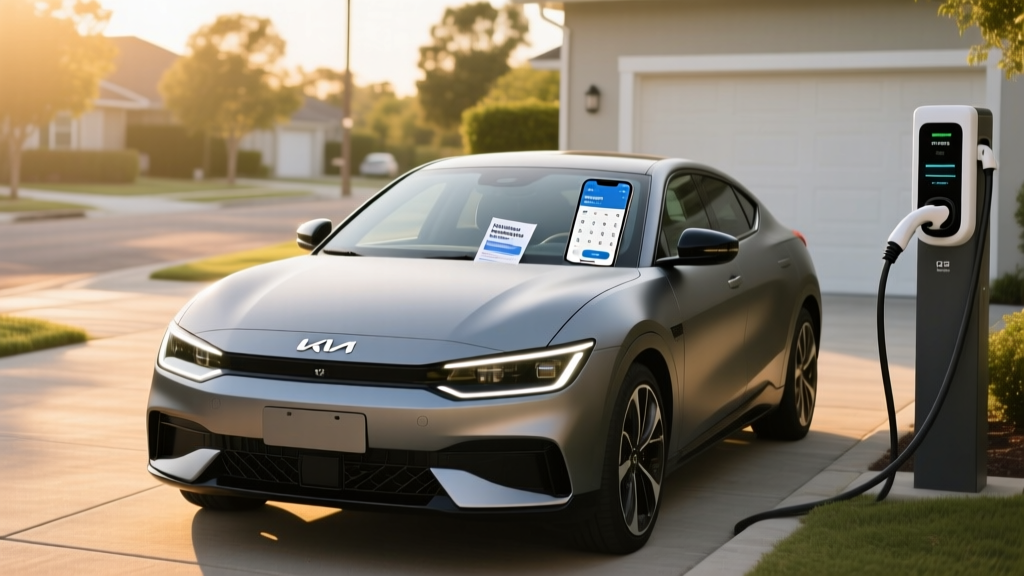
The Kia EV6 remains one of the most searched electric crossovers among lease shoppers, and for good reason. With its 800V E-GMP architecture enabling peak DC fast charging up to 240 kW (10–80% in roughly 18 minutes), an EPA-estimated 310 miles of range on the Long Range RWD trim, and aggressive manufacturer lease support, the EV6 occupies a sweet spot for buyers who want premium EV tech without a premium price tag. But a compelling monthly payment only tells part of the story.
This guide dissects what a 2026 Kia EV6 actually costs to own over five years — factoring in the federal §30D tax credit (up to $7,500 via point-of-sale transfer), real-world electricity costs, insurance premiums, maintenance savings, and depreciation trends. We'll use concrete numbers, not marketing generalizations.
| Spec | Long Range RWD | Long Range AWD | GT |
|---|---|---|---|
| EPA Range | 310 mi | 282 mi | 206 mi |
| Battery (usable) | 77.4 kWh (NMC) | 77.4 kWh (NMC) | 77.4 kWh (NMC) |
| Peak DC Charge | 240 kW | 240 kW | 240 kW |
| 10–80% DC Time | ~18 min | ~18 min | ~18 min |
| Level 2 Rate | 10.9 kW | 10.9 kW | 10.9 kW |
| Horsepower | 225 hp | 320 hp | 576 hp |
| 0–60 mph | 7.2 sec | 5.1 sec | 3.4 sec |
| MPGe (combined) | 134 MPGe | 125 MPGe | 85 MPGe |
| Base MSRP | $42,900 | $46,900 | $61,400 |
| Battery Warranty | 10 yr / 100,000 mi | 10 yr / 100,000 mi | 10 yr / 100,000 mi |
Federal Tax Credit: Do You Qualify Under Current §30D Rules?
The IRS §30D Clean Vehicle Credit offers up to $7,500 for qualifying new EVs, and critically for lease deals, this credit can now be transferred to the dealer at the point of sale — effectively reducing your capitalized cost and lowering monthly payments. However, eligibility is not automatic. The rules have tightened significantly since the Inflation Reduction Act reshaped the landscape.
- MSRP Cap: SUVs/crossovers must have an MSRP ≤ $80,000; sedans ≤ $55,000. The EV6 is classified as an SUV, so the $80,000 cap applies — all trims qualify on price.
- Buyer Income Limits (Modified AGI): Joint filers ≤ $300,000; Head of household ≤ $225,000; Single/other ≤ $150,000. Applies to the tax year of delivery or the prior year (whichever is lower).
- Battery Sourcing — Critical Minerals (½ credit = $3,750): A specified percentage of critical minerals must be extracted or processed in the U.S. or a free-trade-agreement country, or recycled in North America. Thresholds increase annually.
- Battery Sourcing — Components (½ credit = $3,750): A specified percentage of battery components must be manufactured or assembled in North America. Thresholds increase annually.
- Foreign Entity of Concern (FEOC) Exclusion: Beginning 2024 (components) and 2025 (critical minerals), vehicles with battery components or critical minerals from a FEOC (e.g., certain Chinese suppliers) are disqualified entirely.
- Point-of-Sale Transfer: You can elect to transfer the credit to the dealer, reducing your purchase price or lease cap cost — no need to wait for a tax refund.
- VIN Verification: Dealers must report the sale through the IRS Energy Credits Online portal; verify your vehicle qualifies at fueleconomy.gov.
EV6 Credit Reality for 2026: Kia sources battery cells from SK On, which operates manufacturing in Georgia. This North American component production has allowed recent-model EV6 vehicles to qualify for at least partial credit. However, critical-mineral sourcing thresholds tighten each year. Before signing any lease, confirm the exact credit amount the dealer is applying — and verify it against the IRS portal. Tax credit rules are subject to change; consult a tax professional for your specific situation.
5-Year Total Cost of Ownership: The Full Breakdown
A lease typically covers 36 months, but understanding the full 5-year ownership picture helps you evaluate whether to buy at lease-end, re-lease, or compare against purchasing outright. Below is a modeled 5-year TCO for the 2026 EV6 Long Range AWD, assuming 15,000 miles/year, home Level 2 charging at the national average electricity rate, and a Midwestern suburban driving profile.
| Category | 5-Year Cost | Notes |
|---|---|---|
| Vehicle Purchase (MSRP) | $46,900 | Long Range AWD, before incentives |
| Federal Tax Credit (§30D) | −$7,500 | If full credit qualifies; reduces effective price to $39,400 |
| State/Utility Incentives | −$500 to −$2,000 | Varies widely by region; see below |
| Home Level 2 Charger Install | $800–$1,500 | One-time; 240V/48A circuit |
| Charging (5 yrs, 75k mi) | $3,750–$5,625 | $0.10–$0.15/kWh avg; 3.5–4.0 kWh/mi efficiency |
| Insurance (5 yrs) | $9,500–$12,500 | ~$1,900–$2,500/year; higher than gas equivalents |
| Maintenance (5 yrs) | $1,200–$1,800 | Cabin filters, tire rotations, fluid top-offs, wipers |
| Depreciation (5 yrs) | $18,000–$23,000 | Estimated 45–55% of net purchase price |
| Net 5-Year TCO | $55,000–$72,000 | Highly dependent on credit eligibility & electricity rate |
For comparison, a similarly equipped gas crossover (e.g., a midsize turbo AWD SUV at 25 MPG combined, $40,000 MSRP) would cost roughly $11,250 in fuel alone at $3.00/gal over 75,000 miles, plus $3,500–$5,000 in maintenance (oil changes, transmission fluid, brake pads) — but would likely carry lower insurance and stronger near-term resale value.
Charging vs. Gas: The Per-Mile Cost Math
The single largest operating-cost advantage of the EV6 comes from fuel. Let's run the numbers with real figures.
| Metric | Kia EV6 LR AWD | Gas Crossover (25 MPG) |
|---|---|---|
| Energy Source | Electricity | Unleaded (regular) |
| Efficiency | ~28 kWh/100 mi (3.57 mi/kWh) | 25 MPG combined |
| Unit Cost (Home) | $0.13/kWh (national avg) | $3.00/gallon |
| Cost Per Mile (Home) | $0.036 | $0.120 |
| Unit Cost (Public DCFC) | $0.35–$0.48/kWh | $3.00/gallon |
| Cost Per Mile (Public) | $0.10–$0.14 | $0.120 |
| Annual Fuel Cost (15k mi, home) | $540 | $1,800 |
| 5-Year Fuel Cost (home) | $2,700 | $9,000 |
Home charging delivers a roughly 70% per-mile cost reduction versus gasoline. However, if you rely heavily on public DC fast charging (Electrify America, EVgo, etc.), that advantage shrinks dramatically — at $0.40/kWh, the EV6 costs nearly the same per mile as a 25 MPG gas vehicle. This is why home Level 2 access is the single biggest economic factor in EV ownership.
The EV6's 800V architecture shines on road trips: at a 350 kW-capable station, you can add ~180 miles of range in 18 minutes. But note the charge curve — peak 240 kW is sustained only from roughly 10–55% SoC, after which the rate tapers to ~150 kW through 70% and drops further above 80%. Plan your charging stops around the 10–80% window for optimal speed.
Maintenance Savings: What You Actually Skip
EVs eliminate several maintenance categories entirely, but they aren't maintenance-free. Here's a realistic comparison.
| Service Item | Kia EV6 | Gas Crossover |
|---|---|---|
| Oil Changes | $0 (none needed) | $450–$750 (6–10 changes) |
| Transmission Fluid | $0 (sealed reduction gear) | $150–$300 |
| Engine Air Filter | $0 (no engine) | $75–$150 |
| Cabin Air Filter | $150–$250 | $150–$250 |
| Brake Pads/Rotors | $0–$200 (regen extends life significantly) | $600–$1,200 |
| Coolant Flush | $0–$150 (at ~100k mi) | $200–$350 |
| Tire Rotation | $200–$300 | $200–$300 |
| Tire Replacement | $800–$1,400 (EV-specific tires; heavier vehicle + instant torque wear) | $600–$1,000 |
| Wiper Blades/Misc. | $100–$150 | $100–$150 |
| Total (5 yrs) | $1,200–$1,800 | $2,500–$4,500 |
Net maintenance savings run $1,300–$2,700 over five years. The biggest caveat: tire costs are often higher on EVs. The EV6's 4,500+ lb curb weight and instant torque accelerate tire wear. Budget for EV-optimized tires (like the Michelin Pilot Sport EV or Hankook iON evo) at replacement time — they carry a premium but reduce road noise and improve efficiency.
Kia's warranty coverage is a genuine asset: the 10-year/100,000-mile powertrain and battery warranty provides long-term peace of mind, and the 5-year/60,000-mile basic warranty covers most early-ownership repairs.
Insurance Cost Reality: The Hidden Premium
This is where EV ownership economics take a hit that lease calculators often gloss over. EV insurance premiums typically run 15–30% higher than comparable gas vehicles, and the EV6 is no exception.
Why EV insurance costs more:
- Higher repair costs: Battery pack damage from collisions can total a vehicle that would otherwise be repairable. Specialized high-voltage training is required for body shops.
- Parts scarcity: EV-specific components (battery modules, power electronics, heat pump assemblies) can be expensive and slow to source.
- Vehicle value: The EV6's MSRP, even after credits, sits in a premium bracket that insurers price accordingly.
- Total-loss frequency: Insurers are still calibrating repair-vs-replace thresholds for battery damage, leading to more total-loss declarations.
Based on multi-state quote averages, expect $1,900–$2,500/year for full coverage on a 2026 EV6 LR AWD, compared to roughly $1,400–$1,800/year for a comparably priced gas crossover. That's an additional $2,500–$3,500 over five years — a meaningful offset to fuel and maintenance savings.
Cost-reduction strategies: Shop quotes from EV-friendly insurers (Geico, Progressive, and State Farm have competitive EV rates in many states). Bundling with homeowners/renters, maintaining a clean driving record, and selecting higher deductibles can bring premiums closer to gas-car territory.
Depreciation and Resale Value: The EV Market in 2026
Depreciation remains the single largest ownership cost for any vehicle, and EVs have experienced a turbulent resale market over the past few years. After steep depreciation in 2023–2024 driven by Tesla price cuts, new-model proliferation, and rapid charging-tech advancement, the EV resale market has stabilized somewhat heading into 2026.
EV6 Depreciation Outlook:
- Year 1: 15–20% drop from transaction price (typical for new vehicles; mitigated if you applied the $7,500 credit at purchase).
- Years 2–3: 10–12% per year, tracking with mainstream crossovers.
- Years 4–5: 8–10% per year as the vehicle enters the used-EV-credit-eligible market (§25E used EV credit can make 4+ year-old EV6s attractive to second buyers).
- Estimated 5-year retained value: 45–55% of net purchase price (after tax credit).
Key depreciation factors for the EV6:
- Positive: NACS adapter compatibility (giving access to Tesla Superchargers), 800V architecture that remains competitive, strong IIHS Top Safety Pick+ ratings, and Kia's transferable 10-year battery warranty.
- Negative: Rapid advancement in competing platforms (e.g., newer 800V rivals from Hyundai, GM's Ultium models), potential battery degradation concerns for high-mileage examples, and the general EV market's sensitivity to fuel price swings and credit policy changes.
If you're leasing rather than buying, depreciation risk shifts to the lessor. A well-structured EV6 lease with a realistic residual value can actually protect you from the worst depreciation scenarios — which is one reason EV lease deals remain popular. Just ensure the money factor (lease interest rate) and residual percentage are competitive.
Lease vs. Buy Decision Framework for the EV6
- You want to capture the $7,500 federal credit as a cap-cost reduction even if your tax liability is low (point-of-sale transfer works with leases via the lessor).
- You're uncertain about long-term EV depreciation and want to hand the vehicle back at 36 months.
- You drive under 12,000–15,000 miles/year (lease mileage limits).
- You prefer upgrading to newer EV tech every 3 years as charging speeds and battery chemistry evolve.
- Kia or the dealer is offering subsidized money factors or loyalty cash that make the lease payment significantly below the equivalent finance payment.
- You drive 15,000+ miles/year (lease overage penalties at $0.20–$0.25/mile add up fast).
- You plan to keep the vehicle 5+ years and ride out the depreciation curve.
- You qualify for the full $7,500 federal credit and have sufficient tax liability to use it (or use the point-of-sale transfer).
- You want to avoid lease-end disposition fees and wear-and-tear charges.
- You can secure a purchase APR below 5% (manufacturer-subsidized or through a credit union).
Frequently Asked Questions
How much does it really cost to own a 2026 Kia EV6 over 5 years?
With the full $7,500 federal tax credit, home charging at $0.13/kWh, and average insurance rates, a 5-year total cost of ownership for the EV6 Long Range AWD falls in the $55,000–$72,000 range. The biggest variables are whether you qualify for the full tax credit, your local electricity rate, your insurance premium, and actual depreciation at resale.
Do I qualify for the $7,500 federal EV tax credit on the EV6?
Eligibility depends on three factors: (1) your modified adjusted gross income must be ≤ $300,000 (joint), $225,000 (head of household), or $150,000 (single); (2) the vehicle MSRP must be ≤ $80,000 for SUVs (all EV6 trims qualify); and (3) the vehicle must meet battery critical-mineral and component sourcing requirements, which tighten annually. The credit can be transferred to the dealer at point of sale, reducing your lease cap cost or purchase price. Always verify eligibility through the IRS portal and consult a tax professional.
How much do I save on fuel and maintenance vs. a gas crossover?
Charging at home, the EV6 costs roughly $0.036/mile versus $0.12/mile for a 25 MPG gas crossover — saving about $6,300 in fuel over 75,000 miles. Maintenance savings add another $1,300–$2,700 over five years (no oil changes, minimal brake wear from regenerative braking). Combined operating savings of $7,600–$9,000 are realistic, partially offset by higher insurance premiums of $2,500–$3,500 over the same period.
Are EVs more expensive to insure than gas cars?
Yes, typically 15–30% more. For the EV6, expect $1,900–$2,500/year for full coverage versus $1,400–$1,800 for a comparable gas crossover. Higher repair costs for battery and high-voltage components, specialized shop requirements, and total-loss frequency drive the premium. Shopping multiple insurers and bundling policies can reduce the gap.
How well does the Kia EV6 hold its value?
The EV6 retains an estimated 45–55% of its net purchase price after 5 years, which is competitive within the EV segment but generally trails top gas-powered crossovers. Kia's 10-year/100,000-mile battery warranty (transferable to second owners), NACS Supercharger access via adapter, and IIHS Top Safety Pick+ rating support resale. However, rapid EV technology advancement and market-wide price competition continue to pressure used EV values. Leasing transfers this depreciation risk to the lessor.
What's the real-world range of the EV6 Long Range AWD?
The EPA rates it at 282 miles. In real-world highway driving at 70–75 mph, expect 240–260 miles. In cold weather (below 30°F), plan for 200–225 miles. The EV6's heat pump helps preserve range in winter compared to EVs without one, but physics demands a battery-energy trade-off for cabin heating regardless.
Is the EV6's 800V charging still competitive in 2026?
Yes. While more manufacturers have adopted 800V architectures (Hyundai Ioniq 5/6, Porsche Taycan, newer GM Ultium vehicles), the EV6's peak 240 kW DC charging rate and 10–80% time of ~18 minutes remain among the fastest in its price class. The key advantage on road trips is sustained charge speed — the EV6 holds high kW rates longer through the mid-SoC window than many 400V competitors that peak lower and taper earlier.