Quick Verdict: A Driver-Focused EV With a Cabin That Punches Above Its Price
The Kia EV6 remains one of the most compelling electric crossovers on the market, and its interior is a big reason why. With its dual 12.3-inch curved displays, ambient lighting, and a flat floor enabled by the E-GMP platform, the Kia EV6 interior feels a generation ahead of rivals like the Volkswagen ID.4 and Toyota bZ4X — and trades blows with the Hyundai Ioniq 5 and Tesla Model Y in perceived quality. But beyond the cabin aesthetics, buyers need to know the numbers: how far it really goes, how fast it charges, and whether the federal tax credit applies in 2026.
This review breaks down every spec that matters — EPA range, real-world efficiency, DC fast-charging curves, battery chemistry, and total pricing after incentives — so you can decide if the EV6 fits your driving life.
Range, Battery, and Real-World Efficiency
The 2026 Kia EV6 is available with two battery configurations. The Standard Range model uses a 58 kWh (usable) lithium-ion pack with NMC (nickel-manganese-cobalt) chemistry, while the Long Range variant steps up to a 77.4 kWh usable NMC battery. Kia has not adopted LFP (lithium iron phosphate) for the EV6 as of the 2026 model year — that chemistry, which offers longer cycle life but lower energy density, is reserved for lower-priced models in Kia's future lineup.
| Trim / Drivetrain | Battery (kWh usable) | EPA Range (mi) | MPGe (city/hwy/combined) | kWh/100 mi |
|---|---|---|---|---|
| Light RWD (Standard Range) | 58.0 | 232 | 134 / 114 / 125 | 27 |
| Wind RWD (Long Range) | 77.4 | 310 | 134 / 114 / 125 | 27 |
| Wind AWD (Long Range) | 77.4 | 282 | 117 / 99 / 109 | 31 |
| GT-Line AWD (Long Range) | 77.4 | 282 | 117 / 99 / 109 | 31 |
| GT AWD (Performance) | 77.4 | 206 | 85 / 74 / 80 | 42 |
The EPA-rated 310 miles for the Wind RWD is achievable in mixed city/suburban driving at moderate temperatures (60-80°F). On sustained highway trips at 70-75 mph, expect 250-270 miles before needing a charge. In cold weather (below 32°F), range drops 20-30% due to cabin heating and reduced battery efficiency — plan for 215-250 miles from the Long Range RWD. The EV6's heat pump (standard on Long Range trims) helps mitigate winter losses compared to EVs without one. The GT trim's 206-mile EPA rating is optimistic for aggressive driving; real-world highway range often falls between 170-190 miles.
For authoritative efficiency data, the EPA's fueleconomy.gov lists the EV6 across all trims with verified MPGe figures.
Charging Speed: DC Fast, Level 2, and the 800V Advantage
The EV6's 800-volt electrical architecture remains its biggest charging advantage. While most competitors (including the Tesla Model Y and Ford Mustang Mach-E) use 400V systems that peak around 150 kW, the EV6 can accept up to 240 kW at a compatible DC fast charger — meaning shorter stops on road trips.
| Charging Level | Power / Rate | Time / Miles Added |
|---|---|---|
| Level 1 (120V household) | ~1.4 kW | ~4 mi/hr (Long Range) |
| Level 2 (240V home / public) | 10.9 kW (max onboard) | ~34 mi/hr; full charge in ~7.3 hr (77.4 kWh) |
| DC Fast Charge (peak) | Up to 240 kW | 10-80% in ~18 min (Long Range, 350 kW station) |
| DC Fast Charge (50 kW station) | 50 kW | 10-80% in ~73 min |
Charging curve reality check: The 240 kW peak is achieved between roughly 10-45% State of Charge (SoC). Above 55%, the rate tapers to ~150 kW, and above 80% it drops further to protect battery health — typical for NMC chemistry. At a 150 kW Electrify America or EVgo station (more common than 350 kW units), the EV6 will charge at the station's maximum, yielding a 10-80% time of approximately 25-28 minutes. Always precondition the battery using the navigation-linked preconditioning feature for optimal charge speeds in cold weather.
The EV6 uses the CCS1 connector for DC fast charging and J1772 for Level 2. A NACS adapter is not included for 2026, though Kia has confirmed future models will adopt the Tesla-style NACS port natively.
The Kia EV6 Interior: Design, Tech, and Space
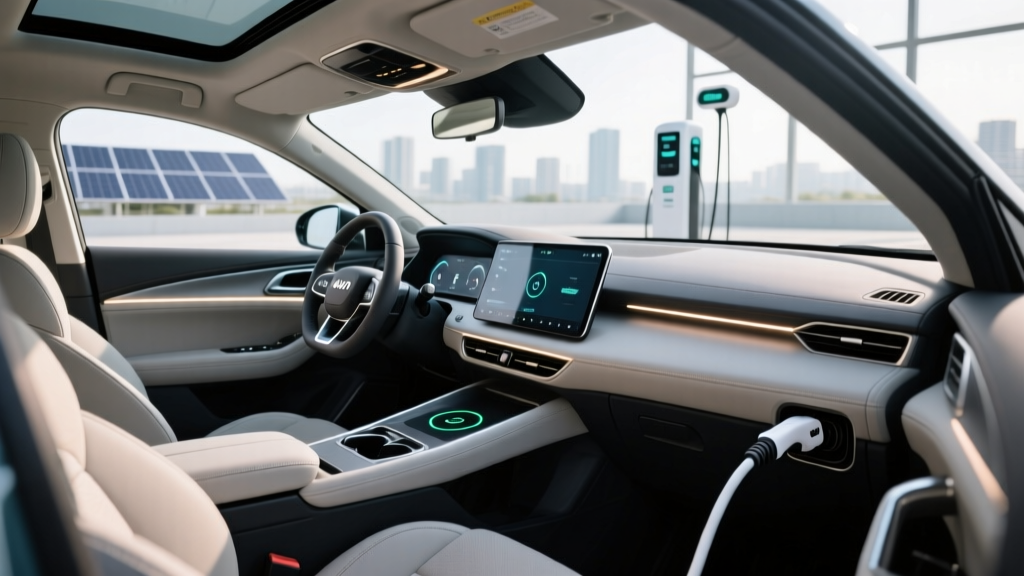
Step inside the EV6 and the first thing you notice is the panoramic curved display — twin 12.3-inch screens (one for the instrument cluster, one for infotainment) housed under a single glass panel. The layout is driver-oriented, with a slight cant toward the driver's seat. Lower trims (Light, Wind) use a combination of fabric and synthetic leather, while GT-Line and GT trims feature full synthetic suede and leather bolsters with contrast stitching.
Infotainment and Connectivity
- Wireless Apple CarPlay and Android Auto (standard all trims)
- Navigation-based smart cruise control with machine learning (adapts to your driving style)
- Over-the-air (OTA) software updates for powertrain calibration, infotainment, and ADAS
- Available head-up display (HUD) with augmented-reality navigation arrows (GT-Line and above)
- Dual-zone climate control with rear vents; heat pump standard on Long Range trims
- USB-C ports front and rear (4 total), plus a wireless charging pad
Passenger and Cargo Dimensions
| Measurement | Dimension |
|---|---|
| Front headroom | 39.4 in |
| Rear headroom | 38.0 in |
| Front legroom | 41.7 in |
| Rear legroom | 39.4 in |
| Cargo (behind rear seats) | 24.4 cu ft |
| Cargo (rear seats folded) | 50.2 cu ft |
| Frunk (front trunk) | 0.7 cu ft (AWD) / 1.8 cu ft (RWD) |
The flat floor — a benefit of the dedicated E-GMP EV platform — gives the rear seat an airy, limousine-like feel. However, the sloping roofline cuts into cargo height for taller items, and the frunk is disappointingly small compared to the Hyundai Ioniq 5's 0.85 cu ft or the Ford Mustang Mach-E's 4.7 cu ft. For families, the 24.4 cu ft behind the rear row fits two large suitcases and a stroller, but a full Costco run requires folding one or both rear seatbacks.
Notable Interior Drawbacks
- Touch-sensitive climate controls: The haptic buttons below the main screen lack physical feedback — a frequent complaint during bumpy drives.
- Limited frunk space: Barely fits a charging cable bag.
- No rear wiper: The fastback design means rain and road grime accumulate on the rear glass with no way to clear it — a real annoyance in wet climates.
- Glare on curved display: In direct sunlight, the panoramic screen can wash out more than flat-panel competitors.
Performance, Drivetrain, and Driving Dynamics
The EV6 lineup spans efficient commuters to legitimate performance machines. Here's the powertrain breakdown:
| Trim | Drivetrain | Horsepower | Torque (lb-ft) | 0-60 mph |
|---|---|---|---|---|
| Light / Wind RWD | Rear-wheel drive | 167 (Std Range) / 225 (Long Range) | 258 | 7.3 sec (LR) / 8.0 sec (SR) |
| Wind / GT-Line AWD | Dual-motor AWD | 320 | 446 | 4.6 sec |
| GT AWD | Dual-motor AWD (performance-tuned) | 576 | 545 | 3.4 sec |
The RWD Long Range is the sweet spot for most buyers: 225 hp is plenty for highway merging, and the single-motor layout maximizes range. The AWD dual-motor trims add genuine quickness (4.6 seconds to 60 mph beats most gas-powered sport SUVs), while the GT is a bonafide performance EV that rivals the Tesla Model Y Performance and Porsche Taycan in straight-line speed.
Regenerative braking is adjustable via steering-wheel paddles, from coasting (Level 0) to near one-pedal driving (Level 3, which brings the car to a complete stop). The i-PEDAL mode enables true one-pedal operation. Brake feel is progressive and natural — a common weak point in EVs that Kia has gotten right.
Pricing, Trims, and Federal Tax Credit Eligibility
For the 2026 model year, Kia has streamlined the EV6 trim structure. All prices below include the $1,375 destination charge.
| Trim | MSRP (incl. destination) | Federal §30D Credit (potential) | Effective Price |
|---|---|---|---|
| Light RWD (Standard Range) | $42,900 | Up to $7,500* | ~$35,400 |
| Wind RWD (Long Range) | $48,700 | Up to $7,500* | ~$41,200 |
| Wind AWD (Long Range) | $52,400 | Up to $7,500* | ~$44,900 |
| GT-Line AWD (Long Range) | $56,500 | Up to $7,500* | ~$49,000 |
| GT AWD | $64,900 | Up to $7,500* | ~$57,400 |
*Federal tax credit eligibility is NOT guaranteed and depends on multiple IRS §30D requirements. See checklist below.
- MSRP cap: Vehicle base price must be ≤ $80,000 for SUVs/crossovers (all EV6 trims qualify).
- Buyer income cap: Modified AGI must not exceed $150,000 (single), $225,000 (head of household), or $300,000 (joint filers).
- Battery sourcing: A percentage of critical minerals and battery components must be sourced from the US or FTA partners — this threshold increases annually. Kia's battery supply chain has partially qualified in prior years, but the exact credit amount ($3,750 or $7,500) depends on current-year sourcing compliance.
- Point-of-sale transfer: You can transfer the credit to the dealer at purchase to reduce your out-of-pocket cost, rather than waiting to claim it on your tax return.
- Final assembly: Must occur in North America. The EV6 is currently assembled in South Korea, which disqualifies it from the new-vehicle §30D credit unless Kia has shifted production. Check the IRS clean vehicle credit page and fueleconomy.gov's credit lookup tool for the latest status before purchasing.
⚠️ Critical note: Because the EV6 is built in South Korea, it has historically not qualified for the new-vehicle federal credit. However, it may qualify for state-level incentives (check your state's energy office) and the used EV credit (§25E, up to $4,000) if purchasing a pre-owned EV6 from a dealer. Always consult a tax professional and verify current IRS guidance before making a purchase decision.
Warranty Coverage and Long-Term Battery Outlook
Kia backs the EV6 with one of the strongest warranty packages in the EV segment:
- Basic vehicle warranty: 5 years / 60,000 miles
- Powertrain warranty: 10 years / 100,000 miles
- Battery warranty: 10 years / 100,000 miles (covers capacity below 70% of original)
- Roadside assistance: 5 years / 60,000 miles
The 70% battery capacity retention threshold is standard for the industry (Tesla uses the same benchmark). NMC batteries in the EV6 have shown approximately 8-12% degradation over the first 100,000 miles based on owner-reported data from early 2022-2024 models — well within the warranty threshold. To maximize longevity, avoid routinely charging to 100% for daily use (set the charge limit to 80% for commuting) and use DC fast charging sparingly when Level 2 is available.
How It Compares: EV6 vs. Key Rivals
| Spec | Kia EV6 (Wind RWD) | Hyundai Ioniq 5 (SEL RWD) | Tesla Model Y (Long Range RWD) | Ford Mustang Mach-E (Premium RWD) |
|---|---|---|---|---|
| EPA Range | 310 mi | 303 mi | 320 mi | 290 mi |
| Battery (kWh usable) | 77.4 | 77.4 | 75.0 | 72.0 |
| Peak DC Charge | 240 kW | 240 kW | 250 kW | 150 kW |
| 10-80% DCFC | ~18 min | ~18 min | ~25 min | ~38 min |
| 0-60 mph | 7.3 sec | 7.4 sec | 6.5 sec | 6.1 sec |
| Cargo (rear seats up) | 24.4 cu ft | 27.2 cu ft | 30.2 cu ft | 29.7 cu ft |
| Base MSRP | $48,700 | $47,500 | $46,990 | $45,995 |
| Battery Warranty | 10 yr / 100k mi | 10 yr / 100k mi | 8 yr / 120k mi | 8 yr / 100k mi |
Choose the Kia EV6 if: You prioritize charging speed (800V architecture), prefer a driver-focused cockpit with premium materials, want the longest battery warranty in the segment, and value distinctive styling over maximum cargo space.
Choose the Hyundai Ioniq 5 if: You want a similar platform with more cargo room (27.2 cu ft), a more spacious frunk, and a retro-futuristic design — at a slightly lower starting price.
Choose the Tesla Model Y if: You need maximum cargo capacity, want access to the Supercharger network natively (NACS port), and value software/Autopilot features — but accept a plainer interior and older platform feel.
Choose the Ford Mustang Mach-E if: You want the most engaging steering feel in the segment, a large frunk, and a lower entry price — but can accept slower DC charging (150 kW peak).
Pros, Cons, and Who Should Buy the EV6
✅ Pros
- 800V architecture enables class-leading 240 kW DC charging
- Premium interior with dual curved displays and excellent build quality
- Industry-best 10-year / 100,000-mile battery and powertrain warranty
- Spacious rear seat with flat floor (39.4 in legroom)
- GT trim offers supercar-level 3.4-second 0-60 mph
- Standard heat pump on Long Range trims for winter efficiency
- Adjustable regen with true one-pedal driving mode
❌ Cons
- South Korean assembly likely disqualifies from new-vehicle §30D federal credit
- Small frunk (0.7-1.8 cu ft) and modest cargo area for the class
- No rear wiper on the fastback glass
- Touch-sensitive climate controls are distracting while driving
- CCS1 connector (no native NACS; adapter-dependent for Supercharger access)
- GT trim's 206-mile EPA range is limiting for road trips
- Display glare in direct sunlight
Who the EV6 Suits Best
- Daily commuters (30-80 miles round trip): The Wind RWD at 310 miles EPA means charging 2-3 times per week on Level 2 — effortless.
- Tech-forward couples: The interior ambiance and dual-screen setup feel premium without the luxury-badge price.
- Performance seekers on a budget: The GT at ~$65K delivers 576 hp and a 3.4-second 0-60 for tens of thousands less than a Taycan.
- Cold-climate drivers: The standard heat pump and battery preconditioning make the EV6 a strong winter performer.
Less ideal for: Large families needing max cargo (look at the Ioniq 5 or Model Y), buyers who rely on the Tesla Supercharger network (CCS-only for now), and anyone counting on the full $7,500 federal credit to make the math work.
Frequently Asked Questions
What is the real-world range of the 2026 Kia EV6?
The Wind RWD Long Range achieves 310 miles EPA-rated. In real-world highway driving at 70-75 mph, expect 250-270 miles. In winter conditions (below freezing), plan for 215-250 miles. The AWD trims lose about 28 miles EPA and proportionally more in cold weather.
How fast does the EV6 charge at home and on the road?
At home on a 240V Level 2 charger (10.9 kW), the Long Range battery charges from empty to full in about 7.3 hours, adding roughly 34 miles per hour of charging. On a 350 kW DC fast charger, it peaks at 240 kW and reaches 10-80% in approximately 18 minutes. At more common 150 kW stations, expect 25-28 minutes for the same 10-80% session.
Does the 2026 Kia EV6 qualify for the federal EV tax credit?
Likely not for new purchases. The EV6 is assembled in South Korea, and the IRS §30D credit requires final assembly in North America. This is the single biggest financial drawback. However, the EV6 may qualify for state incentives (which vary by jurisdiction — check your state's energy office) and the used EV credit (§25E, up to $4,000) if you buy a pre-owned model from a dealer. Always verify current eligibility on the IRS website and consult a tax professional.
Is the Kia EV6 interior better than the Tesla Model Y?
By most measures, yes. The EV6 offers higher-quality materials, physical buttons alongside touchscreens, ambient lighting, a head-up display, and a more driver-focused layout. The Model Y counters with a minimalist aesthetic some buyers prefer, a larger 15-inch center screen, and more cargo space. If interior ambiance and build quality are priorities, the EV6 wins this comparison convincingly.
What's the biggest drawback of the Kia EV6?
The combination of South Korean assembly (disqualifying it from the $7,500 federal credit) and relatively modest cargo space for the crossover segment. The frunk is nearly useless, and 24.4 cu ft behind the rear seats trails the Model Y (30.2) and Mach-E (29.7). If you regularly haul large items, test-load your typical cargo before buying.
How long will the EV6 battery last?
Kia warranties the battery for 10 years or 100,000 miles against capacity loss below 70%. Early owner data from 2022-2024 models suggests approximately 8-12% degradation over 100,000 miles with mixed charging habits. With proper care (80% daily charge limit, moderate DCFC use, preconditioning in cold weather), the NMC battery should comfortably last 150,000-200,000 miles before approaching the warranty threshold.