The ICCU Problem That Haunts the Kia EV6 — And What It Means for 2026 Buyers
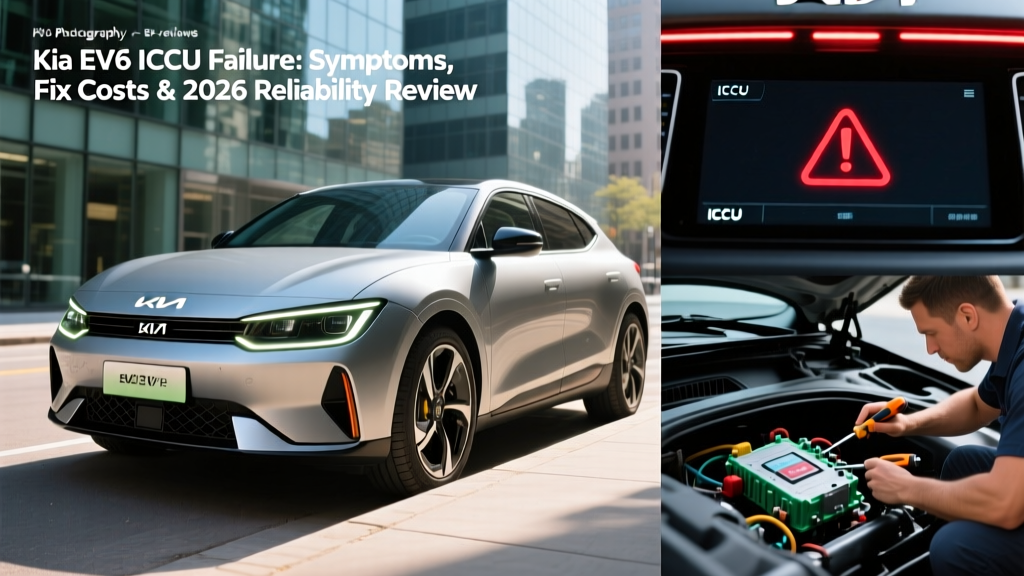
Search forums, Reddit threads, or Kia owner groups for "EV6 ICCU" and you'll find hundreds of posts from owners stranded with dead 12-volt batteries, mysterious warning lights, and tow-truck rides to dealerships. The Integrated Charging Control Unit — the component that manages the EV6's high-voltage to low-voltage power conversion — became the single most discussed reliability issue on Hyundai Motor Group's E-GMP platform vehicles (Kia EV6, Hyundai Ioniq 5, Genesis GV60) from 2022 through 2024.
For 2026, Kia has implemented hardware and software revisions to address these failures. But if you're shopping for a new or used EV6, understanding the ICCU's role, failure patterns, recall history, and what the 2026 model year changes actually fix is essential before you sign a purchase agreement.
This review covers the ICCU issue in depth, then evaluates the 2026 Kia EV6 as a complete package — range, charging, performance, pricing, tax credits, and whether it remains competitive against the Tesla Model Y, Ford Mustang Mach-E, and Hyundai Ioniq 5.
What Is the ICCU and Why Does It Fail?
The Integrated Charging Control Unit (ICCU) is a power electronics module that serves two critical functions in the EV6:
- DC-DC conversion: Steps down the high-voltage traction battery (77.4 kWh pack at ~697V nominal) to 12V to run the vehicle's accessory systems — infotainment, lighting, power steering, brake booster, thermal management controllers, and the battery management system itself.
- Integrated charging management: Coordinates AC Level 2 onboard charging and manages power flow during DC fast charging sessions.
When the ICCU fails, the 12V system loses its power source. The vehicle's 12V auxiliary battery drains rapidly because it's supporting all low-voltage loads without replenishment. Once the 12V battery drops below a critical threshold, the car cannot close the high-voltage contactors — meaning the main traction battery is effectively disconnected, and the car won't drive.
Common ICCU Failure Symptoms
Owners of 2022-2024 EV6 models reported these warning signs, often appearing between 10,000 and 30,000 miles:
- "Check Electric Vehicle System" warning on the instrument cluster
- 12V battery warning light illumination
- Inability to start/drive the vehicle despite high state of charge on the main battery
- Repeated 12V battery drain requiring jump-starts (which only provide temporary relief)
- Loss of accessory power while parked (dashcam footage loss, phone charging failure)
- Diagnostic trouble codes P0A09, P0A1F, or U3000-related communication faults
Root Cause Analysis
Based on service bulletins and owner reports, the primary failure modes include:
- Thermal stress on power MOSFETs: The DC-DC converter section generates significant heat during sustained high-load operation (simultaneous HVAC, heated seats, and fast charging). Early ICCU revisions had insufficient thermal margin.
- Solder joint fatigue: Thermal cycling — particularly in regions with extreme temperature swings — caused micro-cracks in the PCB solder joints connecting power stages.
- Software-driven overcurrent events: Certain firmware versions allowed transient current spikes during mode transitions (e.g., switching from charge mode to drive mode) that stressed components beyond rated limits.
2026 Kia EV6: What Changed and Does the ICCU Issue Persist?
For the 2026 model year (which includes the facelifted EV6 that debuted for 2025 with continued refinements), Kia implemented several changes to the E-GMP platform's power electronics:
- Revised ICCU hardware (Gen 2.1): Upgraded MOSFETs with higher thermal ratings, improved potting compound for vibration/moisture resistance, and redesigned PCB layout with reinforced solder joints on high-current paths.
- Updated firmware: Smoother mode transitions, more conservative current limiting during thermal edge cases, and improved diagnostic granularity for early fault detection.
- Enhanced 12V battery monitoring: The BMS now proactively activates the DC-DC converter to replenish the 12V battery at more aggressive SoC thresholds, reducing the window where a marginal ICCU could allow complete 12V drain.
As of early 2026, owner forums show a significant reduction in ICCU failure reports on 2025-2026 build vehicles compared to 2022-2024 units. However, the sample size on 2026 models is still maturing — most 2026 EV6s haven't yet accumulated the 15,000-25,000 miles where early failures historically appeared.
Recall and Warranty Coverage
Kia issued recalls and service campaigns for affected 2022-2024 vehicles to inspect and replace ICCU units showing early degradation markers. According to NHTSA recall databases, owners should verify any open recalls by entering their VIN before purchasing a used EV6.
All EV6 models carry Kia's powertrain warranty, which covers the ICCU as part of the high-voltage electrical system:
- EV Components Warranty: 10 years / 100,000 miles (covers traction battery, drive motors, ICCU, onboard charger)
- Limited Warranty: 5 years / 60,000 miles (bumper-to-bumper)
- Anti-Perforation: 5 years / 100,000 miles
If you're buying a used 2022-2024 EV6, confirm the ICCU has been inspected/replaced under the recall campaign and that the vehicle's warranty remains intact (Kia's warranty is transferable to subsequent owners).
2026 Kia EV6 Full Specs: Range, Charging, and Performance
Beyond the ICCU story, the 2026 EV6 remains one of the most capable midsize electric crossovers. Here's the complete spec breakdown across the current lineup:
| Spec | Light RWD | Wind RWD | Wind AWD | GT-Line AWD | GT |
|---|---|---|---|---|---|
| Battery (usable) | 58.0 kWh (NMC) | 77.4 kWh (NMC) | 77.4 kWh (NMC) | 77.4 kWh (NMC) | 77.4 kWh (NMC) |
| EPA Range | 232 mi | 310 mi | 282 mi | 282 mi | 206 mi |
| Horsepower | 167 hp | 225 hp | 320 hp | 320 hp | 576 hp |
| 0-60 mph | 7.3 sec | 6.2 sec | 4.5 sec | 4.5 sec | 3.4 sec |
| Drivetrain | RWD (single motor) | RWD (single motor) | AWD (dual motor) | AWD (dual motor) | AWD (dual motor) |
| Max DC Fast Charge | 180 kW | 240 kW | 240 kW | 240 kW | 240 kW |
| 10-80% DC Time | ~22 min | ~18 min | ~18 min | ~18 min | ~18 min |
| Level 2 Rate | 7.2 kW (~25 mi/hr) | 10.9 kW (~38 mi/hr) | 10.9 kW (~38 mi/hr) | 10.9 kW (~38 mi/hr) | 10.9 kW (~38 mi/hr) |
| MPGe (combined) | 117 MPGe | 117 MPGe | 106 MPGe | 106 MPGe | 85 MPGe |
| kWh/100 mi | 29 | 29 | 32 | 32 | 40 |
Source: fueleconomy.gov and Kia America specifications. Verify exact figures for your model year at purchase.
The Wind RWD's EPA-estimated 310 miles is achievable in mild-weather city and suburban driving at moderate speeds. Expect ~260-280 miles on highway road trips at 70-75 mph sustained. In cold weather (below 30°F), plan for ~220-250 miles due to battery chemistry resistance and cabin heating load. The AWD models sacrifice ~28 miles of EPA range for the traction and acceleration benefit — a reasonable tradeoff in snow-belt states. The GT's 206-mile EPA range is its most significant practical compromise; aggressive driving can push real-world range below 170 miles.
Charging Speed and Infrastructure
The EV6's 800V architecture remains one of its strongest competitive advantages. While most rivals (Tesla Model Y, Ford Mach-E, VW ID.4) use 400V systems limited to 150-250 kW peak, the EV6's higher voltage allows it to sustain elevated charge rates longer on capable 350 kW DC fast chargers.
| Charge Level | Power (kW) | Miles Added per Hour | Full Charge Time |
|---|---|---|---|
| Level 1 (120V household) | 1.4 kW | ~4-5 mi/hr | ~55+ hours (77.4 kWh) |
| Level 2 (240V, 32A home) | 7.7 kW | ~27 mi/hr | ~10 hours (77.4 kWh) |
| Level 2 (240V, 48A home) | 10.9 kW | ~38 mi/hr | ~7.5 hours (77.4 kWh) |
| DC Fast (350 kW station) | 240 kW peak | ~700+ mi/hr (peak) | 10-80% in ~18 min |
| DC Fast (150 kW station) | ~130 kW avg | ~440 mi/hr (avg) | 10-80% in ~28 min |
| DC Fast (50 kW station) | 50 kW | ~170 mi/hr | 10-80% in ~65 min |
Charging Curve Reality
The "18-minute 10-80%" figure assumes a 350 kW-capable CCS station (or NACS adapter at a Tesla Supercharger V4) with battery preconditioning active. In practice:
- Preconditioning is essential. Navigate to a charger using the EV6's built-in route planner and it will warm the battery to optimal temperature. Without preconditioning, peak rates may be limited to 150-180 kW even on a 350 kW station.
- The charge curve tapers above 60% SoC. The EV6 sustains its peak ~235-240 kW from roughly 10% to 55-60%, then progressively steps down. Charging from 80-100% on DC fast charging is painfully slow — plan to unplug at 80% on road trips.
- Cold weather impact: Below freezing, even with preconditioning, expect peak rates of 170-200 kW and 10-80% times closer to 25-30 minutes.
NACS Adapter and Tesla Supercharger Access
Kia provides a NACS adapter for CCS-equipped EV6 models, enabling access to Tesla's Supercharger network (V3 and V4 stations). This dramatically expands the practical fast-charging map, particularly in rural corridors where Electrify America and other CCS networks have sparser coverage. The adapter supports up to 150 kW at most V3 Superchargers and higher rates at V4 posts.
Pricing, Trims, and Federal Tax Credit Eligibility
| Trim | MSRP | §30D Credit Eligible? | Effective Price (if eligible) |
|---|---|---|---|
| Light RWD | $42,900 | No (not NA-assembled) | $42,900 |
| Wind RWD | $47,500 | No (not NA-assembled) | $47,500 |
| Wind AWD | $51,500 | No (not NA-assembled) | $51,500 |
| GT-Line AWD | $55,900 | No (not NA-assembled) | $55,900 |
| GT | $61,900 | No (not NA-assembled) | $61,900 |
Source: Kia America pricing and IRS §30D guidelines. All prices exclude $1,375 destination charge.
The Tax Credit Problem
As of 2026, the Kia EV6 does not qualify for the $7,500 federal tax credit under IRS §30D. The reason: final assembly must occur in North America, and the EV6 is manufactured in South Korea at Kia's Hwaseong plant (with some production at the Gwangju facility).
This is the EV6's single biggest competitive disadvantage against:
- Tesla Model Y — assembled in Austin, TX and qualifies for $7,500 (point-of-sale transfer available)
- Ford Mustang Mach-E — assembled in Cuautitlán, Mexico (check current eligibility, sourcing rules apply)
- VW ID.4 — assembled in Chattanooga, TN and qualifies for $7,500
The $7,500 gap means a comparably equipped Model Y Long Range AWD (starting ~$44,990, minus $7,500 = ~$37,490 effective) undercuts the EV6 Wind AWD ($51,500) by roughly $14,000 on effective price — a substantial difference that the EV6 must overcome with superior charging speed, interior quality, and driving dynamics.
State and Local Incentives
Some states offer their own EV rebates that don't carry the North American assembly requirement. Check your state's energy office or Alternative Fuels Data Center for current programs. These can partially offset the federal credit gap.
Interior, Cargo, Technology, and Daily Usability
Passenger Space
The EV6's E-GMP platform delivers a flat floor and generous wheelbase (114.2 inches), translating to:
- Front headroom: 39.0 inches
- Front legroom: 41.7 inches
- Rear headroom: 37.8 inches
- Rear legroom: 39.4 inches — best-in-class for the segment, noticeably more than the Model Y (~37.3 in) and comparable to the Ioniq 5
Cargo Volume
- Behind rear seats: 24.4 cu ft
- Rear seats folded: 50.2 cu ft
- Front trunk (frunk): 0.7 cu ft (AWD) / 1.7 cu ft (RWD) — small, useful for charging cables only
Cargo volume trails the Model Y (30.2 cu ft rear / 72.1 cu ft folded) significantly, which matters for families and frequent haulers. The EV6's sloping roofline prioritizes style over maximum utility.
Infotainment and Tech
The 2026 EV6 features dual 12.3-inch curved displays running Kia's latest ccNC (Connected Car Navigation Cockpit) software:
- Wireless Apple CarPlay and Android Auto
- Over-the-air (OTA) software updates
- Digital key (smartphone-as-key via NFC/UWB)
- Vehicle-to-load (V2L) — powers external devices up to 3.6 kW via the interior outlet or charge-port adapter (standard on Wind and above)
- Augmented reality head-up display (GT-Line and GT)
Driver Assistance (ADAS)
Kia's Highway Driving Assist 2 (HDA2) is a SAE Level 2 system — it provides lane centering and adaptive cruise with stop-and-go, but the driver must remain fully engaged with hands on the wheel. It is not autonomous driving. HDA2 is competent for highway commuting but falls short of GM's Super Cruise or Ford's BlueCruise in hands-free capability on mapped highways.
HDA2, Highway Driving Assist, and all current EV6 driver-assistance features are SAE Level 2. The driver must maintain full attention, keep hands on or near the steering wheel, and be prepared to take over immediately. These systems do not make the EV6 self-driving and do not function reliably in construction zones, unmapped roads, or severe weather.
Driving Impressions and Competitive Position
The EV6's driving dynamics remain a strong point. The E-GMP platform's low center of gravity, rear-biased weight distribution, and well-tuned suspension deliver a composed, engaging feel that outperforms most crossover-EV competitors. The steering is communicative by EV standards, and the regenerative braking system — adjustable via paddle shifters from coasting to near-one-pedal driving — is among the most intuitive in the segment.
Key Competitor Comparison
| Spec | Kia EV6 Wind AWD | Tesla Model Y LR AWD | Hyundai Ioniq 5 Limited AWD | Ford Mach-E Premium AWD ER |
|---|---|---|---|---|
| EPA Range | 282 mi | 311 mi | 290 mi | 290 mi |
| Peak DC Charge | 240 kW | 250 kW | 240 kW | 150 kW |
| 10-80% DC Time | ~18 min | ~25 min | ~18 min | ~36 min |
| 0-60 mph | 4.5 sec | 4.8 sec | 4.5 sec | 4.8 sec |
| Cargo (rear seats up) | 24.4 cu ft | 30.2 cu ft | 27.2 cu ft | 29.7 cu ft |
| Federal Credit | $0 | $7,500 | $0 | Check eligibility |
| Starting MSRP (AWD) | $51,500 | $44,990 | $56,500 | $48,995 |
Pros
- Class-leading DC fast charge speed (800V, 18-min 10-80%)
- Outstanding rear-seat legroom (39.4 in)
- Engaging driving dynamics, well-tuned ride
- V2L capability (3.6 kW external power)
- Excellent 10-yr/100,000-mi EV component warranty
- Distinctive exterior design
- Physical buttons complement touchscreen (better than Tesla's screen-only approach)
Cons
- No federal §30D tax credit ($7,500 disadvantage)
- Cargo volume trails Model Y and Mach-E significantly
- ICCU reliability concern on 2022-2024 models (improved in 2025-2026)
- Small frunk, especially on AWD models
- HDA2 is capable but not hands-free like Super Cruise/BlueCruise
- GT trim's 206-mi EPA range is impractical for road trips
- Dealer markups still present in some markets
Who Should Buy the 2026 Kia EV6?
Choose the EV6 if:
- You prioritize fast DC charging above all else (frequent road tripper with access to 350 kW stations)
- You value interior build quality and physical controls over maximum cargo space
- You want a sporty-driving EV crossover that doesn't feel like an appliance
- Rear-seat passenger comfort is a priority (family with older children, rideshare use)
- V2L capability matters for camping, tailgating, or emergency backup power
- You can absorb the $7,500 tax credit gap through state incentives or simply prefer the EV6's overall package
Look elsewhere if:
- Maximum cargo capacity is essential → Tesla Model Y or Ford Mach-E
- You need the $7,500 federal credit to make the math work → Model Y, VW ID.4
- You want hands-free highway driving → GM vehicles with Super Cruise or Ford with BlueCruise
- You're buying used and considering a 2022-2024 model → verify ICCU recall completion and get the service history before committing
Frequently Asked Questions
What is the real-world range of the 2026 Kia EV6?
The Wind RWD achieves an EPA-estimated 310 miles, but expect 260-280 miles on sustained highway driving at 70-75 mph and 220-250 miles in freezing temperatures. City and suburban driving in mild weather can meet or slightly exceed the EPA number thanks to regenerative braking.
How fast does the EV6 charge at home and on the road?
On a 240V Level 2 home charger at 48 amps, the 77.4 kWh battery adds approximately 38 miles of range per hour, reaching a full charge from empty in about 7.5 hours. On a 350 kW DC fast charger with preconditioning, the EV6 charges from 10-80% in approximately 18 minutes — one of the fastest in its class.
Does the 2026 Kia EV6 qualify for the $7,500 federal EV tax credit?
No. Under current IRS §30D rules, the EV6 does not qualify because final assembly occurs in South Korea, not North America. The federal credit requires North American final assembly, plus compliance with MSRP caps ($80,000 for SUVs), buyer income limits ($300,000 joint / $150,000 single), and battery critical-mineral sourcing requirements. Check the IRS clean vehicle credit page for the most current rules.
Is the ICCU problem fixed on 2025-2026 EV6 models?
Kia implemented revised ICCU hardware and firmware starting with the 2025 model year refresh, and early 2026 reports suggest a significant reduction in failures. However, long-term data (beyond 30,000 miles) on the revised units is still accumulating. The 10-year/100,000-mile EV component warranty covers the ICCU regardless.
Is the EV6 worth buying vs. the Tesla Model Y or Hyundai Ioniq 5?
The EV6 offers faster DC charging than the Model Y and more engaging driving dynamics than both rivals. However, the Model Y's $7,500 tax credit advantage, larger cargo area, and Supercharger-native access make it the value leader. The Ioniq 5 shares the E-GMP platform (identical powertrain and charging) with a different design language and slightly more cargo room. If tax credit eligibility is critical, the Model Y wins on price. If charging speed, build quality, and driving feel matter more and you can absorb the credit gap, the EV6 is an excellent choice.
How much does it cost to charge an EV6 at home vs. gas?
At the US average electricity rate of ~$0.17/kWh, fully charging the 77.4 kWh battery costs approximately $13.16, yielding about $0.04-0.05 per mile. A comparable gas crossover at 25 MPG combined with gas at $3.50/gallon costs $0.14 per mile. Home charging saves roughly $0.09-0.10 per mile, or about $1,080-$1,200 annually at 12,000 miles/year. Public DC fast charging at $0.35-0.50/kWh narrows the gap to roughly $0.08-0.10 per mile.
What should I check before buying a used 2022-2024 EV6?
Enter the VIN at NHTSA.gov/recalls to verify all recall campaigns — especially the ICCU inspection/replacement — have been completed. Request service records confirming the ICCU was updated or replaced. Check the 12V battery health (it may have been damaged by repeated deep discharge from a failing ICCU). Confirm the remaining factory warranty transfers to you as the new owner.