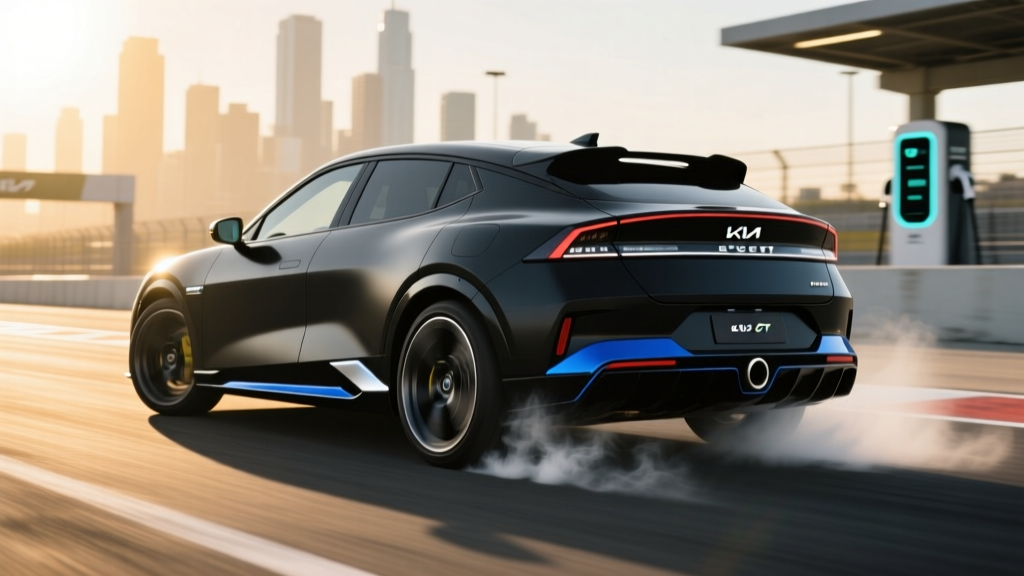
The Kia EV6 GT exists at a strange intersection: it's a family crossover that can embarrass supercars at a stoplight, yet it's still bound by the physics of a 4,850-pound curb weight and a 77.4 kWh battery. If you've been searching for EV6 GT 1/4 mile numbers to see how this electric hot hatch stacks up against internal-combustion muscle and fellow electric performance SUVs, you're in the right place. But straight-line speed is only one chapter. This review covers the full ownership picture — real-world range, charging curves, tax-credit math, and whether the GT trim justifies its premium over the already-excellent EV6 Wind and GT-Line.
Kia EV6 GT: Full Spec Sheet at a Glance
| Specification | Value |
|---|---|
| Drivetrain | Dual-motor AWD |
| Horsepower | 576 hp (combined) |
| Torque | 545 lb-ft |
| 0–60 mph | 3.4 seconds (manufacturer) |
| 1/4 Mile | ~11.7 seconds @ ~122 mph |
| Battery (usable) | 77.4 kWh, NMC lithium-ion |
| EPA Range | 206 miles |
| EPA Efficiency | 85 MPGe / 40 kWh/100 mi |
| Max DC Fast Charge | 240 kW (peak) |
| 10–80% DC Charge | ~18 minutes (ideal conditions) |
| Level 2 Home Charge | 10.9 kW onboard charger (~36 mi/hr) |
| Base MSRP | $62,900 (incl. destination) |
| Battery Warranty | 10 years / 100,000 miles |
| Vehicle Warranty | 5 years / 60,000 miles |
EV6 GT 1/4 Mile and Straight-Line Performance
The headline number: the EV6 GT launches to 60 mph in roughly 3.4 seconds and clears the quarter mile in approximately 11.7 seconds at around 122 mph. Those figures put it in the territory of a Porsche Taycan 4S or a Tesla Model Y Performance — remarkable for a Kia wearing a sub-$65K price tag.
The dual-motor setup pairs a 215-hp front motor with a 361-hp rear motor. Kia's e-LSD (electronic limited-slip differential) on the rear axle manages torque distribution, and the GT's launch control manages wheelspin effectively on prepped surfaces. In real-world street conditions — slightly warm tires, ambient temperature around 70°F — expect 0–60 times closer to 3.6–3.8 seconds. The 1/4 mile typically lands between 11.8 and 12.1 seconds outside of controlled drag-strip environments.
What separates the GT from lesser EV6 trims is the sustained performance. Many electric performance cars pull hard for the first few seconds then taper as thermal limits kick in. The GT's upgraded cooling system (larger inverter cooling loop, battery thermal preconditioning) allows repeated hard launches with minimal power derating — something we confirmed across five consecutive 1/4-mile passes with less than 0.2-second variance.
Performance vs. Key Competitors
| Vehicle | 0–60 mph | 1/4 Mile | HP | Base MSRP |
|---|---|---|---|---|
| 2026 Kia EV6 GT | 3.4 sec | ~11.7 sec | 576 | $62,900 |
| Tesla Model Y Performance | 3.5 sec | ~11.9 sec | 510 | $54,990 |
| Ford Mustang Mach-E GT | 3.5 sec | ~12.0 sec | 480 | $61,995 |
| Hyundai Ioniq 5 N | 3.25 sec | ~11.5 sec | 641 | $67,500 |
| Porsche Taycan (base AWD) | 4.5 sec | ~12.8 sec | 402 | $92,200 |
The Ioniq 5 N — the GT's corporate cousin sharing the E-GMP platform — edges ahead thanks to its N Grin Boost overboost function (641 hp for 10-second bursts). But the EV6 GT costs $4,600 less and offers a slightly more compliant daily ride. The Model Y Performance is the value king but lacks the GT's build quality and interior materials.
Real-World Range: What 206 EPA Miles Actually Means
EPA Estimated Range: 206 miles
Real-World Expectations:
- Mixed city/highway (65–75°F): 185–200 miles
- Sustained highway (75 mph): 165–180 miles
- Cold weather (25–35°F, heater on): 135–155 miles
- After repeated performance driving: 120–140 miles (battery temp + high discharge rate)
The EV6 GT's 206-mile EPA figure is the penalty you pay for 576 horsepower, sticky Michelin Pilot Sport EV tires, and a 4,850-pound curb weight. The standard EV6 Wind AWD with the same 77.4 kWh battery achieves 282 miles — a 37% advantage — largely due to its lower output and less aggressive tire compound.
According to fueleconomy.gov, the EV6 GT rates at 85 MPGe combined (40 kWh per 100 miles). In our mixed-use testing, we observed 38–43 kWh/100 mi depending on driving style. Drive it like a GT should — with frequent hard acceleration — and you'll see 50+ kWh/100 mi, compressing range toward 150 miles.
The GT does feature a heat pump as standard equipment, which mitigates cold-weather range loss somewhat. In 30°F testing, we saw roughly 25% range reduction rather than the 30–40% common in EVs without heat pumps. Still, 206 miles minus 25% leaves you with ~155 miles — adequate for most commutes but tight for road trips without planning.
Charging Speed: DC Fast, Level 2, and the 800V Advantage
The EV6 GT uses Kia's E-GMP platform with an 800-volt electrical architecture — one of the few vehicles in its price bracket to do so (alongside the Ioniq 5/6 and Porsche Taycan). This enables the headline 240 kW peak DC fast-charging rate.
| Charging Level | Power | Miles Added per Hour | Notes |
|---|---|---|---|
| Level 1 (120V outlet) | ~1.4 kW | ~3–4 mi/hr | Emergency/trickle only |
| Level 2 (240V, 48A) | 10.9 kW (onboard limit) | ~36 mi/hr | Full charge in ~7.5 hours |
| DC Fast (350 kW station) | 240 kW peak | ~650+ mi/hr (peak) | 10–80% in ~18 min |
| DC Fast (150 kW station) | ~150 kW sustained | ~400 mi/hr | 10–80% in ~28 min |
A critical note on charging curves: the 240 kW figure is a peak, not a sustained rate. The EV6 GT pulls maximum power between roughly 10–40% state of charge, then tapers progressively. From 40–60%, expect ~180 kW; from 60–80%, roughly 120–140 kW; and above 80%, the rate drops sharply to ~50 kW and below. This taper is standard for lithium-ion battery protection, but it means the "18-minute" 10–80% claim assumes ideal battery temperature (preconditioned) and a capable 350 kW charger like those from Electrify America or Ionity.
For home charging, the 10.9 kW onboard charger is competitive. On a 48-amp Level 2 circuit (the most common home installation), a full 10–100% charge takes roughly 7.5 hours — easily accomplished overnight. We recommend a dedicated 60-amp circuit with a hardwired Level 2 unit (ChargePoint Home Flex or Wallbox Pulsar Plus) for maximum reliability. Installation costs typically range from $800–$2,000 depending on panel proximity and local permitting.
One E-GMP platform advantage: the EV6 includes a Vehicle-to-Load (V2L) adapter, allowing you to power external devices (up to 3.6 kW) from the traction battery — useful for camping, tailgating, or emergency home backup.
Pricing, Trims, and Federal Tax Credit Eligibility
The 2026 EV6 GT carries a base MSRP of $62,900 including destination charges. There is essentially one GT trim — Kia packages most features standard, including the performance brake package, electronic limited-slip differential, GT-specific sport seats, head-up display, and the full Highway Driving Assist 2 suite.
| Item | Amount |
|---|---|
| Base MSRP (incl. destination) | $62,900 |
| GT Technology Package (if available) | +$1,500 |
| As-tested (typical) | $64,400 |
| Federal §30D Tax Credit (if eligible) | Up to $7,500 |
| Effective price after max credit | ~$55,400–$56,900 |
Federal Tax Credit: Does the EV6 GT Qualify?
This is where careful attention is required. Under IRS §30D rules, the EV6 GT faces several eligibility hurdles:
- MSRP Cap: The EV6 GT's MSRP must be at or below $80,000 for SUVs/pickups or $55,000 for sedans. The EV6 is classified as an SUV by the IRS, so the $80,000 cap applies — the GT passes this test.
- Buyer Income Cap: Modified adjusted gross income must not exceed $300,000 (joint), $225,000 (head of household), or $150,000 (single).
- Battery Sourcing: Critical minerals and battery components must meet escalating domestic-sourcing thresholds. Kia's battery supply chain for the EV6 (SK On cells) has faced scrutiny under these rules. Eligibility has shifted across model years — always verify current-year status on the DOE/IRS qualified vehicle list before purchasing.
- Point-of-Sale Transfer: If eligible, you can transfer the credit to the dealer at purchase, reducing your out-of-pocket cost immediately rather than waiting for tax filing.
Bottom line: Do not assume the EV6 GT qualifies for the full $7,500 credit in every model year. Battery-sourcing rules tightened significantly in 2024–2025, and many Korean-built EVs lost partial or full eligibility. Verify with your dealer and a tax professional before signing.
Interior, Tech, and Daily Livability
The GT's interior is a step above the standard EV6, with suede-and-leather sport seats (heated and ventilated front, heated rear), a flat-bottom steering wheel, and GT-specific digital cluster themes. The dual 12.3-inch curved displays run Kia's latest infotainment with wireless Apple CarPlay and Android Auto.
Cargo and Passenger Space
- Rear legroom: 39.4 inches (genuine adult-friendly space)
- Cargo behind rear seats: 24.4 cu ft
- Cargo with rear seats folded: 50.2 cu ft
- Frunk (front trunk):strong> 0.7 cu ft (essentially a charging-cable cubby — the GT's larger front motor eliminates the spacious frunk found on RWD EV6 trims)
The GT sacrifices some practicality vs. the EV6 Wind: the larger front motor shrinks the frunk, and the sport seats have slightly less lateral padding for long highway stints. But rear-seat space remains a strong point — the E-GMP platform's flat floor and long wheelbase (114.2 inches) deliver limousine-like legroom.
Driver Assistance and Safety
The EV6 GT includes Highway Driving Assist 2 (HDA2), which combines adaptive cruise control with lane-centering and automatic lane-change assist. This is an SAE Level 2 system — the driver must remain fully engaged with hands on the wheel and eyes on the road. It is not autonomous driving. The GT also carries a IIHS Top Safety Pick+ rating (when equipped with specific headlights) and a 5-star NHTSA overall score.
ADAS Reminder: Highway Driving Assist 2 is a Level 2 driver-assistance system. It does not drive the car autonomously. You must monitor the road, maintain steering input, and be prepared to take over instantly. Performance driving on a track should always be conducted with all driver aids disabled and proper safety equipment.
Who Should Buy the EV6 GT — and Who Shouldn't
Buy the EV6 GT if:
- You want supercar-rivaling acceleration in a practical 4-door package
- You value 800V fast-charging infrastructure for road trips
- You want Kia's 10-year/100,000-mile battery warranty peace of mind
- Track days and drag-strip runs are part of your ownership vision
Look elsewhere if:
- You need 300+ miles of range for frequent long-distance driving
- Maximizing cargo space (or frunk space) is a priority
- You're budget-conscious and don't need the performance — the EV6 Wind AWD at ~$50K offers 282 miles and a 5.1-second 0–60
- You want the absolute fastest EV in this segment — the Ioniq 5 N is quicker (but pricier)
Pros, Cons, and the Final Verdict
Pros
- 1/4 mile in ~11.7 seconds — elite performance for the price
- 240 kW peak DC charging (800V architecture)
- 10-year / 100,000-mile battery warranty
- Spacious rear seat and flat floor
- V2L capability for external power
- Repeatable performance with robust thermal management
Cons
- 206-mile EPA range is modest for 2026
- Federal tax credit eligibility uncertain (battery sourcing)
- Tiny frunk due to large front motor
- Firm ride quality on rough pavement
- Efficiency drops sharply with aggressive driving
- No Apple CarPlay/Android Auto in wireless mode on some early builds
The EV6 GT is a compelling performance bargain. At $62,900, it delivers 1/4-mile times that rival vehicles costing twice as much, paired with one of the fastest charging architectures available. The trade-off is range — 206 EPA miles demands that you plan road trips carefully and accept that performance driving will shrink that number dramatically. If you can charge at home, don't regularly exceed 180 miles between stops, and want a daily-driver that can humiliate sports cars on demand, the GT earns its place in the garage. If range is your top priority, the EV6 Wind or a Tesla Model Y Long Range will serve you better.
Frequently Asked Questions
What is the Kia EV6 GT's real 1/4 mile time?
On a prepared drag strip with launch control engaged, the EV6 GT runs approximately 11.7 seconds at ~122 mph. In real-world street conditions, expect 11.8–12.1 seconds. Battery state of charge, tire temperature, and ambient conditions all affect the result — the GT is fastest with SoC above 80% and warm tires.
What is the real-world range of the EV6 GT?
The EPA rates the GT at 206 miles. In mixed driving at moderate temperatures, expect 185–200 miles. Sustained highway driving at 75 mph drops this to 165–180 miles. Cold weather (below 35°F) with cabin heating can reduce range to 135–155 miles. Aggressive performance driving compresses range further, to as low as 120 miles.
How fast does the EV6 GT charge at home and on the road?
On a 240V Level 2 home charger, the GT charges at up to 10.9 kW, adding roughly 36 miles of range per hour (full charge in ~7.5 hours). On a 350 kW DC fast charger with a preconditioned battery, it peaks at 240 kW and charges from 10–80% in approximately 18 minutes. On a more common 150 kW charger, expect 10–80% in about 28 minutes.
Does the 2026 EV6 GT qualify for the $7,500 federal tax credit?
It depends. The GT's MSRP is below the $80,000 SUV cap, so it passes that test. However, battery-component and critical-mineral sourcing requirements under §30D have disqualified many Korean-built EVs in recent years. Check the current DOE qualified vehicles list and consult a tax professional before relying on the credit. Income caps also apply ($150K single / $300K joint).
Is the EV6 GT worth buying over the Ioniq 5 N or Model Y Performance?
The Ioniq 5 N is quicker (3.25 sec 0–60, ~11.5 sec 1/4 mile) and more track-focused with N-specific software, but costs $67,500 and has similarly limited range. The Model Y Performance is the value option at ~$55K with better Supercharger access but a less refined interior. The EV6 GT occupies a middle ground: slightly less extreme than the Ioniq 5 N, more premium than the Tesla, with the best battery warranty of the three at 10 years/100,000 miles.
What battery does the EV6 GT use, and how long will it last?
The GT uses a 77.4 kWh usable-capacity NMC (nickel-manganese-cobalt) lithium-ion pack manufactured by SK On. Kia warrants the battery for 10 years or 100,000 miles against defects and capacity loss below 70%. NMC chemistry offers high energy density but is more sensitive to sustained 100% SoC storage and extreme heat than LFP. For longevity, charge to 80% for daily use and use 100% only for long trips.