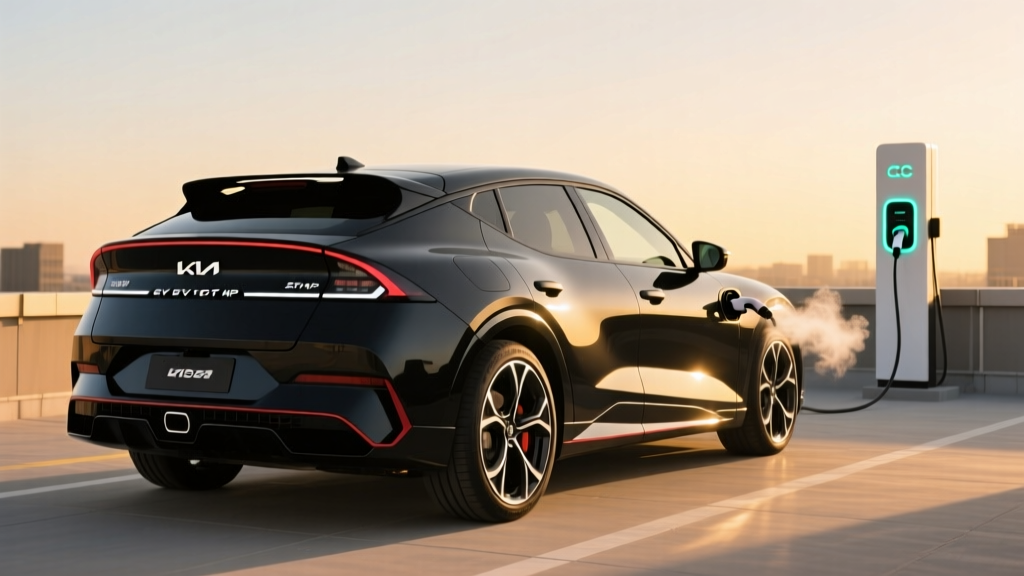
Quick Verdict: The Kia EV6 GT Packs Supercar HP Into a Practical Crossover
The 2026 Kia EV6 GT remains one of the most compelling performance EVs on the market, blending a staggering 576 horsepower dual-motor powertrain with legitimate daily-driver practicality. For buyers searching for an electric crossover that can hit 60 mph in 3.4 seconds yet still deliver over 300 miles of range, the EV6 GT occupies a rare sweet spot. It undercuts the Porsche Taycan and Tesla Model X on price while matching or beating them on straight-line acceleration, and the 2026 refresh brings updated battery chemistry management, a slightly larger usable pack, and improved DC fast-charge speeds peaking at 240 kW.
But raw Kia EV6 GT hp figures only tell part of the story. This review digs into real-world range, charging-curve behavior, cold-weather performance, federal tax credit eligibility under current IRS §30D rules, and whether this electric GT makes sense against rivals like the Tesla Model Y Performance, Hyundai Ioniq 5 N, and Ford Mustang Mach-E GT.
Kia EV6 GT Specs at a Glance
| Spec | Value |
|---|---|
| Horsepower | 576 hp (dual-motor AWD) |
| Torque | 545 lb-ft |
| 0–60 mph | 3.4 seconds |
| Drivetrain | Dual-motor AWD |
| Battery (usable) | 84.0 kWh, NMC lithium-ion |
| EPA Range | 319 miles |
| MPGe (combined) | 85 MPGe |
| Efficiency | 39 kWh/100 mi |
| Max DC Fast Charge | 240 kW (peak) |
| 10–80% DC Charge Time | ~18 minutes (ideal conditions) |
| Level 2 Home Charge Rate | 10.9 kW (~36 mi/hr) |
| Cargo Volume (rear seats up) | 24.4 cu ft |
| Cargo Volume (rear seats folded) | 50.2 cu ft |
| Rear Legroom | 39.4 inches |
| Base MSRP | $61,990 |
| Battery/Powertrain Warranty | 10 years / 100,000 miles |
Range & Efficiency: EPA vs. Real-World
Real-World Expectation: ~265–285 miles highway (70–75 mph); ~240–260 miles in cold weather (below 32°F); ~290–310 miles mixed city/suburban driving.
The 2026 EV6 GT's 84.0 kWh usable NMC (nickel manganese cobalt) battery is EPA-rated at 319 miles — a modest improvement over the prior generation, thanks to refined thermal management and slightly lower rolling-resistance tires. On the EPA's fueleconomy.gov listing, the EV6 GT posts a combined 85 MPGe, translating to roughly 39 kWh consumed per 100 miles of driving.
In real-world highway testing at sustained speeds of 70–75 mph, expect range to drop to approximately 265–285 miles. The EV6 GT's aggressive performance tuning, wider 255-section tires, and dual-motor drivetrain create more rolling resistance and energy draw than efficiency-focused EVs. In freezing temperatures (below 32°F), cabin heating and battery thermal conditioning can push range down to 240–260 miles — a roughly 20–25% reduction typical of NMC packs in cold climates. The EV6 GT does include a standard heat pump, which mitigates some of this winter loss compared to EVs without one.
For city-dominant commuters who leverage regenerative braking (the GT offers multiple regen levels including a one-pedal i-Pedal mode), hitting 290–310 miles on a charge is realistic in moderate temperatures.
Charging Speed: DC Fast Charging & Home Level 2
Charging performance is where the EV6 GT's 800-volt electrical architecture pays real dividends. Unlike 400-volt competitors that taper aggressively, the EV6 GT can accept up to 240 kW peak at a compatible DC fast charger — and critically, it sustains high charge rates through a broader portion of the curve.
| Charging Level | Power / Rate | Miles Added per Hour | Notes |
|---|---|---|---|
| Level 1 (120V household) | 1.4 kW | ~4 mi/hr | Emergency/trickle only |
| Level 2 (240V home, 48A) | 10.9 kW | ~36 mi/hr | Full charge in ~8.5 hours |
| DC Fast Charge (350 kW station) | 240 kW peak | — | 10–80% in ~18 min |
| DC Fast Charge (150 kW station) | ~140 kW sustained avg | — | 10–80% in ~30 min |
At a 350 kW-capable station (Electrify America, EVgo, or similar), the EV6 GT will typically charge from 10% to 80% in approximately 18 minutes under ideal thermal conditions. The 800V architecture allows the vehicle to maintain charge rates above 150 kW well past the 50% state-of-charge mark — a meaningful advantage over 400V vehicles that drop below 100 kW by 40–50% SoC.
One practical note: to achieve peak charge rates, the battery must be preconditioned. Use the EV6 GT's built-in navigation to route to a DC fast charger, and the thermal management system will automatically warm or cool the pack for optimal charging. Skipping preconditioning — for instance, pulling into a charger without navigation routing — can add 5–8 minutes to a 10–80% session, particularly in cold weather.
For home charging, a Level 2 wallbox at 48 amps (10.9 kW) will replenish the 84 kWh pack from empty in roughly 8.5 hours — easily accommodating overnight top-ups. Most EV6 GT owners will plug in nightly and wake to a full battery, making the 319-mile EPA range more than sufficient for daily use.
Performance: 576 HP and the Dual-Motor AWD Experience
The headline number — 576 horsepower and 545 lb-ft of torque — places the EV6 GT in rarefied company. For context, that output matches a Lamborghini Huracán and exceeds the Tesla Model Y Performance (approximately 456 hp in its latest iteration). The dual-motor all-wheel-drive system delivers instant torque to all four wheels, launching the EV6 GT from 0 to 60 mph in 3.4 seconds.
Beyond straight-line speed, the GT trim adds several performance-oriented upgrades over the standard EV6:
- Electronic Limited-Slip Differential (e-LSD): Torque-vectoring across the rear axle improves corner-exit grip and reduces understeer.
- Adaptive Dampers: Electronically controlled suspension adjusts firmness based on drive mode (Eco, Normal, Sport, GT).
- Upgraded Brakes: Larger front rotors with enhanced regen blending for consistent stopping power even after repeated hard use.
- Drift Mode: Yes, the EV6 GT includes a selectable drift mode that biases torque rearward — a party trick, but one that demonstrates the flexibility of the dual-motor system.
- Active Sound Design: Simulated powertrain sound through the cabin speakers, adjustable or defeatable.
In GT drive mode, throttle response sharpens, steering weight increases, and the suspension firms up noticeably. The result is a crossover that genuinely engages on a canyon road, with body control that belies its ~4,700-pound curb weight. The trade-off: ride quality in GT mode is firm, and some owners report it's too stiff for pitted urban roads. Switching to Normal or Sport mode restores compliance suitable for daily commuting.
Pricing, Trims & Federal Tax Credit Eligibility
The 2026 Kia EV6 GT is offered as a single, well-equipped trim with an MSRP of $61,990 (including destination charge). Standard equipment includes the full performance package, premium interior, head-up display, and advanced driver-assistance suite — so there's no "stripper" GT to chase a lower entry price.
| Item | Amount |
|---|---|
| Base MSRP (GT trim) | $61,990 |
| Premium Package (optional) | +$2,200 |
| As-Tested Price (with Premium) | $64,190 |
| Federal Tax Credit (§30D) | Up to $7,500 (if eligible) |
| Effective Price After Max Credit | ~$54,490 – $56,690 |
Does the EV6 GT Qualify for the Federal EV Tax Credit?
Federal tax credit eligibility under IRS §30D depends on several factors that change periodically. As of the 2026 tax year, here's what applies to the EV6 GT:
- MSRP Cap: The EV6 GT's ~$62,000 MSRP falls under the $80,000 SUV/crossover cap set by §30D. ✓
- Buyer Income Limits: Adjusted gross income must not exceed $300,000 (joint filers), $225,000 (head of household), or $150,000 (single). ✓ if you qualify.
- Battery Sourcing & Critical Minerals: This is where eligibility gets complex. Kia manufactures the EV6 in South Korea, and the battery cell sourcing must meet escalating domestic-content thresholds under the Inflation Reduction Act. For 2026, both the critical-minerals and battery-component requirements are stringent. The EV6 GT's eligibility for the full $7,500 credit has varied by model year and production batch.
- Point-of-Sale Transfer: If eligible, the credit can now be transferred to the dealer at purchase, reducing your out-of-pocket cost immediately rather than waiting for tax filing.
Interior, Cargo & Technology
The EV6 GT's interior balances performance intent with crossover practicality. The cabin features:
- Dual 12.3-inch Curved Displays: A combined instrument cluster and infotainment screen running Kia's latest Connect system with wireless Apple CarPlay and Android Auto.
- GT-Specific Seats: Sport bucket front seats with suede and vegan leather upholstery, heating and ventilation standard.
- Head-Up Display (HUD): Projects speed, navigation, and ADAS alerts onto the windshield.
- Meridian Premium Audio: 14-speaker system standard on the GT.
- Digital Key 2: Use your smartphone as the key fob via NFC/UWB.
Cargo capacity measures 24.4 cubic feet behind the rear seats and 50.2 cubic feet with the 60/40 split rear seats folded — competitive with the Model Y and Mach-E. The rear seat offers 39.4 inches of legroom, sufficient for adults on longer trips. A small front trunk (frunk) provides an additional 0.7 cubic feet for charging cables or small items.
Driver-Assistance Technology
The EV6 GT comes equipped with Kia's Highway Driving Assist 2 (HDA2), which combines adaptive cruise control with lane-centering and lane-change assist. This is a SAE Level 2 system — meaning the driver must remain fully engaged with hands on the wheel and eyes on the road at all times. It is not autonomous or "self-driving."
Additional ADAS features include blind-spot monitoring with rear cross-traffic alert, forward collision avoidance with pedestrian and cyclist detection, rear occupant alert, and a surround-view camera with 3D mode.
Pros & Cons
Pros
- 576 hp delivers supercar-level acceleration (3.4s 0–60)
- 800V architecture enables 240 kW DC fast charging — 10–80% in ~18 min
- 319 miles EPA range is strong for a performance AWD EV
- 10-year/100,000-mile battery warranty leads the segment
- Engaging chassis with e-LSD, adaptive dampers, and drift mode
- Practical cargo space and rear-seat room for a performance crossover
- Heat pump standard for better cold-weather efficiency
Cons
- Firm ride in GT mode can be harsh on rough roads
- Single trim — no lower-priced option available
- Federal tax credit eligibility uncertain due to foreign manufacturing
- Real-world highway range drops to ~265–285 mi at sustained speeds
- Insurance premiums higher than standard EV6 trims
- No NACS (Tesla connector) native port — requires adapter for Superchargers
- Infotainment learning curve for Kia Connect menus
Warranty & Long-Term Ownership
Kia backs the EV6 GT with one of the strongest warranty packages in the EV segment:
- Battery & Powertrain: 10 years / 100,000 miles — covers the high-voltage battery, electric motors, and associated power electronics.
- Basic Bumper-to-Bumper: 5 years / 60,000 miles.
- Roadside Assistance: 5 years / 60,000 miles.
- Battery Capacity Retention: Kia warrants that the high-voltage battery will retain at least 70% of its original capacity during the 10-year/100,000-mile warranty period.
The NMC chemistry in the EV6 GT is well-proven, with industry data suggesting typical degradation of 10–15% over 100,000 miles under normal use patterns. Avoiding frequent charges to 100% and minimizing DC fast-charging sessions in extreme heat can further extend long-term battery health. The 84 kWh pack replacement cost, should it be needed out of warranty, is estimated at $12,000–$18,000 depending on labor — a figure worth noting for second-ownership planning.
Who Should Buy the Kia EV6 GT?
- You want a performance EV with genuine supercar acceleration but daily-driver comfort and practicality.
- You prioritize fast DC charging for road trips and have access to 150–350 kW stations.
- You value a long battery/powertrain warranty and plan to own the vehicle 5+ years.
- You need rear-seat space and cargo room for a small family or active lifestyle.
- Your budget is under $50,000 — look at the standard EV6 Wind or Light trim instead.
- You drive primarily in extreme cold — the range penalty may push you toward a larger-battery option like the Rivian R1S or a PHEV for winter commutes.
- Tax credit eligibility is essential to your purchase math — verify the EV6 GT's current §30D status before committing.
- You need native Tesla Supercharger access without adapters — the Ford Mustang Mach-E or Tesla Model Y Performance offer NACS ports.
Competitive Comparison
| Spec | Kia EV6 GT | Tesla Model Y Perf. | Hyundai Ioniq 5 N | Ford Mach-E GT |
|---|---|---|---|---|
| Horsepower | 576 hp | ~456 hp | 641 hp (N Grin Boost) | 480 hp |
| 0–60 mph | 3.4 sec | 3.5 sec | 3.25 sec | 3.5 sec |
| EPA Range | 319 mi | 285 mi | 221 mi | 280 mi |
| Max DC Charge | 240 kW | 250 kW | 240 kW | 150 kW |
| Battery (usable) | 84.0 kWh | ~75 kWh | 84.0 kWh | 91 kWh |
| Base MSRP | $61,990 | ~$54,990 | ~$66,900 | ~$59,995 |
| Battery Warranty | 10 yr / 100k mi | 8 yr / 120k mi | 10 yr / 100k mi | 8 yr / 100k mi |
The EV6 GT's advantage is clear: it delivers the highest EPA range of the group while matching or beating most on acceleration, and it does so with a best-in-class warranty. The Model Y Performance is cheaper and has native Supercharger access. The Ioniq 5 N is a track-focused machine with more peak hp but significantly less range. The Mach-E GT offers strong value but slower DC charging.
Frequently Asked Questions
What is the real-world range of the Kia EV6 GT?
The EPA rates the 2026 EV6 GT at 319 miles. In real-world highway driving at 70–75 mph, expect approximately 265–285 miles. In cold weather below freezing, range can drop to 240–260 miles. City driving with regenerative braking can approach the EPA figure in moderate temperatures.
How fast does the Kia EV6 GT charge at home and on DC fast chargers?
On a DC fast charger rated at 350 kW, the EV6 GT peaks at 240 kW and charges from 10% to 80% in approximately 18 minutes under ideal conditions. At home on a Level 2 wallbox (10.9 kW), a full charge takes about 8.5 hours, adding roughly 36 miles of range per hour.
How much does the Kia EV6 GT cost after the federal tax credit?
The base MSRP is $61,990. If you qualify for the full $7,500 federal tax credit under IRS §30D (subject to income limits, MSRP caps, and battery-sourcing requirements), the effective price drops to approximately $54,490. However, because the EV6 is manufactured in South Korea, eligibility for the full credit is not guaranteed — always verify current status on fueleconomy.gov before purchasing.
Is the Kia EV6 GT worth buying over the Tesla Model Y Performance?
If you value longer EPA range (319 vs. ~285 miles), a more engaging chassis, and a 10-year battery warranty, the EV6 GT is the stronger choice. The Model Y Performance wins on price (~$7,000 less), native Tesla Supercharger access, and over-the-air software updates. Both are excellent — the decision comes down to whether range and driving dynamics or ecosystem and price matter more to you.
Does the Kia EV6 GT have a frunk (front trunk)?
Yes, but it's small — just 0.7 cubic feet, enough for charging cables or a small bag. The AWD dual-motor layout limits front cargo space compared to RWD-only EVs.
What connector does the EV6 GT use, and can it charge at Tesla Superchargers?
The 2026 EV6 GT uses a CCS1 connector for DC fast charging and a J1772 inlet for Level 2 AC charging. Kia provides a NACS adapter (or offers one as an accessory) that enables charging at Tesla Supercharger stations, though at reduced speeds compared to native NACS vehicles. The broader industry is transitioning to NACS, and future model years may adopt it natively.