Quick Verdict: A 576-Horsepower Hot Hatch With a Range Trade-Off
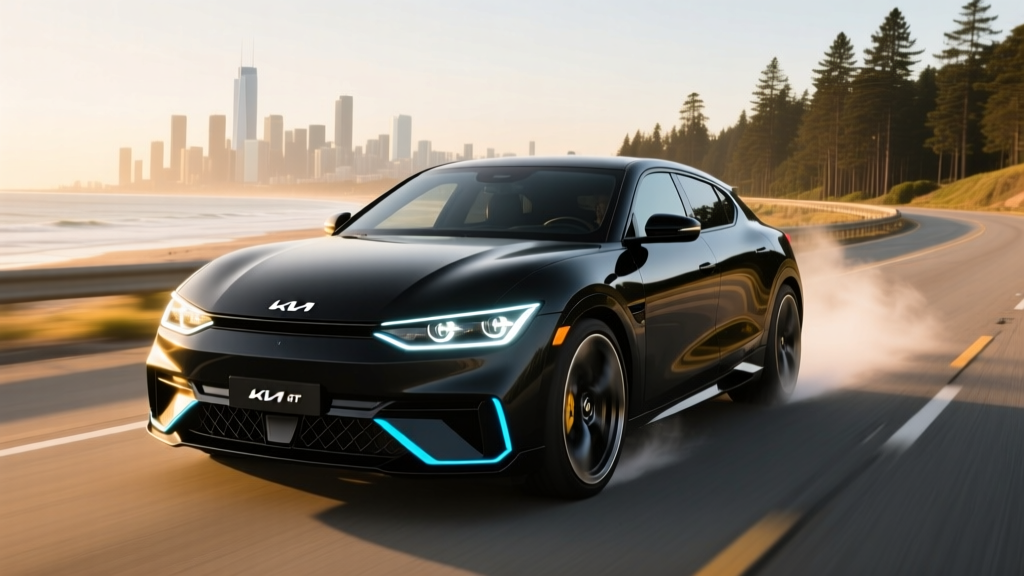
The Kia EV6 GT exists for one reason: to prove that a mainstream-brand electric crossover can embarrass six-figure supercars off the line while still serving as a practical daily driver. With 576 horsepower and 545 lb-ft of torque from its dual-motor all-wheel-drive powertrain, the EV6 GT rockets to 60 mph in 3.4 seconds — a figure that would have been unimaginable in a $60,000 family vehicle just a few years ago.
But that performance comes with a physics-imposed tax. The GT variant uses the same 77.4 kWh (usable) battery pack as the more efficiency-focused EV6 trims, and all that power drains it quickly. The EPA rates the 2026 EV6 GT at 206 miles of range — roughly 100 miles less than the EV6 Wind RWD. If your priority is maximum acceleration and you can charge at home, the GT is thrilling. If you road-trip frequently or lack reliable home charging, the lower-output EV6 trims make more sense.
EPA estimate: 206 miles. In mixed highway driving at 70-75 mph, expect approximately 175-190 miles before needing to charge. In cold weather (below 30°F), range can drop to 145-165 miles due to battery resistance and cabin heating demands. City driving with regenerative braking can push closer to or slightly above the EPA figure. If you regularly drive the GT hard — which is tempting — plan on 150-160 miles between charges.
EV6 GT Specs at a Glance
| Specification | 2026 Kia EV6 GT |
|---|---|
| Powertrain | Dual-motor AWD |
| Horsepower | 576 hp |
| Torque | 545 lb-ft |
| 0-60 mph | 3.4 seconds |
| Top Speed | 161 mph |
| Battery (usable) | 77.4 kWh, NMC lithium-ion |
| EPA Range | 206 miles |
| MPGe (combined) | 85 MPGe |
| Efficiency | 39 kWh/100 mi |
| Max DC Fast Charge | 240 kW (peak) |
| 10-80% DC Charge Time | ~18 minutes |
| Level 2 Home Charge Rate | 10.9 kW (~37 mi/hr) |
| Cargo Volume (rear seats up) | 24.4 cu ft |
| Cargo Volume (rear seats folded) | 50.2 cu ft |
| Rear Legroom | 39.4 inches |
| Frunk | 0.7 cu ft |
| Base MSRP | $62,800 |
| Battery/Powertrain Warranty | 10 years / 100,000 miles |
Performance: Where the EV6 GT Horsepower Shines
The headline number — 576 hp — is achieved in GT mode, which unlocks the full output of both the front and rear permanent-magnet synchronous motors. In standard drive modes, output is dialed back to preserve range and drivability. The GT also features an electronic limited-slip differential (e-LSD) on the rear axle, which actively distributes torque between the rear wheels during hard cornering. This is not just a straight-line bruiser; the torque-vectoring system makes it genuinely capable on a twisty road.
Kia equips the GT with a dedicated GT drive mode that sharpens throttle response, stiffens the adaptive dampers, and enables a "drift mode" that biases torque rearward for controlled oversteer on closed courses. The Brembo high-performance brakes — 15-inch front rotors with four-piston calipers — handle repeated hard stops without the fade you'd expect from a 4,700-pound vehicle.
For comparison, the EV6 GT's 3.4-second 0-60 time matches or beats the Tesla Model Y Performance (3.5 sec, 510 hp) and the Ford Mustang Mach-E GT (3.5 sec, 480 hp). It trails the Model 3 Performance (2.9 sec) but offers substantially more cargo versatility as a crossover.
Charging Speed: 800-Volt Architecture Pays Off
The EV6 GT rides on Hyundai Motor Group's E-GMP platform with an 800-volt electrical architecture — the same system used in the Hyundai Ioniq 5 and Genesis GV60. This allows it to accept DC fast-charge rates that most 400-volt competitors simply cannot match.
| Charging Level | Power | Speed (approx.) |
|---|---|---|
| Level 1 (120V household) | ~1.4 kW | ~4 miles per hour |
| Level 2 (240V home, 48A) | 10.9 kW | ~37 miles per hour |
| DC Fast Charge (50 kW) | 50 kW | ~10-80% in ~65 min |
| DC Fast Charge (150 kW) | 150 kW | ~10-80% in ~28 min |
| DC Fast Charge (350 kW station) | 240 kW (peak) | ~10-80% in ~18 min |
Charging curve reality: The 240 kW figure is a peak, not a sustained rate. In real-world DC fast charging, the EV6 GT pulls close to peak rate from roughly 10% to 55% state of charge, then tapers to around 150-170 kW through 70%, and further drops to 80-100 kW from 70-80%. The 18-minute 10-80% time assumes optimal battery temperature — which means using the car's battery preconditioning feature (activated automatically when you navigate to a charger via the built-in navigation system). Without preconditioning, especially in cold weather, expect the 10-80% charge to take 25-35 minutes even at a 350 kW-capable station.
At home on a Level 2 charger (a 48-amp hardwired unit on a 60-amp circuit), a full charge from empty takes about 7-8 hours. This is the primary charging method for most EV owners and the one that makes the GT's shorter range manageable — you wake up with a full "tank" every morning.
Pricing, Trims & Federal Tax Credit Eligibility
The 2026 Kia EV6 GT is offered as a single, well-equipped trim with an MSRP of $62,800 (including destination). Available options are limited to paint color and a $500 carpeted floor mat package. There is no higher tier — the GT is the range-topping EV6.
For context within the EV6 lineup:
- EV6 Light RWD: ~$42,900 — 232 mi range, 167 hp
- EV6 Wind RWD: ~$47,500 — 310 mi range, 225 hp
- EV6 Wind AWD: ~$51,500 — 282 mi range, 320 hp
- EV6 GT-Line AWD: ~$56,500 — 252 mi range, 320 hp
- EV6 GT AWD: $62,800 — 206 mi range, 576 hp
Does the EV6 GT Qualify for the Federal EV Tax Credit?
This is where the GT's price becomes a sticking point. Under current IRS §30D rules, the federal clean vehicle credit of up to $7,500 has a MSRP cap of $80,000 for SUVs/pickups and $55,000 for sedans. The EV6 is classified as an SUV by the IRS, so the $80,000 cap applies — meaning the GT's $62,800 MSRP clears the price threshold.
However, the full credit also depends on:
- Buyer income limits: Modified adjusted gross income must not exceed $300,000 (joint filers), $225,000 (head of household), or $150,000 (single filers).
- Battery component sourcing: A percentage of battery components must be manufactured or assembled in North America, and critical minerals must be sourced from the U.S. or free-trade-agreement countries. These thresholds increase annually.
- Point-of-sale transfer: As of 2024, buyers can transfer the credit to the dealer at purchase, reducing the out-of-pocket price immediately rather than waiting to claim it on their tax return.
Based on current battery-sourcing requirements, the EV6 GT has qualified for a partial credit of $3,750 in recent model years (meeting the critical-minerals requirement but not the full battery-component threshold). Buyers should verify current-year eligibility on the fueleconomy.gov tax credit page before purchasing, as sourcing rules tighten each year. Always consult a tax professional for your specific situation.
Interior, Cargo & Technology
The GT shares its interior architecture with the rest of the EV6 lineup, which means a wide, flat floor thanks to the dedicated EV platform and a wheelbase that stretches to 114.2 inches. Rear legroom measures a generous 39.4 inches — more than the Tesla Model Y (37.7 in) and competitive with midsize luxury crossovers.
Cargo space behind the rear seats is 24.4 cubic feet, expanding to 50.2 cubic feet with the 60/40 split rear seats folded. The frunk (front trunk) is a small 0.7 cu ft — essentially a place to stash the charging cable, not a second cargo area. For comparison, the Tesla Model Y offers 30.2 cu ft behind the rear seats and 76.2 cu ft total with seats folded, so if maximum cargo volume is your priority, the Model Y wins on utility.
The GT's interior distinguishes itself with suede-and-leather sport seats with GT badging, a heated flat-bottom steering wheel, aluminum pedals, and ambient lighting. The dual 12.3-inch curved display panel handles infotainment and the digital gauge cluster. Wireless Apple CarPlay and Android Auto are standard, along with a head-up display with augmented-reality navigation overlays.
Driver-Assistance Features
The EV6 GT comes with Kia's Highway Driving Assist 2 (HDA2), which combines adaptive cruise control with lane-centering and automatic lane-change assist. This is a SAE Level 2 driver-assistance system — meaning the driver must remain fully engaged with hands on the wheel and eyes on the road at all times. It is not autonomous driving. The system works well on divided highways but requires driver confirmation for lane changes and will disengage if hands-off detection persists.
Highway Driving Assist 2 provides combined steering and speed assistance but requires continuous driver supervision. The driver is responsible for all vehicle operation at all times. This is fundamentally different from Level 4 robotaxi services like Waymo, which operate without a driver in defined areas.
Battery, Warranty & Long-Term Ownership
The EV6 GT uses a 77.4 kWh usable NMC (nickel-manganese-cobalt) lithium-ion battery pack. NMC chemistry offers higher energy density than LFP (lithium iron phosphate), which is necessary to fit sufficient capacity in the GT's performance-oriented packaging. The trade-off is that NMC batteries are more sensitive to sustained high state-of-charge and extreme temperatures over the long term.
Kia backs the battery and powertrain with an industry-leading 10-year / 100,000-mile warranty. This covers the battery if it drops below approximately 70% of original capacity — a threshold consistent with most EV manufacturers. For context, Tesla offers 8 years/100,000 miles on the Model Y battery, and Ford provides 8 years/100,000 miles on the Mach-E.
Based on data from similar E-GMP platform vehicles (Ioniq 5, EV6 standard trims), owners report approximately 5-8% degradation after 50,000 miles with normal charging habits. To maximize longevity, Kia recommends keeping the battery between 20-80% state of charge for daily use and limiting DC fast charging to road trips rather than daily use. The GT's onboard battery management system includes active liquid cooling and heating to maintain optimal cell temperature.
Pros, Cons & Who Should Buy the EV6 GT
Pros
- 576 hp and 3.4-sec 0-60 at a $62,800 MSRP — supercar acceleration at mainstream pricing
- 800V architecture enables best-in-class DC fast charging (~18 min 10-80%)
- 10-year/100,000-mile battery and powertrain warranty
- Spacious rear seat with 39.4 inches of legroom
- Well-equipped single trim — no confusing option packages
- Electronic LSD and drift mode for genuine performance driving
- Vehicle-to-load (V2L) capability — power devices or a campsite from the car
Cons
- 206-mile EPA range is the shortest in the EV6 lineup and below most competitors
- Real-world highway range closer to 175-190 miles; less in cold weather
- Small 0.7 cu ft frunk limits front storage
- Cargo volume trails the Tesla Model Y significantly
- Partial federal tax credit ($3,750) rather than the full $7,500
- No one-pedal driving mode as strong as some competitors (regen is adjustable but doesn't bring the car to a complete hold)
- Insurance costs tend to be higher than lower-output EV6 trims
Who the EV6 GT Is For
The EV6 GT suits the enthusiast driver with reliable home charging who values acceleration and handling over maximum range. If your daily commute is under 80 miles round-trip, you charge at home overnight, and you want a car that can demoliate on-ramps and back roads on the weekend, the GT delivers an experience no other EV at this price point matches. It also works as a family hauler given its generous rear-seat space.
It does not suit the frequent road-tripper or the apartment dweller without home charging access. The 206-mile EPA range means stopping every 150-170 miles on highway trips — manageable given the fast charging, but noticeably more stops than a 300+ mile EV requires.
EV6 GT vs. Key Competitors
| Spec | Kia EV6 GT | Tesla Model Y Perf. | Ford Mach-E GT | BMW iX M60 |
|---|---|---|---|---|
| Horsepower | 576 hp | 510 hp | 480 hp | 610 hp |
| 0-60 mph | 3.4 sec | 3.5 sec | 3.5 sec | 3.6 sec |
| EPA Range | 206 mi | 277 mi | 263 mi | 296 mi |
| Max DC Charge | 240 kW | 250 kW | 150 kW | 195 kW |
| Base MSRP | $62,800 | $52,490 | $59,875 | $111,500 |
| Battery Warranty | 10 yr/100k mi | 8 yr/100k mi | 8 yr/100k mi | 8 yr/80k mi |
The Model Y Performance offers more range and a lower price but lacks the GT's interior quality and steering feel. The Mach-E GT is a compelling alternative with similar performance but slower DC charging. The BMW iX M60 is in a different price bracket entirely. If raw value-for-horsepower is your metric, the EV6 GT occupies a unique middle ground.
Frequently Asked Questions
What is the real-world range of the Kia EV6 GT?
The EPA rates it at 206 miles, but expect 175-190 miles in highway driving at 70-75 mph and potentially 145-165 miles in cold weather below 30°F. City driving with regenerative braking can approach or slightly exceed the EPA figure. Aggressive driving will reduce range further.
How fast does the EV6 GT charge at home and on the road?
On a Level 2 home charger (240V, 48A), it adds approximately 37 miles of range per hour, fully charging overnight in 7-8 hours. On a 350 kW-capable DC fast charger, it peaks at 240 kW and charges from 10-80% in about 18 minutes with battery preconditioning active.
How much does the EV6 GT cost after tax credits?
The MSRP is $62,800. With the partial $3,750 federal credit (current sourcing rules), the effective price drops to approximately $59,050 — before any state incentives. Your actual credit depends on your income, the vehicle's battery-sourcing compliance in the purchase year, and whether you transfer the credit at point of sale. Consult IRS §30D guidance and a tax professional.
Is the Kia EV6 GT worth buying over the Tesla Model Y Performance?
If you prioritize driving dynamics, interior quality, and the fastest DC charging in the segment, yes. If maximum range (277 mi vs. 206 mi), access to the Tesla Supercharger network (though Kia now has NACS adapters for Supercharger access), and a lower purchase price matter more, the Model Y Performance is the pragmatic pick.
Does the EV6 GT qualify for the full $7,500 federal tax credit?
Under current rules, the EV6 GT has qualified for $3,750 (the critical-minerals half of the credit) but not the full $7,500, because its battery components have not fully met the North American manufacturing threshold. This can change as Kia adjusts its supply chain. Always verify on fueleconomy.gov before purchasing.
What is the EV6 GT's towing capacity?
The EV6 GT is rated to tow up to 2,700 pounds when equipped with the factory tow hitch — sufficient for a small utility trailer or a pair of jet skis, but not a large boat or camper. Towing will significantly reduce range, likely to 120-140 miles.