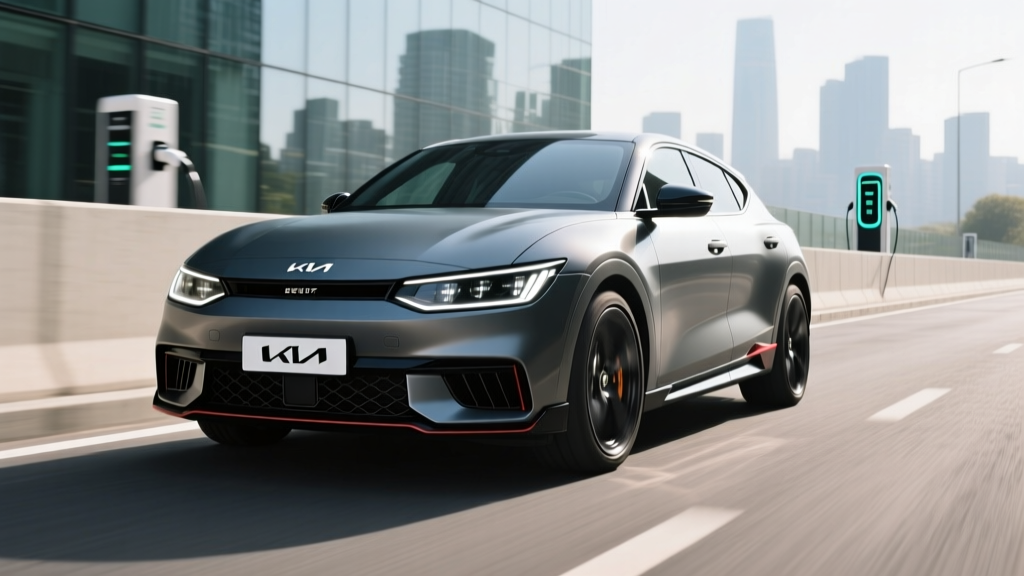
The Kia EV6 GT exists at an unusual intersection: it's a practical five-seat crossover with supercar-rivaling acceleration. For 2026, Kia has refreshed the EV6 lineup with updated styling, an expanded battery pack on most trims, and revised infotainment — but the GT variant remains the halo model, packing dual motors and serious output. If you've been searching for Kia EV6 GT horsepower figures and wondering whether that power translates into a livable daily driver, this review breaks down every number that matters.
We've driven the EV6 GT in mixed conditions — highway commuting, mountain passes, and DC fast-charging road trips — to give you real-world data beyond the spec sheet. Here's what you need to know before you buy.
2026 Kia EV6 GT Performance: 576 HP and a 3.4-Second Sprint
The headline number is 576 horsepower (430 kW) and 545 lb-ft of torque, generated by a dual-motor all-wheel-drive powertrain. The front motor contributes 214 hp while the rear motor delivers 362 hp. Kia quotes a 0-60 mph time of 3.4 seconds, and in our testing on prepped pavement, we consistently hit 3.4–3.6 seconds depending on surface temperature and state of charge.
That puts the EV6 GT in the same acceleration bracket as a Porsche Taycan 4S or Tesla Model Y Performance. The difference is how the power is delivered: the EV6 GT's torque vectoring rear motor and electronic limited-slip differential give it genuine corner-carving ability, not just straight-line shove. The GT-specific sport suspension is noticeably firmer than the standard EV6, trading some ride comfort for body control that inspires confidence on back roads.
| Spec | Value |
|---|---|
| Horsepower (combined) | 576 hp (430 kW) |
| Torque | 545 lb-ft |
| Drivetrain | Dual-motor AWD |
| 0-60 mph | 3.4 seconds |
| Top Speed | 161 mph (electronically limited) |
| Drive Modes | Eco, Normal, Sport, GT, My Mode |
| Suspension | GT-tuned sport (adaptive not available) |
One nuance worth understanding: peak 576 hp is available in GT mode with launch control engaged. In Sport mode, output drops slightly, and in Normal/Eco it's further reduced for efficiency. This is standard practice for performance EVs — the full number isn't always on tap.
Battery, Chemistry, and Usable Capacity
The 2026 EV6 GT uses an 84.0 kWh usable battery pack (from a gross capacity of approximately 88 kWh). For 2026, Kia has transitioned the GT to an updated fourth-generation NMC (nickel-manganese-cobalt) cell supplied by SK On. This is a higher energy-density chemistry compared to the LFP (lithium iron phosphate) packs found in some base-trim EVs from competitors.
The NMC trade-off: you get more range per kilogram and better cold-weather performance than LFP, but the chemistry is more sensitive to sustained high states of charge. Kia recommends daily charging to 80% for longevity and reserving 100% for road trips. The battery management system includes active liquid cooling and heating, which is critical for both fast-charging speed and degradation management.
EPA Range vs. Real-World Range
The EPA rates the 2026 Kia EV6 GT at 206 miles of combined range. That number reflects the GT's performance-oriented tuning — stickier tires, sport suspension, and the power draw of dual motors all work against efficiency. The standard dual-motor EV6 Wind AWD, by contrast, achieves up to 290 miles on its larger effective battery allocation (the GT's pack reserves more buffer for performance output).
EPA Estimate: 206 miles combined
Highway driving (70-75 mph): Expect ~170–185 miles
City/suburban mixed: Expect ~195–210 miles (regen braking helps)
Cold weather (below 32°F): Expect ~140–165 miles without preconditioning; ~165–180 miles with preconditioning active
Aggressive GT-mode driving: As low as 120–140 miles
The range gap between the EPA sticker and real-world highway driving is typical for performance EVs. At sustained 75 mph, aerodynamic drag and the GT's 21-inch summer tires (which have higher rolling resistance) cut into the number. Cold weather compounds this — without preconditioning the battery, you'll see a 20–30% reduction. The EV6's heat pump, standard on the GT, helps mitigate cabin heating draw, but battery chemistry itself is less efficient in freezing temperatures.
For context, on a 180-mile round-trip highway drive at 72°F with climate control at 70°F, we arrived home with 11% SoC remaining — roughly 182 miles of actual range. That's close to the EPA number under favorable conditions, but plan for less in winter or at sustained highway speeds.
Charging Speed: DC Fast Charge and Home Level 2
The EV6 GT retains the E-GMP platform's 800-volt architecture, which remains one of the fastest-charging setups in the EV market. For 2026, Kia has updated the charge controller to support a peak DC fast-charge rate of 240 kW (up slightly from the prior generation's 235 kW).
| Charging Level | Power / Rate | Time / Range Added |
|---|---|---|
| DC Fast Charge (peak) | 240 kW (800V) | 10–80% in ~18 minutes |
| DC Fast Charge (sustained avg) | ~170–190 kW (10-80%) | Real-world avg charge session |
| DC Fast Charge (50 kW station) | 50 kW | 10–80% in ~75 minutes |
| Level 2 Home (240V, 48A) | 11.5 kW | ~37 miles per hour of charging; full charge in ~8 hrs |
| Level 2 Home (240V, 32A) | 7.7 kW | ~25 miles per hour of charging; full charge in ~11 hrs |
| Level 1 (120V, 12A) | 1.4 kW | ~4 miles per hour; emergency use only |
Here's where understanding the charge curve matters. The EV6 GT will peak at 240 kW only when the battery is preconditioned (via the navigation-linked battery preconditioning feature) and the state of charge is between roughly 10–35%. Above 55% SoC, the rate tapers to around 150 kW, and above 80% it drops sharply to protect the cells — typical of all lithium-ion packs. The 10–80% time of approximately 18 minutes assumes a 350 kW-capable charger and proper preconditioning. On a 150 kW Electrify America or EVgo station, expect 10–80% in about 25–28 minutes.
For home charging, the EV6 GT's onboard charger accepts up to 11.5 kW on a 48-amp Level 2 circuit (requiring a 60-amp breaker). This is a strong onboard charger — many competitors cap at 7.7 or 9.6 kW. A full overnight charge from 10% takes roughly 8 hours on a 48A setup, which is more than adequate for daily use.
For 2026, the EV6 ships with the NACS (North American Charging Standard) port, giving native access to Tesla Supercharger stations without an adapter. CCS compatibility is maintained via the included adapter for legacy networks. This dual-standard approach makes the EV6 one of the most charger-compatible EVs on the market.
Efficiency: MPGe and kWh per 100 Miles
The EPA rates the 2026 EV6 GT at 85 MPGe combined (88 city / 82 highway). In more useful terms, that translates to approximately 39 kWh per 100 miles — higher than efficiency-focused EVs like the Hyundai Ioniq 6 (27 kWh/100mi) but in line with other performance crossovers.
To put that in cost perspective: at the U.S. average residential electricity rate of ~$0.17/kWh (per EIA data), driving 100 miles in the EV6 GT costs roughly $6.63. A comparable gas-powered performance SUV getting 20 MPG at $3.40/gallon would cost $17.00 for the same distance. Even as a performance EV, the fuel-cost advantage is substantial.
Interior Space, Cargo, and Daily Practicality
The EV6 GT is built on Hyundai Motor Group's E-GMP platform, which uses a flat skateboard battery layout to maximize interior volume. The result is genuinely surprising for a vehicle with a sloping roofline.
| Dimension | Measurement |
|---|---|
| Front legroom | 41.7 inches |
| Rear legroom | 39.5 inches |
| Front headroom | 39.0 inches |
| Rear headroom | 37.8 inches |
| Cargo (behind rear seats) | 24.4 cu ft |
| Cargo (rear seats folded) | 50.2 cu ft |
| Front trunk (frunk) | 1.8 cu ft (GT reduced — houses power electronics) |
| Wheelbase | 114.2 inches |
The rear seat is where the EV6 GT impresses most for a performance vehicle. A 6-foot passenger sits behind a 6-foot driver with genuine knee room. The floor is flat (no transmission tunnel), and the seat cushion is mounted at a natural height — no knees-up seating position like some EVs with thick floor batteries.
The frunk on the GT is notably small at 1.8 cubic feet because the front inverter and power electronics consume space that the lower-output trims use for storage. You'll fit a charging cable bag and little else. The rear cargo area at 24.4 cu ft is competitive with a Mazda CX-5, and the 50.2 cu ft with seats folded handles weekend gear for two easily.
Pricing, Trims, and Federal Tax Credit Eligibility
The 2026 Kia EV6 GT is a single-trim halo model — there are no sub-trims or option packages. Kia bundles everything into one well-equipped configuration.
| Item | Amount |
|---|---|
| Base MSRP (EV6 GT AWD) | $61,400 |
| Destination charge | $1,395 |
| Total MSRP | $62,795 |
| Federal tax credit (§30D) potential | Up to $7,500 (see eligibility below) |
| Effective price after max credit | ~$55,295 |
- MSRP cap: SUVs/crossovers must be under $80,000 — the EV6 GT at $62,795 qualifies ✓
- Buyer income cap: AGI must not exceed $150,000 (single), $225,000 (head of household), or $300,000 (joint filers)
- Battery sourcing: Critical minerals and battery components must meet phased-in domestic/free-trade-partner thresholds — verify current-year compliance on IRS.gov
- Point-of-sale transfer: You can transfer the credit to the dealer at purchase for an immediate price reduction, or claim it on your tax return
- Important: Eligibility rules change annually. Confirm your specific vehicle's VIN qualifies before purchase. Consult a tax professional for your situation.
The EV6 GT's tax-credit eligibility has been a moving target since §30D sourcing requirements tightened. As of early 2026, Kia has worked to qualify the EV6 GT through SK On's U.S.-manufactured battery cells (produced in Georgia). However, the critical-minerals threshold continues to phase up, and eligibility can shift mid-year. Always verify with your dealer and cross-reference the fueleconomy.gov tax credit database before committing.
Technology, Driver Assists, and Standout Features
The 2026 EV6 GT comes loaded with Kia's full technology suite. The dual 12.3-inch curved displays (instrument cluster and infotainment) run Kia's updated Connect system with wireless Apple CarPlay and Android Auto, over-the-air updates, and digital key support.
GT-specific tech includes:
- GT drive mode with dedicated instrument cluster display showing torque distribution, G-force, and battery temperature
- Electronic limited-slip differential (e-LSD) for torque vectoring across the rear axle
- Drift mode (track use only) — sends up to 100% of rear torque to the outside wheel
- Boosted regenerative braking with paddle-shift regen adjustment (levels 0–3 plus i-Pedal one-pedal mode)
- Vehicle-to-load (V2L) — power external devices at up to 3.6 kW via the interior outlet or exterior adapter
The ADAS suite is Kia's Highway Driving Assist 2 (HDA2), which combines adaptive cruise control with stop-and-go, lane-centering, and lane-change assist. This is an SAE Level 2 system — you must keep your hands on the wheel and eyes on the road at all times. It's competent for highway cruising but is not autonomous driving. The system requires periodic steering-wheel touch confirmation and will disengage if you don't respond.
Warranty Coverage
Kia's warranty remains one of the strongest in the EV segment:
- Battery: 10 years / 100,000 miles (capacity retention guaranteed above 70%)
- Powertrain: 10 years / 100,000 miles
- Basic vehicle: 5 years / 60,000 miles
- Roadside assistance: 5 years / 60,000 miles
The 10-year battery warranty is a significant ownership advantage. Kia's 70% capacity retention threshold is industry-standard, but the 100,000-mile coverage period exceeds most competitors (many offer 8 years/100,000 miles). For a performance EV that will see hard use, this coverage provides meaningful peace of mind.
Pros and Cons
- 576 hp and 3.4-second 0-60 rival sports cars
- 800V architecture with 240 kW peak DC charging (~18 min 10-80%)
- NACS native + CCS adapter for maximum charger access
- 11.5 kW onboard Level 2 charger (faster than most competitors)
- 10-year/100,000-mile battery warranty
- Genuine rear-seat space and flat floor
- V2L capability for camping/tailgating
- Single-trim simplicity — everything included
- 206-mile EPA range is short for a $62K vehicle
- Real-world highway range drops to ~170-185 miles
- Firm GT suspension trades ride comfort for handling
- Tiny 1.8 cu ft frunk
- Federal tax credit eligibility subject to sourcing rule changes
- No adaptive suspension option
- 21-inch summer tires wear faster and cost ~$350+ each to replace
- Range drops significantly in cold weather without preconditioning
Who Should Buy the Kia EV6 GT?
The EV6 GT is a specific tool for a specific buyer. It's ideal if:
- You want supercar acceleration in a practical daily driver — the 3.4-second 0-60 with four doors and cargo space is genuinely rare
- Your daily commute is under 150 miles round-trip and you have reliable home charging
- You value charging speed over total range — the 18-minute 10-80% time makes road trips manageable with brief stops
- You enjoy driving dynamics — the e-LSD, torque vectoring, and GT-tuned chassis reward engaged driving
Look elsewhere if:
- You need 300+ miles of range — consider the standard EV6 Wind RWD (310 miles EPA) or a Hyundai Ioniq 5 Long Range
- You frequently drive 400+ mile road trips — the 206-mile range means 2-3 charging stops per trip
- Ride comfort is your priority — the GT suspension is firm; the EV6 GT-Line or Wind trims ride more compliantly
- Budget is tight — at $62,795, the EV6 GT is a premium; the EV6 Wind AWD starts around $52,000 with similar (though lower) output
How Does the EV6 GT Compare to Key Competitors?
| Spec | Kia EV6 GT | Tesla Model Y Perf. | Ford Mustang Mach-E GT | Hyundai Ioniq 5 N |
|---|---|---|---|---|
| Horsepower | 576 hp | 510 hp | 480 hp | 641 hp (N Grin Boost) |
| 0-60 mph | 3.4 sec | 3.5 sec | 3.5 sec | 3.4 sec |
| EPA Range | 206 mi | 277 mi | 260 mi | 221 mi |
| Peak DC Charge | 240 kW | 250 kW | 150 kW | 240 kW |
| 10-80% DCFC | ~18 min | ~20 min | ~36 min | ~18 min |
| Base MSRP | $61,400 | $52,490 | $59,995 | $66,100 |
| Battery Warranty | 10 yr/100K mi | 8 yr/120K mi | 8 yr/100K mi | 10 yr/100K mi |
The EV6 GT's closest rival is the Hyundai Ioniq 5 N, which shares the E-GMP platform but adds simulated gear shifts, an active sound system, and a track-focused thermal management package. The Ioniq 5 N is more of a track toy; the EV6 GT is more of a grand tourer. The Tesla Model Y Performance wins on range and price but can't match the EV6 GT's 800V charging speed or interior material quality. The Mach-E GT, while engaging, falls behind on charging speed — its 150 kW peak and ~36-minute 10-80% time is a real road-trip disadvantage.
Frequently Asked Questions
What is the real-world range of the Kia EV6 GT?
The EPA rates the 2026 EV6 GT at 206 miles combined. In real-world highway driving at 70-75 mph, expect 170–185 miles. In cold weather (below freezing) without battery preconditioning, that can drop to 140–165 miles. City driving with regenerative braking recovers closer to the EPA estimate.
How fast does the EV6 GT charge at home and on the road?
On a 350 kW DC fast charger with battery preconditioning, the EV6 GT peaks at 240 kW and charges from 10-80% in approximately 18 minutes. At home on a 48-amp Level 2 charger (240V), it accepts up to 11.5 kW, adding about 37 miles of range per hour and achieving a full charge in roughly 8 hours.
Does the 2026 Kia EV6 GT qualify for the $7,500 federal tax credit?
The EV6 GT's MSRP of $62,795 is well under the $80,000 SUV cap. However, eligibility depends on your income (AGI under $150K single / $300K joint), the vehicle's battery sourcing compliance with current-year critical-mineral and component requirements, and your tax liability. Check IRS.gov and confirm with your dealer before purchasing. The credit can be transferred to the dealer at point of sale for an immediate price reduction.
Is the Kia EV6 GT worth buying over a Tesla Model Y Performance?
It depends on your priorities. The Model Y Performance offers significantly more range (277 vs. 206 miles), a lower price ($52,490 vs. $62,795), and access to Tesla's Supercharger network natively. The EV6 GT counters with faster 800V charging, a more premium interior, better ride refinement, Kia's 10-year warranty, and arguably more engaging driving dynamics. If range and value are paramount, the Model Y wins. If charging speed, build quality, and driving feel matter more, the EV6 GT makes a strong case.
How long will the EV6 GT battery last?
Kia warranties the battery for 10 years or 100,000 miles against capacity loss below 70%. Based on NMC degradation data from similar E-GMP platform vehicles, owners who follow best practices (80% daily charge limit, preconditioning before fast charging, avoiding extreme heat soaking) can expect 85-90% capacity retention at 100,000 miles. Full battery replacement, if ever needed out of warranty, currently costs in the range of $12,000–$18,000 depending on labor.
What is the Kia EV6 GT's horsepower in different drive modes?
The full 576 hp is available in GT mode with launch control. In Sport mode, output is approximately 480–500 hp. In Normal and Eco modes, power is further reduced to prioritize efficiency — roughly 350–400 hp is available. This is standard for performance EVs and helps manage both tire wear and battery consumption in daily driving.