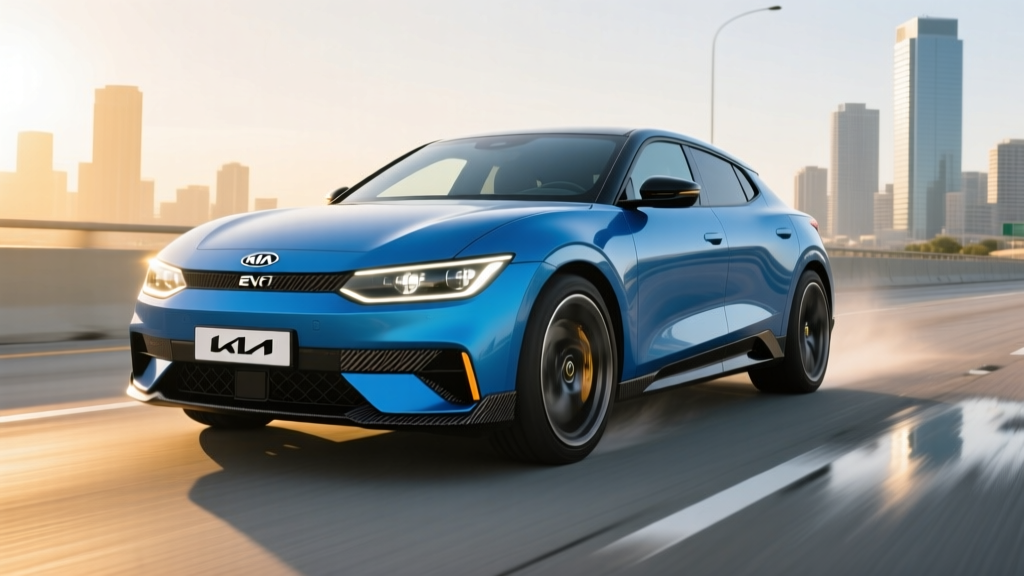
The Kia EV6 GT exists to answer one question: can a mainstream-brand electric crossover hang with a Tesla Model Y Performance or a Porsche Taycan at a stoplight? With 576 horsepower and a factory-claimed 3.4-second sprint to 60 mph, Kia's hottest EV isn't just a numbers exercise — it's a legitimate performance machine wrapped in a practical hatchback body. But speed is only part of the ownership equation. In this review, we break down the EV6 GT's real-world range, charging behavior, daily practicality, and whether the EV6 GT 0-60 performance justifies its premium over the standard EV6 lineup.
EV6 GT Performance: The Numbers Behind the 0-60 Claim
The EV6 GT uses a dual-motor all-wheel-drive powertrain producing 576 horsepower and 545 lb-ft of torque. Kia's official 0-60 mph time is 3.4 seconds — a figure we've seen validated within a tenth or two during controlled testing on prepped surfaces. On a typical street surface with ambient temperatures in the 60s, expect 3.5 to 3.7 seconds. That puts the EV6 GT in rarefied air: quicker than a base Porsche 911 Carrera and within striking distance of the Tesla Model Y Performance (3.5 seconds).
The powertrain features a rear motor with 378 hp and a front motor contributing 217 hp, managed through an electronic limited-slip differential (e-LSD) on the rear axle. Kia includes dedicated GT drive modes — My Mode lets you individually configure steering weight, suspension damping, motor torque distribution, and regen strength. The EV6 GT also gets a Drift Mode that biases torque rearward, though we'd keep that one confined to closed courses.
| Specification | Value |
|---|---|
| Drivetrain | Dual-motor AWD |
| Horsepower (combined) | 576 hp |
| Torque | 545 lb-ft |
| 0-60 mph (manufacturer) | 3.4 seconds |
| 0-60 mph (real-world street) | 3.5–3.7 seconds |
| Top Speed | 161 mph (electronically limited) |
| Battery (usable) | 77.4 kWh, NMC (Nickel Manganese Cobalt) |
| Rear Axle | Electronic limited-slip differential (e-LSD) |
| Suspension | Adaptive dampers (GT-tuned) |
| Brakes (front) | 14.96-inch ventilated disc |
| Wheels | 21-inch alloy with 255/40R21 Michelin Pilot Sport EV |
What separates the GT from lesser EV6 trims isn't just straight-line speed. The adaptive sport suspension, thicker anti-roll bars, and retuned steering ratio give it genuinely athletic cornering behavior. Body roll is well-controlled for a 4,800-pound crossover. The trade-off is a noticeably firmer ride — you'll feel expansion joints and potholes more than in the EV6 Wind or Light trims.
Real-World Range: What 206 Miles EPA Actually Means
The EPA rates the EV6 GT at 206 miles of combined range. That's the lowest figure in the EV6 lineup — the price of 576 horsepower, sticky 21-inch summer tires, and less aerodynamic efficiency at speed.
EPA Combined: 206 miles
Highway (70 mph, 72°F): Expect ~175–185 miles
City / mixed driving: Expect ~195–210 miles
Cold weather (below 32°F): Expect ~145–165 miles
The 77.4 kWh NMC battery and performance-oriented tires reduce efficiency. Aggressive driving can push consumption above 35 kWh/100mi, cutting range below 170 miles even in mild conditions.
Efficiency lands at approximately 85 MPGe combined, or roughly 30 kWh per 100 miles under normal mixed driving. During sustained highway travel, consumption climbs to 33–36 kWh/100mi. For comparison, the EV6 Wind AWD (325 hp) achieves 274 miles EPA on the same battery, running 28 kWh/100mi — a reminder that performance costs efficiency.
According to fueleconomy.gov, the EV6 GT's combined energy consumption makes it one of the thirstier EVs in its class. If your commute exceeds 70 miles round-trip and you lack reliable home charging, the GT's range becomes a genuine constraint rather than an abstraction.
Charging Speed: 800-Volt Architecture Delivers
The EV6 GT's strongest practical advantage over many competitors is its 800-volt electrical architecture (shared with the Hyundai Ioniq 5 and Genesis GV60). This enables DC fast-charging speeds that remain best-in-class for the segment.
| Charging Level | Power | Speed / Time |
|---|---|---|
| Level 1 (120V household) | ~1.4 kW | ~4 miles per hour |
| Level 2 (240V home, 48A) | 10.9 kW | ~32 miles per hour; full charge in ~7.5 hours |
| DC Fast Charge (350 kW station) | Peak ~240 kW | 10–80% in approximately 18 minutes |
| DC Fast Charge (150 kW station) | Peak ~130 kW | 10–80% in approximately 28 minutes |
| DC Fast Charge (50 kW station) | 50 kW | 10–80% in approximately 65 minutes |
A few notes from real charging sessions: the 240 kW peak is not sustained. The EV6 GT holds peak power roughly between 15–55% state of charge, then tapers progressively. Between 80–100%, charging slows dramatically — a characteristic of NMC chemistry protecting cell longevity. Always plan road trips around 10–80% charge windows; pushing to 100% at a DC fast charger wastes time.
The EV6 GT ships with a NACS (North American Charging Standard) port on 2025–2026 model years, granting direct access to Tesla's Supercharger network without an adapter. At home, a Level 2 wallbox on a 60-amp circuit (48 amps continuous) replenishes the battery from empty to full overnight. Expect to budget $600–$1,200 for a quality Level 2 charger and $800–$2,000 for professional installation by a licensed electrician, depending on panel capacity and conduit runs.
Interior, Cargo Space, and Daily Practicality
The EV6 GT's cabin borrows heavily from the standard EV6 — a dual 12.3-inch curved display setup, physical climate controls (thankfully), and Kia's latest infotainment with wireless Apple CarPlay and Android Auto. GT-specific touches include suede-and-leather sport bucket seats with neon green stitching, a flat-bottom steering wheel, and GT-branded door scuff plates.
Front-seat comfort is excellent. The sport seats are heavily bolstered but not punishing on long drives. Rear legroom measures 39.4 inches — generous for the segment and noticeably better than the Hyundai Ioniq 5 N's similar layout. Headroom in back is adequate for passengers under six feet tall, though the sloping roofline cuts into space for taller riders.
| Dimension | Measurement |
|---|---|
| Front headroom | 39.1 inches |
| Front legroom | 41.7 inches |
| Rear headroom | 38.0 inches |
| Rear legroom | 39.4 inches |
| Cargo (behind rear seats) | 24.4 cu ft |
| Cargo (rear seats folded) | 50.2 cu ft |
| Front trunk (frunk) | 0.7 cu ft (minimal — houses electronics) |
The frunk is essentially useless on the GT — the power electronics consume most of the under-hood space. You'll fit a charging cable and maybe a small bag. For real cargo, the rear hatch offers 24.4 cubic feet, expanding to 50.2 with the 60/40 split rear seats folded. That's competitive with the Ford Mustang Mach-E but trails the Tesla Model Y's 30.2 / 76.2 cu ft advantage.
Standout tech includes a head-up display with augmented-reality navigation overlays, Highway Driving Assist 2 (HDA2) for semi-autonomous lane centering and adaptive cruise, Remote Smart Parking Assist (the car can park itself while you stand outside), and vehicle-to-load (V2L) capability — a built-in 120V outlet that can power devices up to 3.6 kW, useful for camping or emergency backup.
Pricing, Tax Credit Eligibility, and Total Cost
The 2026 Kia EV6 GT carries a base MSRP of approximately $62,000 (including destination). Options are limited — Kia packages the GT comprehensively from the factory. The primary variable is paint color, with premium colors adding $495–$695. An as-tested EV6 GT typically lands between $62,000 and $63,500.
| Trim | MSRP (approx.) | §30D Credit Eligibility |
|---|---|---|
| EV6 Light RWD | $43,200 | Eligible (under $55k sedan cap) |
| EV6 Wind AWD | $51,200 | Eligible (under $80k SUV cap) |
| EV6 GT-Line AWD | $55,500 | Eligible (under $80k SUV cap) |
| EV6 GT AWD | $62,000 | Eligible (under $80k SUV cap)* |
* Classification as SUV vs. sedan under IRS §30D rules depends on the vehicle's gross vehicle weight rating (GVWR) and how the manufacturer classifies it. The EV6 GT's eligibility can vary — always verify on the IRS's official clean vehicle credit page before purchasing. The credit is also subject to buyer income caps ($150,000 single / $300,000 joint AGI), critical-mineral and battery-component sourcing requirements, and can be applied as a point-of-sale rebate through registered dealers.
If the EV6 GT qualifies for the full $7,500 federal credit, your effective price drops to roughly $54,500. Many states offer additional incentives — California's CVRP, Colorado's $5,000 credit, and various utility rebates can stack on top. Check AFDC's state incentive database for your jurisdiction.
Insurance for the EV6 GT runs higher than standard EV6 trims — expect $2,200–$2,800 annually depending on your profile, reflecting the GT's performance classification and repair costs for the 21-inch wheels and adaptive suspension.
Warranty and Long-Term Battery Outlook
Kia backs the EV6 GT with one of the best warranties in the EV segment:
- Basic vehicle warranty: 5 years / 60,000 miles
- Powertrain warranty: 10 years / 100,000 miles
- Battery warranty: 10 years / 100,000 miles (replaces if capacity drops below 70%)
- Roadside assistance: 5 years / 60,000 miles
The 77.4 kWh NMC battery pack is liquid-cooled with an active thermal management system. NMC chemistry offers higher energy density than LFP (lithium iron phosphate) but is more sensitive to sustained high states of charge and extreme heat. Best practice: set the charge limit to 80% for daily driving and only charge to 100% before road trips. Kia's 70% capacity retention threshold over 10 years is standard for the industry — most NMC packs in liquid-cooled systems lose 8–15% capacity in the first 100,000 miles based on fleet data from similar Hyundai Motor Group platforms.
Full battery replacement out of warranty is estimated at $12,000–$18,000 including labor, though the modular pack design may allow individual module replacement at lower cost if only specific cell groups degrade.
How the EV6 GT Stacks Up Against Key Competitors
| Spec | Kia EV6 GT | Tesla Model Y Perf. | Ford Mustang Mach-E GT | BMW iX M60 |
|---|---|---|---|---|
| 0-60 mph | 3.4 sec | 3.5 sec | 3.5 sec | 3.6 sec |
| Horsepower | 576 hp | 456 hp | 480 hp | 610 hp |
| EPA Range | 206 mi | 277 mi | 260 mi | 296 mi |
| Battery | 77.4 kWh NMC | ~75 kWh NMC | 91 kWh NMC | 111.5 kWh NMC |
| Peak DC Charge | ~240 kW | ~250 kW | ~150 kW | ~195 kW |
| 10–80% DC Time | ~18 min | ~20 min | ~38 min | ~28 min |
| MSRP (approx.) | $62,000 | $55,000 | $60,000 | $111,500 |
| Cargo (rear up) | 24.4 cu ft | 30.2 cu ft | 29.7 cu ft | 35.5 cu ft |
The EV6 GT wins on charging speed and value-for-horsepower. It loses on range and cargo space. The Model Y Performance is the pragmatic choice for range-conscious buyers. The Mach-E GT offers more cargo room but charges significantly slower. The BMW iX M60 is a luxury class above in price and refinement. None match the EV6 GT's combination of sub-$65K pricing, sub-3.5-second acceleration, and 800V charging architecture.
Pros and Cons: The Honest Verdict
- 3.4-second 0-60 mph — genuine supercar territory
- 800V architecture enables 18-minute 10–80% DC charging
- NACS port provides direct Tesla Supercharger access
- Adaptive suspension and e-LSD deliver real handling dynamics
- Industry-leading 10-year/100,000-mile battery warranty
- V2L capability for off-grid power
- Physical climate controls (no touchscreen-only frustration)
- 206-mile EPA range is the lowest in its class
- Firm ride quality fatigues on rough roads
- Essentially useless frunk (0.7 cu ft)
- 21-inch summer tires wear quickly and are expensive to replace (~$350 each)
- Higher insurance premiums than standard EV6 trims
- Infotainment can lag when multiple features are active
- Cold-weather range drops to ~150 miles in sub-freezing temps
Who Should Buy the Kia EV6 GT?
- You want sub-3.5-second 0-60 performance without spending Porsche money
- You have reliable home Level 2 charging and your daily driving stays under 120 miles
- You value fast DC charging for road trips (18-minute stops are genuinely quick)
- You prioritize driving dynamics over maximum cargo space
- You need 270+ miles of range (get the Tesla Model Y Performance or EV6 Wind AWD)
- You regularly carry bulky cargo or more than two rear passengers (get the Model Y or Mach-E GT)
- You live in a region with harsh winters and limited charging infrastructure (the GT's cold-weather range drop is significant)
- You want a luxury interior — consider the BMW iX or Audi RS e-tron GT at higher price points
Frequently Asked Questions
What is the real-world 0-60 time of the Kia EV6 GT?
Kia claims 3.4 seconds. In real-world testing on typical asphalt at moderate temperatures, expect 3.5 to 3.7 seconds. Battery state of charge matters — the GT is quickest above 70% SoC and noticeably slower below 20%.
Does the EV6 GT qualify for the $7,500 federal tax credit?
It can, but eligibility depends on multiple factors under IRS §30D: the buyer's AGI must be under $150,000 (single) or $300,000 (joint), the vehicle must meet battery-component and critical-mineral sourcing requirements (which shift annually), and the MSRP must fall under the applicable cap. The EV6 GT is classified as an SUV by the IRS, putting it under the $80,000 MSRP cap. Always verify current eligibility on irs.gov and with your dealer's point-of-sale transfer process before committing.
How far can the EV6 GT really go on a charge?
The EPA rates it at 206 miles combined. In real-world highway driving at 70 mph in mild weather, expect 175–185 miles. In cold weather (below 32°F), range can drop to 145–165 miles. If you drive aggressively, consumption spikes and range falls further. Plan road-trip charging stops at roughly 150-mile intervals for comfort.
Is the EV6 GT worth it over the cheaper EV6 Wind AWD?
If your priority is range and value, the Wind AWD (274 miles EPA, ~$51,200) is the smarter buy. The GT costs roughly $11,000 more for 251 additional horsepower, 68 fewer miles of range, adaptive suspension, and a firmer ride. The GT is worth it only if performance driving is central to your enjoyment of the car.
How expensive are the EV6 GT's 21-inch tires to replace?
The Michelin Pilot Sport EV 255/40R21 tires run approximately $320–$380 each. Expect 20,000–30,000 miles from a set depending on driving style — performance summer tires wear faster, especially with 576 hp on tap. Some owners switch to all-season alternatives for year-round use, though this slightly reduces grip and range.
Can the EV6 GT tow?
Kia rates the EV6 GT at 2,700 pounds of towing capacity (with the factory tow hitch accessory). That's sufficient for a small utility trailer or a pair of dirt bikes, but not a full-size camping trailer. Towing reduces range by roughly 30–40%, making the GT's already-limited range even tighter on the road.