Quick Verdict: Is Financing a 2026 Kia EV6 Worth It?
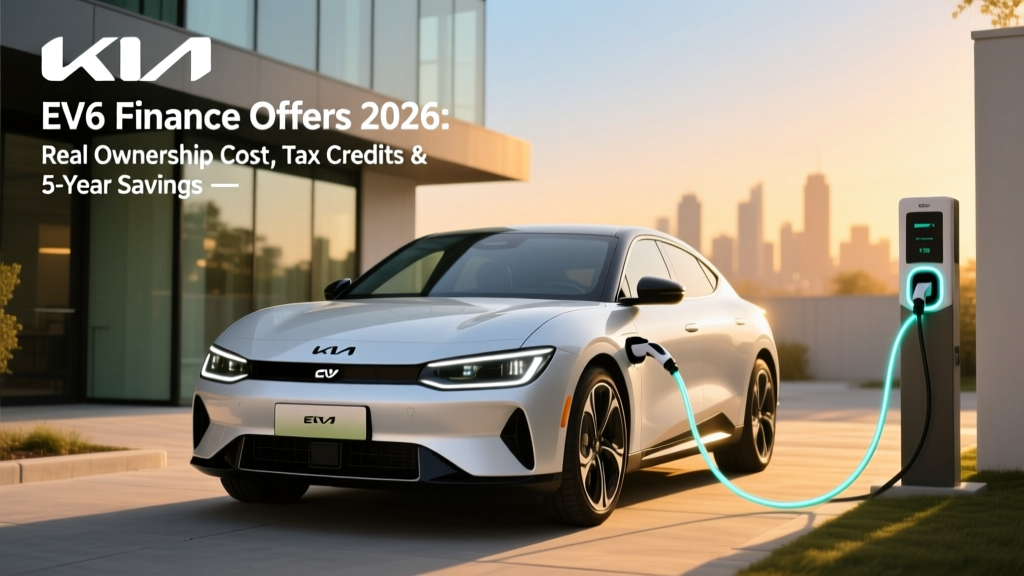
The 2026 Kia EV6 remains one of the most compelling electric crossovers on the market, combining a 310-mile EPA range (on the Light Long Range trim), 800V-class fast charging, and a starting MSRP that undercuts most rivals. But when you're evaluating Kia EV6 finance offers at the dealership, the sticker price is only the beginning. Real ownership economics depend on federal tax credit eligibility, your local electricity rates, insurance premiums, and how the EV6 holds its value over time.
This guide breaks down every dollar — from the point-of-sale tax credit transfer to 5-year depreciation — so you can walk into the finance office with exact numbers, not marketing brochures.
| Spec | Light Long Range RWD | Wind AWD | GT-Line AWD |
|---|---|---|---|
| Base MSRP | $42,600 | $47,500 | $52,200 |
| EPA Range | 310 mi | 282 mi | 274 mi |
| Battery (usable) | 77.4 kWh, NMC | 77.4 kWh, NMC | 77.4 kWh, NMC |
| Peak DC Charge Rate | 240 kW | 240 kW | 240 kW |
| 10–80% DC Fast Charge | ~18 min | ~18 min | ~18 min |
| Level 2 Charge (10.9 kW onboard) | ~7 hr 20 min | ~7 hr 20 min | ~7 hr 20 min |
| 0–60 mph | 7.2 sec | 5.1 sec | 5.1 sec |
| Horsepower | 225 hp | 320 hp | 320 hp |
| MPGe (combined) | 134 MPGe | 117 MPGe | 114 MPGe |
| Battery/Powertrain Warranty | 10 yr / 100,000 mi | ||
| §30D Tax Credit Eligible | Up to $7,500 (see rules below) | ||
2026 Kia EV6 Finance Offers: What Dealers Are Advertising
Kia Motors Finance (now operating under Kia Finance America) typically rotates monthly promotional rates on the EV6. As of early 2026, common offers include:
- Lease deals: Often structured at 36 months / 10,000–12,000 miles per year, with money factors that translate to roughly 4.5–6.0% equivalent APR depending on tier-1 credit.
- Purchase APR promos: Qualified buyers may see 1.9%–3.9% APR for 48–60 months on select trims, though these fluctuate monthly.
- Cash-back alternatives: Some months Kia offers $1,500–$2,500 bonus cash in lieu of low-APR financing — compare the math before choosing.
Critical note: the federal §30D clean vehicle credit can now be transferred to the dealer at point of sale under the Inflation Reduction Act. This means the up-to-$7,500 credit comes off your purchase price immediately, reducing the amount you finance. You do not need to wait until tax filing to benefit — but you must meet all eligibility requirements.
Federal Tax Credit: Do You Actually Qualify?
The §30D credit is not automatic. It's a complex set of rules that determine whether you get $0, $3,750, or the full $7,500. Here's the 2026 eligibility checklist:
- MSRP cap: The EV6 must have an MSRP at or below $80,000 (SUVs/crossovers). All current EV6 trims qualify.
- Buyer income cap (modified AGI): $150,000 single filer / $225,000 head of household / $300,000 joint filers. Based on the year of delivery or the prior year — whichever is lower.
- Final assembly: Must occur in North America. The EV6 is built in West Point, Georgia — qualifies.
- Battery component sourcing: A percentage of battery components must be manufactured or assembled in North America (threshold increases yearly; 100% for 2026 deliveries to claim the full $3,750 component).
- Critical minerals: A percentage of critical minerals must be sourced from the US or a free-trade-agreement country (80% threshold for 2026 deliveries for the $3,750 minerals component).
- Point-of-sale transfer: You can elect to transfer the credit to the dealer, reducing your financed amount. The dealer must be registered with the IRS Energy Credits Online portal.
- One credit per VIN, one vehicle per year per taxpayer.
What this means for the EV6 in 2026: The 2026 EV6, assembled in Georgia, has been eligible for the full $7,500 credit for qualifying buyers in recent model years. However, battery sourcing rules tighten annually. Always verify current eligibility on IRS.gov or fueleconomy.gov before signing — rules can shift mid-year based on supply chain changes.
Disclaimer: Tax credit rules are complex and subject to change. Consult a tax professional for advice specific to your situation. Incentive amounts and eligibility reflect rules current as of early 2026.
5-Year Total Cost of Ownership: EV6 vs. Gas Crossover
Let's run the real numbers. We're comparing the 2026 Kia EV6 Wind AWD ($47,500 MSRP) against a comparably equipped gas crossover like the Kia Sportage Hybrid AWD (~$35,500 MSRP) over 5 years and 75,000 miles (15,000 mi/year).
| Cost Category | EV6 Wind AWD | Gas Crossover (Sportage HEV AWD) |
|---|---|---|
| Purchase Price (MSRP) | $47,500 | $35,500 |
| Federal Tax Credit (§30D) | −$7,500 | $0 |
| Net Purchase After Credit | $40,000 | $35,500 |
| Fuel/Energy (75k mi) | $3,375 | $7,125 |
| Maintenance (5 yr) | $1,200 | $3,750 |
| Insurance (5 yr avg.) | $10,500 | $8,250 |
| Estimated Depreciation (5 yr) | $20,000 | $14,200 |
| Total 5-Year Cost | $75,075 | $68,825 |
| Cost Per Mile | $1.00/mi | $0.92/mi |
Assumptions: Electricity at $0.15/kWh national average, EV6 efficiency of 3.0 mi/kWh (≈117 MPGe combined for AWD). Gas at $3.80/gallon, Sportage HEV at 40 MPG combined. Insurance based on national EV average premium ~$2,100/yr vs. ~$1,650/yr for gas equivalent. Depreciation estimates based on recent EV resale trends (see section below).
Charging vs. Gas: The Per-Mile Math
| Metric | Kia EV6 Wind AWD | Gas Crossover (40 MPG) |
|---|---|---|
| Energy Source | Electricity | Unleaded (regular) |
| Efficiency | 3.0 mi/kWh (117 MPGe) | 40 MPG combined |
| Unit Cost | $0.15/kWh (home avg.) | $3.80/gallon |
| Cost Per Mile | $0.05/mi | $0.095/mi |
| Annual Cost (15k mi) | $750 | $1,425 |
| 5-Year Cost (75k mi) | $3,750 | $7,125 |
| 5-Year Savings | $3,375 saved with EV6 | |
Important caveats:
- The $0.15/kWh figure assumes predominantly home Level 2 charging. If you rely heavily on DC fast charging (typically $0.35–$0.55/kWh at networks like Electrify America or EVgo), your per-mile cost can rise to $0.12–$0.18/mi — narrowing or eliminating the gap with gas.
- Time-of-use utility rates can drop your cost to $0.08–$0.10/kWh if you charge overnight, pushing savings even wider.
- The EV6's 800V architecture means 10–80% in ~18 minutes at a 240 kW charger — minimizing paid DCFC session time, which matters if your utility bills by the minute at some public stations.
Maintenance Savings: Where the EV6 Really Wins
| Service Item | Kia EV6 | Gas Crossover |
|---|---|---|
| Oil changes | $0 (none needed) | $750 (10 changes @ $75) |
| Brake pads | $150 (regen extends life) | $600 (2 sets) |
| Cabin air filter | $200 | $200 |
| Coolant flush | $150 | $200 |
| Transmission fluid | $0 (single-speed reducer) | $300 |
| Tire rotation/replacement | $600 (EV tires wear faster due to weight/torque) | $500 |
| Miscellaneous (wipers, 12V battery) | $100 | $200 |
| Total 5-Year Maintenance | $1,200 | $3,750 |
The EV6's regenerative braking system handles most deceleration, dramatically reducing friction brake wear. Many EV owners report original brake pads lasting 100,000+ miles. The single-speed reduction gear eliminates transmission service entirely. The one area where EVs can cost more is tires — the EV6's ~4,500 lb curb weight and instant torque accelerate tread wear, so budget for a quality EV-rated tire set (like the Michelin Pilot Sport EV or Hankook iON evo) around year 4.
Insurance Reality: The Cost You Can't Ignore
EVs cost more to insure than equivalent gas vehicles. This isn't speculation — it's borne out in national premium data. The 2026 Kia EV6 typically carries annual premiums of $1,900–$2,400 depending on your state, driving record, and coverage level, compared to $1,500–$1,800 for a gas crossover in the same class.
Why EV insurance costs more:
- Higher repair costs: EV battery packs, power electronics, and specialized sensors (like the EV6's Highway Driving Assist 2 suite) are expensive to replace after a collision.
- Specialized labor: Fewer body shops are certified for high-voltage system repairs, driving up labor rates.
- Total-loss thresholds: Even minor battery damage can trigger a total-loss declaration due to the $15,000–$25,000 replacement cost of the battery pack.
- Vehicle weight: Heavier vehicles cause more damage in multi-vehicle accidents, increasing liability exposure.
How to reduce EV6 insurance costs: Shop at least 3 quotes (GEICO, Progressive, and State Farm tend to be competitive on EVs). Ask about EV-specific discounts — some insurers offer reduced rates for vehicles with advanced ADAS. Bundling home and auto can save 10–15%. If you have a clean record, usage-based programs like Progressive's Snapshot or Allstate's Drivewise may lower your premium further.
Depreciation & Resale Value: The EV Market Has Shifted
EV depreciation has been volatile. Early EVs suffered steep value drops, and 2023–2024 saw a wave of price cuts from Tesla that dragged down used EV values industry-wide. However, by 2026, the market has stabilized somewhat as lease volumes normalize and buyer demand for quality used EVs remains strong.
Current EV6 depreciation outlook (5-year projection):
- Year 1: 15–20% loss (typical for new vehicles; partially offset if you captured the $7,500 credit at purchase)
- Year 3: 35–45% cumulative loss from MSRP
- Year 5: 45–55% cumulative loss from MSRP
For the EV6 Wind AWD at $47,500 MSRP, a 45% 5-year depreciation means a residual value of approximately $26,000. That's a $21,375 loss in value — but remember, your net cost basis was $40,000 after the tax credit, so your actual equity loss is closer to $14,000.
Factors working in the EV6's favor:
- Kia's 10-year/100,000-mile battery and powertrain warranty transfers to second owners (reduced to 5yr/60k for some components on resale — verify with Kia), supporting used values.
- The 800V fast-charging architecture will remain competitive for years, unlike early 50 kW EVs that are now functionally obsolete for road trips.
- NMC battery chemistry in the EV6 has shown modest degradation in real-world use — typically 8–12% capacity loss over 5 years/75,000 miles, well within Kia's warranty threshold (the battery is warranted to retain 70% capacity).
State, Local & Utility Incentives: Stack Your Savings
Incentives vary dramatically by location. Below are examples — always verify current availability with your state energy office, utility provider, or the DOE's Alternative Fuels Data Center.
- California: CVRP rebate up to $2,000 (income-dependent); some utility districts offer an additional $1,000–$1,500.
- Colorado: State tax credit of up to $5,000 for new EVs (income-capped, subject to legislative renewal).
- New York: Drive Clean Rebate up to $2,000 (point-of-sale, income-capped).
- Utility rebates: Many utilities (e.g., PG&E, Xcel Energy, ConEdison) offer $250–$1,000 rebates for home Level 2 charger installation, plus time-of-use rates that slash charging costs.
- HOV lane access: Several states grant EVs access to carpool lanes with a single occupant — a significant time savings in metro areas.
State and local incentives change frequently. Confirm eligibility with your state's energy agency and your utility before purchase.
When you stack the federal credit ($7,500), a hypothetical state rebate ($2,000), and a utility charger rebate ($500), the EV6 Wind AWD's effective purchase price drops from $47,500 to $37,500 — competitive with a loaded gas crossover before you even account for fuel and maintenance savings.
Frequently Asked Questions
How much does it really cost to own a Kia EV6 over 5 years?
Based on our analysis of the EV6 Wind AWD with the $7,500 federal credit applied, total 5-year / 75,000-mile ownership costs are approximately $75,075 — or about $1.00 per mile. This includes purchase price (net of credit), electricity, maintenance, insurance, and depreciation. A comparable gas crossover costs roughly $68,825 over the same period. The EV6 narrows the gap through fuel and maintenance savings but loses ground on insurance and depreciation.
Do I qualify for the $7,500 federal EV tax credit on the Kia EV6?
You may qualify for the full $7,500, a partial $3,750, or nothing — it depends on your modified adjusted gross income (caps: $150k single / $300k joint), the vehicle's MSRP (must be ≤$80,000 for SUVs — all EV6 trims qualify), North American final assembly (EV6 is built in Georgia), and battery sourcing requirements that tighten each year. The credit can be transferred to the dealer at point of sale, reducing your financed amount. Always verify current eligibility on IRS.gov and consult a tax professional.
How much do I save on fuel and maintenance with the EV6?
Over 5 years and 75,000 miles, the EV6 saves approximately $3,375 on electricity vs. gasoline (assuming $0.15/kWh home charging and $3.80/gallon gas) and roughly $2,550 on maintenance (no oil changes, minimal brake wear, no transmission service). Combined savings of about $5,925 offset a significant portion of the EV6's higher purchase price and insurance costs.
Are EVs more expensive to insure than gas cars?
Yes, typically 15–30% more. The EV6 averages $1,900–$2,400/year in premiums vs. $1,500–$1,800 for a comparable gas crossover. Higher repair costs for battery and sensor components, specialized labor requirements, and the vehicle's weight all contribute. Shop multiple insurers and ask about EV-specific discounts or ADAS safety credits to reduce your premium.
How well does the Kia EV6 hold its value?
The EV6 is projected to retain approximately 45–55% of its MSRP after 5 years. While this is steeper depreciation than top gas crossovers, it has improved compared to early EVs. The 10-year/100,000-mile battery warranty (partially transferable), 800V fast-charging capability, and Kia's growing EV brand credibility support residuals. Your effective depreciation is also reduced by the $7,500 tax credit, which lowers your actual cost basis.
Should I lease or buy the 2026 Kia EV6?
Leasing can be attractive if you want to avoid long-term depreciation risk and prefer lower monthly payments. However, when you lease, the §30D tax credit technically goes to the lessor (Kia Finance) — they may pass it through as a capitalized cost reduction, but this isn't guaranteed. When buying, you can claim the credit directly (or transfer it at point of sale). Run both scenarios with your dealer's finance desk, comparing the total out-of-pocket over 36 months including the credit benefit. If you plan to keep the EV6 past 5 years, buying typically makes more financial sense.
What happens if I don't have enough tax liability to use the full credit?
The §30D credit is non-refundable — it can only reduce your federal tax liability to zero, not generate a refund. However, the point-of-sale transfer option changes this equation: when you transfer the credit to the dealer, it acts as an upfront price reduction regardless of your tax liability. The dealer then claims the credit. This effectively makes the credit "refundable" in practice through the purchase price reduction. Confirm the dealer is registered with the IRS Energy Credits Online system before relying on this.
Bottom Line: Finance Smart, Not Just Cheap
The best Kia EV6 finance offer isn't necessarily the one with the lowest monthly payment. It's the one that accounts for the full ownership picture: the $7,500 federal credit reducing your financed amount (if you qualify), $675/year in fuel savings, $510/year in maintenance savings, offset by ~$450/year in higher insurance. Over 5 years, a well-structured EV6 purchase — especially with stacked state and utility incentives — can approach cost parity with a gas crossover while delivering 310 miles of EPA range, 18-minute fast charging, and a dramatically better daily driving experience.
Before you sign: verify your §30D eligibility on IRS.gov, confirm the dealer is registered for point-of-sale credit transfers, get at least three insurance quotes, and check your state's incentive database at the DOE Alternative Fuels Data Center. Armed with real numbers, you'll negotiate from strength.