The Current State of Kia EV Cars
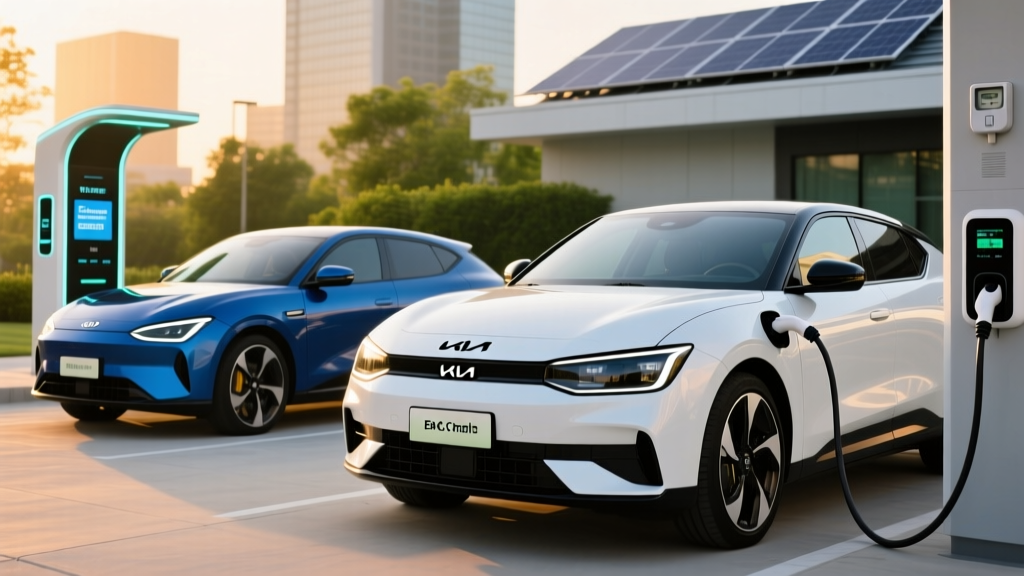
If you are researching Kia EV cars in 2026, the conversation really centers on two production models: the midsize crossover EV6 and the three-row SUV EV9. Kia also sells the Niro EV, but it is a carryover design aimed at budget-minded buyers. The EV6 and EV9 are built on the Hyundai Motor Group E-GMP platform with 800-volt electrical architecture — a feature that still sets Kia apart from most rivals in the $40,000–$60,000 price band when it comes to DC fast-charge speed.
This guide focuses on the two flagship models that shoppers actually cross-shop, with exact EPA figures, real-world range observations, charge-curve behavior, and the current-year federal tax-credit picture.
2026 Kia EV6: Range, Battery, and Real-World Efficiency
The refreshed EV6 continues with two usable battery packs. The Light and Wind trims use a 63.0 kWh pack (NMC chemistry), while the GT-Line and GT trims step up to a 77.4 kWh pack, also NMC. Kia quotes these as net usable capacity, not gross.
EPA estimates run from 232 miles (GT-Line AWD) up to 310 miles (Light RWD). In mixed highway driving at 70 mph, expect roughly 260–275 miles from the long-range RWD model. In sub-freezing winter conditions, plan on 20–25% range loss, which brings a 310-mile sticker down to around 235–250 miles on a full charge.
| Trim | Battery (kWh) | Drivetrain | HP | EPA Range | MPGe (combined) | 0-60 mph |
|---|---|---|---|---|---|---|
| Light RWD | 77.4 | RWD | 225 | 310 mi | 134 | 7.2 s |
| Wind AWD | 77.4 | Dual-motor AWD | 320 | 282 mi | 120 | 5.1 s |
| GT-Line AWD | 77.4 | Dual-motor AWD | 320 | 274 mi | 117 | 5.1 s |
| GT AWD | 77.4 | Dual-motor AWD | 576 | 232 mi | 85 | 3.4 s |
Efficiency on the long-range RWD model sits at roughly 28 kWh/100 mi on the combined cycle, which is competitive with the Tesla Model Y Long Range and Hyundai Ioniq 5. The GT's 576 hp comes at a steep efficiency penalty — around 43 kWh/100 mi — so it is strictly a performance play, not a road-trip optimizer.
Charging the EV6: 800V Architecture Still Pays Off
The headline feature of Kia EV cars on the E-GMP platform is the 800-volt system, which allows peak DC fast-charge rates of up to 240 kW on a compatible 350 kW charger. In controlled testing, the 77.4 kWh pack typically hits a 10–80% charge in about 18 minutes, though the charge curve tapers hard above 80% — a 10–90% session will take closer to 30 minutes.
| Level | Power | Miles of Range Added per Hour | Notes |
|---|---|---|---|
| Level 1 (120V) | ~1.4 kW | ~4–5 mi/hr | Emergency/trickle only |
| Level 2 (240V, 48A) | 10.9 kW | ~38 mi/hr | Full charge in ~8 hrs |
| DC Fast (peak) | 240 kW | ~210 mi in 18 min (10–80%) | Requires 350 kW station, preconditioning |
Preconditioning matters here. If you navigate to a DC fast charger using the EV6's built-in route planner, the battery thermal management system warms the pack automatically. Without preconditioning — especially below 50°F — you may see peak rates limited to 150–170 kW for the first several minutes.
2026 Kia EV9: The Three-Row Option
The EV9 fills a gap that almost no other mainstream EV addresses: a genuine three-row electric SUV with usable third-row space. It rides on a stretched version of the same E-GMP platform with a 99.8 kWh usable battery (NMC).
| Trim | Drivetrain | HP | EPA Range | MPGe (combined) | 0-60 mph | Cargo (cu ft, behind 3rd/2nd/1st) |
|---|---|---|---|---|---|---|
| Light RWD | RWD | 215 | 304 mi | 94 | 7.7 s | 20.2 / 43.5 / 81.7 |
| Wind/Land AWD | Dual-motor AWD | 379 | 270 mi | 87 | 6.0 s | 20.2 / 43.5 / 81.7 |
| GT-Line AWD | Dual-motor AWD | 379 | 270 mi | 85 | 5.0 s | 20.2 / 43.5 / 81.7 |
The EV9's boxy shape and 5,000+ lb curb weight hurt highway efficiency. On the RWD model, plan on 250–265 miles at 70 mph. AWD trims drop to roughly 225–240 miles in real-world mixed driving. Cold weather (below 30°F) can shave another 15–20% off those figures.
Interior space is where the EV9 earns its keep. Third-row legroom measures 32.0 inches — tight for adults on long trips but fine for kids. Second-row legroom is a generous 42.8 inches, and the available captain's chairs with relaxation mode are among the most comfortable seats in any mainstream SUV, gas or electric.
Pricing, Trims, and Federal Tax-Credit Eligibility
Kia EV cars sit in a complicated spot for the §30D federal tax credit. The credit offers up to $7,500, but it comes with MSRP caps ($80,000 for SUVs like the EV9, $55,000 for sedans/crossovers like the EV6), adjusted gross income limits ($150,000 single / $300,000 married filing jointly), and battery component and critical-mineral sourcing requirements that change annually.
| Model / Trim | Base MSRP | As-Tested (typical) | §30D Eligibility |
|---|---|---|---|
| EV6 Light RWD | $43,500 | $45,200 | MSRP under $55K cap; partial credit likely (~$3,750–$7,500 depending on sourcing) |
| EV6 GT-Line AWD | $53,500 | $56,800 | Over $55K cap — ineligible for §30D new-vehicle credit |
| EV6 GT | $61,500 | $63,500 | Over $55K cap — ineligible |
| EV9 Light RWD | $56,500 | $59,000 | Under $80K SUV cap; partial credit likely |
| EV9 Land AWD | $66,500 | $71,000 | Under $80K SUV cap; partial credit likely |
The critical detail: even when MSRP and income qualify, the battery-sourcing rules may reduce the credit to $3,750 if critical-mineral or component thresholds are only partially met. Always verify current-year eligibility on IRS.gov and confirm with your tax professional before relying on the credit in your purchase math.
The point-of-sale transfer option lets you apply the credit as a down-payment reduction at the dealer, which is a meaningful cash-flow advantage if you qualify.
Tech, Safety, and Driver Assistance
Both models come with Kia's Highway Driving Assist 2 (HDA2), a Level 2 driver-assistance system combining adaptive cruise, lane-centering, and lane-change assist. This is not self-driving — the driver must keep hands on the wheel and eyes on the road at all times. It is, however, one of the smoother Level 2 systems on the market, with gentle inputs and reliable lane-keeping even on faded highway markings.
The EV6 and EV9 both feature dual 12.3-inch displays running Kia's latest infotainment, wireless Apple CarPlay and Android Auto, and over-the-air updates. The EV9 adds an available digital rear-view mirror and a fingerprint-authenticated driver profile system.
Safety ratings are strong: the EV6 earned an IIHS Top Safety Pick+ designation in prior model years, and the EV9 received top marks in NHTSA crash testing. Both include standard forward collision-avoidance, blind-spot monitoring, and rear cross-traffic alert.
Warranty and Long-Term Ownership
Kia backs both models with a 5-year/60,000-mile limited warranty and a 10-year/100,000-mile battery and powertrain warranty. The battery warranty guarantees that the high-voltage pack retains at least 70% of its original capacity during the coverage period. If degradation exceeds 30%, Kia will repair or replace the pack.
For context, most competitors match the 8-year/100,000-mile federal minimum for battery coverage. Kia's 10-year term is among the longest in the segment, which matters when you are committing to a $50,000+ EV with long-term depreciation uncertainty.
Who Should Buy a Kia EV6 or EV9?
- You want fast DC charging (18-min 10–80%) for regular road trips
- Your daily commute is under 80 miles round-trip
- You value sporty handling and don't need three rows
- You can charge at home with Level 2 (the EV6 is not ideal for street-parking-only owners)
- You need three rows and can't compromise on passenger space
- You want an electric alternative to the Telluride or Palisade
- Most of your driving is local/suburban, where range matters less
- You can absorb the higher MSRP and potential loss of full tax credit on upper trims
Pros and Cons at a Glance
- 800V architecture delivers class-leading DC charge speed (240 kW peak)
- 10-year/100,000-mile battery warranty exceeds most competitors
- EV9 offers a rare three-row EV option with genuine cargo versatility
- HDA2 is a refined, smooth Level 2 system
- Vehicle-to-load (V2L) capability lets you power devices or appliances from the car
- Several EV6 trims exceed the $55,000 §30D MSRP cap, disqualifying them from the federal credit
- EV9 highway efficiency is poor for its class — real-world range falls well short of EPA on road trips
- Infotainment relies on touch-capacitive controls that are harder to use while driving
- No front trunk (frunk) on the EV6; EV9 has only a small one
- Dealer markups remain common on EV9 GT-Line trims in high-demand markets
Frequently Asked Questions
What is the real-world range of Kia EV cars?
The EV6 Light RWD delivers roughly 260–275 miles in real-world highway driving versus its 310-mile EPA sticker. The EV9 RWD returns around 250–265 miles versus its 304-mile EPA figure. Cold weather reduces both by 15–25%.
How fast do Kia EV cars charge at home and on the road?
On a Level 2 home charger at 10.9 kW, the EV6 adds about 38 miles of range per hour, fully charging overnight in roughly 8 hours. On a 350 kW DC fast charger, the EV6 peaks at 240 kW and reaches 10–80% in about 18 minutes with battery preconditioning active.
How much does a Kia EV cost after tax credits?
The EV6 Light RWD starts at $43,500 MSRP. If you qualify for the full $7,500 §30D credit (subject to income, MSRP cap, and battery-sourcing rules), the effective price drops to around $36,000. Higher EV6 trims exceed the $55,000 MSRP cap and are ineligible. The EV9, classified as an SUV, qualifies up to the $80,000 cap, so most trims remain credit-eligible.
Does the Kia EV6 or EV9 qualify for the federal EV tax credit?
It depends on trim, your income, and current-year battery-sourcing rules. The EV6 Light and some Wind trims fall under the $55,000 sedan/crossover MSRP cap; the GT-Line and GT do not. The EV9, as an SUV, uses the $80,000 cap and most trims qualify on MSRP alone. Verify sourcing eligibility at fueleconomy.gov and consult a tax professional.
Is the Kia EV6 worth buying over the Hyundai Ioniq 5 or Tesla Model Y?
The EV6 trades blows with the Ioniq 5 (which shares the E-GMP platform) on charging speed and range, but offers a more driver-focused cockpit and sportier tuning. The Model Y still wins on Supercharger network access and cargo efficiency, but the EV6's 10-year warranty and faster peak charge rate make it compelling for buyers who don't rely on Tesla's network.