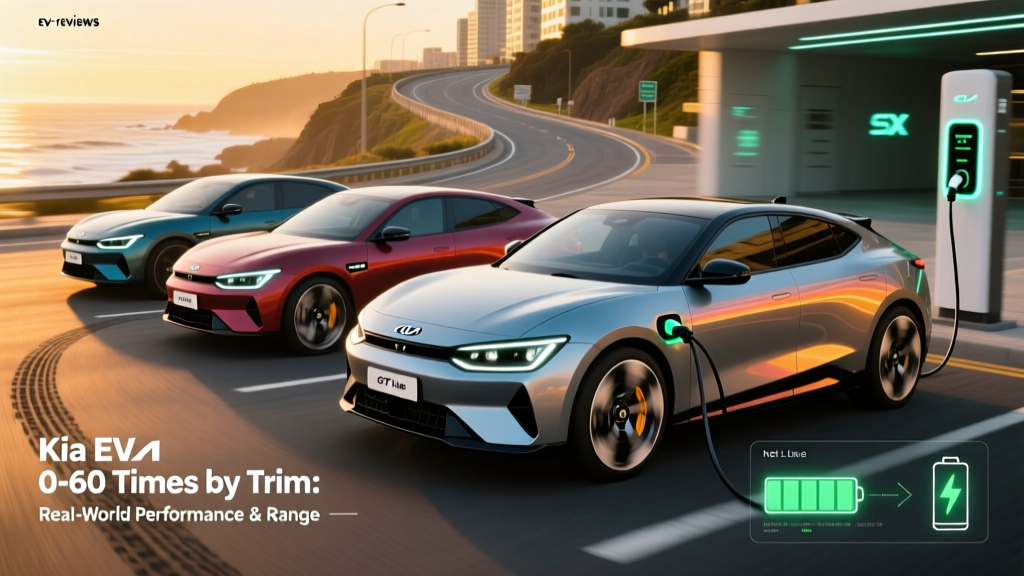
The Kia EV6 has earned its reputation as one of the most versatile electric crossovers on the market, and a big part of that story is straight-line performance. Buyers searching for the Kia EV6 0-60 time will find a wide spread depending on trim: a relaxed 7.2 seconds for the base rear-wheel-drive model and a ferocious 3.4 seconds for the dual-motor GT. This review breaks down every powertrain configuration, pairs those acceleration numbers with real-world range and charging data, and answers the ownership questions that spec sheets leave out.
Quick Verdict: Which EV6 Trim Matches Your Driving Style?
The EV6 lineup rewards buyers who know what they want. If efficiency and value matter most, the RWD models deliver over 300 miles of range and a sub-$45,000 starting price. If you want all-weather confidence without sacrificing too much range, the AWD trims split the difference. And if you want supercar-rivaling acceleration in a practical hatchback body, the GT exists in a class almost entirely its own at this price point.
Choose the EV6 Wind AWD if you face snow or rain regularly but still want 280+ miles of range.
Choose the EV6 GT-Line AWD if you want sport-tuned suspension, premium tech, and a 4.5-second 0-60 time.
Choose the EV6 GT if you want a 3.4-second 0-60 and track-capable performance without moving to a luxury badge.
Kia EV6 0-60 Times and Performance Specs by Trim
The EV6 uses Hyundai Motor Group's E-GMP platform with an 800-volt electrical architecture — the same underpinnings as the Hyundai Ioniq 5 and Genesis GV60. That 800V system is what enables the EV6's standout DC fast-charging capability, but it also supports a range of motor configurations that dramatically change the driving character.
| Trim | Drivetrain | Motor(s) | Horsepower | Torque (lb-ft) | 0-60 mph | Top Speed |
|---|---|---|---|---|---|---|
| Light RWD | Rear-wheel drive | Single rear | 167 hp | 258 | 7.2 sec | 115 mph |
| Wind RWD | Rear-wheel drive | Single rear | 225 hp | 258 | 6.2 sec | 115 mph |
| Wind AWD | All-wheel drive | Dual motor | 320 hp | 446 | 5.1 sec | 115 mph |
| GT-Line AWD | All-wheel drive | Dual motor | 320 hp | 446 | 4.5 sec | 120 mph |
| GT | All-wheel drive | Dual motor (performance) | 576 hp | 545 | 3.4 sec | 161 mph |
That 0-60 spread — from 7.2 seconds to 3.4 seconds — is among the widest in any single EV nameplate. For context, the EV6 GT's 3.4-second time matches a Porsche Taycan 4S and beats a Tesla Model Y Performance (3.5 seconds). The Light RWD's 7.2 seconds is leisurely by EV standards but entirely adequate for merging and city driving, and it comes with the range advantage of pushing less mass with a single motor.
EPA Range vs. Real-World Range: What to Actually Expect
The EV6's battery pack is a 77.4 kWh usable lithium-ion unit (NMC chemistry — nickel-manganese-cobalt) across all non-GT trims. The GT uses the same pack but with different thermal management tuning to support sustained high-output driving.
| Trim | Battery (usable) | Chemistry | EPA Range | MPGe (combined) | kWh/100 mi |
|---|---|---|---|---|---|
| Light RWD | 77.4 kWh | NMC | 310 mi | 134 MPGe | 25 |
| Wind RWD | 77.4 kWh | NMC | 310 mi | 134 MPGe | 25 |
| Wind AWD | 77.4 kWh | NMC | 282 mi | 117 MPGe | 29 |
| GT-Line AWD | 77.4 kWh | NMC | 282 mi | 117 MPGe | 29 |
| GT | 77.4 kWh | NMC | 206 mi | 85 MPGe | 40 |
The GT's 206-mile EPA range is the trade-off for 576 horsepower and stickier tires with higher rolling resistance. Owners who drive the GT aggressively will see that number shrink further — sustained track use or frequent full-throttle launches can push consumption well above 40 kWh/100 mi. For most GT owners who drive it like a grand tourer rather than a track car, 180–195 real-world miles is achievable in mixed conditions.
Charging Speed: 800V Architecture Put to Work
The EV6's 800-volt electrical architecture is its most underappreciated advantage. While many competitors in this price range top out at 150 kW on DC fast chargers, the EV6 can accept up to 240 kW peak on a compatible 350 kW charger — putting it in rarefied company alongside the Porsche Taycan and its corporate cousin, the Ioniq 5.
| Charging Level | Power | Connector | Speed / Time | Notes |
|---|---|---|---|---|
| Level 1 (120V) | ~1.4 kW | J1772 / NACS adapter | ~3–4 mi/hr | Emergency/trickle only |
| Level 2 (240V, 48A) | 10.9 kW | J1772 (2025) / NACS (2026+) | ~36 mi/hr / 7–8 hr full | Standard home install |
| DC Fast (350 kW station) | Peak 240 kW | CCS (2025) / NACS (2026+) | 10–80% in ~18 min | Preconditioning required |
| DC Fast (150 kW station) | ~150 kW | CCS / NACS | 10–80% in ~25 min | More common station type |
Charging curve reality: The 240 kW peak only holds between roughly 10% and 45% state of charge. After 50%, the rate tapers to around 150 kW, and above 80%, it drops sharply to protect the battery — often below 50 kW. This is normal for NMC chemistry but worth understanding: if you're road-tripping, plan your stops around 10–80% increments rather than trying to fill to 100% at a fast charger. A full 10–100% session can take 40+ minutes, whereas 10–80% is done in 18.
Preconditioning matters. The EV6 will not reach peak charge rates unless the battery is warmed to its optimal temperature window. Use the navigation-based battery preconditioning (available in the infotainment system's EV settings) by routing to your charging stop — the car will warm the pack automatically in the final 10–15 minutes of driving. Without preconditioning, especially in cold weather, expect peak rates closer to 150–175 kW even at a 350 kW station.
For 2026 models, Kia has transitioned the EV6 to the NACS (Tesla-style) charge port, giving native access to Tesla Supercharger stations. For 2025 models with CCS ports, a Kia-provided NACS adapter enables Supercharger access, though at slightly reduced peak speeds (~150 kW) due to adapter limitations.
Pricing, Tax Credits, and What You'll Actually Pay
The EV6's pricing has shifted upward for the current model year, reflecting both added content and inflationary pressure across the EV market. Here's the breakdown by trim, including the federal tax credit landscape as of 2026.
| Trim | Base MSRP | Federal §30D Credit | Est. Net Price | Notes |
|---|---|---|---|---|
| Light RWD | $42,900 | Up to $7,500* | ~$35,400 | Qualifies if sourcing rules met |
| Wind RWD | $47,900 | Up to $7,500* | ~$40,400 | Popular value trim |
| Wind AWD | $51,900 | Up to $7,500* | ~$44,400 | AWD value option |
| GT-Line AWD | $57,400 | Up to $7,500* | ~$49,900 | Premium sport trim |
| GT | $62,900 | Up to $7,500* | ~$55,400 | Halo performance model |
*Critical §30D eligibility caveats (per IRS guidelines): The full $7,500 credit requires meeting both critical-mineral and battery-component sourcing thresholds, which shift annually. The EV6 is assembled in South Korea, which has historically complicated credit eligibility under the North American final-assembly requirement — however, Kia's West Point, Georgia production of select trims has expanded. Additionally, buyer income caps apply ($150,000 single / $300,000 joint AGI), and the MSRP must not exceed $80,000 for SUVs (all EV6 trims qualify on MSRP). The credit can be transferred to the dealer at point of sale as an instant discount. Always confirm current eligibility with your dealer and a tax professional before purchasing.
Interior Space, Tech, and Daily Livability
The EV6's sloping roofline gives it a sportback silhouette, but interior packaging is surprisingly generous thanks to the flat-floor E-GMP platform and a 114.2-inch wheelbase.
- Front legroom: 41.2 inches
- Rear legroom: 39.4 inches (class-leading — more than a Model Y or Mustang Mach-E)
- Cargo behind rear seats: 24.4 cu ft
- Cargo with rear seats folded: 50.2 cu ft
- Front trunk (frunk): 0.7 cu ft (RWD) / 0.5 cu ft (AWD) — essentially a charging-cable cubby
The dual 12.3-inch panoramic display (instrument cluster + infotainment) runs Kia's latest Connect system with wireless Apple CarPlay and Android Auto. The EV6 also offers a head-up display with augmented-reality navigation prompts, a digital key (phone-as-key via NFC/UWB), and an integrated dash cam.
Driver assistance falls under Kia's Highway Driving Assist 2 (HDA2), a competent SAE Level 2 system that combines adaptive cruise control with lane-centering and automatic lane changes when you activate the turn signal. It is not self-driving — you must keep hands on the wheel and eyes on the road at all times. HDA2 works well on divided highways but does not handle construction zones, unmapped roads, or complex urban intersections.
Warranty and Long-Term Battery Outlook
Kia backs the EV6 with one of the strongest warranty packages in the EV segment:
- Basic vehicle warranty: 5 years / 60,000 miles
- Powertrain warranty: 10 years / 100,000 miles
- Battery warranty: 10 years / 100,000 miles (covers capacity below 70% of original)
- Roadside assistance: 5 years / 60,000 miles
The 70% capacity-retention threshold is standard for the industry. Real-world data from early 2022–2023 EV6 owners suggests NMC pack degradation is tracking at roughly 5–8% loss after 50,000 miles, well within warranty coverage. Long-term projections based on E-GMP platform data indicate 85–90% capacity retention at 100,000 miles for owners who avoid frequent DC fast-charging to 100% and who use the battery preconditioning feature regularly.
The EV6 also supports vehicle-to-load (V2L) via an adapter that plugs into the charge port, delivering up to 3.6 kW of 120V AC power — enough to run power tools, a small refrigerator, or emergency lighting during an outage.
EV6 vs. Key Competitors: Where It Stands
| Spec | Kia EV6 GT-Line AWD | Hyundai Ioniq 5 Limited AWD | Tesla Model Y LR AWD | Ford Mustang Mach-E GT |
|---|---|---|---|---|
| 0-60 mph | 4.5 sec | 5.1 sec | 4.8 sec | 3.5 sec |
| EPA Range | 282 mi | 290 mi | 303 mi | 260 mi |
| Max DC Charge | 240 kW | 240 kW | 250 kW | 150 kW |
| 10-80% Time | ~18 min | ~18 min | ~22 min | ~38 min |
| Base MSRP (comparable) | $57,400 | $56,200 | $52,490 | $59,995 |
| Cargo (rear seats up) | 24.4 cu ft | 27.2 cu ft | 30.2 cu ft | 29.7 cu ft |
The EV6's closest rival is the Ioniq 5, which shares the E-GMP platform but leans more retro-futuristic in design and slightly softer in ride tuning. The Model Y wins on cargo space and Supercharger network convenience (though the EV6's NACS transition narrows that gap significantly). The Mach-E GT is the EV6 GT's natural competitor — the Ford is slightly quicker to 60 but charges considerably slower and has less range.
Pros and Cons at a Glance
- Class-leading 800V DC fast charging (10–80% in ~18 min)
- Wide performance spread: 310-mi RWD to 3.4-sec GT
- Generous rear legroom (39.4 in) for the segment
- 10-year/100,000-mi battery and powertrain warranty
- NACS port on 2026 models = native Supercharger access
- V2L capability for camping and emergency power
- Quiet, refined ride quality on non-GT trims
- GT trim's 206-mile EPA range is limiting for road trips
- Tiny frunk (0.7 cu ft) — barely fits the charge cable
- Infotainment touch-capacitive controls can be finicky
- Rear visibility hampered by thick C-pillars and sloping roof
- No front wiper on rear camera (gets dirty in rain)
- Tax credit eligibility varies by production location and sourcing
Who Should Buy the Kia EV6?
The EV6 is best suited for buyers who want a single EV that can serve as a daily commuter, a weekend road-tripper, and — in GT form — a genuine performance car. Its 800V charging architecture makes it one of the most road-trip-friendly EVs in its price range, provided you plan stops around the 10–80% sweet spot. Families will appreciate the rear-seat space, though those needing maximum cargo volume should cross-shop the Model Y or Ioniq 5.
If you rarely drive more than 200 miles between charges and want the quickest car in the lineup, the GT delivers thrills that embarrass cars costing twice as much. If range is your priority and AWD isn't necessary, the Wind RWD at 310 miles EPA and a ~$40,400 net price (after credit) represents the strongest value in the lineup.
Frequently Asked Questions
What is the real-world range of the Kia EV6?
The RWD models are EPA-rated at 310 miles; expect 255–275 miles in real-world highway driving and 220–240 miles in cold weather. The AWD trims are rated at 282 miles EPA, with real-world highway range around 230–250 miles. The GT is rated at 206 miles EPA and delivers roughly 160–195 miles in mixed real-world driving depending on how aggressively you use its 576 horsepower.
How fast does the EV6 charge at home and on the road?
On a Level 2 home charger (240V, 48 amps), the EV6 charges at 10.9 kW, adding roughly 36 miles of range per hour — a full charge takes 7–8 hours. On a 350 kW DC fast charger, it peaks at 240 kW and charges from 10–80% in approximately 18 minutes, though preconditioning the battery via navigation routing is essential to hit that peak rate.
Does the Kia EV6 qualify for the federal EV tax credit?
Eligibility depends on current IRS §30D rules, including battery-sourcing requirements, buyer income caps ($150K single / $300K joint), and the $80,000 MSRP cap for SUVs (all trims qualify on price). Because the EV6 has been assembled in South Korea, final-assembly requirements have historically limited eligibility, though Kia's Georgia production is expanding. Always verify current status with your dealer and consult a tax professional. The credit can be applied at point of sale as an instant price reduction.
Is the EV6 GT worth it over the GT-Line AWD?
If you want a 3.4-second 0-60 time, electronically controlled limited-slip differential, and track-tuned suspension, the GT is the only choice in this price range. But you sacrifice 76 miles of EPA range (206 vs. 282) and pay roughly $5,500 more. For most buyers who want a sporty EV without the range penalty, the GT-Line AWD's 4.5-second 0-60 and 282-mile range is the smarter daily driver.
How does the EV6 compare to the Tesla Model Y?
The Model Y wins on cargo space (30.2 vs. 24.4 cu ft) and range (303 vs. 282 miles for AWD). The EV6 wins on charging speed (18 min vs. 22 min for 10–80%), rear-seat legroom, interior material quality, and warranty coverage (10-year vs. 4-year powertrain). With 2026 EV6 models gaining native NACS ports, Tesla's Supercharger exclusivity advantage is diminishing.
What is the EV6's towing capacity?
The EV6 AWD models are rated to tow up to 2,700 pounds when properly equipped — enough for a small utility trailer or a pair of jet skis, but not a camper or boat. RWD models are not rated for towing. Note that towing significantly reduces range, often by 30–50% depending on trailer weight and aerodynamics.
Sources: EPA fueleconomy.gov, IRS §30D Clean Vehicle Credits, NHTSA. All specifications reflect the latest available model-year data. Pricing and tax credit rules are subject to change — verify with your dealer and tax professional.