Quick Verdict: Is the Kia EV6 0% APR Promotion Worth It?
Kia's recurring 0% APR financing on the EV6 has become one of the most compelling EV deals on the market — and in 2026, it's back for select trims through participating dealers. When you pair zero-interest financing with the EV6's class-leading 800V charging architecture, real-world usable range, and Kia's generous 10-year powertrain warranty, the math starts to make a lot of sense for buyers who qualify.
But 0% APR doesn't mean free money. It means you're trading the federal §30D tax credit's point-of-sale rebate for dealer-subsidized financing — and depending on your tax situation, one may beat the other. This review breaks down the 2026 Kia EV6 with hard numbers: EPA range, real-world highway and cold-weather expectations, DC fast-charging curves, total cost with and without incentives, and how it stacks up against the Hyundai Ioniq 5, Tesla Model Y, and Ford Mustang Mach-E.
2026 Kia EV6: Range, Battery, and Efficiency
| Spec | Light Range (RWD) | Wind / GT-Line (RWD) | Wind / GT-Line (AWD) | GT (AWD) |
|---|---|---|---|---|
| EPA Range | 232 mi | 310 mi | 282 mi | 206 mi |
| Battery (usable) | 58.0 kWh (NMC) | 77.4 kWh (NMC) | 77.4 kWh (NMC) | 77.4 kWh (NMC) |
| MPGe (combined) | 117 MPGe | 117 MPGe | 106 MPGe | 85 MPGe |
| kWh/100 mi | 29 | 28 | 31 | 39 |
| Horsepower | 167 hp | 225 hp | 320 hp | 576 hp |
| 0-60 mph | 7.7 sec | 6.2 sec | 4.5 sec | 3.4 sec |
| Drivetrain | RWD | RWD | Dual-motor AWD | Dual-motor AWD |
| Max DC Charge | ~175 kW | ~240 kW | ~240 kW | ~240 kW |
| 10-80% DCFC Time | ~22 min | ~18 min | ~18 min | ~18 min |
Real-World Range: What to Actually Expect
EPA sticker: Up to 310 miles (Wind RWD with 77.4 kWh battery).
Highway driving (70-80 mph): Expect roughly 250–270 miles before needing a charge. The EV6's aerodynamic fastback shape helps, but sustained highway speeds cut into efficiency.
Cold weather (below 32°F / 0°C): Range drops 20–30% depending on cabin heating use and whether you precondition. A 310-mile EPA rating can shrink to 215–250 miles in freezing conditions without preconditioning.
City / mixed driving: Regenerative braking in stop-and-go traffic lets you meet or occasionally exceed the EPA number. Real-world owners commonly report 290–310 miles in mild-weather city commuting.
The EV6 uses nickel-manganese-cobalt (NMC) lithium-ion chemistry across all trims. NMC offers higher energy density than LFP (lithium iron phosphate), which is why the 77.4 kWh pack fits in a relatively compact skateboard platform while delivering over 300 miles. The trade-off: NMC batteries benefit from charging habits that avoid sustained 100% states of charge — Kia recommends daily charging to 80% for longevity and using 100% only for long trips.
For efficiency, the EPA's fueleconomy.gov lists the Wind RWD at 117 MPGe combined (28 kWh/100 mi), which is competitive with the Hyundai Ioniq 5 and slightly behind the Tesla Model Y RWD's ~122 MPGe.
Charging Speed: 800V Architecture Makes the Difference
The EV6's standout technical advantage is its 800V electrical architecture — shared with the Hyundai Ioniq 5 and Genesis GV60 on the E-GMP platform. While most competitors in this price range (Tesla Model Y, Ford Mustang Mach-E) run 400V systems, the EV6 can accept substantially higher DC fast-charging power when paired with a capable station.
| Charging Level | Power | Speed (approx.) | Use Case |
|---|---|---|---|
| Level 1 (120V household) | ~1.4 kW | ~4–5 mi/hr | Emergency / overnight trickle |
| Level 2 (240V, 32A) | 7.7 kW | ~26 mi/hr | Home / workplace daily charging |
| Level 2 (240V, 48A) | 11.5 kW | ~39 mi/hr | Faster home charging (requires 60A circuit) |
| DC Fast Charge (peak) | ~240 kW | 10–80% in ~18 min | Road trips (350 kW-capable stations) |
| DC Fast Charge (150 kW station) | ~150 kW | 10–80% in ~25 min | Common public chargers (EA, EVgo) |
Charging curve reality: The EV6 peaks near 240 kW only at high-capacity 350 kW chargers (like Electrify America's newest stalls or Tesla Superchargers with a NACS adapter). That peak is sustained roughly from 10% to 55% state of charge, after which the curve tapers progressively. From 80% to 100%, charging slows dramatically — plan your road-trip stops around 10–80% cycles for the fastest overall travel time.
Home charging: The onboard charger maxes at 11.5 kW on 240V/48A. With a 77.4 kWh battery, a full 10–100% charge at 11.5 kW takes roughly 7 hours — ideal for overnight replenishment. Most EV6 owners install a Level 2 wallbox on a 60-amp dedicated circuit. Expect installation costs of $800–$2,000 depending on panel proximity and local permit requirements (consult a licensed electrician for your specific setup).
NACS adapter note: Kia began equipping new EV6 models with the NACS (Tesla) charge port starting with the 2025 refresh. If you're buying a 2026 model, you'll have native access to Tesla's Supercharger network — currently the most reliable DC fast-charging network in North America — without an adapter. CCS1 port versions from prior model years still require a Kia-approved NACS adapter for Supercharger access.
Pricing, Trims, and the 0% APR vs. Tax Credit Decision
| Trim | Base MSRP | AWD Add-On | Est. As-Tested | §30D Credit Eligible? |
|---|---|---|---|---|
| Light Range (RWD) | $42,900 | N/A | $43,500 | Check sourcing rules |
| Wind (RWD) | $48,300 | +$3,500 | $48,900–$52,500 | Check sourcing rules |
| GT-Line (RWD) | $52,200 | +$3,500 | $53,000–$56,500 | Check sourcing rules |
| GT (AWD) | $61,600 | Included | $62,500+ | Exceeds MSRP cap* |
*Under current IRS §30D rules, SUVs have an $80,000 MSRP cap and sedans/hatchbacks a $55,000 cap. The EV6 is classified as a small SUV by the EPA, so the $80,000 cap applies — but the GT trim with options can approach this ceiling. Buyer income caps also apply: $300K joint / $225K head of household / $150K individual modified AGI. Battery critical-mineral and component sourcing requirements must also be met. Always verify current-year eligibility with a tax professional before purchasing.
The 0% APR vs. $7,500 Tax Credit Trade-Off
Here's the calculation that matters most when you see a "Kia EV6 0% APR" promotion:
Scenario A — 0% APR, 60-month loan on a $48,300 Wind RWD:
Monthly payment: $805/mo. Total interest paid: $0. Total cost: $48,300.
Scenario B — $7,500 point-of-sale credit + 6.5% APR, 60-month loan:
Financed amount: $40,800. Monthly payment: $798/mo. Total interest paid: $7,080. Total cost: $47,880.
In this scenario, the tax credit saves you roughly $420 over the life of the loan despite the interest — but only if you have the tax liability to use the credit (or use the point-of-sale transfer option, which reduces the purchase price directly). If you don't owe enough in federal taxes to claim the full $7,500, or if the specific vehicle doesn't meet battery-sourcing requirements, the 0% APR deal becomes the clear winner.
Key point: The point-of-sale transfer (available since 2024 under IRS rules) lets you apply the credit as a down-payment reduction at the dealer, regardless of your tax liability. But the vehicle must still meet all sourcing and MSRP requirements. Check the latest eligibility details at fueleconomy.gov's tax credit center before signing.
Interior, Cargo, and Technology
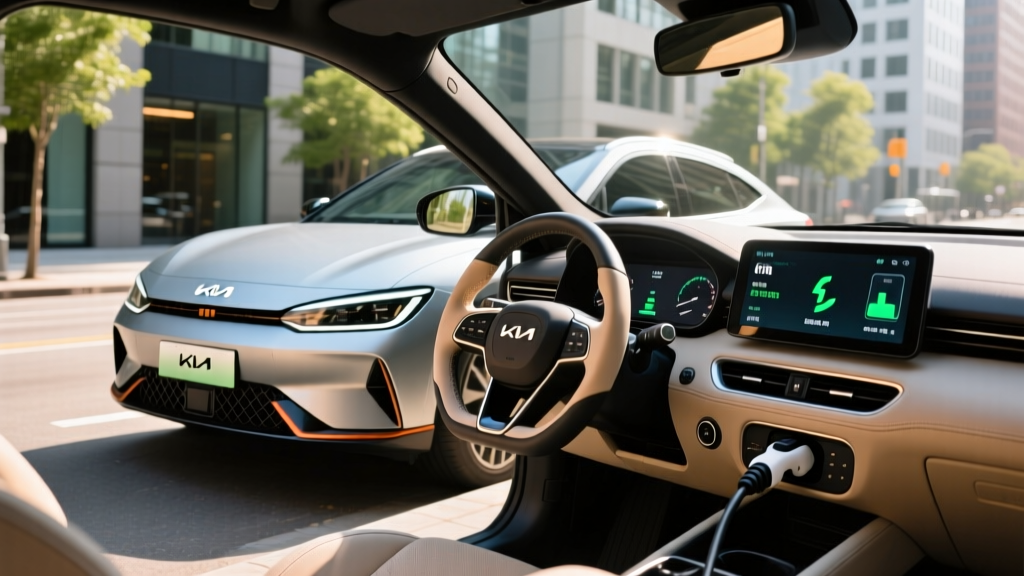
The EV6's cabin is one of its strongest selling points against the Tesla Model Y's minimalist approach. The dual 12.3-inch panoramic curved displays (instrument cluster + infotainment) run Kia's latest Connect system with wireless Apple CarPlay and Android Auto, over-the-air updates, and a dedicated EV routing system that factors in charging stops, battery preconditioning, and terrain.
Cargo volume:
- Behind rear seats: 24.4 cu ft
- Rear seats folded: 50.2 cu ft
- Front trunk (frunk): 0.7 cu ft (small — mainly for charging cables)
Passenger space:
- Rear legroom: 39.4 inches (competitive with midsize SUVs)
- Front headroom: 39.0 inches
- Rear headroom: 37.8 inches (the sloping roofline cuts into space for taller passengers)
Standout tech:
- Vehicle-to-Load (V2L): The EV6 can output up to 3.6 kW of AC power through an interior outlet or exterior adapter — enough to run a laptop, campsite appliances, or emergency home equipment during an outage.
- Highway Driving Assist 2 (HDA2): Kia's Level 2 driver-assistance system with adaptive cruise, lane centering, and lane-change assist. It's competent on highways but requires hands-on-wheel engagement — this is not autonomous driving.
- Remote Smart Parking Assist: The EV6 can park and unpark itself from tight spaces while you stand outside using the key fob.
- Augmented reality HUD: Available on GT-Line and GT trims, projecting navigation and speed onto the windshield.
Notable drawbacks:
- The frunk is nearly useless at 0.7 cu ft — don't count on meaningful front storage.
- Rear visibility is compromised by the thick C-pillars and sloping roof; the digital rearview mirror option helps.
- The touch-capacitive climate controls below the main screen are fiddly to use while driving.
- Ride quality on 20-inch wheels (GT-Line, GT) is firm over broken pavement; the 19-inch wheels on Wind offer noticeably better compliance.
Warranty, Reliability, and Ownership Costs
Kia's warranty coverage remains one of the best in the EV segment:
- Battery warranty: 10 years / 100,000 miles (whichever comes first), covering capacity loss below 70% state of health.
- Powertrain warranty: 10 years / 100,000 miles.
- Bumper-to-bumper: 5 years / 60,000 miles.
- Roadside assistance: 5 years / 60,000 miles.
For context, Tesla offers 8 years / 120,000 miles on the Model Y battery, and Ford provides 8 years / 100,000 miles on the Mach-E. Kia's 10-year coverage stands out for buyers planning long-term ownership, though the 70% capacity threshold is industry-standard rather than generous.
Insurance: Expect EV6 insurance premiums to run 15–25% higher than a comparable gas-powered Kia Sportage. The GT trim, with its 576 hp output, commands significantly higher rates. Get quotes before committing — insurer treatment of EVs varies widely.
Maintenance: EVs eliminate oil changes, spark plugs, and transmission fluid. Expect to pay for cabin air filter replacement ($30–$60), brake fluid checks, tire rotation, and tire replacement. The EV6's instant torque and heavy curb weight (~4,500–4,700 lbs) wear tires faster than gas equivalents — budget for new tires every 25,000–35,000 miles.
Kia EV6 vs. Key Competitors
| Spec | Kia EV6 Wind RWD | Hyundai Ioniq 5 SEL RWD | Tesla Model Y LR RWD | Ford Mach-E Premium RWD |
|---|---|---|---|---|
| EPA Range | 310 mi | 303 mi | 320 mi | 290 mi |
| Battery | 77.4 kWh NMC | 77.4 kWh NMC | ~75 kWh (est.) | 72 kWh NMC |
| Max DC Charge | ~240 kW | ~240 kW | ~250 kW | ~150 kW |
| 10–80% DCFC | ~18 min | ~18 min | ~22 min | ~32 min |
| 0–60 mph | 6.2 sec | 6.3 sec | 5.8 sec | 6.1 sec |
| Cargo (rear seats up) | 24.4 cu ft | 27.2 cu ft | 30.2 cu ft | 29.7 cu ft |
| Base MSRP | ~$48,300 | ~$47,500 | ~$44,990 | ~$45,995 |
| Battery Warranty | 10 yr/100K mi | 10 yr/100K mi | 8 yr/120K mi | 8 yr/100K mi |
Choose the Kia EV6 If:
- You prioritize the fastest DC charging in the segment for road-trip flexibility.
- You want a 10-year powertrain/battery warranty for long-term peace of mind.
- You value V2L capability for camping, job sites, or backup power.
- 0% APR financing is available and you don't qualify for (or prefer not to use) the §30D credit.
- You prefer a conventional crossover interior with physical buttons over Tesla's screen-only approach.
Look Elsewhere If:
- Maximum cargo space is your priority — the Model Y and Mach-E offer significantly more.
- You need the largest Supercharger-network advantage (Tesla still leads in charger density).
- You want the lowest base MSRP — the Model Y RWD undercuts the EV6 by ~$3,300.
- The frunk matters to you — the EV6's 0.7 cu ft is essentially non-functional.
Who Is the Kia EV6 Best For?
Daily commuters (20–60 mile round trips): The Wind RWD's 310-mile EPA range means most commuters charge once or twice a week at home. The 11.5 kW Level 2 onboard charger replenishes overnight easily. This is the sweetest spot for EV ownership economics.
Road trippers: The 800V architecture and ~18-minute 10–80% charge time make the EV6 one of the best non-Tesla EVs for highway travel. With NACS compatibility on 2026 models, Supercharger access removes the biggest historical objection.
Small families: Rear seat space is generous for child seats and rear-facing car seats. Cargo space (24.4 cu ft) handles strollers and groceries but falls short of the Model Y for bulkier family gear like double strollers or large coolers.
Not ideal for: Heavy towing (the EV6 is rated for only 2,700 lbs with a dealer-installed hitch), large families needing three rows, or buyers in extreme-cold climates who don't have access to a heated garage for preconditioning.
Pros and Cons
Pros
- Class-leading 800V DC fast charging (~240 kW peak, 18 min 10–80%)
- 10-year / 100,000-mile battery and powertrain warranty
- Vehicle-to-Load (V2L) capability up to 3.6 kW
- Engaging driving dynamics, especially in AWD and GT trims
- Attractive interior with dual curved displays and conventional controls
- NACS charge port on 2026 models (native Supercharger access)
- 0% APR financing periodically available — strong value when offered
Cons
- Frunk is nearly useless (0.7 cu ft)
- Cargo space trails Model Y and Mach-E by 5–6 cu ft
- Rear visibility hampered by thick C-pillars
- Touch-capacitive climate controls are distracting while driving
- Firm ride on 20-inch wheels (GT-Line, GT)
- Light Range trim's 58 kWh battery limits range to 232 miles
- Federal tax credit eligibility depends on evolving battery-sourcing rules
Frequently Asked Questions
What is the real-world range of the Kia EV6?
The Wind RWD with the 77.4 kWh battery is EPA-rated at 310 miles. In real-world highway driving at 70–80 mph, expect 250–270 miles. In cold weather (below freezing), range can drop to 215–250 miles without preconditioning. City driving with regenerative braking can match or slightly exceed the EPA estimate in mild weather.
How fast does the Kia EV6 charge?
On a 350 kW-capable DC fast charger, the EV6 peaks at approximately 240 kW and charges from 10% to 80% in about 18 minutes. On a more common 150 kW station, expect 10–80% in roughly 25 minutes. At home on a Level 2 (240V/48A) charger, the EV6 adds about 39 miles of range per hour, fully charging in around 7 hours.
How much does the Kia EV6 cost after tax credits?
If the vehicle and buyer meet all IRS §30D requirements (income caps, MSRP caps, battery sourcing), the $7,500 point-of-sale credit can bring a $48,300 Wind RWD down to approximately $40,800 before state incentives. However, when Kia offers 0% APR financing, you may need to choose between the promotional rate and the credit — run both scenarios based on your loan term and tax situation to determine which saves more.
Does the Kia EV6 qualify for the federal EV tax credit?
Eligibility under IRS §30D depends on several factors: buyer income (must be under $300K joint / $150K individual MAGI), vehicle MSRP (must be under $80,000 for SUVs), and battery critical-mineral and component sourcing requirements that change annually. The EV6's classification as a small SUV gives it the higher MSRP cap. Always verify current-year eligibility on fueleconomy.gov and consult a tax professional before relying on the credit.
Is the Kia EV6 worth buying over the Tesla Model Y or Hyundai Ioniq 5?
The EV6 wins on charging speed and warranty coverage. The Ioniq 5 is its mechanical twin with slightly more cargo room and a similar price. The Model Y offers more cargo space, a lower starting price, and the Supercharger network advantage (though the EV6 now has native NACS access). If 0% APR financing is available and you value fast charging and long warranty coverage, the EV6 is a compelling choice. If cargo volume or the lowest base price matters most, the Model Y has the edge.
Can I use Tesla Superchargers with the 2026 Kia EV6?
Yes. The 2026 EV6 comes equipped with the NACS (North American Charging Standard) charge port, which is the Tesla connector. This gives you native access to the Supercharger network without an adapter — a significant advantage for road-trip charging reliability.
What is the battery replacement cost for the Kia EV6?
Out-of-warranty battery pack replacement for the EV6's 77.4 kWh NMC pack is estimated at $12,000–$18,000 including labor, based on current E-GMP platform pricing. However, Kia's 10-year/100,000-mile battery warranty (covering degradation below 70% state of health) means most owners will never face this cost. Real-world degradation data from early EV6 owners shows approximately 5–8% capacity loss over the first 60,000 miles — well within the warranty threshold.