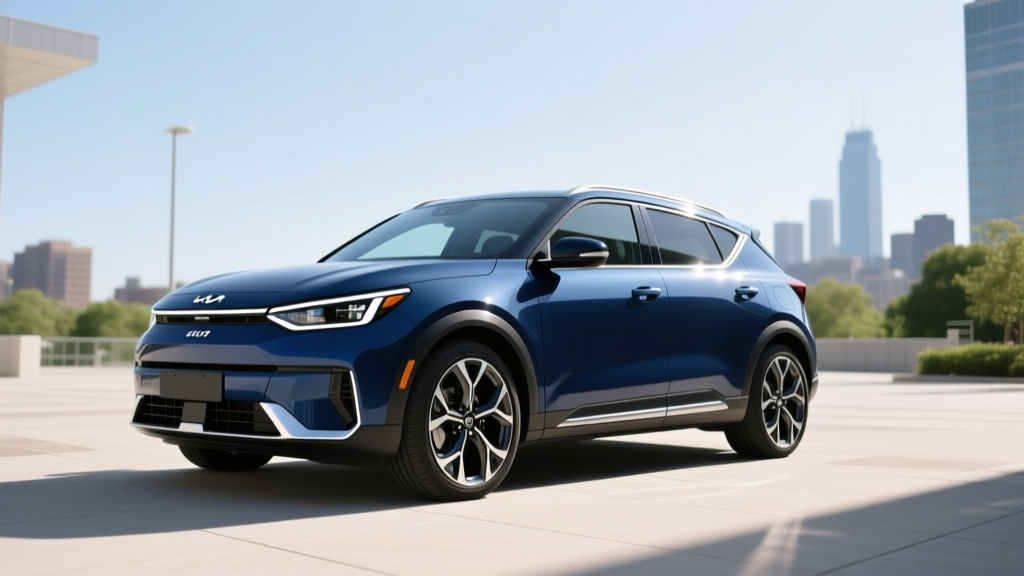
The Kia EV5 has been turning heads in China and Australia since its 2024 debut, and American EV shoppers have been asking one persistent question: when is it coming stateside? As of early 2026, Kia has confirmed that the EV5 is destined for the U.S. market, with a projected arrival in late 2026 as a 2027 model-year vehicle. Until it lands on dealer lots, every specification remains preliminary — but between international homologation data, Kia's U.S. product roadmap statements, and the platform it shares with proven models like the EV6 and EV9, we can build a highly informed picture of what to expect.
This profile compiles everything confirmed and projected about the Kia EV5 USA launch — range, battery chemistry, charging performance, pricing, tax credit outlook, and how it stacks up against the compact electric SUV competition. We'll update this page with EPA-certified figures the moment they're published.
What Is the Kia EV5, and Why Does It Matter for U.S. Buyers?
The EV5 is a compact-to-midsize electric SUV built on Hyundai Motor Group's E-GMP (Electric Global Modular Platform) — the same 800V-capable architecture underpinning the Kia EV6, Hyundai Ioniq 5, and Genesis GV60. Where the EV6 leans sporty and low-slung, the EV5 adopts a boxier, more utilitarian shape closer to a traditional SUV, prioritizing interior volume and cargo practicality over aerodynamic sleekness.
Think of it as Kia's electric answer to the Honda CR-V and Toyota RAV4 segment — the highest-volume vehicle category in America. If priced correctly, the EV5 could undercut the EV6 while offering more rear-seat and cargo space, filling a gap in Kia's U.S. electric lineup between the smaller Niro EV and the three-row EV9.
Projected Range, Battery, and Efficiency
In markets where the EV5 is already on sale, it's offered with two battery pack sizes. For the U.S. market, Kia is expected to offer the larger pack as standard on most trims, consistent with American range expectations.
| Specification | Standard Range (Projected) | Long Range (Projected) |
|---|---|---|
| Battery Capacity (usable) | ~58 kWh | ~81 kWh |
| Battery Chemistry | LFP (Lithium Iron Phosphate) | LFP (Lithium Iron Phosphate) |
| EPA Estimated Range | ~220–240 miles | ~290–310 miles |
| Efficiency (MPGe, combined) | ~110–115 MPGe | ~105–110 MPGe |
| Energy Consumption | ~30–31 kWh/100 mi | ~31–33 kWh/100 mi |
The EPA sticker is only the starting point. Based on the EV5's boxy aerodynamics and real-world testing of E-GMP siblings, here's what to anticipate:
- City/mixed driving (Long Range): Expect ~280–300 miles with moderate regen use and temperate weather.
- Sustained highway (70–80 mph): Aerodynamic drag takes a toll on the boxy profile. Plan for ~240–265 miles on a full charge.
- Cold weather (below 32°F): LFP chemistry is more susceptible to cold-weather range loss than NMC. Expect a 20–30% reduction — roughly 200–240 miles from the Long Range pack in freezing conditions. Preconditioning via the navigation-linked battery heating system will help mitigate this at DC chargers.
Source: fueleconomy.gov (EPA figures pending U.S. certification; estimates based on WLTP-to-EPA conversion ratios observed on the EV6 and Ioniq 5.)
The decision to use LFP (lithium iron phosphate) chemistry is significant. LFP batteries sacrifice some energy density (meaning a slightly heavier pack for the same kWh) but gain major advantages: they tolerate regular 100% charging without accelerated degradation, contain no cobalt or nickel (lowering cost and supply-chain risk), and typically offer longer cycle life. For a daily-driver SUV, LFP is a pragmatic choice — just be aware of the cold-weather trade-off and plan charging stops accordingly in winter.
Charging Speed: DC Fast Charging and Home Level 2
The E-GMP platform's 800V architecture is one of its strongest assets, enabling DC fast-charge speeds that outpace most competitors still on 400V systems. Here's what to expect from the Kia EV5 in U.S. charging scenarios:
| Charging Level | Power / Rate | Speed / Time |
|---|---|---|
| Level 1 (120V household outlet) | ~1.4 kW | ~4–5 miles of range per hour |
| Level 2 (240V home/public, 48A) | ~10.9 kW | ~32–36 miles of range per hour; full charge in ~8–9 hours (Long Range) |
| DC Fast Charge (peak) | Up to ~210 kW (Long Range) | 10–80% in approximately 25–28 minutes |
| DC Fast Charge (sustained avg.) | ~150–170 kW average to 80% | Charge curve tapers significantly above 80%; 80–100% can add 15+ minutes |
A few real-world charging notes from E-GMP platform experience:
- Peak vs. sustained: The 210 kW figure is a peak, not a sustained rate. The EV5 will hold strong charge speeds between 10–55% SoC, then begin tapering. This is normal for all lithium-ion packs, but LFP's charge curve can taper more abruptly past 80% than NMC. Plan road-trip stops around 10–80% cycles for maximum efficiency.
- Preconditioning matters: If you navigate to a DC fast charger using the EV5's built-in navigation, the battery thermal management system will precondition the pack for optimal charge acceptance. Arriving at a 350 kW Electrify America or Tesla Supercharger (via NACS adapter) with a cold, un-preconditioned pack can cut peak speeds by 30–50%.
- Connector: The U.S.-spec EV5 is expected to ship with the NACS (North American Charging Standard) connector natively, giving direct access to Tesla's Supercharger network without an adapter. This follows Kia's 2024 announcement transitioning all U.S. models to NACS.
Performance and Drivetrain
The EV5 isn't positioned as a performance EV — it's a family hauler. But E-GMP's low center of gravity and instant electric torque still deliver respectable acceleration.
| Specification | RWD (Long Range) | AWD (Long Range) |
|---|---|---|
| Drivetrain | Rear-Wheel Drive (single motor) | Dual-Motor All-Wheel Drive |
| Horsepower | ~215 hp | ~320 hp (combined) |
| Torque | ~258 lb-ft | ~446 lb-ft (combined) |
| 0–60 mph | ~7.5 seconds | ~5.5 seconds |
| Top Speed | ~115 mph (electronically limited) | ~120 mph (electronically limited) |
| Towing Capacity | ~1,500 lbs (estimated) | ~2,500 lbs (estimated) |
The RWD variant will be the range and efficiency leader, while the AWD adds all-weather confidence and brisker acceleration at the cost of roughly 15–25 miles of EPA range. Neither variant will match the EV6 GT-Line's sporty dynamics, but the EV5's tuning is expected to prioritize ride comfort and low-speed maneuverability — appropriate for its commuter-family mission.
Interior Space, Cargo, and Practicality
This is where the EV5 differentiates itself from the EV6 and most compact electric crossovers. The boxy design pays dividends inside:
- Rear legroom: ~40.5 inches — competitive with the Honda CR-V and significantly more than the EV6's ~38.7 inches.
- Cargo volume (behind rear seats): ~32–35 cubic feet (estimated, U.S. measurement method).
- Cargo volume (rear seats folded): ~68–72 cubic feet (estimated).
- Front trunk (frunk): Small storage compartment (~1.5–2.0 cu ft) — enough for charging cables and a small bag, but not a major storage area.
- Seating: Five passengers across two rows. No third-row option (that's the EV9's territory).
International-market EV5s feature a minimalist dashboard with a wide panoramic display, physical climate knobs (a welcome departure from touch-only panels), and Kia's latest ccNC infotainment software with wireless Apple CarPlay and Android Auto. Expect U.S. models to include at least two USB-C ports per row and a available digital key via smartphone.
Pricing, Trims, and Federal Tax Credit Eligibility
Kia has not announced official U.S. MSRP figures, but based on the EV5's positioning below the EV6 and competitive pressure from the Tesla Model Y, Chevrolet Equinox EV, and Hyundai Ioniq 5, here is our projected pricing structure:
| Trim | Estimated MSRP | After Est. Federal Credit* |
|---|---|---|
| Light (RWD, Standard Range) | $35,000–$37,000 | $27,500–$29,500 |
| Wind (RWD, Long Range) | $40,000–$42,500 | $32,500–$35,000 |
| GT-Line (AWD, Long Range) | $46,000–$49,000 | $38,500–$41,500 |
*Federal tax credit estimates assume eligibility. See below for requirements.
The Kia EV5's tax credit eligibility is not guaranteed and depends on several factors that remain in flux for the 2027 model year:
- MSRP cap: SUVs must have an MSRP at or below $80,000 to qualify. All projected EV5 trims clear this threshold comfortably.
- Buyer income cap: Modified adjusted gross income must not exceed $150,000 (single), $225,000 (head of household), or $300,000 (joint filers).
- Battery sourcing & critical minerals: A percentage of battery components must be manufactured or assembled in North America, and critical minerals must be sourced from the U.S. or free-trade-agreement partners. This is the biggest unknown for the EV5, as Kia's LFP cells are currently sourced from CATL (China). If Kia shifts to a North American or FTA-partner battery supplier for the U.S. spec, full or partial credit eligibility is likely. If not, the EV5 may qualify for a reduced credit or none at all.
- Point-of-sale transfer: If eligible, the credit can be applied at the dealership as an immediate price reduction rather than waiting for a tax refund.
- Lease loophole (§45W): If the EV5 doesn't qualify for the purchase credit due to battery sourcing, leasing may still unlock a $7,500 commercial credit passed through as a lease capital-cost reduction. This has been a reliable workaround for Hyundai/Kia EVs in prior model years.
Always verify current rules at IRS.gov and consult a tax professional before making a purchase decision based on credit eligibility.
Tech, Driver Assistance, and Safety
The U.S.-spec EV5 is expected to ship with Kia's latest Highway Driving Assist 2 (HDA2) suite, which includes:
- Adaptive cruise control with stop-and-go and curve-speed adjustment
- Lane centering and lane-change assist
- Navigation-based speed limit adjustment
- Rear cross-traffic collision-avoidance assist
HDA2 is a Level 2 driver-assistance system per SAE International classification. This means the system can control steering and acceleration simultaneously under certain conditions, but the driver must remain fully attentive with hands on or near the wheel at all times. It is not self-driving. Kia does not currently offer a Level 3 or higher system in any U.S. production vehicle.
Additional expected tech features:
- 12.3-inch dual panoramic displays (instrument cluster + infotainment)
- Over-the-air (OTA) software updates for powertrain, infotainment, and ADAS calibration
- Digital Key 2 (NFC/BLE smartphone-as-key)
- Vehicle-to-Load (V2L) capability via interior outlet and external adapter — power a laptop, campsite, or emergency appliance at up to ~3.6 kW
- Available head-up display with augmented-reality navigation prompts
How the Kia EV5 Compares to Key Competitors
| Attribute | Kia EV5 (Long Range AWD) | Tesla Model Y (Long Range) | Hyundai Ioniq 5 (Long Range AWD) | Chevrolet Equinox EV (RS AWD) |
|---|---|---|---|---|
| EPA Range | ~290–310 mi | 320 mi | 290 mi | 285 mi |
| Battery (usable kWh) | ~81 kWh (LFP) | ~75 kWh (NMC) | 77.4 kWh (NMC) | 85 kWh (NMC) |
| Peak DC Charge | ~210 kW | ~250 kW | ~240 kW | ~190 kW |
| 10–80% DC Time | ~25–28 min | ~22–25 min | ~18–22 min | ~30–34 min |
| 0–60 mph | ~5.5 sec | 4.8 sec | 5.1 sec | ~6.0 sec |
| Rear Legroom | ~40.5 in | 41.6 in | 38.7 in | ~38.0 in |
| Cargo (behind rear) | ~33 cu ft | 30 cu ft | 27 cu ft | ~26 cu ft |
| Starting MSRP (AWD) | ~$46,000–$49,000 | $48,990 | $50,285 | $44,900 |
Where the EV5 wins: Cargo volume behind the second row (thanks to the boxy roofline), projected value pricing, LFP battery longevity, and V2L capability.
Where it trails: The Model Y still leads in range and Supercharger network maturity. The Ioniq 5 charges faster (10–80% in ~18 minutes on a 350 kW charger). The Equinox EV undercuts on price for the base AWD trim.
Warranty Coverage
Kia's U.S. warranty is among the strongest in the industry, and the EV5 should carry the same coverage:
- Basic vehicle warranty: 5 years / 60,000 miles
- Powertrain warranty: 10 years / 100,000 miles
- EV battery warranty: 10 years / 100,000 miles (capacity retention threshold expected at 70% of original capacity, consistent with Kia's current EV battery warranty terms)
- Roadside assistance: 5 years / 60,000 miles
The LFP chemistry should provide additional peace of mind: LFP cells typically degrade more slowly and more linearly than NMC, meaning the battery is likely to remain well above the 70% threshold throughout the warranty period under normal use. Source: Kia.com.
Who Should Buy the Kia EV5?
- You want a practical, boxy electric SUV with strong cargo space and rear-seat comfort — not a crossover coupe.
- You charge primarily at home and want an LFP battery you can charge to 100% daily without degradation anxiety.
- You value Kia's 10-year/100,000-mile battery warranty and strong resale trajectory.
- You want NACS Supercharger access without an adapter.
- Budget matters: you're targeting a sub-$40,000 effective price after incentives.
- You need maximum range for frequent 300+ mile road trips — the Model Y Long Range or Ioniq 5 (with faster charging) may serve you better.
- You live in a consistently cold climate and can't charge at home — LFP's cold-weather range loss is a real daily inconvenience without reliable home charging.
- You need a third row — step up to the EV9.
- You want sporty driving dynamics — the EV6 or Ioniq 5 N are sharper choices.
Frequently Asked Questions
When will the Kia EV5 be available in the USA?
Kia has confirmed U.S. availability for the EV5, with a projected on-sale date in late 2026 as a 2027 model-year vehicle. Exact timing may shift based on production ramp-up at Kia's planned manufacturing facility (likely the West Point, Georgia plant, which also builds the EV9 and Telluride).
What is the real-world range of the Kia EV5?
The Long Range RWD variant is projected at approximately 290–310 miles EPA. In real-world mixed driving, expect 280–300 miles. Highway-heavy trips at 75+ mph will reduce that to roughly 240–265 miles. In freezing weather, LFP chemistry means you may see only 200–240 miles from a full charge. Always precondition the battery before DC fast charging in cold weather.
How fast does the Kia EV5 charge?
On a DC fast charger rated at 350 kW, the Long Range EV5 is projected to peak at approximately 210 kW and charge from 10–80% in about 25–28 minutes. At home on a Level 2 (240V, 48A) charger, expect roughly 32–36 miles of range added per hour, or a full overnight charge in 8–9 hours.
Does the Kia EV5 qualify for the federal EV tax credit?
Eligibility depends on battery sourcing and critical-mineral requirements under IRS §30D rules at the time of purchase. The EV5's projected MSRP (well under the $80,000 SUV cap) and typical buyer income profiles are favorable, but LFP cell sourcing from Chinese suppliers could disqualify it from the full $7,500 purchase credit. Leasing may unlock the credit via the §45W commercial clean vehicle provision. Check current rules at IRS.gov before purchasing.
Is the Kia EV5 worth buying vs. the Tesla Model Y or Hyundai Ioniq 5?
If cargo space, rear-seat comfort, and projected value pricing are your top priorities, the EV5 is a strong contender — particularly once official pricing and tax credit eligibility are confirmed. If maximum range, charging speed, or performance are paramount, the Model Y and Ioniq 5 currently hold advantages. Wait for EPA certification and final MSRP before making a direct comparison.
What are the biggest pros and cons of the Kia EV5?
Pros: Spacious boxy interior, LFP battery longevity and 100% charge tolerance, 800V fast-charging architecture, NACS connector for Supercharger access, Kia's 10-year warranty, competitive projected pricing, V2L capability.
Cons: LFP cold-weather range loss, boxy shape hurts highway efficiency, not yet EPA-certified (specs are projections), tax credit eligibility uncertain due to battery sourcing, less sporty than the EV6, no third-row option.
This article will be updated with confirmed EPA range, official MSRP, and IRS tax credit eligibility once Kia publishes U.S.-spec data. Last updated: early 2026.