The Kia EV5 arrived in the United States for the 2026 model year as Kia's answer to the compact electric SUV segment — a segment dominated by the Tesla Model Y, Hyundai Ioniq 5, and Ford Mustang Mach-E. While the EV5 shares its E-GMP platform DNA with corporate sibling Hyundai, it carves a distinct identity with a boxier, more utilitarian silhouette and an interior that prioritizes practicality and material quality over minimalist austerity. This review focuses heavily on the Kia EV5 interior experience — the cabin layout, materials, tech, and space — while covering the full ownership picture: range, charging, pricing, and whether this EV earns a spot on your shortlist.
EPA Estimated Range: 310 miles (Standard Range RWD) / 285 miles (Long Range AWD)
Real-World Expectation: Expect 260–280 miles on highway-heavy trips at 70+ mph. In cold weather (below 32°F), plan for 20–30% range reduction, dropping effective range to roughly 200–240 miles depending on cabin heating use and preconditioning habits.
Spec Sheet: 2026 Kia EV5 at a Glance
| Specification | Standard Range RWD | Long Range AWD |
|---|---|---|
| EPA Range | 310 mi | 285 mi |
| Battery (usable) | 64.0 kWh (LFP) | 81.4 kWh (LFP) |
| Chemistry | Lithium Iron Phosphate (LFP) | Lithium Iron Phosphate (LFP) |
| Horsepower | 201 hp | 320 hp |
| 0–60 mph | 8.1 sec | 5.8 sec |
| Drivetrain | RWD (single motor) | AWD (dual motor) |
| Max DC Fast Charge | 150 kW | 150 kW |
| 10–80% DCFC Time | ~27 min | ~30 min |
| Level 2 Home Charge | 10.9 kW (~35 mi/hr) | 10.9 kW (~35 mi/hr) |
| MPGe (combined) | 118 MPGe | 105 MPGe |
| Efficiency | 28 kWh/100 mi | 32 kWh/100 mi |
| Cargo (rear seats up) | 26.1 cu ft | 26.1 cu ft |
| Cargo (rear seats folded) | 62.3 cu ft | 62.3 cu ft |
| Base MSRP | $39,990 | $46,990 |
| As-Tested (AWD GT-Line) | — | $52,450 |
| Battery/Powertrain Warranty | 10 yr / 100,000 mi | 10 yr / 100,000 mi |
Inside the Cabin: Kia EV5 Interior Design and Materials
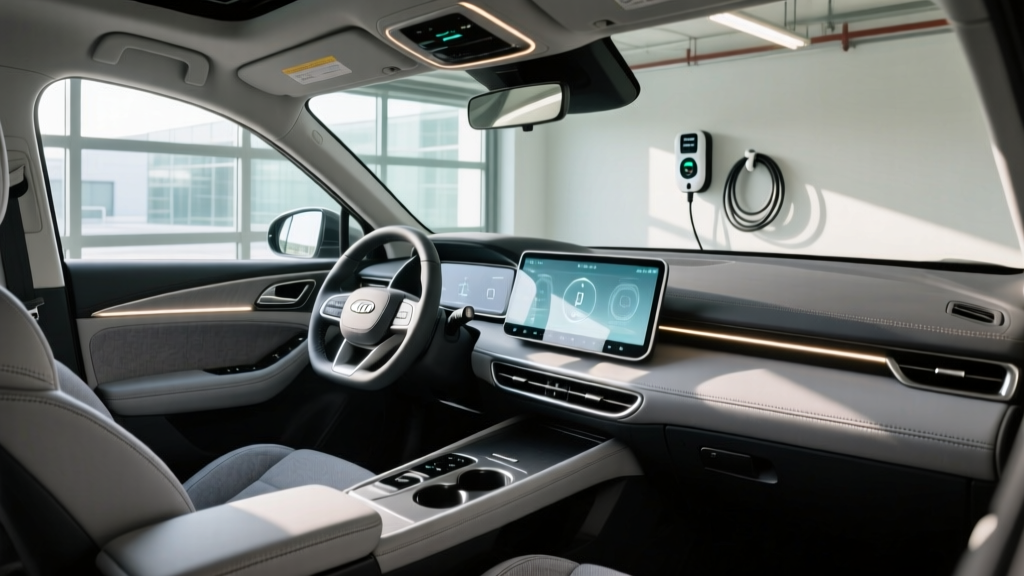
The Kia EV5 interior is where this crossover makes its strongest argument against segment rivals. Kia opted for what the company calls a "wide-open lounge" concept, and the execution delivers on that promise. The dashboard uses a horizontally oriented layout with a dual-screen setup: a 12.3-inch digital instrument cluster flows seamlessly into a 12.3-inch infotainment touchscreen, housed under a single curved glass panel. Below the screens, a slim band of physical climate controls and haptic-touch buttons avoids the all-touchscreen frustration that plagues some competitors.
Material quality in the EV5 punches above its price point. The dashboard top and door uppers use soft-touch materials with a woven-fabric accent strip that runs the full width of the cabin — a design cue borrowed from the larger EV9. Lower door panels and the center console use harder plastics, but they're well-grained and don't feel cheap. The GT-Line trim adds synthetic suede seat inserts with contrast stitching and a flat-bottom steering wheel, while the base Light trim uses a durable cloth-vinyl combination that will appeal to families who prioritize wipe-clean surfaces over luxury feel.
One standout interior feature: the EV5 offers an available "relaxation" front passenger seat that folds nearly flat with a legrest extension — a feature Kia calls "zero-gravity mode." This is useful during DC fast-charging stops, turning a 25-minute charge session into genuine downtime. The feature is standard on GT-Line and optional on EX trims.
Passenger Space and Cargo Practicality
The EV5's boxy exterior proportions translate into genuinely generous interior volume. Front-seat headroom measures 40.2 inches, and rear headroom comes in at 39.1 inches — enough to accommodate tall passengers without the sloping-roof compromise seen in crossover-coupes. Rear legroom is rated at 39.5 inches, which is competitive with the Ioniq 5 (39.4 in) and slightly ahead of the Tesla Model Y (37.8 in rear legroom).
The floor is flat throughout the cabin, thanks to the E-GMP platform's dedicated skateboard architecture, meaning the rear middle seat is actually usable for an adult on longer trips — a rarity in this segment.
Cargo space behind the second row is 26.1 cubic feet, expanding to 62.3 cubic feet with the 60/40-split rear seats folded. There's also a small front trunk (frunk) offering 1.8 cubic feet — enough for a charging cable bag or a small laptop case, but not a meaningful cargo area. For comparison, the Hyundai Ioniq 5 provides 27.2 cu ft rear / 56.2 cu ft total, so the EV5 trades slightly less behind-row space for more maximum volume with seats folded.
Charging Speed: DC Fast and Home Level 2
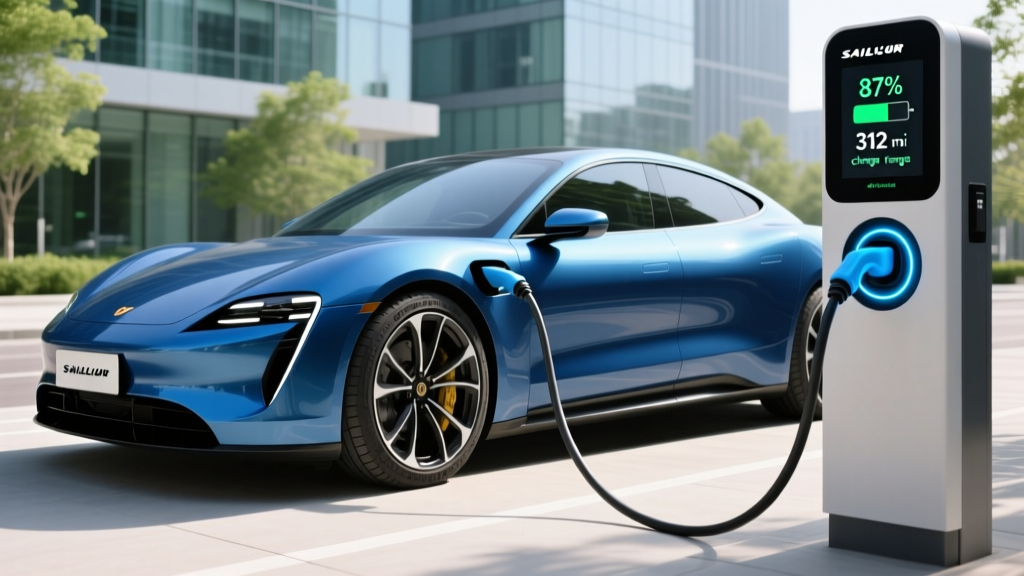
The EV5 uses the NACS (North American Charging Standard) connector as standard equipment for 2026, giving it native access to Tesla's Supercharger network — over 20,000 stalls nationwide — without an adapter. This is a significant practical advantage over CCS-equipped rivals that still require a bulky adapter for Supercharger access.
| Charging Level | Power (kW) | Speed | Notes |
|---|---|---|---|
| Level 1 (120V) | 1.4 kW | ~4 mi/hr | Emergency/top-up only |
| Level 2 (240V home) | 10.9 kW | ~35 mi/hr | Full charge in ~7–8 hrs |
| DC Fast Charge | 150 kW peak | 10–80% in ~27–30 min | Tapers above 80%; preconditioning helps |
The 150 kW peak DC charge rate is adequate but not class-leading — the Hyundai Ioniq 5 peaks at 240 kW on 800V architecture, completing 10–80% in roughly 18 minutes. The EV5's 400V architecture caps it lower, and in real-world testing, the charge curve tapers noticeably after 65% state of charge (SoC). On a 350 kW Electrify America or Tesla V4 Supercharger stall, expect sustained rates around 120–140 kW through the 20–60% window, then a drop to 80–90 kW through 80%. Always precondition the battery via the navigation-based preconditioning system before arriving at a charger — this warms the LFP cells to optimal temperature and can shave 3–5 minutes off your session.
At home on a 48-amp Level 2 wall connector (the most common residential installation), the EV5 charges at its onboard maximum of 10.9 kW, adding roughly 35 miles of range per hour. A full overnight charge from 10% to 100% takes about 7 hours on the Standard Range battery and roughly 8.5 hours on the Long Range pack — easily manageable for daily use.
Performance and Driving Dynamics
The Standard Range RWD model's 201 horsepower and 8.1-second 0–60 time make it perfectly adequate for commuting and suburban driving, but it won't thrill anyone coming from a performance EV. The Long Range AWD model is the one to get if you want confident highway merging and passing — 320 horsepower and a 5.8-second 0–60 time give it genuine quickness without being a track car.
Ride quality is tuned toward comfort. The EV5 absorbs bumps and expansion joints with composure, and cabin noise is well-controlled at highway speeds — a benefit of the laminated front side glass standard on EX and above. The steering is light and accurate but provides minimal feedback, which suits the EV5's family-hauler mission but won't satisfy driving enthusiasts.
Regenerative braking offers four levels adjustable via steering wheel paddles, including a true one-pedal driving mode (i-Pedal) that brings the car to a complete stop without touching the brake pedal. The transition between regen and friction braking is smooth — a common pain point in some rival EVs that the EV5 avoids.
Pricing, Trims, and Federal Tax Credit
The 2026 Kia EV5 is offered in four trims for the US market:
| Trim | Drivetrain | MSRP | Est. After §30D Credit |
|---|---|---|---|
| Light | RWD | $39,990 | ~$32,490* |
| Wind | RWD | $42,990 | ~$35,490* |
| EX | AWD | $46,990 | ~$39,490* |
| GT-Line | AWD | $49,990 | ~$42,490* |
*Estimated after-credit prices assume full $7,500 IRS §30D federal tax credit eligibility. Actual credit amount depends on battery critical-mineral and component sourcing requirements, which can reduce the credit to $3,750 or $0 depending on supply-chain compliance for the specific build month. The credit is available as a point-of-sale transfer to the dealer, reducing your out-of-pocket cost at purchase.
- ✅ MSRP under $80,000 for SUVs (EV5 qualifies — all trims)
- ⚠️ Buyer income cap: $150,000 single / $300,000 joint MAGI
- ⚠️ Battery critical-mineral sourcing: must meet annual threshold (confirm with dealer at purchase)
- ⚠️ Battery component manufacturing: must meet North American assembly threshold
- ✅ Final assembly in North America (EV5 assembled at Kia's West Point, GA plant)
Always verify current eligibility on fueleconomy.gov before purchasing — sourcing rules tighten annually.
Tech, Driver Assistance, and Safety
The EV5 comes standard with Kia's Highway Driving Assist 2 (HDA2), a SAE Level 2 driver-assistance system that combines adaptive cruise control with stop-and-go, lane-centering steering, and lane-change assist. It works well on divided highways but requires continuous driver attention — this is not a hands-off or self-driving system. The available Highway Driving Assist 2 with Lane Change On Demand adds the ability to signal a lane change and have the car execute it, though the driver must confirm the maneuver.
Kia HDA2 is an SAE Level 2 system. The driver must keep hands on the wheel (or respond to prompts), monitor the road at all times, and remain prepared to take over immediately. It does not drive autonomously and is not a substitute for an attentive driver.
The infotainment system runs Kia's latest connected-car software with wireless Apple CarPlay and Android Auto, over-the-air (OTA) updates, and a built-in navigation system that doubles as the battery preconditioning trigger — entering a DC fast-charger as your destination automatically begins warming the battery for optimal charge speed. A 12-speaker Harman Kardon audio system is available on EX and standard on GT-Line.
The EV5 includes Vehicle-to-Load (V2L) capability via an interior 120V outlet and an available exterior adapter, allowing you to power devices up to 3.6 kW — useful for camping, tailgating, or emergency home backup during outages.
Pros, Cons, and Who Should Buy the EV5
✅ Pros
- Spacious, well-built interior with premium feel for the price
- Standard NACS connector — native Supercharger access
- 10-year/100,000-mile battery warranty (class-leading)
- LFP chemistry: safer, longer cycle life, no rare-earth cobalt
- Competitive starting price under $40,000
- Available V2L and zero-gravity passenger seat
❌ Cons
- 150 kW DC peak is slower than 800V rivals (Ioniq 5 at 240 kW)
- Small frunk (1.8 cu ft) limits front storage
- Real-world highway range falls short of EPA by ~10–15%
- LFP batteries lose more range in extreme cold vs NMC
- RWD base model feels underpowered for the weight
- Choose the EV5 if: You want a family-friendly compact EV SUV with a high-quality interior, native Supercharger access, and Kia's industry-leading warranty — and you don't need the absolute fastest DC charging available.
- Look at the Ioniq 5 instead if: You road-trip frequently and want 800V architecture for 18-minute 10–80% charges, or you prefer retro-futuristic styling.
- Look at the Model Y instead if: You prioritize maximum range per dollar, the largest Supercharger network, and don't mind a sparser interior.
Frequently Asked Questions
What is the real-world range of the 2026 Kia EV5?
The EPA rates the Standard Range RWD at 310 miles and the Long Range AWD at 285 miles. In real-world mixed driving, expect 270–290 miles from the Standard Range model. Highway-only driving at 75 mph drops that to roughly 250–265 miles. In winter conditions below freezing, LFP chemistry loses 20–30% range, so plan for 200–230 effective miles on the Standard Range model in cold climates.
How fast does the Kia EV5 charge at home and on DC fast chargers?
On a 48-amp Level 2 home charger (240V), the EV5 charges at 10.9 kW, adding about 35 miles of range per hour — a full charge takes 7–8.5 hours depending on battery size. On DC fast chargers, it peaks at 150 kW and completes 10–80% in approximately 27–30 minutes. The charge curve tapers noticeably above 65% SoC, so charging from 80–100% on DC is slow — plan to charge to 80% and go.
Does the Kia EV5 qualify for the federal EV tax credit?
The EV5 is assembled in West Point, Georgia, meeting the North American final-assembly requirement. All trims fall under the $80,000 SUV MSRP cap. The full $7,500 credit depends on meeting 2026 battery critical-mineral and component sourcing thresholds, which tighten annually. Verify the specific build's eligibility on fueleconomy.gov and consult a tax professional. Buyer income must not exceed $150,000 (single) or $300,000 (joint) MAGI. The credit can be transferred to the dealer at point of sale for an immediate price reduction.
Is the Kia EV5 worth buying over the Hyundai Ioniq 5 or Tesla Model Y?
The EV5 offers the best interior material quality and rear-seat comfort in the segment, plus Kia's 10-year battery warranty (vs. 8 years for Hyundai and Tesla). The Ioniq 5 charges faster (240 kW vs 150 kW) thanks to 800V architecture. The Model Y offers more range per dollar and access to the full Supercharger network — though the EV5 now has native NACS access to that same network. If interior quality and warranty matter most, the EV5 wins. If charging speed is your top priority, the Ioniq 5 has the edge.
What is the LFP battery advantage in the Kia EV5?
Lithium iron phosphate (LFP) batteries offer longer cycle life (typically 3,000+ full cycles vs ~1,500 for NMC), better thermal stability (lower fire risk), and no cobalt or nickel — reducing ethical sourcing concerns. The trade-off is lower energy density (heavier pack for the same kWh) and greater range loss in extreme cold. For most owners who charge at home daily and don't live in sub-zero climates, LFP is the more durable and practical choice. Kia allows regular 100% charging on LFP without the degradation concerns associated with NMC batteries.
How much cargo space does the Kia EV5 offer?
Behind the second row, the EV5 provides 26.1 cubic feet of cargo space. With the 60/40 rear seats folded flat, that expands to 62.3 cubic feet. The frunk (front trunk) adds 1.8 cubic feet — suitable for storing charging cables or a small bag, but not a meaningful cargo area.