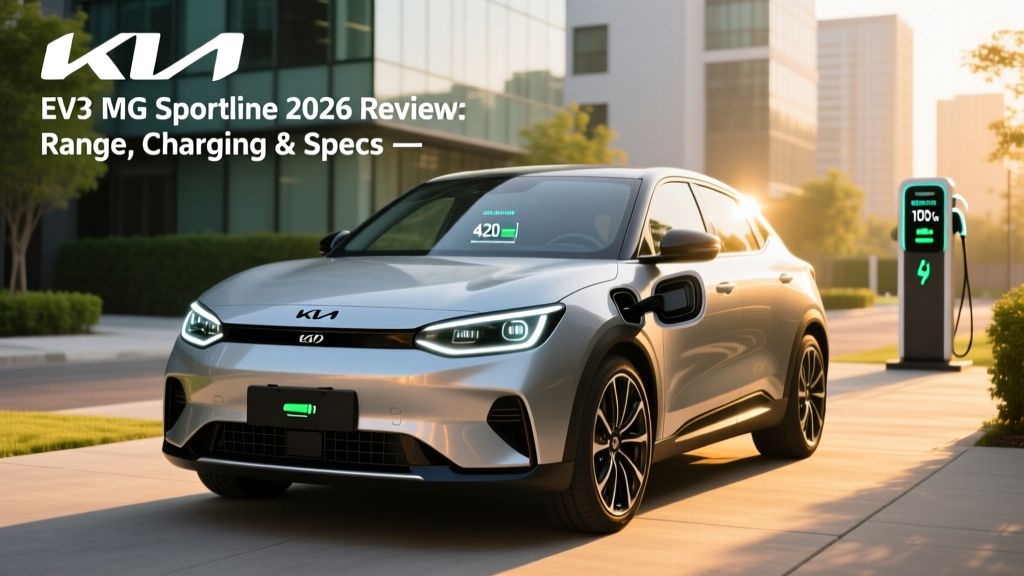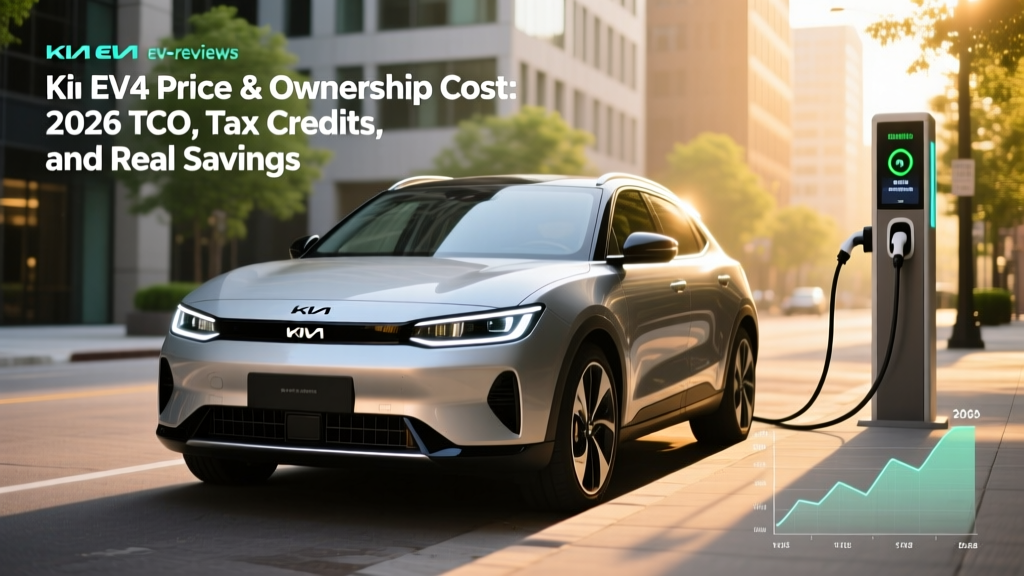
The compact electric sedan segment just got a serious contender. The 2026 Kia EV4 enters the US market as a sleek, tech-forward alternative to the Tesla Model 3 and Hyundai Ioniq 6, built on Hyundai Motor Group's E-GMP platform with a focus on aerodynamic efficiency and practical range. But the sticker price is only the beginning of the ownership equation. Between federal tax credits, fluctuating insurance premiums, charging costs, and long-term depreciation, the true cost of owning a Kia EV4 requires a careful, number-driven analysis.
This guide breaks down every dollar: the 2026 Kia EV4 price by trim, IRS §30D tax credit eligibility, 5-year total cost of ownership (TCO), charging vs. gas economics, insurance realities, and what to expect when it's time to sell.
2026 Kia EV4 Price by Trim: What You'll Actually Pay
The 2026 Kia EV4 launches in the US with three primary trims, all featuring a long-range battery pack. Pricing reflects Kia's strategy to undercut the Model 3 while delivering competitive range and standard features.
| Trim | MSRP | Drivetrain | EPA Est. Range | Battery |
|---|---|---|---|---|
| Light Long Range | $38,900 | RWD | ~310 mi | 77.4 kWh (NMC) |
| Wind Long Range | $42,500 | RWD | ~305 mi | 77.4 kWh (NMC) |
| GT-Line AWD | $47,900 | AWD | ~275 mi | 77.4 kWh (NMC) |
All trims come equipped with an 800V electrical architecture capable of ultra-fast DC charging, a 12.3-inch dual panoramic display, and Kia's Highway Driving Assist 2 (a Level 2 SAE driver-assistance system — the driver must remain engaged at all times).
Federal Tax Credit: Do You Qualify for Up to $7,500?
The IRS §30D Clean Vehicle Credit can reduce the effective price of the Kia EV4 by up to $7,500 — but eligibility is not automatic. The rules tightened significantly under the Inflation Reduction Act, and they continue to evolve. Here's the current-year framework you need to verify before signing any paperwork.
- Vehicle MSRP Cap: Sedans and compact cars must have an MSRP ≤ $55,000. All 2026 Kia EV4 trims qualify.
- Buyer Income Limits (Modified AGI): ≤ $150,000 single filers; ≤ $225,000 head of household; ≤ $300,000 joint filers.
- Battery Component Manufacturing: A percentage of battery components must be manufactured or assembled in North America (threshold increases annually). Verify with your dealer that the specific VIN qualifies.
- Critical Minerals Sourcing: A percentage of critical minerals must be sourced from the US or a free-trade-agreement partner country. This requirement tightens each year.
- Foreign Entity of Concern (FEOC) Exclusion: Vehicles with battery components or critical minerals from designated FEOC entities are disqualified.
- Point-of-Sale Transfer: Eligible buyers can transfer the credit to the dealer at purchase, receiving an immediate price reduction rather than waiting to claim it on their tax return.
- One Credit Per Vehicle, Per Taxpayer: You can only claim the §30D credit once every three years for new EV purchases.
Source: IRS — Credits for New Clean Vehicles. Rules are subject to legislative and regulatory changes. Consult a tax professional before relying on credit eligibility for purchase decisions.
If the Kia EV4 qualifies for the full $7,500 credit and you meet all income and sourcing requirements, the effective starting price drops from $38,900 to $31,400 for the Light Long Range trim — a compelling entry point into the long-range EV sedan segment.
5-Year Total Cost of Ownership: The Full Breakdown
To understand the real financial commitment, we modeled a 5-year / 75,000-mile ownership scenario for the 2026 Kia EV4 Light Long Range, compared against a similarly priced gas-powered compact sedan (2026 Honda Civic Touring, ~$32,000 MSRP, 33 MPG combined).
| Category | Kia EV4 Light LR | Gas Sedan Baseline | Difference |
|---|---|---|---|
| Purchase Price (after $7,500 credit) | $31,400 | $32,000 | −$600 |
| Fuel / Charging (75k mi) | $4,875 | $8,525 | −$3,650 |
| Maintenance | $1,800 | $3,750 | −$1,950 |
| Insurance (5-yr total) | $11,250 | $8,500 | +$2,750 |
| Depreciation (est.) | $14,100 | $11,200 | +$2,900 |
| Total 5-Year Cost | $63,425 | $63,975 | −$550 |
Key takeaway: Over five years, the EV4's total cost is roughly comparable to a gas sedan — but only when the full $7,500 federal credit applies. Without the credit, the EV4 costs approximately $6,950 more over five years, driven primarily by higher insurance and steeper depreciation. The break-even point shifts further in the EV's favor if gas prices rise above $4/gallon or if you charge primarily on off-peak utility rates.
Charging vs. Gas: The Per-Mile Economics
The Kia EV4's efficiency is rated at approximately 130 MPGe combined (EPA estimate), translating to roughly 26 kWh per 100 miles. How that converts to real dollars depends entirely on where and how you charge.
| Charging / Fueling Scenario | Cost Per Mile | Annual Cost (15k mi) |
|---|---|---|
| Home Level 2 — national avg. $0.16/kWh | $0.042 | $630 |
| Home Level 2 — off-peak rate $0.09/kWh | $0.023 | $345 |
| Public DC Fast — avg. $0.40/kWh | $0.104 | $1,560 |
| Public DC Fast — premium network $0.55/kWh | $0.143 | $2,145 |
| Gas sedan at $3.50/gal, 33 MPG | $0.106 | $1,590 |
| Gas sedan at $4.50/gal, 33 MPG | $0.136 | $2,040 |
Home charging is the economic sweet spot. At off-peak rates, the EV4 costs 83% less per mile than the gas sedan. But exclusive reliance on premium DC fast charging can actually cost more than gasoline — a critical reality for apartment dwellers or frequent road-trippers without home charging access.
The EV4's 800V architecture allows DC fast charging at up to ~230 kW peak, achieving a 10–80% charge in approximately 18 minutes at a compatible 350 kW charger. On Level 2 home charging (11.5 kW onboard charger), a full 0–100% charge takes about 7 hours — easily manageable overnight.
Maintenance Savings: Where EVs Genuinely Cost Less
Electric drivetrains eliminate dozens of maintenance items that plague internal combustion vehicles. The EV4 has no engine oil, no transmission fluid, no spark plugs, no timing belt, and no exhaust system. Regenerative braking significantly reduces brake pad wear.
| Service Item | Kia EV4 | Gas Sedan |
|---|---|---|
| Oil Changes (5 years) | $0 | $750 |
| Brake Pads (front + rear) | $300 (regen extends life 2–3×) | $900 |
| Transmission Fluid | $0 | $250 |
| Coolant / Engine Services | $150 (battery thermal mgmt) | $500 |
| Cabin Air Filter | $200 | $200 |
| Tire Rotation / Replacement | $900 (EV tires wear ~15% faster due to weight/torque) | $750 |
| Miscellaneous (wipers, 12V battery) | $250 | $400 |
| Total Estimated | $1,800 | $3,750 |
The EV4 saves approximately $1,950 in maintenance over five years. The biggest offset is tire cost — EVs are heavier and deliver instant torque, accelerating tire wear. Budget for a tire replacement around year 3 or 4, and consider EV-specific tire compounds (like the Michelin Pilot Sport EV or Hankook iON) designed for lower rolling resistance and noise.
Kia backs the EV4 with a 10-year / 100,000-mile powertrain warranty and an 8-year / 100,000-mile battery warranty covering capacity retention below 70% of original capacity. This coverage is among the best in the segment and provides meaningful peace of mind against the most expensive potential repair.
Insurance Reality: The Hidden EV Cost Premium
Here's where the EV ownership math gets less favorable. Electric vehicles typically cost 15–30% more to insure than comparable gas vehicles, and the EV4 is no exception.
Why the premium? Several factors converge:
- Higher repair costs: EV battery packs and power electronics are expensive to replace after collision damage. Even minor rear-end impacts can trigger battery safety inspections costing thousands.
- Specialized labor: Fewer body shops have high-voltage EV repair certification, driving up labor rates.
- Higher vehicle values: The purchase price directly influences comprehensive and collision premiums.
- Total-loss thresholds: Insurers may declare an EV a total loss at lower damage percentages due to battery replacement costs.
For the Kia EV4, expect annual premiums in the range of $2,000–$2,500 depending on your state, driving record, age, and coverage level — compared to $1,500–$1,800 for a similarly priced gas sedan. Over five years, that's an additional $2,500–$3,500 in insurance costs that partially offsets fuel and maintenance savings.
Mitigation strategies: Shop quotes from EV-friendly insurers (Geico, Progressive, and State Farm have competitive EV rates in many states). Some insurers offer discounts for vehicles with advanced ADAS features — the EV4's Highway Driving Assist 2, automatic emergency braking, and blind-spot monitoring may qualify you for a 5–10% discount.
Depreciation & Resale Value: The EV Wild Card
Depreciation remains the largest single cost of vehicle ownership, and EVs have historically depreciated faster than gas vehicles. The 2023–2024 market saw significant EV resale value declines driven by Tesla price cuts, rapid technology advancement, and consumer hesitation about battery longevity.
However, the trend is stabilizing. According to industry data, mainstream EVs from established brands now retain approximately 45–55% of their value after five years, compared to 55–65% for comparable gas vehicles. The gap is narrowing as battery durability data improves and charging infrastructure expands.
For the 2026 Kia EV4, we project a 5-year residual value of approximately 45–50% for the Light Long Range trim, translating to roughly $17,500–$19,450 in retained value from the $38,900 MSRP (or less if purchased after the tax credit, since depreciation is calculated from MSRP, not your effective price).
- Kia's 10-year battery warranty (transferable to second owner in some cases)
- 800V fast-charging architecture (future-proofs against charging-speed obsolescence)
- Growing consumer familiarity with non-Tesla EVs
- Rapid EV tech advancement makes older models feel dated faster
- Potential for manufacturer price cuts on new models to compress used values
- Battery health uncertainty in high-mileage examples
State, Local, and Utility Incentives: The Stacked Savings
The federal §30D credit is only one layer. Depending on your state and utility, additional incentives can further reduce the EV4's effective cost:
- State rebates: States like California (CVRP, up to $2,000 for income-qualified buyers), Colorado (up to $5,000 state credit), Massachusetts, New York, and others offer additional purchase incentives. These programs have income caps, application deadlines, and funding limits — check your state's energy office or Alternative Fuels Data Center for current availability.
- Utility rebates: Many electric utilities offer $250–$1,500 rebates for EV purchase and/or Level 2 home charger installation. Examples include PG&E, ConEdison, Xcel Energy, and numerous municipal utilities.
- HOV lane access: Several states grant EVs access to carpool lanes regardless of occupancy — a non-monetary but time-valuable benefit.
- Reduced registration fees or toll discounts: A handful of jurisdictions offer EV-specific toll or registration benefits.
These incentives change frequently and vary by zip code. Always verify current availability with official state and utility sources before factoring them into your purchase budget.
Decision Framework: Is the 2026 Kia EV4 the Right Financial Move?
- You qualify for the full $7,500 federal tax credit (income and sourcing requirements met)
- You have reliable access to home Level 2 charging (the economics collapse without it)
- You drive 12,000–15,000+ miles annually (more miles = faster fuel savings payback)
- You live in a state with additional EV rebates that stack on top of the federal credit
- You plan to keep the vehicle 5–8 years (amortizing the higher insurance and depreciation)
- You cannot install or reliably access home charging
- Your income exceeds the §30D caps, eliminating the tax credit advantage
- You drive fewer than 8,000 miles per year (fuel savings won't offset insurance premium)
- You change vehicles every 2–3 years (depreciation will dominate your cost)
- You live in a region with extreme cold and limited charging infrastructure
Frequently Asked Questions
How much does it really cost to own the 2026 Kia EV4 over 5 years?
Our model estimates approximately $63,425 over 5 years / 75,000 miles for the Light Long Range trim, assuming the full $7,500 federal tax credit, home charging at $0.16/kWh, and average insurance rates. Without the tax credit, the 5-year cost rises to roughly $70,925. The EV4 breaks even with a comparable gas sedan when the credit applies and you charge primarily at home.
Do I qualify for the $7,500 federal tax credit on the Kia EV4?
Eligibility depends on your modified adjusted gross income (≤$150k single / ≤$300k joint), the vehicle's MSRP (≤$55k for sedans — all EV4 trims qualify), and battery sourcing/compliance with FEOC rules. The credit can be transferred to the dealer at point of sale for an immediate price reduction. Verify your specific eligibility on IRS.gov and with your Kia dealer before purchase.
How much do I save on fuel and maintenance vs. a gas car?
With home charging, the EV4 saves approximately $3,650 on fuel and $1,950 on maintenance over five years compared to a 33 MPG gas sedan — totaling about $5,600 in operational savings. These savings are maximized with off-peak electricity rates and diminish significantly if you rely exclusively on premium-priced DC fast charging.
Are EVs more expensive to insure than gas cars?
Yes, typically 15–30% more. For the EV4, expect $2,000–$2,500 annually versus $1,500–$1,800 for a comparable gas sedan. The premium reflects higher repair costs, specialized labor requirements, and elevated vehicle values. Shopping multiple insurers and leveraging ADAS safety discounts can reduce this gap.
How well does the Kia EV4 hold its resale value?
We project the EV4 will retain approximately 45–50% of its MSRP after five years, which is competitive with other mainstream EVs but trails gas vehicles by 5–10 percentage points. Kia's strong warranty coverage and the EV4's 800V architecture help support residual values. Leasing may be a financially prudent alternative if you're concerned about long-term depreciation risk.
What home charging setup do I need for the EV4?
A Level 2 home charger (240V, 40–48 amp circuit) is strongly recommended. Expect to spend $500–$800 on the charger unit and $500–$2,000 on professional installation depending on your electrical panel's capacity and the run distance. The EV4's 11.5 kW onboard charger delivers roughly 35–40 miles of range per hour of Level 2 charging. A standard 120V outlet (Level 1) adds only about 3–4 miles per hour — adequate for low-mileage drivers but impractical for most owners.