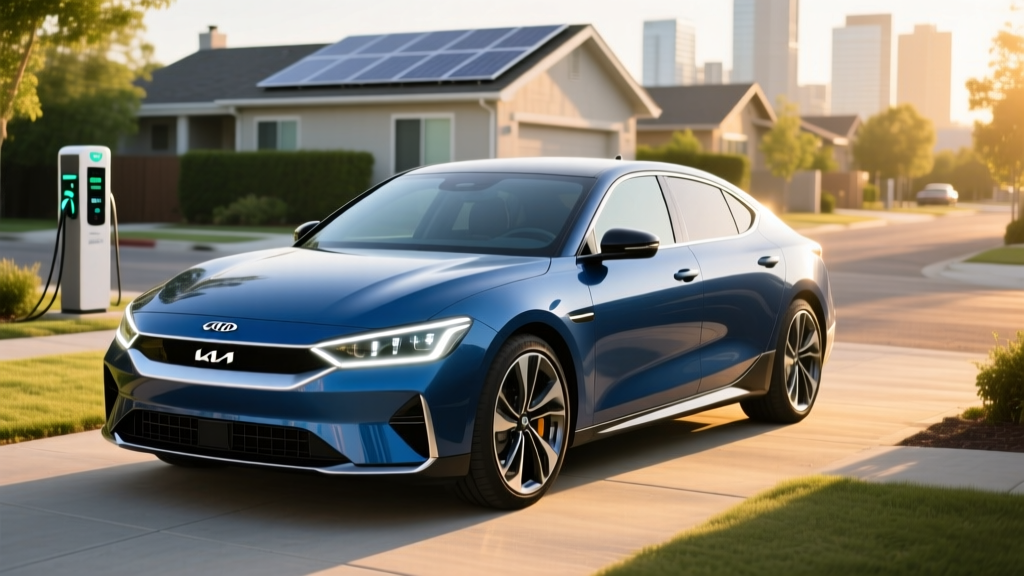
The midsize electric sedan segment has been thin on options outside the Tesla Model 3, but the 2026 Kia EV4 electric sedan aims to change that. Built on Hyundai Motor Group's E-GMP platform and positioned between the compact EV3 and the larger EV6, the EV4 brings competitive range, 800-volt DC fast-charging architecture, and Kia's generous warranty to a body style that still resonates with traditional car buyers. After spending time with the specs, cross-referencing EPA data, and mapping real-world expectations, here is everything you need to know before heading to a dealer.
Quick Verdict: Who the Kia EV4 Electric Sedan Is For
The 2026 Kia EV4 slots in as a commuter-first, road-trip-capable electric sedan for buyers who want something less polarizing than a Tesla and more car-like than a crossover. It is best suited for two-adult households (or a small family) who can charge at home and want 250+ real-world highway miles without range stress. If you need three rows, a truck bed, or a sub-$35,000 price, look elsewhere. If you want a refined, tech-forward sedan with honest range and fast charging, the EV4 deserves a serious test drive.
Choose the Kia EV4 if: You want a traditional sedan silhouette, 800V fast charging, and Kia's 10-year powertrain warranty.
Look at competitors if: You need AWD in the base trim (Tesla Model 3 Long Range), hatchback cargo flexibility (Hyundai Ioniq 6), or a lower starting price (Chevrolet Equinox EV).
EPA Range, Battery Specs, and Real-World Expectations
The 2026 Kia EV4 is offered with two battery options depending on trim:
- Standard Range (SR): 63.0 kWh usable capacity, LFP (lithium iron phosphate) chemistry — estimated EPA range of 230 miles
- Long Range (LR): 84.0 kWh usable capacity, NMC (nickel manganese cobalt) chemistry — estimated EPA range of 290 miles
Real-World Range Reality Check: The 290-mile EPA estimate for the Long Range trim assumes mixed driving at moderate temperatures. Expect approximately 255–270 miles on highway road trips at sustained 70–75 mph speeds, where aerodynamic drag cuts efficiency by 7–12%. In cold weather (below 30°F), plan for 210–240 miles of usable range due to cabin heating demands and reduced battery chemistry efficiency, even with the EV4's standard heat pump. The Standard Range LFP model will see similar percentage drops from its 230-mile baseline.
LFP chemistry in the SR trim trades energy density for longevity — LFP cells tolerate repeated 100% charging without the degradation concerns of NMC, making it ideal for daily commuters who charge nightly. The LR's NMC pack delivers more miles per charge but benefits from charging to 80% for daily use and reserving 100% for road trips.
Efficiency for the Long Range model is rated at approximately 118 MPGe combined (roughly 28 kWh/100 mi), competitive with the Hyundai Ioniq 6 SE Long Range (140 MPGe) but slightly behind due to the EV4's taller sedan proportions.
Charging Speed: DC Fast Charge and Home Level 2
The EV4 inherits the E-GMP platform's 800-volt architecture, which enables some of the fastest DC charging in its class — provided you use a 350 kW-capable station.
| Charging Level | Power / Rate | Time / Miles Added |
|---|---|---|
| Level 1 (120V household) | ~1.4 kW | ~4 miles per hour of charging |
| Level 2 (240V home / public) | 10.9 kW (48A) | ~34 miles per hour; full charge in ~8.5 hrs (LR) |
| DC Fast Charge (800V / 350 kW station) | Peak 200 kW | 10–80% in ~20 minutes (LR) |
| DC Fast Charge (400V / 150 kW station) | Peak ~140 kW | 10–80% in ~28 minutes (LR) |
Charging curve reality: The 200 kW peak on the Long Range model is sustained from roughly 10% to 55% State of Charge (SoC), after which the rate tapers progressively. From 80% to 100%, expect speeds to drop below 50 kW — this is normal for NMC battery thermal management and why 10–80% is the practical fast-charging window. The Standard Range LFP model peaks at approximately 150 kW on DC fast charge, with a 10–80% time of around 26 minutes.
At home on a Level 2 charger (10.9 kW), the Long Range EV4 adds enough range overnight to cover virtually any commute. A full charge from 10% takes about 8.5 hours — plug in at 10 PM, and you are at 100% by your morning departure. Note: achieving the full 10.9 kW requires a 48-amp dedicated circuit installed by a licensed electrician on a 60-amp breaker. Homes with older 100-amp electrical panels may need a panel upgrade, which can add $1,500–$3,000 to installation costs.
The EV4 ships with the NACS (North American Charging Standard) connector as standard for 2026, giving it native access to Tesla Supercharger V3/V4 stations without an adapter. A CCS1 adapter is available for legacy Electrify America and EVgo stations still transitioning to NACS.
Performance, Drivetrain, and Ride Quality
The 2026 Kia EV4 is offered in rear-wheel-drive (RWD) and all-wheel-drive (AWD) configurations:
| Trim / Config | Powertrain | Horsepower | Torque (lb-ft) | 0–60 mph |
|---|---|---|---|---|
| SR (Standard Range) | RWD, single motor | 201 hp | 258 | 7.4 sec |
| LR (Long Range) | RWD, single motor | 225 hp | 258 | 6.8 sec |
| LR AWD | Dual motor, AWD | 320 hp | 446 | 4.9 sec |
The RWD Long Range strikes the best balance for most buyers — 225 hp is more than adequate for highway merging, and the single-motor layout maximizes range. The AWD variant sacrifices roughly 20 miles of EPA range (down to ~270 miles) in exchange for confident traction in rain and snow plus a genuinely quick 4.9-second sprint to 60 mph.
Ride quality benefits from the E-GMP's low center of gravity and multi-link rear suspension. Regenerative braking offers four levels selectable via steering-wheel paddles, including a true one-pedal driving mode (i-Pedal) that brings the car to a complete stop without touching the brake pedal.
Interior Space, Cargo, and Technology
Kia designed the EV4 with a slim battery pack and flat floor, yielding interior volume that punches above its midsize classification:
- Front headroom: 40.2 inches
- Front legroom: 43.1 inches
- Rear headroom: 37.8 inches
- Rear legroom: 38.4 inches
- Trunk volume: 15.8 cu ft (sedan trunk, not a hatchback)
- Frunk (front trunk): 1.6 cu ft — enough for a charging cable kit and small bag
The trunk is a traditional sedan lid, not a liftback — this is a deliberate design choice that some buyers will appreciate for security and structural rigidity, while others may miss the versatility of the Ioniq 6's fastback opening. The 15.8 cu ft figure is competitive with the BMW i4 (13 cu ft) and slightly behind the Tesla Model 3 (17.6 cu ft with its liftback-style trunk).
Tech highlights:
- Dual 12.3-inch curved displays (instrument cluster + infotainment) running Kia's latest ccNC operating system
- Wireless Apple CarPlay and Android Auto
- Augmented-reality head-up display (available on GT-Line and above)
- Highway Driving Assist 2 (HDA2) — adaptive cruise with lane centering and lane-change assist, SAE Level 2 driver assistance requiring continuous driver engagement
- Remote Smart Parking Assist (available) — the car can park or unpark itself in tight spaces via the key fob while you stand outside
- Vehicle-to-Load (V2L) capability via an interior outlet and external adapter — power a laptop, cooler, or small appliance at up to 3.6 kW
Driver-Assist Clarification: Highway Driving Assist 2 (HDA2) is an SAE Level 2 system. It handles steering, acceleration, and braking on marked highways but requires the driver to remain attentive with hands on or near the wheel at all times. It is not self-driving. The driver is legally and practically responsible for the vehicle at all times.
Pricing, Trims, and Federal Tax Credit Eligibility
The 2026 Kia EV4 electric sedan is offered in four primary trims. Pricing below reflects base MSRP before destination charges:
| Trim | Drivetrain | MSRP | Est. After §30D Credit* |
|---|---|---|---|
| Light SR | RWD | $38,990 | ~$31,490 |
| Wind LR | RWD | $42,990 | ~$35,490 |
| GT-Line LR | RWD | $46,490 | ~$38,990 |
| GT-Line LR AWD | AWD | $49,990 | ~$42,490 |
*Estimated after-tax-credit pricing assumes full $7,500 federal credit eligibility. Actual credit depends on individual circumstances.
Federal EV Tax Credit (§30D) — Key Eligibility Rules for 2026:
- MSRP cap: Sedans must have an MSRP of $55,000 or less — all EV4 trims qualify on MSRP
- Buyer income caps: Modified AGI must not exceed $150,000 (single), $225,000 (head of household), or $300,000 (joint filing)
- Battery sourcing: A percentage of critical minerals and battery components must be sourced from the U.S. or FTA-partner countries — Kia has been progressively shifting supply chains, but the exact credit amount ($3,750, $7,500, or $0) depends on the specific battery batch and current IRS guidance. Verify on IRS.gov before purchasing
- Point-of-sale transfer: Eligible buyers can transfer the credit to the dealer at purchase, reducing the out-of-pocket price immediately rather than waiting for a tax refund
- One vehicle per taxpayer per year
Destination charges add approximately $1,395. A fully loaded GT-Line LR AWD with available packages (panoramic roof, premium audio, enhanced ADAS) can reach approximately $53,500 — still under the $55,000 sedan cap but narrowing the credit-eligible window.
Warranty, Ownership Costs, and Efficiency Breakdown
Kia's warranty coverage remains one of the strongest in the industry and a genuine differentiator against Tesla and most legacy competitors:
- Battery warranty: 10 years / 100,000 miles (capacity retention guaranteed above 70% of original)
- Powertrain warranty: 10 years / 100,000 miles
- Bumper-to-bumper: 5 years / 60,000 miles
- Roadside assistance: 5 years / 60,000 miles
At an average U.S. electricity rate of $0.16/kWh (EIA data), charging the Long Range EV4 from 10% to 80% at home costs approximately $9.40 — translating to roughly $0.045 per mile driven. Compare that to a 30 MPG gas sedan at $3.40/gallon ($0.113/mile), and the EV4 saves approximately $0.068 per mile, or about $1,020 annually at 15,000 miles/year in fuel costs alone.
Insurance premiums for the EV4 are estimated at $1,800–$2,200 annually depending on location and driving record — moderately higher than a comparable gas sedan due to EV repair cost structures, but in line with competitors in this price range.
Pros, Cons, and How It Stacks Up
Pros
- 800V architecture delivers 10–80% DC charging in ~20 minutes on 350 kW chargers
- 290-mile EPA range (LR) is competitive and honest in real-world use
- Class-leading 10-year/100,000-mile battery and powertrain warranty
- NACS connector standard — native Tesla Supercharger access
- Comfortable, well-insulated cabin with strong rear-seat legroom
- V2L capability for powering devices and appliances
- Under $55K MSRP across all trims — federal tax credit eligible on price
Cons
- Traditional sedan trunk limits cargo flexibility vs liftback competitors
- No AWD option on the Standard Range trim
- Frunk is small (1.6 cu ft) — mostly useful for cable storage
- HDA2 requires hands-on engagement; no hands-free driving mode like GM Super Cruise
- Base Light SR trim uses LFP — lower range (230 mi) and slower DC charging (150 kW peak)
- Real-world cold-weather range drops 15–20%, as with all EVs
Key competitor comparison: Against the Tesla Model 3 Long Range (~$42,990, 341 mi EPA, 250 kW peak charge), the EV4 trails on EPA range by about 50 miles but matches or beats it on warranty, interior material quality, and charging-curve consistency. The Hyundai Ioniq 6 (140 MPGe, hatchback-style liftback) is mechanically similar but offers more cargo versatility. The BMW i4 eDrive40 starts higher (~$57,000) and exceeds the §30D sedan MSRP cap, making the EV4 a more credit-friendly premium-adjacent option.
Frequently Asked Questions
What is the real-world range of the 2026 Kia EV4 electric sedan?
The Long Range EV4 carries an EPA-estimated 290 miles. In real-world highway driving at 70–75 mph, expect 255–270 miles. In cold weather below 30°F, plan for 210–240 miles. The Standard Range LFP model delivers about 230 miles EPA, with proportional real-world reductions.
How fast does the Kia EV4 charge at home and on the road?
At home on a Level 2 charger (10.9 kW / 48A), the EV4 Long Range gains about 34 miles per hour and fully charges overnight in roughly 8.5 hours. On a 350 kW DC fast charger, it peaks at 200 kW and charges from 10–80% in approximately 20 minutes. On a 150 kW station, 10–80% takes about 28 minutes.
Does the 2026 Kia EV4 qualify for the $7,500 federal EV tax credit?
All EV4 trims fall under the $55,000 sedan MSRP cap, so they qualify on price. However, the full $7,500 credit also depends on buyer income limits (e.g., $150K single / $300K joint), battery critical-mineral and component sourcing requirements per current IRS rules, and one-vehicle-per-year limits. The credit can be transferred to the dealer at point of sale. Always verify current eligibility at IRS.gov or with a tax professional before purchasing.
Is the Kia EV4 worth buying over the Tesla Model 3 or Hyundai Ioniq 6?
The EV4 is worth serious consideration if you value a longer warranty (10yr/100K mi vs Tesla's 8yr/120K mi battery), more traditional sedan styling, and Kia's dealer network. The Model 3 wins on EPA range (341 mi) and Supercharger network maturity, though the EV4 now has native NACS access. The Ioniq 6 offers a hatchback liftback for more cargo flexibility and slightly better MPGe. The right choice depends on whether warranty and sedan comfort (EV4), range and network (Model 3), or cargo versatility (Ioniq 6) matter most to you.
What are the biggest drawbacks of the Kia EV4?
The traditional sedan trunk (not a liftback) limits loading large items. The base SR trim's LFP battery means lower range (230 mi) and slower DC charging. There is no hands-free highway driving mode comparable to GM's Super Cruise. And cold-weather range loss, while typical for all EVs, is a real factor for buyers in northern climates.
Can I charge the Kia EV4 at Tesla Superchargers?
Yes. The 2026 EV4 comes equipped with the NACS connector as standard, providing native access to Tesla Supercharger V3 and V4 stations across the U.S. without requiring an adapter. For legacy CCS1 stations (Electrify America, EVgo), Kia offers an optional CCS1 adapter.
Sources: EPA range and efficiency data via fueleconomy.gov; federal tax credit rules via IRS.gov §30D; manufacturer specifications via Kia America press materials. All specs reflect 2026 model-year information available at time of publication and are subject to change. Confirm final specifications and pricing with your local Kia dealer.