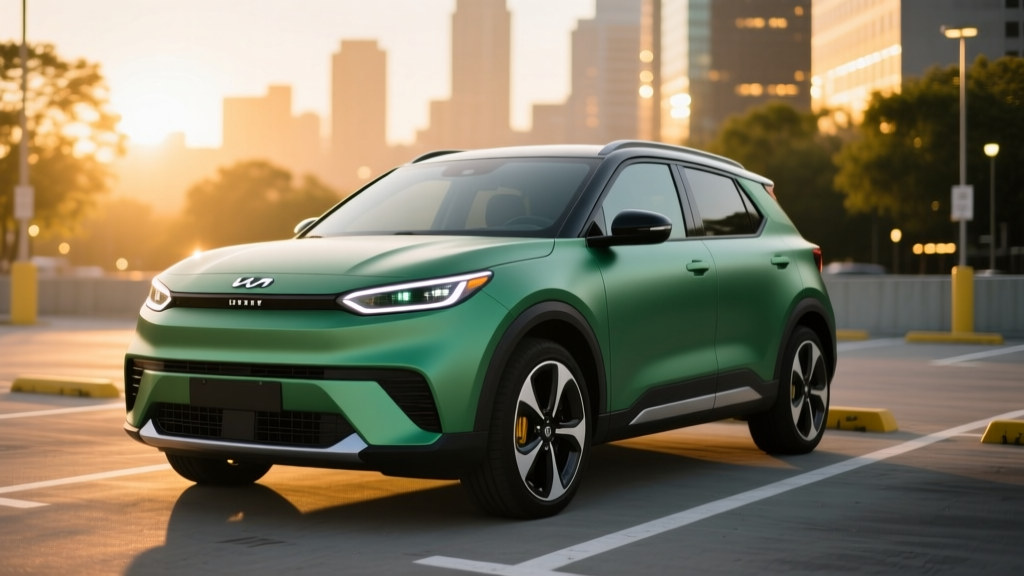
Kia has confirmed the EV3 compact electric SUV for the United States, positioning it as an affordable entry point into its dedicated electric-vehicle lineup. Announced globally in 2024 with European and Korean deliveries already underway, the EV3 targets US showrooms for the 2026 model year. If the preliminary specs hold, it will undercut nearly every rival in the compact electric crossover segment on price while delivering competitive range and practicality.
Here is everything confirmed and projected about the Kia EV3 for the US market — battery chemistry, charging speeds, real-world range expectations, pricing, and federal tax-credit eligibility — based on global specifications, Kia's official announcements, and segment benchmarks.
The European WLTP-rated EV3 Long Range achieves up to 373 miles (600 km). The US EPA rating will be lower — expect approximately 290–310 miles EPA based on the typical 20–25% WLTP-to-EPA reduction. Real-world highway driving at 70+ mph will yield roughly 240–270 miles, and cold-weather (below 30°F) operation may reduce range by an additional 15–25%, bringing winter highway range to approximately 190–220 miles.
Battery, Powertrain, and Efficiency
The global Kia EV3 Long Range uses an 81.4 kWh (usable) NMC (nickel-manganese-cobalt) lithium-ion battery pack paired with a single front-mounted electric motor. A Standard Range variant with a smaller ~58 kWh pack is available in some markets but has not been confirmed for the US.
| Spec | Value |
|---|---|
| Battery (usable) | 81.4 kWh, NMC chemistry |
| Motor | Single front motor (FWD) |
| Horsepower | 201 hp (150 kW) |
| Torque | 214 lb-ft |
| 0–60 mph (est.) | ~7.5 seconds |
| Drivetrain | Front-wheel drive |
| EPA Range (projected) | ~290–310 mi |
| Efficiency (projected) | ~115–120 MPGe / ~29–31 kWh/100mi |
| Heat Pump | Standard (expected for US) |
The EV3's efficiency is a key selling point. At roughly 29–31 kWh per 100 miles, it matches or beats rivals like the Hyundai Ioniq 5 and Tesla Model Y in energy consumption per mile. The included heat pump — critical for cold-climate owners — reduces winter range loss by warming the cabin using waste heat from the drivetrain rather than relying solely on resistive heating.
An all-wheel-drive dual-motor variant has not been confirmed for the US market at launch. If Kia follows its EV6/EV9 playbook, an AWD GT-Line could arrive in a subsequent model year with approximately 320 hp and a slight range reduction.
Charging Speed: DC Fast Charge and Home Level 2
Charging speed determines how livable an EV is for road trips and daily use. The EV3 Long Range supports the following charge rates based on global specifications:
| Level | Power | Speed |
|---|---|---|
| Level 1 (120V household) | ~1.4 kW | ~3–4 mi/hr |
| Level 2 (240V home/public) | 11 kW (onboard charger) | ~28–32 mi/hr; full charge ~8.5 hr |
| DC Fast Charge (CCS/NACS) | Peak ~150 kW | 10–80% in ~31 min |
Understanding kW vs kWh: The battery stores 81.4 kWh (kilowatt-hours) of energy — think of it as the tank size. The charger delivers power measured in kW (kilowatts) — the flow rate. A 150 kW DC fast charger can theoretically deliver 150 kWh per hour, though real-world charging follows a curve that tapers as the battery fills.
The EV3's ~150 kW peak DC rate is modest compared to the EV6's 800V architecture (which peaks at 240+ kW), but it is competitive with the Volkswagen ID.4 and Toyota bZ4X. The 10–80% charge time of approximately 31 minutes is adequate for highway rest stops but falls short of the sub-20-minute benchmarks set by Hyundai/Kia's E-GMP platform vehicles.
For the US market, Kia is expected to equip the EV3 with the NACS (North American Charging Standard) connector, granting native access to Tesla Supercharger stations without an adapter. This is a significant practical advantage over CCS-only vehicles, given the Supercharger network's reliability and coverage.
At home on a Level 2 charger (240V, 48A circuit), the EV3's 11 kW onboard charger replenishes roughly 30 miles of range per hour. A full overnight charge from 10% to 100% takes approximately 8.5 hours — easily achievable with a standard home Level 2 installation. Expect a professional Level 2 home charger installation to cost between $800 and $2,200 depending on panel capacity and conduit run length.
Projected US Pricing and Federal Tax Credit Eligibility
Kia has positioned the EV3 as a budget-friendly electric SUV. In South Korea, the EV3 Long Range starts at the equivalent of approximately $32,000 USD before incentives. European pricing is higher due to VAT and market positioning. For the US, industry analysts project the following MSRP structure:
| Trim | Est. MSRP | After Potential §30D Credit |
|---|---|---|
| Light (base) | ~$34,000–$36,000 | ~$26,500–$28,500 |
| Wind | ~$38,000–$40,000 | ~$30,500–$32,500 |
| GT-Line / Limited | ~$42,000–$45,000 | ~$34,500–$37,500 |
Federal tax credit (IRS §30D) eligibility is the biggest variable. As of current rules, the credit offers up to $7,500 — split into $3,750 for meeting critical-minerals sourcing requirements and $3,750 for battery-component sourcing. Under the Inflation Reduction Act, eligibility requires:
- Vehicle MSRP at or below $80,000 for SUVs (the EV3 clears this easily)
- Buyer modified adjusted gross income at or below $150,000 (single) / $300,000 (joint)
- Battery components and critical minerals must meet phased-in domestic-sourcing thresholds — these tighten annually
- Credit may be transferred to the dealer at point of sale as an immediate purchase-price reduction
Because Kia manufactures the EV3 in South Korea (Hwaseong plant), and battery cells are sourced from Samsung SDI, the credit eligibility depends entirely on whether Kia's battery supply chain meets the current-year critical-minerals and component thresholds. Buyers should verify eligibility on fueleconomy.gov at the time of purchase and consult a tax professional. Rules have shifted frequently since 2023.
Interior Space, Cargo, and Technology
The EV3 sits on Kia's EV-dedicated platform, which allows a flat floor and generous interior packaging relative to its compact footprint (approximately 177 inches long — shorter than a Sportage).
Passenger space is competitive: expect approximately 41 inches of front legroom and 38 inches of rear legroom, sufficient for adults on longer trips. The flat floor and thin front seatbacks contribute to an airy rear cabin.
Cargo volume is projected at roughly 22–24 cubic feet behind the rear seats and 50+ cubic feet with the 60/40 split rear seats folded. A small front trunk (frunk) of approximately 1.5–2.0 cubic feet provides additional storage for charging cables or a small bag.
Technology highlights expected for the US market include:
- Dual 12.3-inch displays (instrument cluster + infotainment) in a single curved panel
- Wireless Apple CarPlay and Android Auto
- Over-the-air (OTA) software updates for powertrain and infotainment
- Kia Connect remote services (preconditioning, charge monitoring, remote start)
- Vehicle-to-Load (V2L) capability — power external devices up to ~3.6 kW via an interior or adapter outlet
- Highway Driving Assist 2 (HDA2) — a Level 2 driver-assistance system combining adaptive cruise, lane centering, and lane-change assist. This is not self-driving; the driver must remain attentive with hands on the wheel at all times.
Notable drawbacks reported from international reviews include a firm ride on larger wheels, a rear wiper that is absent on some trims (a common Kia/Hyundai omission that frustrates owners in rainy climates), and a 400V charging architecture that limits peak DC speed compared to Kia's own 800V vehicles.
How the Kia EV3 Compares to Key Rivals
The EV3 enters a compact electric SUV segment with established players. Here is how the projected specs stack up:
| Spec | Kia EV3 LR | Hyundai Ioniq 5 (Std Rgn) | VW ID.4 (Pro) | Volvo EX30 (LR) |
|---|---|---|---|---|
| EPA Range | ~300 mi | 220 mi | 291 mi | ~265 mi |
| Battery | 81.4 kWh NMC | 58 kWh | 82 kWh | 69 kWh NMC |
| DC Peak kW | ~150 kW | ~175 kW | ~170 kW | ~153 kW |
| 10–80% Time | ~31 min | ~18 min | ~28 min | ~27 min |
| 0–60 mph | ~7.5 sec | ~7.4 sec | ~7.7 sec | ~6.3 sec |
| Est. Base MSRP | ~$35,000 | ~$42,000 | ~$40,000 | ~$45,000 |
The EV3's primary advantage is price. At a projected $35,000 starting point, it undercuts the Ioniq 5, ID.4, and EX30 by $5,000–$10,000 while matching or exceeding their EPA range. The trade-off is a slower DC charge rate and a FWD-only powertrain at launch.
For buyers who prioritize road-trip charging speed, the Ioniq 5's 800V architecture and 18-minute 10–80% time remain the segment benchmark. For those focused on daily commuting and home charging, the EV3's range-per-dollar ratio is difficult to beat.
Warranty and Ownership Costs
Kia's US warranty coverage is among the best in the industry and is expected to carry over to the EV3:
- Battery & drive unit: 10 years / 100,000 miles (capacity retention threshold expected at 70%, consistent with Hyundai/Kia policy)
- Limited vehicle warranty: 5 years / 60,000 miles
- Powertrain: 10 years / 100,000 miles
- Roadside assistance: 5 years / 60,000 miles
The 10-year battery warranty provides long-term peace of mind. NMC batteries in Kia/Hyundai EVs have demonstrated moderate degradation — typically 8–12% capacity loss over 100,000 miles based on fleet data from the Niro EV and Kona Electric. The EV3's larger battery means that even with 10% degradation, usable range would remain above 260 EPA miles.
Insurance costs for compact EVs have trended higher than gas equivalents, typically 15–25% above comparable ICE SUVs. Expect annual premiums in the $1,400–$2,000 range depending on state, driving record, and coverage level. Get quotes before purchasing.
Who the Kia EV3 Is For
- You want maximum EPA range per dollar in a compact SUV
- You charge primarily at home and road-trip infrequently (2–4 times per year)
- You want a sub-$30,000 effective price after tax credits
- You value Kia's 10-year warranty and V2L capability
- You're a commuter covering 30–60 miles daily with weekend flexibility
🚫 Look elsewhere if:
- You road-trip frequently and need the fastest possible DC charging (consider Ioniq 5 or EV6)
- You need AWD for snow-belt climates at launch (AWD EV3 may not be available immediately)
- You need maximum cargo space (consider the Ioniq 5 or Model Y)
- You want a sporty driving experience (the EV3 is tuned for comfort and efficiency, not performance)
Kia EV3 USA: Frequently Asked Questions
When will the Kia EV3 be available in the US?
Kia has confirmed the EV3 for the US market targeting the 2026 model year. Based on typical Kia US launch timelines, expect showroom arrivals in mid-to-late 2025 as a 2026 model. Exact timing depends on production ramp-up at Kia's Hwaseong plant and port logistics.
What is the real-world range of the Kia EV3?
While the final EPA rating is pending, expect approximately 290–310 miles based on the global WLTP figure of 373 miles and the typical 20–25% EPA reduction. Real-world highway driving at 70–80 mph will yield roughly 240–270 miles. In freezing temperatures (below 30°F), expect 190–220 miles on the highway. The standard heat pump helps mitigate cold-weather losses compared to EVs without one.
Does the Kia EV3 qualify for the $7,500 federal EV tax credit?
Eligibility depends on battery-sourcing requirements that tighten annually under IRS §30D rules. The EV3's MSRP (well below the $80,000 SUV cap) and buyer income are unlikely to be barriers. The limiting factor is whether Samsung SDI's battery cells meet the critical-minerals and component-sourcing thresholds in the purchase year. Check fueleconomy.gov at time of purchase for the definitive answer.
How fast does the Kia EV3 charge at home and on the road?
On a home Level 2 charger (240V), the EV3 charges at up to 11 kW, adding approximately 30 miles of range per hour — a full charge takes about 8.5 hours. On a DC fast charger, it peaks at approximately 150 kW and charges from 10–80% in about 31 minutes. This is adequate for road trips but slower than 800V rivals like the Ioniq 5 (18 minutes).
Is the Kia EV3 worth buying over the Hyundai Ioniq 5 or Tesla Model Y?
It depends on your priorities. The EV3 wins on price and range-per-dollar. The Ioniq 5 wins on charging speed and interior space. The Model Y wins on Supercharger network access (though NACS adoption is narrowing this gap) and performance. If budget and daily commuting range are your top criteria, the EV3 is a strong value. If road-trip charging speed or cargo room matter more, look at the Ioniq 5 or Model Y.
Will the Kia EV3 have a NACS connector for Tesla Superchargers?
Kia has committed to adopting the NACS connector for its US EVs. The EV3 is expected to ship with a native NACS port, allowing direct access to Tesla Supercharger stalls without an adapter. This is a meaningful advantage for road-trip charging convenience.
Does the EV3 have a frunk (front trunk)?
Yes, the EV3 includes a small front trunk (approximately 1.5–2.0 cubic feet). It is sufficient for storing charging cables, a small bag, or emergency supplies — but not large enough for a carry-on suitcase.
- Projected sub-$35,000 base price — among the cheapest 300-mile EVs
- Strong ~300-mile EPA range from 81.4 kWh NMC battery
- Standard heat pump for cold-weather efficiency
- 10-year/100,000-mile battery warranty
- NACS connector for native Supercharger access
- V2L capability for camping/emergency power
- Competitive efficiency (~29–31 kWh/100mi)
- 150 kW peak DC charging is slower than 800V rivals
- FWD only at launch — no AWD option initially
- Compact cargo area vs. Ioniq 5 and Model Y
- Firm ride quality reported on larger wheel sizes
- No rear wiper on some international trims (US spec TBD)
- Tax-credit eligibility uncertain due to battery-sourcing rules
- 201 hp is adequate, not quick — 7.5-sec 0–60
Note: Specifications in this article are based on Kia's global EV3 announcements and projected US-market configurations. Final EPA ratings, MSRP, and tax-credit eligibility will be confirmed closer to the US launch date. Always verify current figures on kia.com and fueleconomy.gov before purchasing.