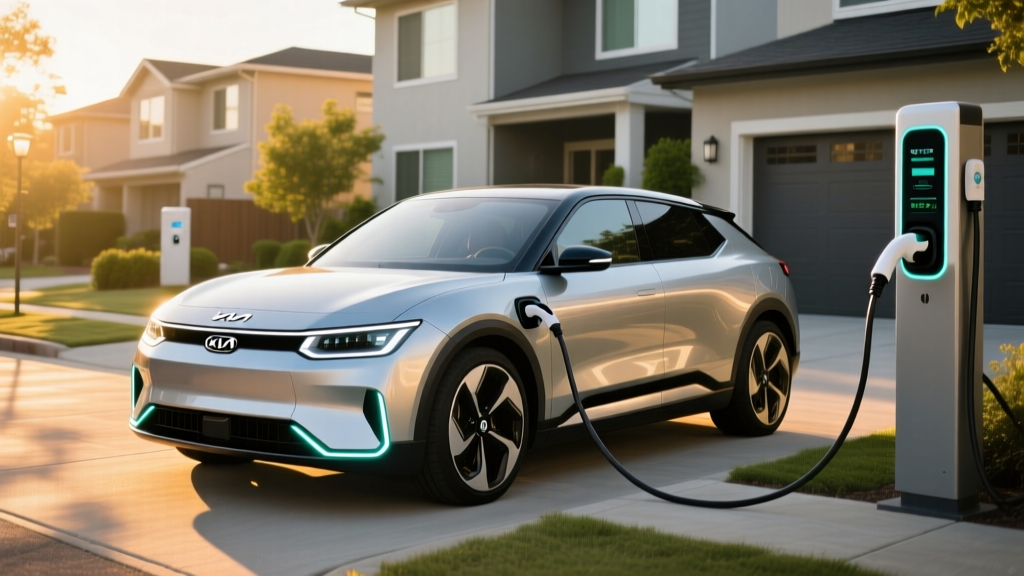
The subcompact electric crossover segment has been one of the most glaring gaps in the U.S. EV market. While European and South Korean buyers have had access to affordable, right-sized electric SUVs for years, American shoppers have been largely stuck choosing between premium-priced compact crossovers or aging plug-in hybrids. The Kia EV3 — already on sale in Europe since mid-2024 — is widely expected to address that gap when it arrives in the United States, likely as a 2026 or 2027 model. Here's everything we know, what's confirmed, and what remains preliminary.
Platform and Powertrain: What We Know About the EV3
The EV3 rides on a dedicated EV architecture derived from Hyundai Motor Group's E-GMP platform, though it uses a more cost-optimized variant designed for front-wheel-drive applications. Unlike the larger EV6 and EV9, which support 800-volt ultra-fast charging, the EV3 is built on a 400-volt architecture — a deliberate trade-off that keeps costs down while still delivering competitive charging speeds for its class.
In Europe, Kia offers the EV3 with two battery options:
| Specification | Standard Range | Long Range |
|---|---|---|
| Battery Capacity (usable) | 58.3 kWh | 81.4 kWh |
| Battery Chemistry | NMC (Nickel Manganese Cobalt) | NMC (Nickel Manganese Cobalt) |
| Drivetrain | FWD, single motor | FWD, single motor |
| Horsepower | 201 hp | 201 hp |
| Torque | 229 lb-ft | 229 lb-ft |
| 0-62 mph (0-100 km/h) | ~7.7 sec | ~7.7 sec |
| WLTP Range | ~268 mi (435 km) | ~373 mi (600 km) |
For the U.S. market, Kia will almost certainly offer the Long Range variant with the 81.4 kWh NMC battery as the volume model, given American buyers' preference for maximum range. A Standard Range model could follow as a lower-priced entry point. An AWD dual-motor variant has not been confirmed but would not be surprising given the competitive landscape.
The 201-hp single-motor FWD setup won't win drag races, but it's appropriate for a vehicle in this class. Expect a 0-60 mph time in the mid-to-high 7-second range — comparable to a Nissan Ariana or base Volkswagen ID.4 and perfectly adequate for highway merging and daily driving.
Expected EPA Range and Real-World Efficiency
The European-spec Long Range EV3 is rated at 373 miles on the WLTP cycle. However, WLTP figures consistently overstate range compared to the EPA's more conservative testing methodology. Based on the typical WLTP-to-EPA conversion factor of roughly 80-85%, and accounting for the EV3's aerodynamic profile and battery capacity, we estimate the U.S.-spec Long Range model will achieve an EPA-estimated range of approximately 290–310 miles.
EPA Estimated: ~290–310 miles (Long Range, projected)
Highway (70-75 mph sustained): ~240–270 miles — aerodynamic drag hits all EVs hard at speed
Cold Weather (below 30°F): ~210–250 miles — expect 15-25% range reduction without preconditioning
Mixed Commute (city + suburban): ~280–300 miles — regenerative braking recovers energy in stop-and-go traffic
Note: The EV3's available heat pump (standard in Europe, likely standard or optional in the U.S.) significantly mitigates cold-weather cabin heating losses compared to resistance heaters.
For efficiency, expect an EPA rating in the neighborhood of 115–125 MPGe combined, or roughly 27–30 kWh per 100 miles. That puts the EV3 in the same efficiency ballpark as the Hyundai Ioniq 5 and slightly behind the Tesla Model Y, which benefits from class-leading aerodynamics.
Charging Speed: DC Fast Charging and Home Level 2
Charging capability is where the EV3's 400-volt architecture shows its limitations compared to the 800-volt EV6 and EV9 — but the numbers remain competitive for the subcompact crossover segment.
| Charging Level | Power / Rate | Time / Speed |
|---|---|---|
| Level 1 (120V household) | ~1.4 kW | ~3–4 miles of range per hour |
| Level 2 (240V home/workplace) | ~11 kW (onboard charger) | ~30–35 mi/hr; 10–100% in ~8 hours |
| DC Fast Charging (peak) | ~150 kW (peak) | 10–80% in ~31 minutes |
The ~31-minute 10-80% DC fast-charge time is a confirmed European figure and should hold for the U.S. Long Range model. While this trails the 18-minute times achievable by 800V vehicles like the EV6 and Ioniq 5, it's competitive with other 400V rivals like the Volkswagen ID.4 and Nissan Ariya.
Charging curve reality check: The EV3 will sustain its peak ~150 kW rate only in the lower portion of the battery (roughly 10-40% SoC). Above 60%, the charge rate tapers significantly — as is true for virtually all lithium-ion EVs. If you regularly DC fast-charge to 100%, expect the 80-100% portion to add another 25-30 minutes. For road trips, plan your stops around the 10-80% window for the best time efficiency.
For U.S. buyers, expect the EV3 to come equipped with the NACS (North American Charging Standard) connector, given Kia's commitment to the Tesla Supercharger network transition. This would give EV3 owners access to both the Supercharger network and CCS-equipped stations via adapter during the transition period. (Kia has not yet confirmed the exact U.S. connector configuration.)
Interior, Cargo Space, and Technology
The EV3 is a subcompact crossover — think of it as slotting below the EV6 in Kia's electric lineup, roughly analogous to a Seltos in size but with EV packaging advantages. The dedicated EV platform pushes the wheels to the corners, creating a flat floor and generous interior volume for the exterior footprint.
Expected U.S. interior dimensions:
- Front legroom: ~41 inches
- Rear legroom: ~38 inches
- Cargo volume (behind rear seats): ~16–18 cu ft
- Cargo volume (rear seats folded): ~46–50 cu ft
- Frunk (front trunk): Small utility compartment (~1.5–2 cu ft), primarily for charging cables
On the technology front, the European EV3 features:
- Dual 12.3-inch displays in a single curved housing (digital cluster + infotainment)
- Wireless Apple CarPlay and Android Auto
- OTA (over-the-air) software updates for powertrain and infotainment
- Kia Connect remote services (preconditioning, charge scheduling, vehicle location)
- AI-based voice assistant with natural language processing
- V2L (Vehicle-to-Load) capability — power laptops, appliances, or camping gear from the traction battery
For driver assistance, expect the full Kia Highway Driving Assist 2 (HDA2) suite, which includes adaptive cruise control with stop-and-go, lane centering, and lane-change assist. HDA2 is a SAE Level 2 system — it requires continuous driver attention and hands-on or eyes-on engagement at all times. It is not autonomous driving.
Pricing, Trims, and Federal Tax Credit Eligibility
In Europe, the Kia EV3 Long Range starts at approximately €43,000 (~$47,000 USD at current exchange rates), though European pricing includes VAT and different equipment levels. For the U.S., Kia will need to price aggressively to compete with the Chevrolet Equinox EV, Hyundai Ioniq 5, and Tesla Model Y.
Projected U.S. pricing (pre-incentives):
| Trim (Projected) | Est. MSRP | Key Features |
|---|---|---|
| Light (Standard Range) | ~$33,000–$35,000 | 58 kWh battery, FWD, 17" wheels, HDA2 |
| Wind (Long Range) | ~$38,000–$40,000 | 81 kWh battery, heat pump, power liftgate |
| GT-Line (Long Range) | ~$42,000–$44,000 | Sport styling, 19" wheels, premium audio, HUD |
Federal EV Tax Credit (§30D) Eligibility
Whether the U.S.-spec Kia EV3 qualifies for the $7,500 federal EV tax credit under IRS §30D depends on several factors that won't be finalized until Kia confirms U.S. battery sourcing and assembly details. Here are the key eligibility requirements as of 2026:
- MSRP Cap: SUVs/crossovers must have an MSRP at or below $80,000 — the EV3 easily clears this bar
- Buyer Income Cap: Modified adjusted gross income must not exceed $150,000 (single), $225,000 (head of household), or $300,000 (joint)
- Battery Component Manufacturing: A percentage of battery components must be manufactured or assembled in North America (threshold increases annually)
- Critical Minerals Sourcing: A percentage of critical minerals must be sourced from the U.S. or free-trade-agreement countries (threshold increases annually)
- Final Assembly: Must occur in North America
- Point-of-Sale Transfer: Eligible buyers can transfer the credit to the dealer at purchase, reducing the purchase price directly
The honest assessment: Kia currently manufactures the EV3 in South Korea (at the Hwaseong plant). Unless Kia shifts U.S.-bound production to its West Point, Georgia assembly plant — which is possible but unconfirmed — the EV3 will not qualify for the §30D credit due to the final-assembly requirement. This is a critical factor buyers should monitor. Kia may introduce a U.S.-assembled variant to address this. For the latest rules, consult the IRS clean vehicle credits page.
Warranty Coverage
Kia's warranty coverage is one of its strongest competitive advantages and should carry over to the EV3:
- Basic Vehicle Warranty: 5 years / 60,000 miles
- Powertrain Warranty: 10 years / 100,000 miles
- EV Battery Warranty: 10 years / 100,000 miles (covering capacity retention below 70% of original)
- Roadside Assistance: 5 years / 60,000 miles
The 10-year battery warranty with a 70% capacity-retention threshold is competitive with the industry standard. Kia's NMC batteries have demonstrated solid degradation curves in the EV6 and Niro EV, typically retaining 90%+ capacity after 3 years of normal use. For more details on how NMC chemistry ages, see our battery technology guide and the EPA's EV resources at fueleconomy.gov.
Competitive Landscape: How the EV3 Stacks Up
The EV3 will enter a segment with several established and incoming rivals. Here's how it's likely to compare:
| Vehicle | Est. EPA Range | DC Fast Charge (10-80%) | Est. Starting Price |
|---|---|---|---|
| Kia EV3 LR | ~290–310 mi | ~31 min (150 kW peak) | ~$38,000 |
| Chevrolet Equinox EV | 315 mi | ~30 min (150 kW peak) | ~$33,000 |
| Hyundai Ioniq 5 (Std Range) | 245 mi | ~18 min (800V, 240 kW) | ~$42,000 |
| Tesla Model Y (LR) | 320 mi | ~25 min (250 kW peak) | ~$44,000 |
| Volvo EX30 | 265 mi | ~27 min (153 kW peak) | ~$36,000 |
- You want ~300 miles of range under $40,000
- Kia's 10-year warranty matters to you
- You prefer a subcompact footprint for city driving
- You want V2L capability for camping or backup power
- You value physical climate controls alongside touchscreens
- You need the fastest possible DC charging (look at 800V vehicles)
- You require AWD for snow or mountain driving (AWD unconfirmed)
- Federal tax credit eligibility is essential (depends on assembly location)
- You need more than ~18 cu ft of cargo space
- You want Tesla Supercharger access without an adapter transition
Who the Kia EV3 Is For
The EV3 occupies a specific niche: buyers who want a right-sized, affordable electric crossover without stepping up to the price and footprint of a Model Y or EV6. It's ideal for:
- Urban and suburban commuters who need ~300 miles of range for weekly charging but don't need a large SUV
- First-time EV buyers who want a mainstream brand with a strong dealer network and warranty
- Two-car households replacing a gas compact crossover with an EV for daily driving
- Downsizers who've outgrown large SUVs and want something manageable in tight parking situations
It is not the right choice for frequent 400+ mile road-trippers who can't tolerate 30-minute charge stops, families needing three-row seating, or buyers in regions with limited DC fast-charging infrastructure who need maximum charge speed.
Frequently Asked Questions
When will the Kia EV3 be available in the USA?
Kia has not announced an exact U.S. on-sale date. Industry reporting suggests a late-2026 or early-2027 arrival, likely as a 2027 model year vehicle. Kia's U.S. launch event will confirm pricing, specs, and timing.
Will the Kia EV3 qualify for the $7,500 federal EV tax credit?
It depends on where Kia assembles U.S.-bound vehicles. The §30D credit requires final assembly in North America. Currently, the EV3 is built in South Korea. If Kia shifts production to Georgia, it could qualify — but this is unconfirmed. Always check the IRS clean vehicle credits page before purchasing.
Does the Kia EV3 have all-wheel drive?
The European EV3 is offered exclusively in front-wheel drive. Kia has not confirmed an AWD variant for any market, though the platform could support a dual-motor setup. U.S. buyers in snow-belt states should watch for AWD confirmation before committing.
How does the EV3 compare to the Kia EV6?
The EV6 is a larger, more powerful, and more expensive vehicle built on an 800V architecture with faster charging (~18 min 10-80%). The EV3 is smaller, more affordable, and uses a 400V system. Think of the EV3 as the budget-friendly, city-oriented sibling to the sportier EV6.
What connector does the Kia EV3 use?
The European EV3 uses CCS2. For the U.S., Kia is expected to adopt the NACS (Tesla) connector for new models, granting access to the Supercharger network. Final U.S. connector details will be confirmed at launch.
Can the Kia EV3 tow?
Kia has not published a U.S. towing rating. The European EV3 is rated for up to ~1,600 lbs (braked). This is sufficient for a small utility trailer but not for boats or campers. Do not expect serious towing capability from this class of EV.