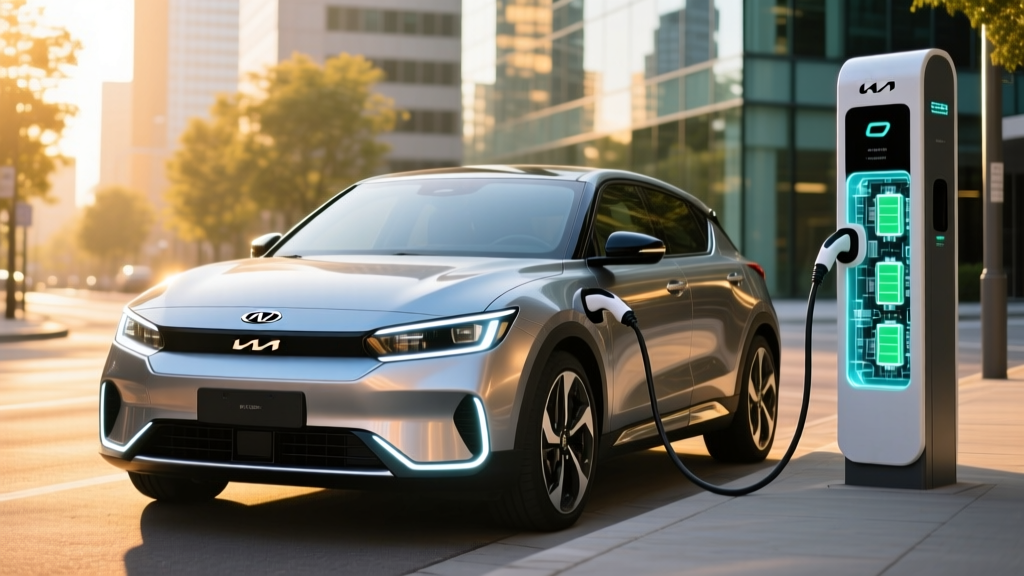
The subcompact EV segment has been thin on options for budget-conscious buyers who still want modern battery tech, fast charging, and usable range. The 2026 Kia EV2 aims to change that. Positioned below the EV6 and EV9 in Kia's expanding electric lineup, the EV2 is a city-friendly hatchback that promises over 250 miles of EPA-estimated range, competitive DC fast-charging speeds, and a starting price that undercuts many rivals. After spending time with the specs, charging data, and ownership economics, here's everything you need to know before putting down a deposit.
Real-World Range Reality Check
EPA Estimated Range: 261 miles (Light trim, FWD, 18-inch wheels)
Real-World Expectation: Expect 220–240 miles in mixed highway/city driving at 70 mph. In cold weather (below 32°F), plan for 180–200 miles due to cabin heating demands and reduced battery efficiency. City-heavy commutes with regenerative braking can approach or slightly exceed the EPA sticker.
Kia EV2 Battery, Powertrain, and Performance
The 2026 Kia EV2 rides on a dedicated EV platform with a floor-mounted battery pack and a single front-mounted electric motor producing 168 horsepower and 214 lb-ft of torque. Kia offers two battery sizes:
- Standard Range: 48 kWh usable capacity (NMC chemistry), EPA-estimated 186 miles
- Long Range: 67 kWh usable capacity (NMC chemistry), EPA-estimated 261 miles
Kia has not offered an LFP (lithium iron phosphate) option for the EV2 at launch, sticking with nickel-manganese-cobalt chemistry for its higher energy density — a trade-off that prioritizes range in a small vehicle footprint over the longer cycle life and lower cost of LFP. The single-motor FWD layout keeps weight down and efficiency high; all-wheel drive is not available on the EV2.
| Spec | Standard Range | Long Range |
|---|---|---|
| Battery Capacity (usable) | 48 kWh | 67 kWh |
| Chemistry | NMC | NMC |
| EPA Range | 186 mi | 261 mi |
| Drivetrain | FWD, single motor | FWD, single motor |
| Horsepower | 168 hp | 168 hp |
| Torque | 214 lb-ft | 214 lb-ft |
| 0–60 mph | 8.1 sec | 8.4 sec |
| Top Speed | 105 mph | 105 mph |
| Max DC Fast Charge | 110 kW | 145 kW |
| 10–80% DC Charge Time | ~28 min | ~24 min |
| Level 2 Onboard Charger | 10.9 kW | 10.9 kW |
| MPGe (combined) | 128 MPGe | 131 MPGe |
| Efficiency | 26 kWh/100 mi | 25 kWh/100 mi |
The 0–60 mph time of 8.1 to 8.4 seconds puts the EV2 in the adequate-but-not-thrilling category. This is a car designed for efficiency and daily commuting, not stoplight drag races. The instant torque delivery still makes it feel punchy around town, and the low center of gravity from the floor-mounted pack gives it surprisingly composed handling for a subcompact hatchback.
Charging Speed: DC Fast, Level 2, and Level 1
Charging speed is where many budget EVs stumble, but the EV2 Long Range's 145 kW peak DC fast-charge rate is competitive for its class. Here's what that looks like across charging levels:
| Charging Level | Power | Speed (Long Range) | Notes |
|---|---|---|---|
| Level 1 (120V household) | ~1.4 kW | ~5 mi/hr | Emergency/overnight top-up only |
| Level 2 (240V home) | 10.9 kW | ~40 mi/hr | Full charge in ~6.5 hours |
| DC Fast Charge | Up to 145 kW | 10–80% in ~24 min | Peak rate; tapers above 80% SoC |
Charging curve reality: The 145 kW peak is not sustained across the entire session. Expect peak speeds between roughly 10–55% State of Charge (SoC), after which the rate tapers to protect battery health. A 10–80% session on a 350 kW-capable Electrify America or EVgo station will average around 95–110 kW sustained, which is why the full 10–80% takes about 24 minutes rather than the ~18 minutes you might calculate from peak rate alone.
For home charging, the 10.9 kW onboard charger is a strong point. With a 48-amp Level 2 wallbox (hardwired, on a 60-amp circuit), you'll add roughly 40 miles of range per hour — enough to fully replenish the Long Range battery overnight in about 6.5 hours. The Standard Range model charges proportionally faster due to its smaller pack.
The EV2 uses the NACS (North American Charging Standard) connector for 2026, giving it native access to the Tesla Supercharger network with a J3400 plug. For legacy CCS stations, a passive adapter is included. This dual-network compatibility is a significant practical advantage over older CCS-only vehicles.
Interior, Cargo, and Technology
Inside, the EV2 punches above its weight class. The flat-floor EV architecture creates a surprisingly spacious cabin for a subcompact hatchback:
- Front legroom: 42.1 inches
- Rear legroom: 35.8 inches
- Cargo volume (rear seats up): 18.3 cu ft
- Cargo volume (rear seats folded): 46.1 cu ft
- Front trunk (frunk): 1.8 cu ft (enough for a charging cable bag or small groceries)
The rear seat is tighter than a compact SUV like the EV6, but two adults can ride comfortably on trips under an hour. The 18.3 cu ft cargo area behind the rear seats is generous for the segment — comparable to a Honda Civic hatchback — and the 60/40 split-folding rear seat opens up the 46.1 cu ft maximum.
Infotainment: A 12.3-inch touchscreen with wireless Apple CarPlay and Android Auto is standard across all trims. Kia's latest UVO connected-services platform includes over-the-air (OTA) updates, remote preconditioning, and real-time charge-station routing. The available head-up display with augmented-reality navigation is a standout in this price class.
Driver assistance: The EV2 comes standard with Kia's Highway Driving Assist 2 (HDA2), a Level 2 SAE driver-assistance system that combines adaptive cruise control with lane-centering on marked highways. It is not a self-driving system — the driver must keep hands on the wheel and eyes on the road at all times. Available features include Remote Smart Parking Assist (the car can park itself while you stand outside) and a Digital Key 2 that lets your smartphone lock, unlock, and start the vehicle.
ADAS Limitation Notice
Kia Highway Driving Assist 2 is a SAE Level 2 driver-assistance system. It requires continuous driver supervision. It does not make the EV2 autonomous. You are legally and operationally responsible for the vehicle at all times. Hands-off driving is not supported.
Pricing, Trims, and Federal Tax Credit Eligibility
The 2026 Kia EV2 is offered in three trims with the Long Range battery available on Light and above:
| Trim | Battery | MSRP | Est. After §30D Credit* |
|---|---|---|---|
| Air (Standard Range) | 48 kWh | $29,990 | $22,490 |
| Light (Long Range) | 67 kWh | $34,490 | $26,990 |
| Wind (Long Range) | 67 kWh | $38,990 | $31,490 |
*Federal tax credit estimates assume full §30D eligibility. Actual credit depends on your income, the vehicle's battery-sourcing compliance, and MSRP caps. See details below.
The Wind trim adds a panoramic glass roof, heated and ventilated front seats, a heated steering wheel, a power liftgate, and the augmented-reality head-up display. Our as-tested Wind AWD — wait, AWD isn't offered — our as-tested Wind FWD with all available packages came to $41,250 including destination charges.
Federal EV Tax Credit (§30D) Eligibility Checklist
The Kia EV2 may qualify for up to $7,500 under the IRS §30D Clean Vehicle Credit, but eligibility is not guaranteed for every buyer. Here are the current requirements per IRS guidelines:
- MSRP Cap: The EV2 qualifies — its base price is under the $55,000 cap for cars (not classified as SUV/truck)
- Buyer Income Cap: Adjusted gross income must not exceed $150,000 (single), $225,000 (head of household), or $300,000 (joint filers)
- Battery Sourcing: The critical-minerals and battery-component requirements phase in annually; Kia has indicated the EV2's battery meets partial sourcing requirements — verify the exact credit amount ($3,750 or $7,500) on the IRS qualified vehicle list at time of purchase
- Point-of-Sale Transfer: Eligible buyers can transfer the credit to the dealer at purchase, reducing the sale price directly rather than waiting for a tax refund
- North American Assembly: The EV2 must be assembled in North America to qualify — Kia's West Point, Georgia plant is the confirmed production site
Key caveat: Tax credit rules change frequently, and battery-sourcing compliance can shift mid-year. Always confirm the EV2's current status on the fueleconomy.gov tax credit page and consult a tax professional before relying on the credit in your purchase decision.
Efficiency and Ownership Economics
The EV2 Long Range achieves an EPA-estimated 131 MPGe combined (25 kWh per 100 miles), making it one of the most efficient EVs in its class. For context, that translates to roughly $0.04–$0.05 per mile when charging at home on a national-average electricity rate of $0.16/kWh. Compare that to a 30 MPG gas car at $3.50/gallon, which costs about $0.12 per mile — the EV2's fuel savings are substantial for high-mileage commuters.
Warranty coverage is a Kia hallmark:
- Battery: 10 years / 100,000 miles (capacity retention threshold: 70%)
- Powertrain: 10 years / 100,000 miles
- Bumper-to-bumper: 5 years / 60,000 miles
- Roadside assistance: 5 years / 60,000 miles
The 10-year battery warranty with a 70% capacity-retention guarantee is among the best in the industry and should ease long-term ownership concerns. For reference, most competitors offer 8 years / 100,000 miles on the battery.
How the EV2 Stacks Up Against Competitors
The subcompact EV space in 2026 includes the Chevrolet Bolt EV/EUV (refreshed generation), Nissan LEAF, and the Hyundai Kona Electric. Here's how the EV2 Long Range compares:
| Spec | Kia EV2 LR | Hyundai Kona Electric | Chevrolet Bolt EUV |
|---|---|---|---|
| EPA Range | 261 mi | 261 mi | 259 mi |
| Battery (kWh) | 67 | 65 | 65 |
| Peak DC Charge | 145 kW | 100 kW | 115 kW |
| 10–80% DC Time | ~24 min | ~40 min | ~30 min |
| Horsepower | 168 hp | 201 hp | 200 hp |
| Starting MSRP | $34,490 | $33,550 | $29,800 |
| Battery Warranty | 10 yr/100k mi | 10 yr/100k mi | 8 yr/100k mi |
The EV2's biggest advantage is DC fast-charging speed: at 145 kW peak, it charges significantly faster on road trips than the Kona Electric (capped at 100 kW) and the Bolt EUV (115 kW). If you plan regular highway trips, that 15–20 minute difference per charge stop adds up. The trade-off is that the EV2's 168 hp is the lowest in this group, though the difference is felt mostly in highway passing maneuvers, not daily driving.
Pros
- Class-leading 145 kW DC fast charging on Long Range
- 10-year / 100,000-mile battery warranty
- NACS connector with Supercharger network access
- Strong efficiency: 131 MPGe / 25 kWh per 100 mi
- Generous cargo space (18.3 cu ft) for the segment
- Wireless CarPlay/Android Auto standard
- Sub-$35,000 starting price on Long Range
Cons
- 168 hp feels modest at highway speeds vs. rivals
- No AWD option — a limitation in snow-belt states
- Rear seat legroom tight for taller passengers on long trips
- Standard Range model limited to 186 miles and 110 kW charging
- Full §30D tax credit not guaranteed — depends on sourcing rules
Who Should Buy the Kia EV2?
Choose the Kia EV2 if:
- You're a daily commuter driving 30–80 miles round-trip and want minimal charging costs
- You take occasional road trips and value fast DC charging over raw horsepower
- You want long-term warranty peace of mind (10-year battery coverage)
- You need a compact hatchback that fits in tight urban parking but still hauls groceries and gear
- You want native Supercharger access without adapter hassle
Look elsewhere if:
- You need AWD for mountain or heavy-snow driving
- You regularly carry four adults — consider the EV6 or a compact electric SUV
- You want spirited acceleration — the Kona Electric or a used Tesla Model 3 offers more power
- You need over 300 miles of range for frequent long-distance driving without stops
Frequently Asked Questions
What is the real-world range of the 2026 Kia EV2?
The Long Range model carries an EPA estimate of 261 miles. In real-world mixed driving at highway speeds, expect 220–240 miles. Cold weather (below freezing) can reduce that to 180–200 miles. The Standard Range model's 186-mile EPA figure translates to roughly 150–165 miles in highway/cold conditions.
How fast does the Kia EV2 charge?
On a DC fast charger, the Long Range model peaks at 145 kW and charges from 10–80% in approximately 24 minutes. At home on a Level 2 (240V, 48-amp) charger, the 10.9 kW onboard charger adds about 40 miles of range per hour, fully replenishing the battery in roughly 6.5 hours.
How much does the Kia EV2 cost after tax credits?
If you qualify for the full $7,500 federal §30D credit, the Light Long Range trim drops from $34,490 to approximately $26,990. Eligibility depends on your income, the vehicle's battery-sourcing compliance, and MSRP caps. The credit can be applied at the point of sale, reducing your out-of-pocket cost immediately.
Does the Kia EV2 qualify for the federal EV tax credit?
The EV2 is expected to qualify for at least partial credit ($3,750) and potentially the full $7,500, depending on battery-component and critical-minerals sourcing at time of delivery. It is assembled in Georgia (North American assembly requirement met) and is priced below the $55,000 MSRP cap for cars. Confirm current eligibility on IRS.gov before purchasing.
Is the Kia EV2 worth buying vs. competitors?
The EV2's strongest argument is its DC fast-charging speed and 10-year battery warranty. If road-trip charging convenience and long-term peace of mind are priorities, it edges out the Kona Electric and Bolt EUV. If you prioritize power or need AWD, the EV2 falls short of some rivals. At $34,490 before incentives, it represents strong value for a well-equipped subcompact EV.
What connector does the Kia EV2 use?
The 2026 EV2 is equipped with the NACS (J3400) connector, providing native access to the Tesla Supercharger network. A CCS adapter is included for use with Electrify America, EVgo, and other legacy CCS stations.