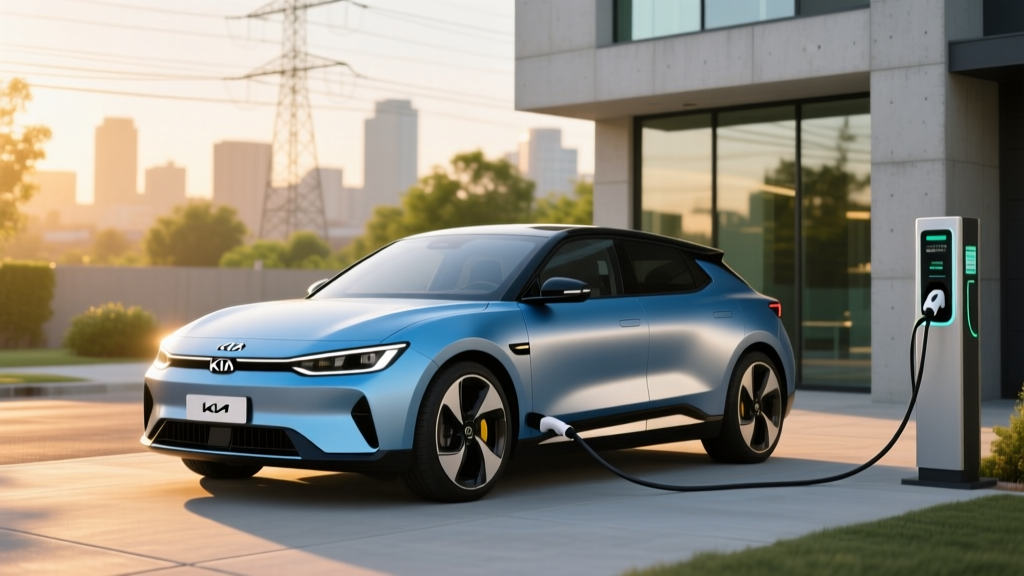
The Kia EV2 is generating serious interest as one of the most affordable entries in Kia's expanding electric lineup. But the sticker price is only the beginning of the ownership equation. Between federal tax credits, home-charging savings, higher insurance premiums, and depreciation curves, the real cost of owning a Kia EV2 can look very different from the MSRP on the window sticker.
This guide breaks down the Kia EV2 price in the context of total five-year ownership, with exact numbers for federal incentives, fuel savings, maintenance, insurance, and resale value. We'll also clarify which buyers actually qualify for the up-to-$7,500 federal tax credit under current IRS §30D rules — because eligibility is far from automatic.
Est. Base MSRP: ~$30,000–$35,000 (final U.S. pricing TBD)
Est. Battery: ~58–77 kWh usable (LFP/NMC variants expected)
Est. EPA Range: 200–270 miles (depending on battery pack)
Est. DC Fast Charge: Up to ~150 kW peak, 10–80% in ~30 min
Platform: Hyundai Motor Group dedicated EV architecture
Status: Announced for global markets; U.S. availability and final specs pending. All figures below use preliminary estimates and should be confirmed at launch.
What the Kia EV2 Price Actually Means at Purchase
Kia has positioned the EV2 as an accessible compact electric crossover, targeting buyers who want EV benefits without the $50,000+ price tags of larger models. The estimated base MSRP of roughly $30,000–$35,000 places it in competition with vehicles like the Chevrolet Equinox EV and the Hyundai Kona Electric.
However, the effective purchase price depends heavily on incentives. A buyer who qualifies for the full federal tax credit and a utility rebate could see the net cost drop by $8,500–$10,000, while a buyer who exceeds income caps or whose vehicle doesn't meet battery-sourcing requirements might pay full MSRP. That's a swing of thousands of dollars on a vehicle in this price range — enough to change the buy-or-wait decision entirely.
Federal Tax Credit: Do You Qualify for §30D?
The federal EV tax credit under IRS §30D offers up to $7,500 for qualifying new clean vehicles. But "up to" is the operative phrase. The credit has multiple gates, and a buyer must clear every one:
- Buyer Income Caps: Modified AGI must not exceed $300,000 (joint filers), $225,000 (head of household), or $150,000 (single). The credit phases out above these thresholds.
- MSRP Caps: Vans, SUVs, and pickup trucks: $80,000 max. Sedans and other passenger cars: $55,000 max. The Kia EV2, as a compact crossover, will likely fall under the $80,000 SUV cap — well within range.
- Battery Component Sourcing: A percentage of battery components must be manufactured or assembled in North America. This threshold increases each year. If the EV2's battery cells are sourced from South Korea or China, partial or full credit disqualification is possible.
- Critical Minerals: A percentage of critical minerals must be extracted or processed in the U.S. or a free-trade-agreement country, or recycled in North America. This threshold also escalates annually.
- Point-of-Sale Transfer: As of 2024, buyers can elect to transfer the credit to the dealer at purchase, receiving it as an immediate price reduction rather than waiting to claim it on their tax return. This requires the dealer to be registered with the IRS Energy Credits Online system.
- Final Assembly: The vehicle must undergo final assembly in North America. Verify the VIN at fueleconomy.gov.
⚠️ Battery-sourcing and critical-mineral requirements tighten annually. A vehicle that qualifies in one model year may not qualify the next. Always confirm current eligibility on the IRS website or with a tax professional before purchasing.
For the Kia EV2 specifically, the key uncertainty is battery sourcing. Kia's parent company Hyundai Motor Group has been investing heavily in U.S. battery manufacturing (including the Metaplant America facility in Georgia), but early production batches of newer models may still rely on overseas cell supply. Buyers should confirm the specific VIN's credit eligibility at the point of sale — don't rely on general model-level claims.
State, Local, and Utility Incentives
Beyond the federal credit, many states and utilities offer additional rebates:
- California: Up to $7,000 via the Clean Cars 4 All program (income-dependent), plus potential CARB rebates.
- Colorado: State tax credit of up to $5,000 for new EVs (income-dependent, sunsetting provisions apply).
- New York: Drive Clean Rebate up to $2,000 (point-of-sale).
- Utility Rebates: Many electric utilities offer $250–$1,500 rebates for EV purchase or home charger installation. Check with your local provider.
These programs have their own income caps, funding limits, and expiration dates. Check your state energy office and utility provider for current availability. We recommend the AFDC state law database as a starting point.
Charging vs. Gas: The Per-Mile Cost Math
The single largest ongoing savings from EV ownership comes from fuel. Here's how the Kia EV2 stacks up against a comparable gas-powered compact crossover (e.g., Kia Seltos, ~29 MPG combined):
| Metric | Kia EV2 (Est.) | Gas Crossover (29 MPG) |
|---|---|---|
| Energy/Fuel Cost | $0.16/kWh (nat'l avg.) | $3.30/gallon |
| Efficiency | ~3.5 mi/kWh (~120 MPGe) | 29 MPG combined |
| Cost Per Mile | $0.046/mi | $0.114/mi |
| Annual cost (12,000 mi) | $552 | $1,368 |
| Annual Savings | ~$816/year | |
Key nuance: The $0.16/kWh figure reflects the national residential average. If you charge primarily on public DC fast chargers at $0.35–$0.55/kWh, your per-mile cost rises to $0.10–$0.16 — erasing much of the advantage. Home Level 2 charging is where the economics work best. If you can't charge at home, the fuel savings shrink significantly, and the EV2's cost advantage narrows.
Over five years and 60,000 miles of home-charged driving, that's roughly $4,080 in fuel savings versus the gas crossover.
Maintenance Savings: Fewer Parts, Less Spending
EVs eliminate several recurring maintenance items that gas vehicles require. Here's a realistic comparison:
| Maintenance Item | Kia EV2 (Est.) | Gas Crossover |
|---|---|---|
| Oil changes | None ($0) | $40–$70 × 10+ over 5 yr ($500+) |
| Brake pad replacement | Rarely needed (regen braking) — $0–$200 | $200–$400 per axle, 1–2× over 5 yr |
| Transmission fluid/service | None (single-speed reduction gear) | $150–$300 |
| Coolant, spark plugs, belts | Minimal (coolant check only) | $200–$500 combined |
| Tire rotation & replacement | Same or slightly higher (EV weight + torque) | Standard |
| Est. 5-Year Maintenance Total | ~$800–$1,200 | ~$2,500–$3,500 |
Net maintenance savings over five years: approximately $1,500–$2,300. Note that EV tires can wear faster due to instant torque and higher curb weight — budget for at least one set of replacement tires over a five-year period, and consider EV-specific tire compounds (e.g., Hankook iON, Michelin Pilot Sport EV) that are designed for lower rolling resistance and noise.
Insurance: The Cost EV Owners Often Overlook
Here's where the EV ownership story gets less rosy. Insurance premiums for electric vehicles are typically 15–30% higher than for comparable gas vehicles. Several factors drive this:
- Higher repair costs: EV battery packs and power electronics are expensive to replace after collision damage. Insurers price this risk in.
- Specialized repair networks: Fewer body shops are certified for high-voltage EV repairs, which increases labor rates and cycle times.
- Vehicle value: Even at a ~$30,000–$35,000 MSRP, the EV2's total-loss replacement cost may be higher than a similarly priced gas car due to battery replacement expenses.
- Parts availability: Newer EV models can face longer parts wait times after claims, increasing rental-car costs for insurers.
For a Kia EV2, expect annual insurance premiums in the range of $1,800–$2,400 depending on your driving record, location, and coverage level — compared to roughly $1,400–$1,900 for a gas compact crossover. That's an additional $400–$500/year, or $2,000–$2,500 over five years.
Tip: Shop quotes from at least three insurers before purchasing. Some carriers (e.g., GEICO, Progressive, State Farm) have started offering EV-specific discounts or telematics-based pricing that can narrow the gap. Bundling home and auto can also help.
Depreciation and Resale Value: The EV Wildcard
EV depreciation has been one of the most volatile variables in ownership economics. The used EV market saw significant price corrections in 2023–2025, driven by Tesla's aggressive new-vehicle price cuts, expanding EV supply, and shifting consumer sentiment. Here's what the data suggests:
- Average 5-year EV depreciation: 50–60% of original MSRP (vs. ~40–50% for mainstream gas vehicles), according to industry resale trackers.
- Kia EV brand factor: Kia and Hyundai EVs have held value somewhat better than some competitors, thanks to strong warranty coverage (10-year/100,000-mile powertrain warranty) and growing brand credibility in the EV space.
- Battery health perception: Used EV buyers are increasingly savvy about battery degradation. A well-maintained battery with documented State of Health (SoH) above 90% will command a premium.
- Tax credit effect: When new EVs qualify for $7,500 in federal credits, the effective "new" price drops — which compresses used values. A buyer comparing a $27,500 new EV2 (after credit) against a $22,000 used one will negotiate hard.
For the Kia EV2 at an estimated $32,500 mid-trim MSRP, expect a five-year resale value in the range of $13,000–$16,250 (50–50% retained). That translates to depreciation of roughly $16,250–$19,500 over five years. This is the single largest ownership cost and the one most sensitive to market conditions at trade-in time.
5-Year Total Cost of Ownership: The Full Picture
Pulling all categories together, here's a realistic five-year TCO for the Kia EV2 versus a comparable gas compact crossover. Assumptions: 12,000 miles/year, 60,000 miles total, home Level 2 charging, mid-trim EV2 at ~$32,500 MSRP with $7,500 federal credit applied, gas crossover at ~$28,000 MSRP.
| Cost Category | Kia EV2 (Est.) | Gas Crossover |
|---|---|---|
| Purchase Price (after credits) | $25,000 | $28,000 |
| Fuel / Charging (5 yr) | $2,760 | $6,840 |
| Maintenance (5 yr) | $1,000 | $3,000 |
| Insurance (5 yr) | $10,500 | $8,250 |
| Depreciation (5 yr) | $17,500* | $12,600 |
| Home Charger Install (one-time) | $800–$1,500 | $0 |
| Est. 5-Year Total Cost | ~$40,060–$40,760 | ~$46,090 |
| Net 5-Year Savings (EV2) | ~$5,330–$6,030 | |
*Depreciation calculated on pre-credit MSRP of $32,500. If calculated on post-credit effective purchase price, depreciation cost to owner is reduced to ~$10,000, improving EV2 TCO further. Methodology varies — we use MSRP-based depreciation as the conservative estimate.
The bottom line: if you qualify for the full federal tax credit and charge primarily at home, the Kia EV2 can save you roughly $5,000–$6,000 over five years compared to a gas crossover. If you don't qualify for the credit, charge mostly on expensive public chargers, or face high insurance rates in your state, those savings narrow to $1,000–$2,000 — or may disappear entirely.
Decision Framework: Is the Kia EV2 the Right Financial Move?
- You qualify for the full $7,500 federal tax credit (income under caps, battery sourcing confirmed)
- You can install a Level 2 home charger (or already have one)
- Your daily commute is under 80 miles round-trip (well within the EV2's range even in cold weather)
- You plan to own the vehicle 5+ years (amortizing the higher insurance and depreciation)
- Your state or utility offers additional rebates
⏸ Wait or consider a hybrid/PHEV if:
- You exceed the federal income caps and your state offers no incentives
- You live in an apartment or lack reliable home/workplace charging access
- You regularly drive 200+ miles in a single day or live in a charging-desert region
- You plan to sell within 2–3 years (depreciation will eat your fuel savings)
- Your insurance quotes come back 40%+ above your current gas vehicle
Frequently Asked Questions
How much does it really cost to own a Kia EV2 over 5 years?
With the federal tax credit applied and home charging, expect a total five-year cost of approximately $40,000–$41,000, including purchase, charging, insurance, maintenance, and depreciation. Without the credit and relying on public charging, that figure rises to $47,000–$49,000. Compare this to roughly $46,000 for a gas crossover in the same segment.
Does the Kia EV2 qualify for the $7,500 federal tax credit?
It depends. The EV2's estimated MSRP falls well under the $80,000 SUV cap, so price isn't the barrier. The determining factors are: (1) your modified adjusted gross income must fall under IRS thresholds, (2) the vehicle's battery components and critical minerals must meet North American sourcing requirements for the model year you purchase, and (3) final assembly must occur in North America. Confirm eligibility by VIN at the IRS Energy Credits Online portal before signing a purchase agreement.
How much do I save on fuel and maintenance with the EV2?
Combined fuel and maintenance savings average approximately $5,500–$6,400 over five years and 60,000 miles, assuming home charging at $0.16/kWh and a gas comparison vehicle at 29 MPG with $3.30/gallon fuel. The biggest variable is your electricity rate — if you have access to off-peak utility rates or solar, savings increase; if you rely on DC fast charging at $0.40+/kWh, savings decrease substantially.
Are EVs more expensive to insure than gas cars?
Yes, typically 15–30% more. For the Kia EV2, budget an extra $400–$500/year versus a gas equivalent. The primary drivers are higher collision repair costs (battery and power electronics), a smaller network of certified EV repair shops, and elevated total-loss values. Shopping multiple insurers and asking about EV-specific discounts can reduce the premium gap.
How well do EVs hold their value compared to gas cars?
Historically, EVs have depreciated faster — roughly 50–60% over five years versus 40–50% for mainstream gas vehicles. The Kia EV2's strong warranty (10-year/100,000-mile powertrain) and Kia's growing EV brand reputation may help it retain value better than some competitors, but the used EV market remains sensitive to new-vehicle price changes, battery health perception, and shifting incentive landscapes. Expect to retain roughly 45–50% of MSRP at the five-year mark.
Can I transfer the federal tax credit to the dealer at point of sale?
Yes. Under current §30D rules, you can elect to transfer the credit to a registered dealer, who then applies it as a direct price reduction at purchase. This means you don't need to wait until tax season to benefit. The dealer must be registered with the IRS Energy Credits Online system, and you'll need to provide income attestation. If your actual tax liability turns out to be less than the credit transferred, you may owe the difference back to the IRS — so confirm your expected AGI carefully.
What happens to my savings if I can't charge at home?
Public DC fast charging at $0.35–$0.55/kWh raises your per-mile energy cost to $0.10–$0.16, compared to $0.046/mi on home Level 2. Over 60,000 miles, that's $6,000–$9,600 in charging costs versus $2,760 at home — a difference of $3,200–$6,800. If home charging isn't an option, the EV2's financial advantage over gas narrows dramatically, and a plug-in hybrid (PHEV) may offer a better economic fit.
Note: The Kia EV2 is announced for global markets with U.S. availability pending. All specifications, pricing, and tax credit eligibility discussed in this article are based on preliminary estimates and current-year IRS rules. Confirm final details with Kia and a qualified tax professional before making a purchase decision. Federal and state incentive rules are subject to legislative change.