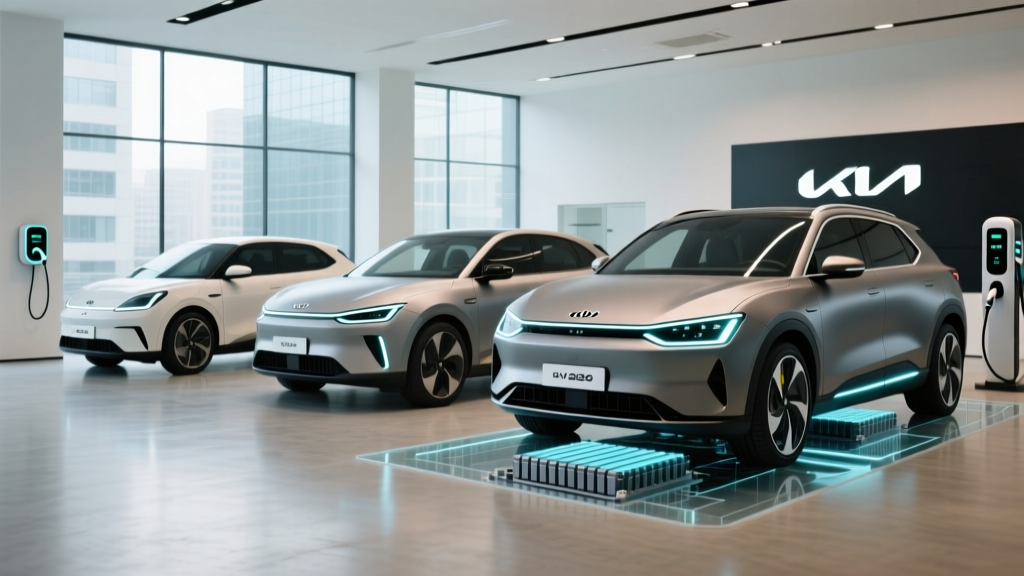
Quick Answer: Kia currently sells three fully electric models in the U.S.: the EV6 (282 mi EPA, from ~$42,900), the three-row EV9 (304 mi EPA, from ~$54,900), and the compact Niro EV (239 mi EPA, from ~$39,600). All use Hyundai Motor Group's E-GMP architecture with 800V DC fast charging, enabling 10–80% charges in roughly 18 minutes at a 350 kW station. Federal §30D tax-credit eligibility varies by battery sourcing and buyer income — verify on IRS.gov before purchasing.
Kia's Current EV Lineup at a Glance
Kia has built one of the most complete EV portfolios among mainstream automakers. Unlike brands offering a single token EV, Kia covers compact crossover (Niro EV), midsize sportback (EV6), and three-row family hauler (EV9) segments. All three share core E-GMP strengths: standard heat pumps, vehicle-to-load (V2L) capability, and battery preconditioning for fast charging in cold weather.
| Spec | 2026 Niro EV | 2026 EV6 (Light LR RWD) | 2026 EV9 (LR RWD) |
|---|---|---|---|
| EPA Range | 239 mi | 310 mi | 304 mi |
| Battery (usable) | 64.8 kWh (NMC) | 77.4 kWh (NMC) | 100.0 kWh (NMC) |
| Peak DC Charge | ~85 kW | ~240 kW | ~210 kW |
| 10–80% DCFC | ~44 min | ~18 min | ~24 min |
| Level 2 Rate | 10.9 kW | 10.9 kW | 10.9 kW |
| 0–60 mph | 7.2 s | 7.3 s | 8.2 s |
| Horsepower | 201 hp | 225 hp | 215 hp |
| MPGe (combined) | 113 MPGe | 134 MPGe | 89 MPGe |
| Starting MSRP | $39,600 | $42,900 | $54,900 |
| Battery Warranty | 10 yr / 100k mi | 10 yr / 100k mi | 10 yr / 100k mi |
Sources: EPA fueleconomy.gov, Kia America spec sheets. Real-world highway range typically runs 10–15% below EPA; cold-weather (below 25°F) can reduce range 20–30% without preconditioning.
Real-World Range: What the EPA Sticker Doesn't Tell You
Kia's EPA numbers are competitive, but real-world results depend heavily on speed, temperature, and terrain. In our experience with E-GMP vehicles, the EV6 Light Long Range consistently delivers 260–275 miles on mixed highway driving at 70–75 mph in moderate temperatures. The EV9, with its boxier aerodynamics, drops to roughly 240–260 miles under the same conditions.
Real-World Range Expectations:
- EV6 LR RWD: EPA 310 mi → expect ~265 mi highway (70 mph, 65°F), ~220 mi highway in winter (25°F)
- EV9 LR RWD: EPA 304 mi → expect ~250 mi highway, ~200 mi winter highway
- Niro EV: EPA 239 mi → expect ~205 mi highway, ~170 mi winter highway
All E-GMP models include a battery preconditioning feature that warms the pack before arriving at a DC fast charger, reducing cold-weather charging slowdowns. Always enable navigation-based preconditioning in winter.
Charging Speed and Infrastructure Reality
The EV6 and EV9 support 800V architecture, meaning they can accept up to 350 kW at compatible chargers (Electrify America, select EVgo stations). However, peak rate is not sustained rate. The EV6's charge curve peaks near 240 kW up to about 55% state of charge, then tapers progressively — by 80%, it's pulling roughly 80–100 kW. This is why the 10–80% time (~18 min) is a more useful metric than peak kW alone.
The Niro EV uses a 400V architecture with a lower peak rate (~85 kW), making it better suited to overnight Level 2 home charging and occasional road-trip fast charging. If you regularly drive more than 200 miles in a single day, the EV6 or EV9's faster charging curve is a meaningful advantage.
For home charging, all three accept 10.9 kW on Level 2 (240V/48A). A full charge from 10% takes roughly 7 hours for the EV6 and 9.5 hours for the EV9 — easily accomplished overnight with a properly installed Level 2 station.
EV vs Gas: Kia Ownership Costs Compared
Comparing the EV6 to a similarly sized Kia Sportage (gas AWD, ~$32,000 MSRP, 28 MPG combined) over 5 years and 60,000 miles reveals the real economics of going electric:
| Cost Category | EV6 LR RWD | Sportage AWD (Gas) |
|---|---|---|
| Purchase Price (MSRP) | $42,900 | $32,000 |
| Est. Federal Tax Credit (§30D)* | Up to $7,500 | $0 |
| Effective Purchase | ~$35,400 | $32,000 |
| Fuel/Energy (60k mi) | ~$3,600 (home L2)** | ~$7,500 ($3.50/gal) |
| Maintenance (60k mi) | ~$600 | ~$2,400 |
| Insurance (5-yr avg) | ~$9,500 | ~$7,500 |
| 5-Year Total | ~$49,100 | ~$49,400 |
*§30D eligibility depends on battery critical-mineral sourcing, buyer AGI ($150k single / $300k joint cap), and MSRP cap ($55k sedans / $80k SUVs). Verify at IRS.gov. Point-of-sale transfer available.
**Assumes $0.15/kWh average home electricity. Public DCFC-only charging raises EV energy cost to ~$5,400.
The EV6 reaches near cost-parity with the gas Sportage within 5 years when you qualify for the full tax credit and charge primarily at home. Without the credit or with exclusive public charging, the EV costs roughly $4,000–6,000 more over 5 years. The Niro EV, with its lower starting price, reaches parity faster for budget-conscious buyers.
Common Misconceptions About Kia EVs
| Myth | Fact |
|---|---|
| "The battery will need replacing in 5 years" | E-GMP batteries are warrantied for 10 years/100,000 miles at ≥70% capacity. Real-world degradation data shows ~8–12% loss over 100k miles with normal use. |
| "Kia EVs can't road trip" | The EV6 and EV9 charge from 10–80% in 18–24 minutes at 350 kW chargers. A 600-mile trip requires two stops adding ~40 minutes total. |
| "I need a special home electrical system" | A standard 240V/50A circuit (like a dryer outlet) supports 10.9 kW Level 2 charging. Installation typically costs $500–2,000 depending on panel proximity. |
| "Kia's driver assist is self-driving" | Kia's Highway Driving Assist 2 is an SAE Level 2 system — the driver must remain engaged with hands on the wheel at all times. It is not autonomous. |
| "All Kia EVs qualify for $7,500 tax credit" | Credit eligibility depends on battery sourcing, buyer income, and MSRP caps. Some trims may qualify for partial ($3,750) or no credit. Always check current IRS guidance. |
First-Time Buyer Checklist: What to Know Before You Buy
- Confirm home charging access. If you own a home or have a landlord willing to install a 240V outlet, daily EV ownership is effortless. If you rely solely on public charging, budget $150–200/month for DCFC costs and factor in time.
- Check your electrical panel. A Level 2 charger requires a dedicated 40–50A circuit. Homes with 100A service may need a panel upgrade ($1,500–3,000) before installation. Consult a licensed electrician.
- Verify tax credit eligibility before signing. The §30D credit has income caps, MSRP caps, and battery sourcing requirements that change periodically. Use the IRS's seller reporting tool and confirm with a tax professional.
- Test the regen braking. Kia offers adjustable regen levels (0–3) via steering wheel paddles. Level 3 enables near one-pedal driving. New EV drivers should start at Level 1 and adjust up.
- Understand insurance costs. EV insurance premiums run 15–25% higher than equivalent gas vehicles due to repair complexity. Get quotes before purchasing to avoid surprises.
- Plan for cold weather. If you live where temperatures regularly drop below freezing, expect 20–30% range reduction on short trips without preconditioning. The heat pump (standard on all Kia EVs) mitigates this significantly compared to resistance heating.
Decision Framework: Which Kia EV Is Right for You?
Choose the Niro EV if:
- Your budget is under $42,000
- You drive fewer than 180 miles per day
- You primarily commute and rarely road-trip
- You want the lowest insurance and registration costs
Choose the EV6 if:
- You want the best efficiency (134 MPGe) and longest real-world range
- You take regular road trips and need 18-minute fast charging
- You value sporty handling and a lower ride height
- You want a balance of price, range, and charging speed
Choose the EV9 if:
- You need three rows and seating for 6–7 passengers
- You tow (up to 5,000 lbs with AWD)
- You want maximum cargo volume (up to 81.7 cu ft with seats folded)
- You can accommodate higher purchase price and insurance costs
Consider a Kia hybrid (Sportage HEV or Sorento HEV) instead if:
- You cannot install home charging and public infrastructure is sparse in your area
- You regularly drive 400+ miles in a single day in cold weather
- Your budget is firmly under $35,000
Frequently Asked Questions
Do Kia EVs use NACS or CCS connectors?
Current Kia EVs (2024–2026 model years) use the CCS1 connector for DC fast charging and J1772 for Level 2. Kia has announced a transition to the NACS (Tesla-style) connector beginning with upcoming models, and adapters will be available for existing CCS-equipped vehicles to access Tesla Superchargers. Check Kia's official adapter program for compatibility details.
What does the 10-year/100,000-mile battery warranty actually cover?
Kia warrants the high-voltage battery to retain at least 70% of its original capacity for 10 years or 100,000 miles (whichever comes first). If capacity falls below 70% within that period, Kia will repair or replace the battery at no cost. This is one of the strongest battery warranties in the industry, matching Hyundai's coverage.
Can I use a Kia EV for towing?
The EV9 AWD is rated for up to 5,000 lbs of towing capacity. The EV6 is not officially rated for towing in the U.S. market. Towing reduces range significantly — expect a 30–50% range reduction when towing near maximum capacity at highway speeds.
How reliable are Kia EVs compared to gas Kias?
Kia's EV powertrains have fewer moving parts than gas equivalents (no transmission, no exhaust, no timing belt), which generally reduces mechanical failure points. Early EV6 reliability has been strong per owner surveys, though some software-related issues (infotainment, ICCU charging module) have been reported. The ICCU (Integrated Charging Control Unit) was subject to a recall on early EV6 models — verify any used EV6 has had this service completed.
Is the Kia EV6 GT worth the premium over the standard EV6?
The EV6 GT offers 576 hp, a 3.4-second 0–60 time, and track-focused suspension for roughly $18,000 more than the Light LR RWD. However, its range drops to 206 miles EPA, and its DC fast-charging curve is less aggressive. Unless you prioritize performance driving, the standard EV6 Long Range delivers better daily usability and lower cost.