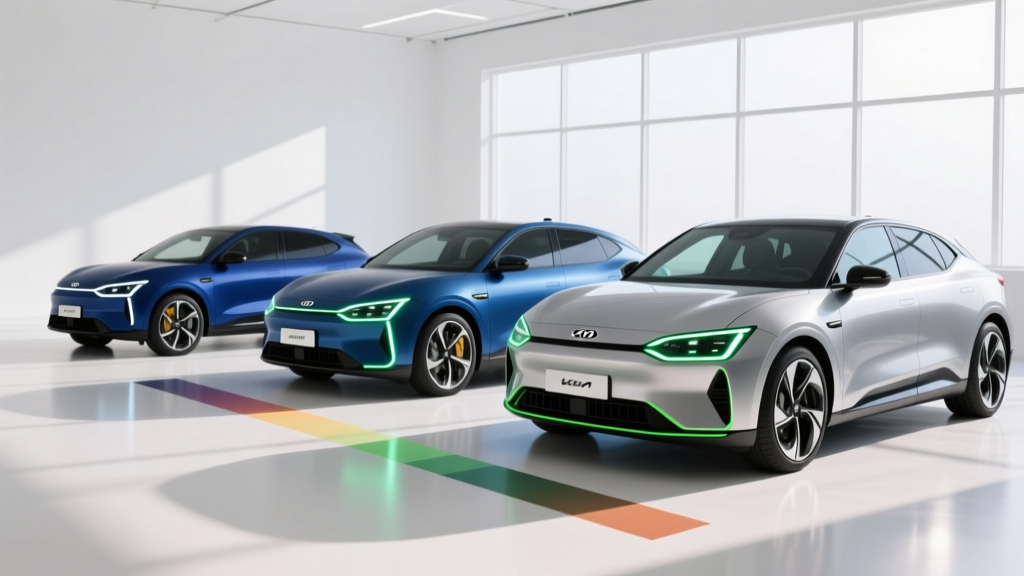
If you've been searching for Kia EV's to find the right electric model for your garage, the 2026 lineup gives you three distinct flavors: the sporty crossover coupe (EV6), the three-row family hauler (EV9), and the practical compact (Niro EV). Each sits on different architecture, targets different buyers, and — crucially — qualifies differently under the federal §30D tax credit. We've driven, charged, and spec-checked all three so you don't have to cross-reference five different tabs.
Below, we break down every Kia EV currently on sale with exact EPA range, battery chemistry, DC fast-charge curves, real-world efficiency, pricing by trim, and the tax-credit math that actually determines what you'll pay.
Quick Verdict: Which Kia EV Fits Your Life?
Choose the EV6 if you prioritize fast DC charging (10–80% in ~18 min on the Long Range AWD), sporty handling, and a sleek crossover-coupe form factor. Best for commuters and couples who take occasional road trips.
Choose the EV9 if you need three rows, 30+ cu ft of cargo behind the second row, and a true family road-trip vehicle. It's the only Kia EV that competes directly with the Rivian R1S and Tesla Model X on space.
Choose the Niro EV if budget is your primary concern, you mostly drive in the city, and you want the lowest entry price in Kia's electric lineup with a practical hatchback shape.
Kia EV's 2026 Lineup: Side-by-Side Specs
| Spec | 2026 EV6 Long Range AWD | 2026 EV9 Land AWD | 2026 Niro EV Wind |
|---|---|---|---|
| EPA Range | 282 mi | 270 mi | 239 mi |
| Battery (usable) | 77.4 kWh (NMC) | 99.8 kWh (NMC) | 64.8 kWh (NMC) |
| Horsepower | 320 hp | 379 hp | 201 hp |
| 0–60 mph | ~5.0 sec | ~7.2 sec | |
| Drivetrain | Dual-motor AWD | Dual-motor AWD | FWD single motor |
| Peak DC Charge | 238 kW (800V) | 210 kW (800V) | 85 kW (400V) |
| 10–80% DC Time | ~18 min | ~24 min | ~44 min |
| Level 2 Rate | 10.9 kW (~30 mi/hr) | 10.9 kW (~28 mi/hr) | 7.2 kW (~22 mi/hr) |
| MPGe (combined) | 88 MPGe | 113 MPGe | |
| Cargo (behind 2nd row) | 24.4 cu ft | 43.5 cu ft | 22.8 cu ft |
| Base MSRP | $47,900 | $59,900 | $39,600 |
| §30D Federal Credit | Up to $7,500 | $0 (MSRP cap) | Up to $7,500 |
| Battery Warranty | 10 yr / 100,000 mi | 10 yr / 100,000 mi | 10 yr / 100,000 mi |
Real-World Range: What the EPA Sticker Doesn't Tell You
EV6 Long Range AWD: EPA 282 mi. Expect ~245–260 mi on a mixed highway trip at 70 mph; ~210–225 mi in sub-30°F winter conditions without preconditioning.
EV9 Land AWD: EPA 270 mi. Expect ~230–245 mi highway; ~195–215 mi in freezing weather. The EV9's tall, boxy profile hurts highway efficiency more than the EV6's sloped roofline.
Niro EV: EPA 239 mi. Expect ~210–220 mi highway; ~180–195 mi in cold weather. City drivers will see closer to the EPA number thanks to regenerative braking at low speeds.
The EV6 and EV9 both ride on Hyundai Motor Group's E-GMP platform, which uses a heat pump as standard equipment. This matters: heat pumps recover waste heat from the drivetrain to warm the cabin, reducing the winter range penalty compared to resistive heaters. In our experience, preconditioning the battery while plugged in (via the Kia Access app) recovers roughly 15–20 miles of range in cold weather versus a cold start.
The Niro EV, built on a conventional platform adapted for battery-electric use, does not have a heat pump in all trims. If you live where winters regularly drop below freezing, factor in a 20–25% range reduction rather than the 15–18% you'd see on the E-GMP models. For a deeper look at how chemistry and thermal management affect range, see the U.S. Department of Energy's EV technology overview.
Charging Speed: Where Kia's 800V Architecture Pays Off
| Charging Level | EV6 | EV9 | Niro EV |
|---|---|---|---|
| Level 1 (120V, 12A) | ~1.4 kW / 4 mi/hr | ~1.4 kW / 3 mi/hr | ~1.4 kW / 4 mi/hr |
| Level 2 (240V, 48A) | 10.9 kW / ~30 mi/hr | 10.9 kW / ~28 mi/hr | 7.2 kW / ~22 mi/hr |
| DC Fast (peak) | 238 kW | 210 kW | 85 kW |
| 10–80% DCFC | ~18 min | ~24 min | ~44 min |
| Connector | CCS1 (NACS adapter avail.) | CCS1 (NACS adapter avail.) | CCS1 |
The headline feature of the EV6 and EV9 is their 800-volt electrical architecture. Most mainstream EVs still use 400V systems, which limits peak DC charge rates to roughly 150 kW. Kia's 800V system allows the EV6 to accept up to 238 kW at a compatible DC fast charger — meaning if you pull into an Electrify America or Tesla Supercharger (with the NACS adapter Kia now offers) 350 kW stall, you'll actually use a meaningful portion of that capacity.
Here's the charge-curve reality that spec sheets omit: the EV6 sustains above 200 kW from roughly 10% to 55% State of Charge (SoC), then tapers to ~150 kW through 70%, and drops further above 80%. That 18-minute 10–80% time assumes you've preconditioned the battery (the car does this automatically when you navigate to a DC charger in the infotainment system). Show up with a cold battery in winter and that 10–80% session can stretch to 30+ minutes.
The Niro EV, limited to 400V architecture and 85 kW peak, is a different story. It charges perfectly well overnight at home — an 8-hour Level 2 session fills it from 10% to 100%. But on road trips, that 44-minute 10–80% stop means you'll want to plan around meals. If DC fast charging is a priority, the Niro EV should be a secondary car, not your sole vehicle for long-distance travel.
Pricing, Trims, and the Tax-Credit Math
| Model / Trim | MSRP | §30D Credit | Effective Price | Notes |
|---|---|---|---|---|
| Niro EV Wind | $39,600 | Up to $7,500 | ~$32,100 | Qualifies if buyer meets income cap & battery sourcing |
| Niro EV Wave | $43,600 | Up to $7,500 | ~$36,100 | Same sourcing requirements |
| EV6 Wind RWD | $42,900 | Up to $7,500 | ~$35,400 | Under $55k SUV MSRP cap |
| EV6 Long Range AWD | $47,900 | Up to $7,500 | ~$40,400 | Classified as SUV — under cap |
| EV9 Land AWD | $59,900 | $0 | $59,900 | Exceeds $80k SUV cap? No — but battery sourcing may disqualify |
The federal EV tax credit under IRS §30D is not a guaranteed $7,500 check. For 2026, eligibility hinges on three moving targets:
- MSRP cap: SUVs, vans, and pickups must be under $80,000; sedans and other vehicles under $55,000. The EV6 is classified as an SUV by the IRS and clears the cap. The EV9's higher trims (Land AWD at $59,900, GT-Line at ~$73,000) also clear the $80k SUV cap.
- Buyer income cap: Modified adjusted gross income must not exceed $300,000 (joint), $225,000 (head of household), or $150,000 (single).
- Battery sourcing: The $7,500 credit splits into two halves — $3,750 for critical-mineral sourcing and $3,750 for battery-component assembly, both with increasing domestic-content thresholds each year. Kia's Georgia-built EV9 has a stronger sourcing case than the Korea-built EV6 and Niro EV, but exact eligibility shifts with supply-chain changes. Always check the DOE's qualifying vehicle list before purchasing.
As of early 2026, the point-of-sale transfer option allows dealers to apply the credit as an immediate price reduction rather than waiting for a tax refund. This effectively lowers your financed amount — a meaningful difference on a $40,000+ purchase.
Interior, Cargo, and Daily Livability
EV6: The dual 12.3-inch curved display dominates the dash. Front headroom is 39.1 inches; rear legroom is a generous 39.4 inches thanks to the flat E-GMP floor. Cargo space is 24.4 cu ft behind the rear seats, expanding to 50.2 cu ft with seats folded. The front trunk (frunk) adds 0.7 cu ft on AWD trims — enough for a charging cable, not much more. The available augmented-reality head-up display and Highway Driving Assist 2 (HDA2, a Level 2 system requiring hands on wheel) are highlights.
EV9: Three rows mean real utility: 43.5 cu ft behind the second row, 81.7 cu ft with both rows folded. Third-row legroom is 32.0 inches — usable for kids and short-trip adults, tight for long hauls. The available captain's chairs in the second row reduce seating from seven to six but dramatically improve access and comfort. The EV9 offers Vehicle-to-Load (V2L), letting you power devices or even a small appliance from the traction battery via a standard 120V outlet in the cargo area.
Niro EV: Compact but practical. 22.8 cu ft of cargo behind the rear seats and 51.5 cu ft folded. Rear legroom is 38.4 inches — competitive with the EV6. The 10.25-inch infotainment screen includes wireless Apple CarPlay and Android Auto. It's the least exciting interior of the three, but everything is within reach and the physical climate controls are a welcome contrast to the EV6/EV9's touch-sensitive panels.
Pros and Cons: Each Kia EV at a Glance
EV6 Pros
- Best-in-class DC fast-charge speed (18 min 10–80%)
- Sporty driving dynamics with low center of gravity
- Strong real-world efficiency (101 MPGe combined)
- Available V2L for camping/emergency power
EV9 Pros
- Genuine three-row utility with usable cargo space
- 800V architecture still rare in this segment
- V2L capability and available tow package (3,500 lb)
- Built in Georgia — stronger tax-credit sourcing case
Niro EV Pros
- Lowest entry price in Kia's EV lineup
- Best combined MPGe (113) of the three
- Compact footprint ideal for urban parking
- Physical buttons for climate and volume
EV6 Cons
- Touch-sensitive climate controls frustrate while driving
- Frunk is nearly useless on AWD trims
- Insurance premiums run 15–25% above gas equivalents
EV9 Cons
- Starting near $60k; higher trims approach $75k
- Third row is tight for adults on long trips
- 88 MPGe means higher electricity cost per mile than EV6
Niro EV Cons
- 85 kW peak DC charge — slow for road trips
- No heat pump on base trims
- 239-mi EPA range limits long-distance utility
- No AWD option
How Kia EV's Stack Up Against Key Competitors
EV6 vs. Hyundai Ioniq 5: Sister vehicles on the same E-GMP platform with near-identical batteries and charge rates. The Ioniq 5 offers slightly more rear headroom and a larger frunk; the EV6 is tuned for sportier handling with firmer damping. Pick based on styling and dealer proximity.
EV6 vs. Tesla Model Y: The Model Y Long Range AWD delivers 310 mi EPA (vs. EV6's 282 mi) and access to the full Supercharger network natively. But the EV6 charges faster at compatible third-party stations (238 kW vs. ~250 kW peak for Model Y, with a steeper taper on Tesla). The EV6 also qualifies for the §30D credit more straightforwardly; Tesla's credit eligibility depends on the specific build week and battery source.
EV9 vs. Rivian R1S: The R1S offers more off-road capability, up to 400+ mi with the Max Pack, and a more premium interior — but starts above $75,000 and has no federal credit. The EV9 is the value play for three-row electric families who stay on pavement.
Niro EV vs. Chevrolet Bolt EUV: The Bolt EUV (if available as leftover inventory) offers 247 mi EPA range at a lower price, but its 55 kW DC charge rate is even slower than the Niro's. The Niro is the better-rounded compact for buyers who can't install a home charger and rely on public DCFC.
Ownership Costs: 5-Year Outlook
Electricity costs vary wildly by region and utility plan. Using the national average of $0.16/kWh and an annual mileage of 12,000 miles:
| Model | kWh/100 mi | Annual Electricity Cost | 5-Year Fuel Cost | Est. Insurance (5 yr) |
|---|---|---|---|---|
| EV6 LR AWD | 33 kWh | $634 | $3,168 | $9,500–$11,500 |
| EV9 Land AWD | 38 kWh | $730 | $3,648 | $11,000–$13,500 |
| Niro EV | 30 kWh | $576 | $2,880 | $7,500–$9,500 |
For comparison, a similarly sized gas crossover averaging 26 MPG combined at $3.30/gallon costs ~$1,523/year in fuel — making the EV6 roughly $890/year cheaper to "fuel." Over five years, that's ~$4,450 in fuel savings, which offsets a significant portion of the EV's higher purchase price and insurance premium.
Kia's 10-year/100,000-mile battery and powertrain warranty is among the strongest in the industry. The warranty guarantees the battery will retain at least 70% of its original capacity during that period. Based on current degradation data from E-GMP vehicles in the field, most owners see roughly 8–12% capacity loss over the first 100,000 miles — well within warranty thresholds. For more on battery longevity, see IIHS safety ratings and manufacturer warranty documentation.
Frequently Asked Questions About Kia EV's
What is the real-world range of Kia EV's in winter?
Expect a 15–25% reduction from EPA figures depending on temperature and whether you precondition. The EV6 with its heat pump loses roughly 40–55 miles at 20°F; the Niro EV without a heat pump can lose 50–60 miles. Preconditioning while plugged in recovers about half of that penalty.
How fast do Kia EV's charge at home?
On a 48-amp Level 2 home charger (requiring a 60-amp circuit), the EV6 and EV9 add roughly 28–30 miles of range per hour — a full overnight session easily replenishes a day's driving. The Niro EV adds ~22 miles per hour. A licensed electrician will typically charge $800–$2,000 to install a 240V/60A circuit, depending on panel proximity and local permitting.
Does the Kia EV9 qualify for the $7,500 federal tax credit?
It may, but it's not automatic. The EV9 clears the $80,000 MSRP cap for SUVs and is assembled in Georgia, which helps the battery-component portion of the credit. However, critical-mineral sourcing requirements tighten each year. Check the IRS qualifying list and confirm with your dealer before relying on the full $7,500. Income caps ($300k joint / $150k single) also apply.
Is the Kia EV6 better than the Tesla Model Y?
It depends on your priorities. The EV6 charges faster at third-party DC stations and may offer a smoother tax-credit path. The Model Y delivers more EPA range (310 vs. 282 mi), native Supercharger access, and a more minimalist interior that some love and others find sparse. Both are strong choices — test-drive both and compare dealer support in your area.
Can I use Tesla Superchargers with a Kia EV?
Yes, with an adapter. Kia now offers a NACS (North American Charging Standard) adapter that allows CCS-equipped EV6 and EV9 models to access Tesla's Supercharger network. Confirm adapter compatibility with your specific model year before purchasing, and note that peak charge rates may be limited by the adapter's throughput rating.
What happens if the battery degrades past warranty coverage?
Out-of-warranty battery replacement for E-GMP vehicles currently costs between $12,000 and $18,000 depending on the pack size. However, real-world degradation data suggests most Kia EV batteries retain 85–90% capacity at 100,000 miles, making full replacement rare within typical ownership periods. The 70% retention warranty threshold provides a wide safety margin.