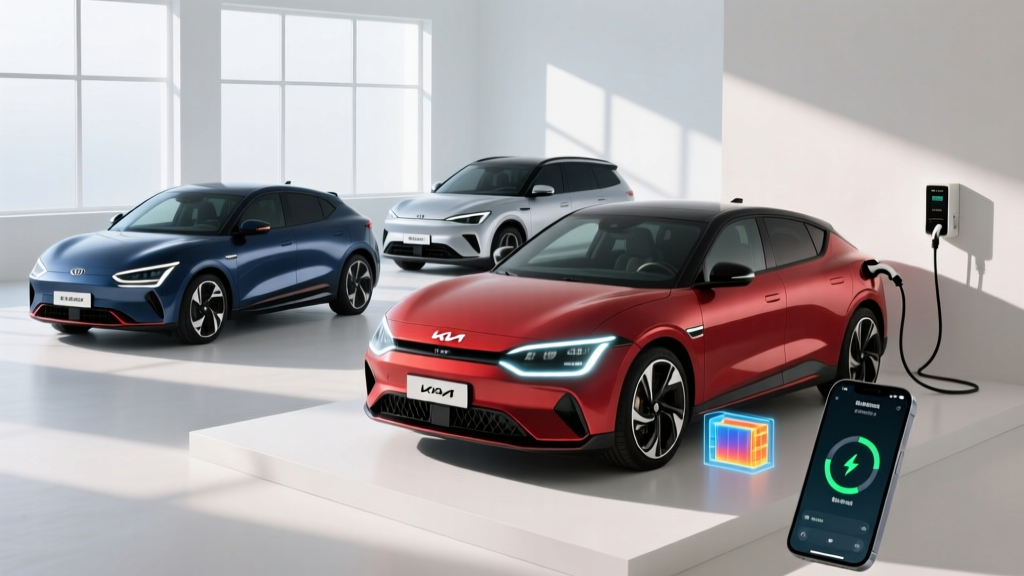
If you are shopping for an electric vehicle and want practical space, strong charging speeds, and a long warranty, the 2026 Kia EV lineup deserves serious attention. Kia now fields three distinct battery-electric models in the U.S. market: the compact crossover EV6, the three-row flagship EV9, and the value-oriented Niro EV. Each targets a different buyer, but they share Kia's E-GMP architecture (EV6/EV9) or a proven dedicated EV platform (Niro), along with class-leading warranty coverage.
This guide breaks down every current Kia EV with the exact numbers that matter — EPA range, usable battery capacity, peak and sustained DC fast-charge rates, real-world highway and cold-weather expectations, and total pricing after the federal §30D tax credit. Whether you need a commuter, a family hauler, or a budget-friendly daily, you will find the right fit below.
2026 Kia EV Lineup at a Glance
| Spec | Niro EV | EV6 (RWD Long Range) | EV9 (RWD Light) |
|---|---|---|---|
| EPA Range | 239 mi | 310 mi | 304 mi |
| Usable Battery | 64.8 kWh (NMC) | 77.4 kWh (NMC) | 100.0 kWh (NMC) |
| Peak DC Charge | ~85 kW | 239 kW | 210 kW |
| 10–80% DC Time | ~44 min | ~18 min | ~24 min |
| Level 2 Rate | 11 kW (~32 mi/hr) | 10.9 kW (~40 mi/hr) | 10.9 kW (~35 mi/hr) |
| 0–60 mph | 6.8 sec | 7.2 sec | 8.0 sec |
| Horsepower | 201 hp | 225 hp | 215 hp |
| Drivetrain | FWD | RWD (AWD opt.) | RWD (AWD opt.) |
| MPGe (combined) | 113 MPGe | 134 MPGe | 89 MPGe |
| Base MSRP | $39,600 | $42,900 | $54,900 |
| Cargo (rear seats up) | 19.1 cu ft | 24.4 cu ft | 20.2 cu ft |
Sources: fueleconomy.gov, Kia Motors America press specifications. AWD trims reduce range by 10–20 miles depending on model.
Kia EV6: The Sweet-Spot Crossover
The EV6 remains the core of the Kia EV lineup for buyers who want a balance of range, charging speed, and driving dynamics. Built on the Hyundai Motor Group E-GMP 800-volt architecture, it can accept up to 239 kW at a DC fast charger — a number that translates to a genuine 10–80% charge in roughly 18 minutes when the battery is preconditioned and you are plugged into a 350 kW station.
EPA estimate: 310 miles. On a 70-mph highway loop in moderate temperatures (65–75°F), expect approximately 265–280 miles. In freezing weather (below 32°F) without preconditioning, that number can drop to 210–235 miles. Engaging the heat pump and preconditioning the battery before departure recovers a meaningful portion of cold-weather loss.
The 77.4 kWh NMC (nickel-manganese-cobalt) battery provides strong energy density for its class. Efficiency in the RWD Long Range trim peaks at 134 MPGe combined, or roughly 25 kWh/100 miles — making it one of the most efficient midsize electric crossovers available.
EV6 Performance and Trims
The RWD Long Range delivers 225 hp and a 7.2-second 0–60 time. The dual-motor AWD variant bumps output to 320 hp with a 5.1-second sprint, at the cost of about 20 miles of EPA range (282 mi). The high-performance EV6 GT produces 576 hp and hits 60 mph in 3.4 seconds, though range drops to 206 miles.
Interior space includes 24.4 cu ft of cargo behind the rear seats and 50.2 cu ft with the seats folded. Rear legroom measures 39.4 inches — adequate for adults on longer trips. The standard 12.3-inch dual-screen curved display runs Kia's latest infotainment with wireless Apple CarPlay and Android Auto, plus over-the-air updates.
Kia EV9: Three-Row Family Hauler
The EV9 is the largest vehicle in the Kia EV lineup and one of the few mainstream three-row electric SUVs on the market. Its 100.0 kWh NMC battery and boxy proportions deliver genuine family utility, though the aerodynamic penalty shows in an 89 MPGe combined rating — noticeably lower than the EV6.
EPA estimate: 304 miles (Light trim). Highway driving at 70–75 mph yields approximately 245–265 miles. Cold-weather highway range can fall to 195–220 miles. The AWD Land trim with the same battery drops to 270 miles EPA; expect ~220–240 miles highway in temperate conditions.
DC fast charging peaks at approximately 210 kW on the 800-volt system. A 10–80% session takes about 24 minutes under optimal conditions — roughly six minutes longer than the EV6 due to the larger battery. Level 2 home charging at 10.9 kW adds around 35 miles per hour, meaning a full overnight replenishment is easily achievable with a 48-amp hardwired station.
EV9 Space and Practicality
Cargo volume behind the third row is 20.2 cu ft, expanding to 81.7 cu ft with both rear rows folded — competitive with midsize gas SUVs. Third-row legroom is 32.0 inches, best suited for children or shorter adults on trips under two hours. The EV9 offers vehicle-to-load (V2L) capability, allowing you to power devices or small appliances from the traction battery via an adapter.
Driver assistance includes Highway Driving Assist 2 (HDA2), a Level 2 SAE system that provides adaptive cruise, lane centering, and lane-change assist on divided highways. The driver must maintain hands-on-wheel supervision at all times — this is not autonomous driving.
Kia Niro EV: The Budget Entry Point
The Niro EV anchors the Kia EV lineup at the lowest price point. It does not ride on the 800V E-GMP platform, which means DC fast charging is limited to approximately 85 kW on a CCS connector — a 10–80% session takes roughly 44 minutes. For buyers who charge primarily at home and take only occasional road trips, this trade-off is manageable. For frequent highway travelers, the EV6's charging advantage becomes significant.
EPA estimate: 239 miles. Highway driving in moderate weather nets approximately 200–215 miles. In freezing conditions, plan for 165–185 miles before needing a charge. The smaller 64.8 kWh battery means less absolute buffer — this is a commuter and city car first.
At 113 MPGe combined (30 kWh/100 mi), the Niro EV is efficient for its class, though the EV6's superior aerodynamics give it a clear advantage. The 201 hp front motor and 6.8-second 0–60 time are adequate for merging and passing. Cargo space is 19.1 cu ft behind the rear seats and 53.0 cu ft with seats folded — enough for a week's groceries or two carry-on suitcases.
Charging Speed Compared: Home, Public, and the 800V Advantage
Understanding the difference between kW (power, or charge rate) and kWh (energy, or battery capacity) is essential when comparing the Kia EV lineup. A higher kW rating means faster charging; a higher kWh rating means more stored energy and typically more range.
| Charge Level | Niro EV | EV6 | EV9 |
|---|---|---|---|
| Level 1 (120V / 1.4 kW) | ~4 mi/hr | ~5 mi/hr | ~5 mi/hr |
| Level 2 (240V / ~11 kW) | ~32 mi/hr | ~40 mi/hr | ~35 mi/hr |
| DC Fast (peak kW) | ~85 kW | 239 kW | 210 kW |
| DC 10–80% Time | ~44 min | ~18 min | ~24 min |
| Connector | CCS1 | CCS1 (NACS adapter avail.) | CCS1 (NACS adapter avail.) |
The EV6 and EV9 benefit from 800-volt architecture, which allows higher sustained charge rates and less taper above 80% state of charge compared to the Niro EV's 400-volt system. On a road trip, the EV6's ability to add roughly 170 miles in 15 minutes at a 350 kW Electrify America or Tesla Supercharger (with adapter) station is a practical advantage you will feel on every stop.
For home charging, all three models benefit from a 48-amp Level 2 station on a 60-amp circuit. Expect installation costs of $500–$2,000 depending on your panel capacity and wiring run — consult a licensed electrician for a site-specific quote.
Pricing and Federal Tax Credit Eligibility
Pricing across the Kia EV lineup varies significantly, and the federal §30D tax credit can shift the math. Under current IRS rules, the credit is worth up to $7,500 for new EVs, but eligibility depends on three factors: buyer income caps (AGI ≤ $150,000 single / $300,000 joint), vehicle MSRP caps ($55,000 for SUVs, $80,000 for vans/pickups — note that the EV9's classification as an SUV applies the $80,000 cap), and battery critical-mineral and component sourcing requirements that tighten annually.
| Model / Trim | Base MSRP | As-Tested (typical) | Est. §30D Credit | Effective Price |
|---|---|---|---|---|
| Niro EV Wind | $39,600 | $42,500 | $3,750–$7,500* | $32,100–$38,750 |
| EV6 Wind RWD | $42,900 | $47,800 | $3,750–$7,500* | $35,400–$44,050 |
| EV6 GT-Line AWD | $50,200 | $55,600 | $3,750–$7,500* | $42,700–$51,850 |
| EV9 Light RWD | $54,900 | $59,200 | $3,750–$7,500* | $47,400–$55,450 |
| EV9 Land AWD | $63,900 | $69,500 | $3,750–$7,500* | $55,400–$65,750 |
*Credit amount depends on battery sourcing compliance for the specific build month. The point-of-sale transfer option allows dealers to apply the credit directly at purchase. Always verify current eligibility at irs.gov and confirm with your tax professional.
The Kia EV6 and EV9 are built in Georgia at the Metaplant America facility. As of 2026, domestically assembled EVs may qualify for the full credit if sourcing thresholds are met — but critical-mineral requirements continue to tighten, which is why the credit range above is presented as a spread rather than a guarantee.
Warranty and Long-Term Battery Confidence
Every model in the Kia EV lineup carries one of the strongest warranty packages in the industry:
- Battery: 10 years / 100,000 miles (capacity retention threshold: 70% of original)
- Powertrain: 10 years / 100,000 miles
- Bumper-to-bumper: 5 years / 60,000 miles
- Roadside assistance: 5 years / 60,000 miles
The 10-year battery warranty exceeds the federal minimum of 8 years / 100,000 miles and provides meaningful peace of mind. NMC chemistry in all three models has demonstrated moderate degradation in real-world fleet data — typically 8–12% capacity loss over the first 100,000 miles, well within the 70% warranty threshold. Proper care (avoiding sustained 100% SoC parking, using DC fast charging judiciously, preconditioning in cold weather) can minimize long-term degradation.
Driver Assistance and Technology
All three Kia EVs come equipped with Kia's suite of Level 2 SAE driver-assistance features:
- Highway Driving Assist 2 (HDA2): Adaptive cruise + lane centering on highways (EV6, EV9)
- Forward Collision-Avoidance Assist: Automatic emergency braking with pedestrian/cyclist detection
- Blind-Spot Collision-Avoidance Assist: Active steering intervention
- Rear Occupant Alert: Ultrasonic detection of rear-seat passengers after exit
The EV6 and EV9 feature Kia's dual 12.3-inch curved panoramic display, digital key 2.0 (phone-as-key via UWB), and over-the-air software updates. The EV9 adds an available fingerprint authentication system and a column-mounted shifter that frees up center-console storage. The Niro EV uses a more conventional 10.25-inch infotainment screen — functional, if less visually impressive.
Who Should Buy Which Kia EV?
- Your budget is under $40,000 before credits
- You charge at home 95%+ of the time
- Your daily commute is under 60 miles round-trip
- You rarely take road trips over 200 miles
- You want the best charging speed in the lineup
- You take regular road trips (200–400 mi)
- You value driving dynamics and efficiency
- You need 280+ real-world highway miles
- You need three rows of seating regularly
- You want V2L capability for camping/tailgating
- You tow (up to 5,000 lbs with AWD)
- Cargo volume is a priority over efficiency
- You need LFP battery chemistry (Kia uses NMC across the lineup)
- You want a sedan or truck body style
- Public DC charging is your only option and you need sub-15-min stops
Frequently Asked Questions
What is the real-world range of the Kia EV lineup?
The Niro EV delivers roughly 200–215 highway miles in temperate weather and 165–185 in freezing conditions. The EV6 RWD returns approximately 265–280 highway miles (moderate) and 210–235 (cold). The EV9 RWD achieves about 245–265 highway miles (moderate) and 195–220 (cold). Always precondition the battery before highway driving to minimize losses.
How fast does each Kia EV charge?
The EV6 peaks at 239 kW DC, reaching 10–80% in about 18 minutes. The EV9 peaks at 210 kW with a 10–80% time of roughly 24 minutes. The Niro EV peaks at ~85 kW, taking about 44 minutes for 10–80%. All three charge at approximately 10–11 kW on Level 2 home stations.
Does the Kia EV lineup qualify for the federal EV tax credit?
Eligibility for the §30D credit (up to $7,500) depends on buyer income (≤$150K single / ≤$300K joint AGI), vehicle MSRP caps, and battery sourcing requirements. All Kia EVs are assembled in the U.S. (Georgia), which satisfies the final-assembly requirement, but critical-mineral sourcing thresholds change annually. Verify at irs.gov before purchasing.
Is a Kia EV worth buying versus competitors?
The EV6 competes directly with the Hyundai Ioniq 5, Tesla Model Y, and Ford Mustang Mach-E. Its 800V charging speed, 10-year warranty, and strong efficiency give it a compelling edge for road-trippers. The EV9 has few direct three-row EV rivals (the Rivian R1S is far more expensive). The Niro EV competes with the Chevrolet Bolt EUV and Hyundai Kona Electric on price, though its slower DC charging is a drawback. Overall, Kia's warranty and charging infrastructure make the lineup highly competitive.
What are the biggest pros and cons of Kia's EVs?
- Class-leading 10-yr/100K-mi battery warranty
- 800V fast charging on EV6 and EV9
- U.S. assembly supports tax credit eligibility
- Strong efficiency (EV6 at 134 MPGe)
- V2L capability on EV6 and EV9
- Niro EV DC charging is slow (~85 kW)
- EV9 efficiency is low (89 MPGe) for an EV
- No LFP battery option for cost/durability preference
- CCS1 connector; NACS requires adapter
- EV9 AWD trims push past $65K before credit
What connector do Kia EVs use?
All 2026 Kia EVs use the CCS1 connector for DC fast charging and J1772 for Level 2. Kia offers a NACS adapter that enables access to Tesla Supercharger stations — a meaningful expansion of the public charging network. The industry is transitioning to NACS natively, and future Kia models are expected to adopt the connector directly.
For official EPA range and efficiency data, always cross-reference fueleconomy.gov. For safety ratings, consult the NHTSA and IIHS databases.