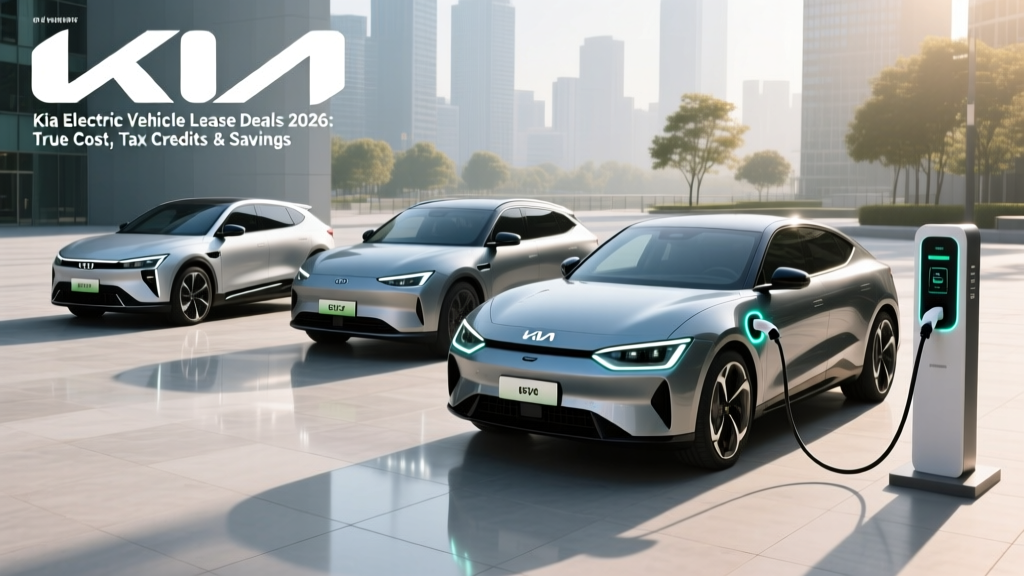
Shopping for Kia electric vehicle lease deals in 2026 means navigating a maze of monthly payments, federal tax-credit fine print, and fluctuating electricity rates. Kia's current EV lineup — the compact crossover EV6, the flagship three-row EV9, and the Niro EV — offers some of the most competitive lease rates in the segment, but the advertised monthly price is only the starting point. The real question is what these vehicles cost to own over five years once you factor in charging, insurance, maintenance, depreciation, and the evolving IRS §30D credit rules.
This guide dissects the true economics of leasing or buying a Kia EV in 2026, using exact EPA figures, real-world charging costs, and current federal incentive rules. Whether you're eyeing a $350/month EV6 Wind lease or weighing the EV9 Land against a gas SUV, the numbers below will tell you what you'll actually spend.
Kia's 2026 EV Lineup at a Glance
Kia offers three battery-electric models for the 2026 model year, each built on the Hyundai Motor Group's E-GMP platform with 800V architecture — enabling some of the fastest DC charging in the mainstream segment. Here are the core specs that drive ownership cost:
| Spec | 2026 Niro EV | 2026 EV6 Wind RWD | 2026 EV6 GT-Line AWD | 2026 EV9 Land AWD |
|---|---|---|---|---|
| MSRP (base) | $39,600 | $47,900 | $54,600 | $59,900 |
| Battery (usable) | 64.8 kWh (NMC) | 77.4 kWh (NMC) | 77.4 kWh (NMC) | 100.0 kWh (NMC) |
| EPA Range | 239 mi | 310 mi | 274 mi | 280 mi |
| Real-World Range* | ~195–215 mi | ~250–280 mi | ~220–250 mi | ~230–260 mi |
| Peak DC Charge | 77 kW | 240 kW | 240 kW | 210 kW |
| 10–80% DC Time | ~44 min | ~18 min | ~18 min | ~24 min |
| Level 2 Rate | 11 kW | 10.9 kW | 10.9 kW | 11 kW |
| Horsepower | 201 hp | 225 hp | 320 hp | 379 hp |
| 0–60 mph | 7.2 sec | 7.3 sec | 4.5 sec | 5.0 sec |
| MPGe (combined) | 113 MPGe | 134 MPGe | 106 MPGe | 89 MPGe |
| Battery Warranty | 10 yr / 100k mi | 10 yr / 100k mi | 10 yr / 100k mi | 10 yr / 100k mi |
*Real-world range reflects highway driving at 70–75 mph in moderate temperatures. Expect 15–30% reduction in sub-freezing conditions depending on heat-pump usage and cabin preconditioning. Source: fueleconomy.gov and independent testing.
The Federal Tax Credit: What Actually Qualifies in 2026
The IRS §30D Clean Vehicle Credit offers up to $7,500 for eligible new EVs — but the full amount is far from guaranteed for every Kia EV buyer. The credit is split into two halves ($3,750 for battery components, $3,750 for critical minerals), each with its own sourcing requirements that tighten annually. For 2026, battery components must be 100% manufactured or assembled in North America, and critical minerals must meet an 80% threshold for US-sourced or FTA-partner-sourced materials.
§30D Eligibility Checklist — 2026 Rules
- MSRP Cap: Vans, SUVs, and pickups ≤ $80,000; sedans ≤ $55,000. All current Kia EVs fall under the cap.
- Buyer Income Cap: AGI ≤ $150,000 (single), $225,000 (head of household), $300,000 (married filing jointly).
- Battery Sourcing: Components and critical minerals must meet escalating annual thresholds per IRS guidance.
- Final Assembly: Vehicle must undergo final assembly in North America. The EV6 (assembled in West Point, GA) qualifies; verify VIN on fueleconomy.gov.
- Point-of-Sale Transfer: You can transfer the credit to the dealer at purchase, reducing the purchase price directly — this also applies to qualifying leases under §30D as structured by the lessor.
- Leasing Loophole (§45W): Some leases route the credit through the lessor under the commercial clean vehicle credit, potentially allowing the dealer to pass savings even when §30D personal-credit sourcing rules aren't fully met. Always ask how the lease is structured.
As of early 2026, the EV6 and EV9 (both assembled in Georgia) have qualified for the full $7,500 credit for eligible buyers, though Kia's sourcing documentation can shift model year to model year. The Niro EV, also US-assembled, typically qualifies for the full credit. Always verify your specific VIN and consult a tax professional before assuming eligibility — rules are subject to legislative change.
5-Year Total Cost of Ownership: Kia EV6 vs. Gas Crossover Baseline
To understand what a Kia EV actually costs, we modeled a 5-year / 75,000-mile ownership cycle for the EV6 Wind RWD against a comparably priced gas crossover (the Kia Sportage EX AWD at ~$34,000 MSRP). The EV6 benefits from the $7,500 credit applied at point of sale, bringing its effective purchase price down significantly.
| Cost Category (5 yr / 75k mi) | 2026 EV6 Wind RWD | Gas Crossover Baseline |
|---|---|---|
| Purchase Price (after credit) | $40,400 | $34,000 |
| Financing/Interest (60 mo, 6.5%) | $7,050 | $5,940 |
| Fuel / Charging | $3,940 | $8,440 |
| Maintenance | $1,200 | $3,750 |
| Insurance | $9,750 | $7,500 |
| Depreciation (est.) | $18,200 | $14,600 |
| Total 5-Year Cost | $80,540 | $74,230 |
| Cost per mile | $1.07 | $0.99 |
Assumptions: Electricity at $0.14/kWh national average (85% home L2, 15% DCFC at $0.40/kWh); gas at $3.50/gal at 28 MPG combined; EV6 efficiency at 3.0 mi/kWh (134 MPGe). Insurance averages sourced from industry data. Depreciation based on current EV resale trends.
The EV6 still carries a higher total 5-year cost in this scenario — primarily due to steeper depreciation and higher insurance premiums. However, the gap narrows considerably if you charge predominantly at home with low utility rates, or if gas prices rise above $4/gal. Buyers who keep the vehicle 8+ years see the math flip in the EV's favor as maintenance savings compound and the depreciation curve flattens.
Charging Cost vs. Gas: The Per-Mile Math
The single biggest operating-cost advantage of a Kia EV is fuel. Here's how the numbers break down by charging scenario:
| Scenario | Rate | Cost per Mile (EV6 Wind) | Annual Cost (15k mi) |
|---|---|---|---|
| Home Level 2 (avg utility) | $0.14/kWh | $0.047 | $700 |
| Home L2 (off-peak TOU rate) | $0.08/kWh | $0.027 | $400 |
| Public DCFC (avg) | $0.40/kWh | $0.133 | $2,000 |
| Tesla Supercharger (NACS adapter) | $0.30/kWh | $0.100 | $1,500 |
| Gas crossover (28 MPG, $3.50/gal) | — | $0.125 | $1,875 |
At home on a standard utility rate, the EV6 costs roughly $0.05/mile to "fuel" — about 60% less than a gas crossover. Even on expensive DC fast chargers, the EV6 can match or beat gas per mile. The catch: if you rely exclusively on public DCFC at $0.40+/kWh, your fuel advantage disappears. Home charging access is the single biggest determinant of EV operating cost savings.
Maintenance Savings: Where EVs Quietly Win
EVs eliminate the most common recurring maintenance items on gas vehicles. Over 75,000 miles, a Kia EV6 will never need an oil change, transmission fluid service, spark plug replacement, or exhaust system repair. Regenerative braking significantly extends brake pad and rotor life — many EV owners report original brake pads at 80,000+ miles.
| Maintenance Item | Gas Vehicle (75k mi) | Kia EV6 (75k mi) |
|---|---|---|
| Oil Changes (5–7) | $350–$500 | $0 |
| Transmission Fluid | $150–$250 | $0 (reduction gear) |
| Spark Plugs | $200–$400 | $0 |
| Brake Pads (1–2 sets) | $400–$800 | $0–$200 (regen extends life) |
| Engine Air Filter | $75–$150 | $0 |
| Cabin Air Filter | $100–$150 | $100–$150 |
| Tire Rotation (5x) | $150–$250 | $150–$250 |
| Coolant / Fluid Services | $200–$400 | $100–$200 |
| Total Estimated | $1,625–$2,900 | $350–$800 |
Net maintenance savings over five years: $1,000–$2,500, depending on gas-vehicle service intervals and local labor rates. Tire wear on EVs can be slightly higher due to vehicle weight and instant torque, so budget for a set of replacement tires around 40,000–50,000 miles — typically $800–$1,200 for a set of EV-rated touring tires.
Insurance Premiums: The Cost Nobody Advertises
EV insurance premiums run 15–30% higher than equivalent gas vehicles. For the EV6 Wind, expect annual premiums of $1,800–$2,200 depending on your state, driving record, and coverage level — compared to $1,400–$1,700 for a gas crossover. The reasons are structural:
- Higher repair costs: EV battery packs and power electronics are expensive to replace after collision damage. Even minor rear-end impacts can trigger battery safety inspections costing thousands.
- Specialized labor: Fewer body shops are certified for high-voltage EV repair, driving up labor rates.
- Total-loss thresholds: Insurers are more likely to declare an EV a total loss when battery damage is suspected, raising claim payouts.
- Vehicle price: The EV6's higher MSRP means higher comprehensive and collision premiums.
Shop quotes from EV-friendly insurers (Geico, Progressive, and State Farm all have growing EV experience) before signing a lease. Some insurers offer EV-specific discounts for garaged vehicles with home charging.
Depreciation and Resale: The Wildcard
EV depreciation has been volatile. After steep value drops in 2023–2024 driven by Tesla price cuts and rapid battery-tech advancement, the market has stabilized somewhat for 2025–2026 models. Current projections for Kia EVs:
- EV6: ~45–50% value retention at 5 years / 75,000 miles. Strong demand in the used market thanks to its 800V charging and proven E-GMP platform.
- EV9: ~40–45% retention. The three-row EV segment is newer, and competition is intensifying, putting downward pressure on resale.
- Niro EV: ~38–42% retention. Smaller battery and lower range limit long-term appeal as newer EVs push past 300 miles.
Leasing can insulate you from depreciation risk entirely — you return the vehicle at term-end and walk away. This is one reason Kia electric vehicle lease deals are attractive: you lock in the residual value upfront. However, if the EV market stabilizes and residuals improve, you miss the upside. Leasing is the safer bet if you're uncertain about long-term EV resale trends.
State, Local, and Utility Incentives
Beyond the federal credit, many states and utilities stack additional savings. Examples include California's CVRP rebate (up to $2,000 for income-qualified buyers), Colorado's $5,000 state tax credit, and utility rebates of $500–$1,500 for home Level 2 charger installation. These vary significantly by ZIP code and change frequently. Check your state energy office and local utility for current programs. These incentives can reduce effective lease or purchase cost by $1,000–$7,000+ in the most generous jurisdictions.
Leasing vs. Buying: Which Kia EV Strategy Wins?
Kia's 2026 lease deals typically offer the EV6 Wind at $349–$429/month (36 months, $3,999 due at signing, depending on region and credit tier), with the EV9 Land starting around $499–$599/month. Here's the decision framework:
Choose a Lease If:
- You want to avoid depreciation risk in a volatile EV resale market
- The lease is structured under §45W, passing through credit savings you wouldn't qualify for under §30D
- You plan to upgrade every 3 years to get the latest battery and charging tech
- Your annual mileage stays under 10,000–12,000 miles (most lease limits)
Choose to Buy If:
- You qualify for the full $7,500 §30D credit and can apply it at point of sale
- You plan to keep the vehicle 7+ years, where maintenance savings compound
- You drive 15,000+ miles annually (lease overage penalties at $0.20–$0.30/mile add up fast)
- You have low-cost home charging and want to maximize long-term fuel savings
Frequently Asked Questions
How much does it really cost to own a Kia EV over 5 years?
For the 2026 EV6 Wind RWD with the $7,500 federal credit applied, total 5-year / 75,000-mile ownership runs approximately $78,000–$83,000 depending on your electricity rate, insurance profile, and state. That's roughly $5,000–$8,000 more than a comparable gas crossover at current fuel prices — but the gap closes with cheap home charging, higher gas prices, and longer ownership horizons.
Do I qualify for the $7,500 federal tax credit on a Kia EV?
You qualify if your AGI is under $150,000 (single) or $300,000 (married filing jointly), the vehicle MSRP is under the cap ($80,000 for SUVs — all Kia EVs qualify), and the battery meets 2026 sourcing thresholds. The EV6 and EV9 are assembled in Georgia and have generally qualified for the full credit, but always verify your specific VIN on fueleconomy.gov and consult a tax professional. Point-of-sale transfer is available, reducing your purchase price directly.
How much do I save on fuel and maintenance with a Kia EV?
Fuel savings: approximately $900–$1,200/year vs. a gas crossover at 15,000 miles annually, assuming mostly home charging at $0.14/kWh. Maintenance savings: $1,000–$2,500 over 5 years from eliminated oil changes, fewer brake replacements, and no engine or transmission service. Combined operating savings of $5,500–$8,500 over five years are realistic for most owners.
Are Kia EVs more expensive to insure?
Yes — typically 15–30% higher premiums than equivalent gas vehicles. For the EV6, budget $1,800–$2,200/year depending on your state and driving record. Higher repair costs for battery and power electronics, fewer certified body shops, and higher vehicle MSRP all contribute. Shop multiple insurers and ask about EV-specific discounts.
How well do Kia EVs hold their value?
The EV6 retains an estimated 45–50% of its value at 5 years / 75,000 miles — competitive for the EV segment but below top gas crossovers. The EV9 retains roughly 40–45%. EV depreciation remains more volatile than gas vehicles due to rapid technology advancement and price competition. Leasing transfers this risk to the lessor.
Can I get the tax credit on a Kia EV lease?
Possibly. Some Kia leases are structured under the commercial clean vehicle credit (§45W), which has different sourcing rules than the personal §30D credit. When a lease qualifies under §45W, the lessor receives the credit and may pass savings through as a capitalized-cost reduction (lowering your monthly payment). Ask the dealer exactly how the credit is applied to your specific lease agreement.
What's the real-world range of the 2026 Kia EV6?
The EV6 Wind RWD carries an EPA rating of 310 miles. In real-world highway driving at 70–75 mph, expect 250–280 miles in mild weather. In sub-freezing temperatures without preconditioning, range can drop to 200–230 miles. The EV6's heat pump (standard on most trims) helps mitigate cold-weather losses. Use the vehicle's preconditioning feature before DC fast charging to maximize charge speed — a cold battery will limit peak kW significantly.
The bottom line on Kia electric vehicle lease deals in 2026: the monthly payment is only one variable. Run the full 5-year math with your local electricity rate, insurance quotes, and confirmed tax-credit eligibility before signing. For buyers with home charging and credit eligibility, the EV6 Wind offers one of the best value propositions in the segment. For those uncertain about long-term EV depreciation, a well-structured lease with credit pass-through may be the smartest path in.