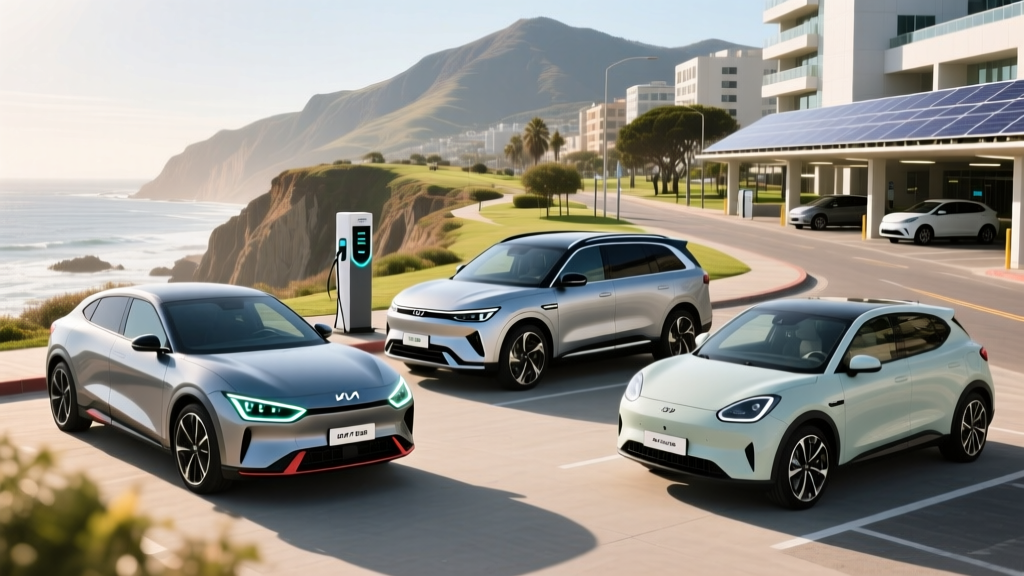
If you're researching Kia's electric cars, the short answer is that Kia currently sells three fully electric models in the U.S.: the compact Niro EV, the midsize crossover EV6, and the three-row EV9. Together they cover most buyer needs — from a 239-mile commuter to a 304-mile family hauler — with starting MSRPs spanning roughly $39,600 to $54,900 before incentives. The EV6 remains the value-and-performance sweet spot, the EV9 is the only mainstream electric three-row SUV at this price point, and the Niro EV serves budget-focused urban drivers. All three use Hyundai Motor Group's E-GMP platform (except the Niro, which uses a dedicated CE platform) and support DC fast charging up to 240 kW on the EV6/EV9, with 10–80% charges in roughly 18 minutes under ideal conditions.
Quick Answer: Which Kia EV Is Right for You?
- Budget commuter, city driving, ~239 mi range: Niro EV (from ~$39,600)
- Best all-around crossover, fast charging, sporty: EV6 (from ~$42,900)
- Three rows, family hauler, up to 304 mi: EV9 (from ~$54,900)
Kia's 2026 EV Lineup at a Glance
Before comparing costs or debating gas vs. electric, here are the hard numbers for each model. These figures reflect the latest EPA data and manufacturer specifications for the 2025–2026 model years.
| Spec | Niro EV | EV6 (Light RWD) | EV6 GT-Line AWD | EV9 (LR RWD) | EV9 GT-Line AWD |
|---|---|---|---|---|---|
| EPA Range | 239 mi | 310 mi | 282 mi | 304 mi | 270 mi |
| Battery (usable, kWh) | 64.8 kWh (NMC) | 77.4 kWh (NMC) | 77.4 kWh (NMC) | 100.0 kWh (NMC) | 100.0 kWh (NMC) |
| Horsepower | 201 hp | 225 hp | 320 hp | 215 hp | 379 hp |
| 0–60 mph | ~7.8 sec | ~7.2 sec | ~4.5 sec | ~7.8 sec | ~4.9 sec |
| Peak DC Fast Charge | 85 kW | 240 kW | 240 kW | 210 kW | 210 kW |
| 10–80% DCFC Time | ~43 min | ~18 min | ~18 min | ~24 min | ~24 min |
| Level 2 (240V) Rate | 11 kW | 10.9 kW | 10.9 kW | 11 kW | 11 kW |
| MPGe (combined) | 113 MPGe | 134 MPGe | 106 MPGe | 89 MPGe | 85 MPGe |
| Starting MSRP | ~$39,600 | ~$42,900 | ~$51,300 | ~$54,900 | ~$63,900 |
| Battery/Powertrain Warranty | 10 yr / 100,000 mi | 10 yr / 100,000 mi | 10 yr / 100,000 mi | 10 yr / 100,000 mi | 10 yr / 100,000 mi |
Sources: fueleconomy.gov, Kia America. Real-world range varies; see below.
Real-World Range vs. EPA Stickers
EPA numbers are measured under controlled lab conditions. In practice:
- Highway driving at 75 mph: Expect 10–15% less than EPA. An EV6 Light RWD rated at 310 mi will deliver roughly 265–280 mi on a flat interstate.
- Cold weather (below 32°F): Range can drop 20–30% due to battery chemistry and cabin heating. The EV9 LR RWD's 304 mi EPA could shrink to 210–240 mi in a northern winter.
- Mixed city/highway in mild weather: Most drivers will match or slightly beat EPA numbers thanks to regenerative braking in stop-and-go traffic.
All three models include a heat pump (standard on EV6/EV9, available on Niro EV), which mitigates cold-weather loss compared to resistive heaters.
Charging Speed and the 800-Volt Advantage
The EV6 and EV9 are built on Hyundai Motor Group's 800-volt E-GMP architecture. This matters because it enables peak DC fast-charge rates of 210–240 kW — meaning you can add roughly 180–200 miles of range in an 18-minute session on a 350 kW charger. The Niro EV, on a 400V architecture, peaks at 85 kW, which is adequate for overnight and around-town use but noticeably slower on road trips.
A critical detail many buyers miss: peak kW is not sustained kW. The EV6's 240 kW peak holds roughly from 10% to 45% state of charge, then tapers progressively. From 80% to 100%, charging slows dramatically to protect battery health — often dropping below 40 kW. This is why manufacturers quote 10–80% times rather than 0–100%. On a road trip, plan to charge from 10% to 80% and keep moving; the last 20% takes nearly as long as the first 70%.
| Charging Level | Power (kW) | EV6 Miles Added per Hour | EV9 Miles Added per Hour | Typical Use Case |
|---|---|---|---|---|
| Level 1 (120V household) | ~1.4 kW | ~4–5 mi/hr | ~3–4 mi/hr | Emergency / trickle top-off |
| Level 2 (240V, 48A home charger) | ~10.9–11 kW | ~35–40 mi/hr | ~28–32 mi/hr | Daily home charging (full overnight) |
| DC Fast (50 kW public) | 50 kW | ~150–170 mi/hr* | ~130–150 mi/hr* | Older public stations |
| DC Fast (350 kW capable) | 210–240 kW peak | ~600–700 mi/hr* | ~500–600 mi/hr* | Modern highway chargers (EA, Tesla Supercharger w/ adapter) |
*Miles-per-hour figures are approximate and based on peak charge rates; actual throughput tapers as battery fills.
For home Level 2 installation, budget $800–$2,500 total (charger hardware: $400–$700; electrician labor + permit: $400–$1,800). If your home's electrical panel needs a 200-amp upgrade, add $1,500–$3,000. Always get a site assessment from a licensed electrician before purchasing equipment.
EV vs. Gas: The Real Cost Comparison
Let's compare the EV6 Light RWD against a comparably priced gas crossover — the Kia Sportage (non-hybrid, FWD) — over 5 years and 60,000 miles. This is the comparison most buyers actually want to make.
| Cost Category (5 yr / 60k mi) | EV6 Light RWD | Gas Sportage FWD |
|---|---|---|
| Base MSRP | $42,900 | $30,490 |
| Federal Tax Credit (§30D, if eligible) | –$3,750 to $7,500† | $0 |
| Fuel / Electricity (60k mi) | $3,200 (home L2 at $0.14/kWh avg) | $7,400 (28 MPG combined at $3.45/gal) |
| Maintenance (oil, filters, brakes) | $900 (no oil changes; regen saves brake pads) | $3,200 |
| Insurance (avg) | $8,500 | $6,800 |
| Estimated 5-yr Depreciation | $18,500 | $13,200 |
| Total 5-yr Cost | ~$33,250–$36,850 | ~$34,690 |
† Federal §30D credit eligibility depends on MSRP caps, buyer income limits, battery sourcing, and critical-mineral requirements. Check current rules at irs.gov. Some Kia EVs qualify for partial or full credit depending on battery sourcing and model year — verify before purchase. Point-of-sale transfer is available at participating dealers.
The EV6 reaches cost parity with a gas Sportage around year 3–4 in this scenario, primarily through fuel and maintenance savings. The gap widens if you have access to cheap overnight electricity (some utility rates drop below $0.08/kWh) or if gas prices rise. However, the EV6's higher insurance premiums and steeper depreciation partially offset those gains. This is not a slam-dunk financial win in every scenario — it's a close call that depends heavily on your driving mileage, electricity rate, and tax-credit eligibility.
Federal Tax Credits and Incentive Reality
The IRS §30D clean vehicle credit offers up to $7,500 for qualifying new EVs, but eligibility is a moving target. Here's the framework as of the 2025–2026 tax year:
- MSRP cap: SUVs/pickups/vans must be under $80,000; sedans/other under $55,000. All current Kia EVs fall within these caps at base trims, but loaded EV9 GT-Line Prestige trims can exceed $80K.
- Buyer income cap: AGI must not exceed $150K (single), $225K (head of household), or $300K (joint).
- Battery sourcing: The $7,500 is split into two $3,750 halves — one for critical-minerals sourcing, one for battery-component assembly. Kia's E-GMP vehicles have historically qualified for partial credit ($3,750) due to South Korean battery-component sourcing, though this changes as supply chains shift. Always confirm the exact credit amount for the specific VIN at the dealer.
- Point-of-sale transfer: You can transfer the credit to the dealer at purchase to reduce the price on the spot, rather than waiting to claim it on your tax return.
State and local incentives vary widely — California's CVRP, Colorado's innovative motor vehicle credit, and various utility rebates can stack on top of federal credits. Check your state's energy office and local utility for current programs.
Common Misconceptions About Kia EVs
| Myth | Fact |
|---|---|
| "The battery will need replacing in 5 years." | Kia's battery warranty covers 10 years / 100,000 miles with a capacity-retention threshold (typically 70% of original capacity). Real-world degradation data from E-GMP vehicles shows roughly 5–8% loss over the first 100,000 miles with normal use. Full replacement, if ever needed outside warranty, runs $12,000–$18,000 depending on the model. |
| "You can't road-trip an EV." | The EV6 and EV9 have access to the Tesla Supercharger network (via NACS adapter, now standard or included on 2025+ models) in addition to Electrify America, EVgo, and ChargePoint. A 300-mile trip requires one 15–20 minute stop — comparable to a gas-car break for food and rest. |
| "EVs are worse in cold weather." | Range drops 20–30% in freezing temps — real and significant. But preconditioning (warming the battery while plugged in before departure) recovers much of that loss. The heat pump on EV6/EV9 is highly efficient, and EVs start reliably in any temperature, unlike gas cars with cold-cranking issues. |
| "EVs cost more to insure." | Partly true. EV insurance premiums run 15–25% higher on average due to higher repair costs and battery replacement risk. Shop quotes from multiple carriers; some now offer EV-specific discounts. |
| "I need a special charger at home." | A standard 120V outlet (Level 1) adds ~4 miles per hour — enough if you drive under 40 miles daily. For most owners, a 240V Level 2 home charger ($800–$2,500 installed) is the sweet spot, adding 30–40 miles per hour and fully replenishing overnight. |
First-Time EV Buyer: What You Actually Need to Know
If this is your first electric vehicle, here are the practical ownership realities no brochure mentions:
Home charging is the foundation. Over 80% of EV charging happens at home. If you live in a single-family home with a garage or driveway, Level 2 installation is straightforward. If you're in an apartment or rely on street parking, your experience will depend entirely on your local public-charging infrastructure — and that varies enormously by city. Before buying, map out your nearest reliable DC fast chargers using PlugShare or the Electrify America app. Living without home charging is doable but adds friction and cost (public DCFC rates of $0.35–$0.55/kWh vs. home rates of $0.10–$0.18/kWh).
Tires wear faster. EVs are heavier and deliver instant torque, which accelerates tire wear by 15–25% compared to equivalent gas cars. Budget for tire replacement every 30,000–40,000 miles, and consider EV-specific tire compounds (like Michelin's EV-optimized lines) that reduce rolling resistance and road noise.
Regenerative braking changes how you drive. All three Kia EVs offer adjustable regen levels, including an "i-Pedal" mode (on EV6/EV9) that enables near-one-pedal driving. It takes about a week to adjust, and once you do, you'll rarely touch the brake pedal in city driving. This also extends brake-pad life dramatically — many EV owners haven't replaced pads at 80,000+ miles.
Software updates matter. Kia delivers over-the-air (OTA) updates that can improve charging curves, add features, and refine efficiency. The EV6 and EV9 support full OTA including powertrain calibration; the Niro EV's update capability is more limited. When comparing trims, note that higher trims include features like remote smart parking assist and enhanced ADAS (Kia's Highway Driving Assist 2, which is a Level 2 SAE driver-assist system — not self-driving — requiring your hands on the wheel and eyes on the road at all times).
ADAS Reminder: Level 2 Is Not Self-Driving
Kia's Highway Driving Assist 2 (HDA2) and Highway Driving Assist (HDA) are SAE Level 2 driver-assistance systems. They provide adaptive cruise control and lane-centering, but you must remain fully engaged as the driver. Kia does not currently offer a Level 3 or Level 4 autonomous system. Never treat any consumer driver-assist feature as a substitute for attentive driving.
Decision Framework: Which Kia EV Should You Buy?
Choose Based on Your Situation
Choose the Niro EV if:
- Your daily commute is under 50 miles round-trip
- You want the lowest entry price and don't need DC fast-charging speed
- You primarily drive in urban/suburban environments
- You have reliable home Level 2 charging
Choose the EV6 if:
- You want the best balance of range (310 mi), charging speed (18 min 10–80%), and price
- You take regular road trips and need fast DC charging
- You want sporty acceleration (4.5 sec 0–60 in GT-Line AWD)
- You value 800V architecture for future-proofing
Choose the EV9 if:
- You need three rows of seating for family duty
- You want maximum interior space (up to 81.7 cu ft cargo with seats folded)
- You tow occasionally (up to 5,000 lbs on AWD trims with tow package)
- Your budget accommodates the ~$55K+ starting price
Consider a Kia PHEV (Sorento PHEV or Sportage PHEV) instead if:
- You lack reliable home charging access
- You frequently drive 400+ mile routes through rural charging deserts
- You want 30–33 miles of electric-only commuting with a gas backup for road trips
- You're not ready to commit to full EV ownership logistics
5-Year Total Cost of Ownership: Kia EV Lineup
| 5-Year Cost (60k mi) | Niro EV Wind | EV6 Light RWD | EV9 LR RWD |
|---|---|---|---|
| Net Purchase Price (after est. credit) | $32,100–$35,850 | $35,400–$39,150 | $47,400–$51,150 |
| Electricity (home, $0.14/kWh avg) | $2,900 | $2,600 | $3,700 |
| Maintenance | $900 | $900 | $1,000 |
| Insurance (avg) | $7,500 | $8,500 | $9,800 |
| Est. Depreciation | $14,500 | $18,500 | $24,000 |
| Est. 5-Year Total | ~$57,900–$61,650 | ~$65,900–$69,650 | ~$85,900–$89,650 |
| Cost per mile (all-in) | $0.97–$1.03 | $1.10–$1.16 | $1.43–$1.49 |
Depreciation estimates based on current EV resale trends; actual values fluctuate with market conditions. Tax credit amounts are estimates — confirm eligibility for your specific VIN and tax situation with a tax professional and the IRS.
Frequently Asked Questions
Can I use Tesla Superchargers with a Kia EV?
Yes, with an adapter. Starting with 2025 model-year EV6 and EV9 vehicles, Kia includes or offers a NACS (North American Charging Standard) adapter that grants access to Tesla's Supercharger network — over 20,000 stations in North America. The Niro EV uses a CCS1 port and can access Superchargers via adapter as well, though at its lower 85 kW peak rate. Built-in NACS ports are expected on future Kia models as the industry standardizes.
How long will the battery last before it needs replacing?
Kia warrants its EV batteries for 10 years or 100,000 miles against capacity loss below 70% of original. Industry data from E-GMP platform vehicles (shared with Hyundai Ioniq 5/6) suggests typical degradation of 5–8% over 100,000 miles with normal charging habits. Most EV batteries outlast the vehicle itself; full replacements are rare and typically only needed after collision damage or extreme abuse. Avoid routinely charging to 100% on NMC batteries — setting your daily charge limit to 80% extends long-term health.
Is the EV9 really practical as a family three-row SUV?
The EV9 is the only mainstream electric three-row SUV under $70,000. Second-row captain's chairs offer generous legroom (42.8 inches), and the third row fits adults on shorter trips. Cargo space behind the third row is 20.2 cu ft — comparable to a midsize gas SUV. The 5,000-lb towing capacity (AWD with tow package) covers most boat and small-trailer duty. The trade-off is efficiency: at 85–89 MPGe combined, the EV9 costs more per mile to fuel than the EV6 or Niro EV.
What happens if I run out of charge on the road?
The same thing that happens if you run out of gas: you call roadside assistance. Kia includes 5 years of roadside assistance, and most EV-specific roadside services (including AAA) now carry portable chargers or can flatbed your vehicle to the nearest station. The Kia Connect app provides real-time range estimates and routing to chargers, making it very difficult to be caught off guard if you plan even minimally.
Should I wait for Kia's upcoming EV models?
Kia has announced plans for additional EVs including a compact EV3 and a midsize EV4 sedan, with U.S. availability expected in the 2025–2027 timeframe. If you need a smaller, more affordable Kia EV, the EV3 could be worth waiting for. However, these models are still preliminary for the U.S. market — pricing, specs, and timing are not finalized. If a current model meets your needs, there's no strong reason to delay; if you're flexible on timing, monitoring Kia's U.S. press announcements is worthwhile.