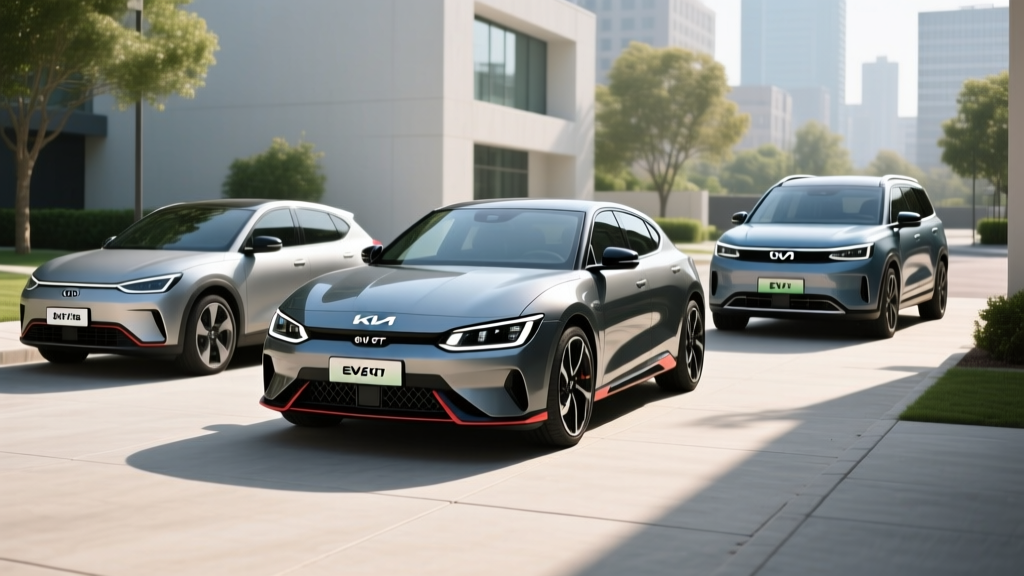
If you're researching a Kia electric car in 2026, you're likely weighing three models: the EV6 crossover, the three-row EV9 SUV, and the Niro EV compact. Here's what matters most: the EV6 Long Range delivers an EPA-estimated 310 miles of range and charges from 10-80% in about 18 minutes on a DC fast charger, starting around $42,900. The EV9 offers up to 304 miles and three rows from $54,900, while the Niro EV provides 239 miles of practical commuter range from $39,600. All three use Hyundai Motor Group's E-GMP platform (EV6/EV9) or dedicated EV architecture (Niro), feature 10-year/100,000-mile powertrain warranties, and may qualify for partial or full federal tax credits depending on your income, the vehicle's MSRP, and battery-sourcing requirements that shift annually.
Quick Answer: Which Kia Electric Car Fits You?
Best for most buyers: EV6 Long Range RWD — 310 mi EPA, 18-min fast charge, ~$42,900 MSRP
Need three rows? EV9 Land AWD — 280 mi EPA, family hauler, ~$63,000 MSRP
Budget commuter? Niro EV — 239 mi EPA, lowest entry price at ~$39,600 MSRP
2026 Kia EV Lineup: Spec-by-Spec Breakdown
Kia's current battery-electric lineup spans three distinct vehicle classes. The table below captures the numbers that actually drive purchase decisions — not marketing claims.
| Spec | 2026 EV6 LR RWD | 2026 EV6 GT-Line AWD | 2026 EV9 LR RWD | 2026 EV9 Land AWD | 2026 Niro EV |
|---|---|---|---|---|---|
| EPA Range | 310 mi | 282 mi | 304 mi | 280 mi | 239 mi |
| Battery (usable kWh) | 77.4 kWh (NMC) | 77.4 kWh (NMC) | 100.0 kWh (NMC) | 100.0 kWh (NMC) | 64.8 kWh (NMC) |
| Peak DC Charge Rate | 238 kW | 238 kW | 210 kW | 210 kW | 85 kW |
| 10–80% DCFC Time | ~18 min | ~18 min | ~24 min | ~24 min | ~45 min |
| Level 2 Charge Rate | 10.9 kW | 10.9 kW | 10.9 kW | 10.9 kW | 11 kW |
| Horsepower | 225 hp | 320 hp | 215 hp | 379 hp | 201 hp |
| 0–60 mph | 7.2 sec | 4.5 sec | 8.2 sec | 4.5 sec | 7.8 sec |
| MPGe (combined) | 134 MPGe | 116 MPGe | 88 MPGe | 83 MPGe | 113 MPGe |
| Starting MSRP | $42,900 | $52,900 | $54,900 | $63,000 | $39,600 |
| Battery/Powertrain Warranty | 10 yr / 100,000 mi | 10 yr / 100,000 mi | 10 yr / 100,000 mi | 10 yr / 100,000 mi | 10 yr / 100,000 mi |
Sources: EPA / fueleconomy.gov, Kia America. Real-world highway range typically runs 10–15% below EPA estimates; cold-weather (below 30°F) can reduce range 20–30%.
Real-World Range Reality Check
EPA 310 mi (EV6 LR RWD) → Expect ~265–280 mi on highway trips at 70–75 mph. In winter conditions (20–30°F), plan for ~220–240 mi before needing a charge. The EV9's larger frontal area and boxier shape hit highway efficiency harder — a 304-mi EPA rating translates to roughly 250–265 mi real-world highway, and as low as 200 mi in deep cold.
Charging Speed Deep Dive: What the Numbers Actually Mean
The EV6 and EV9 both use Hyundai Motor Group's 800-volt E-GMP architecture, which is the single biggest technical differentiator in Kia's EV lineup. Here's why it matters:
kW vs kWh — the critical distinction: kW (kilowatts) measures power — how fast energy flows into the battery. kWh (kilowatt-hours) measures energy — the total capacity of the battery. Think of kW as the width of the pipe and kWh as the size of the tank.
At a 350 kW DC fast charger (like Electrify America or EVgo's newest stations), the EV6 can accept a peak of 238 kW. However, no EV sustains its peak rate for the entire session. The charge curve tapers significantly above 50% state of charge (SoC), and drops sharply past 80% to protect battery health. That 10–80% time of ~18 minutes assumes you arrive with a preconditioned battery (the EV6's navigation system will precondition automatically when a DC fast charger is set as your destination) and an ambient temperature above ~60°F.
| Charging Level | Power (kW) | EV6 Miles Added/Hour | EV9 Miles Added/Hour | Niro EV Miles Added/Hour |
|---|---|---|---|---|
| Level 1 (120V outlet) | ~1.4 kW | ~4–5 mi | ~3–4 mi | ~4–5 mi |
| Level 2 (240V home) | 10.9 kW | ~35–40 mi | ~28–33 mi | ~35–39 mi |
| DC Fast Charge | Up to 238 kW (EV6) | ~100+ mi in 5 min | ~80+ mi in 5 min | ~25–30 mi in 10 min |
Connector note: For 2026, Kia has transitioned to the NACS (North American Charging Standard / Tesla-style) port on new production EV6 and EV9 models, granting access to Tesla Superchargers with native compatibility. Earlier model years (2022–2024) use CCS1 and require a Kia-provided adapter for Supercharger access. Verify your specific vehicle's port type before planning road trips.
Kia EV vs Gas: The True Cost of Ownership
Numbers settle the EV-vs-gas debate better than opinions. Below is a 5-year total cost of ownership (TCO) comparison between the EV6 LR RWD and a comparably priced gas crossover (2026 Kia Sportage EX AWD, ~$35,000 MSRP, 28 MPG combined).
| Cost Category (5 Years / 75,000 mi) | EV6 LR RWD | Gas Crossover (Sportage EX AWD) |
|---|---|---|
| Purchase Price (MSRP) | $42,900 | $35,000 |
| Federal Tax Credit (§30D, est.) | −$3,750 to $7,500* | $0 |
| Fuel / Electricity | $3,200–$4,800** | $8,900–$9,500 |
| Maintenance | $1,200–$1,600 | $3,000–$3,800 |
| Insurance (avg) | $7,500–$9,000 | $6,000–$7,200 |
| Estimated 5-Year Depreciation | $18,000–$22,000 | $14,000–$17,000 |
| Total 5-Year Cost (est.) | $42,000–$53,000 | $49,000–$57,000 |
* §30D credit eligibility depends on MSRP caps (vans/SUVs/trucks: ≤$80,000; others: ≤$55,000), buyer income limits ($150K single / $300K joint AGI), and battery critical-mineral and component sourcing requirements that tighten annually. Check current rules at IRS.gov. Credit can now be transferred to the dealer at point of sale as an upfront discount.
** Electricity cost assumes $0.14/kWh national average for home charging; public DCFC at $0.35–$0.50/kWh. Gas assumes $3.40/gal. Your local rates will shift these figures significantly.
Cost-Per-Mile Snapshot
EV6 home charging: $0.04–$0.05/mile (at $0.14/kWh, 3.5 mi/kWh efficiency)
EV6 public DCFC: $0.10–$0.15/mile
Gas crossover: $0.12–$0.14/mile (at $3.40/gal, 28 MPG)
Home charging is where EVs win decisively. If you rely exclusively on public DC fast charging, the per-mile cost advantage narrows or disappears — a critical factor for apartment dwellers without Level 2 access.
First-Time Kia EV Buyer: What You Must Know Before Signing
Buying your first EV involves considerations that don't exist with a gas car. Here's the unvarnished checklist:
Home Charging Access Is Non-Negotiable for Most Owners
Over 80% of EV charging happens at home. A Level 2 home charger (240V, 32–48 amp) delivers a full overnight charge for the EV6 in roughly 7–8 hours and the EV9 in about 9–10 hours. Installation costs range from $800–$2,500 if your electrical panel has capacity, or $3,000–$5,000+ if you need a panel upgrade (common in older homes with 100-amp service). Get a quote from a licensed electrician before you buy the car — not after.
The Niro EV Charges Noticeably Slower
The Niro EV maxes out at 85 kW DC fast charging — roughly one-third the EV6's rate. On a road trip, that means 45-minute stops vs 18-minute stops for a 10–80% charge. For a commuter who rarely road-trips, this is irrelevant. For anyone driving 300+ miles regularly, the EV6 is a fundamentally different ownership experience.
Insurance Will Likely Cost More
EV insurance premiums run 15–25% higher than comparable gas vehicles, driven by higher repair costs (battery replacement, specialized body-shop training) and elevated vehicle prices. Get a quote from your insurer before committing — the $1,000–$2,000/year premium increase can erase fuel savings if you drive low annual miles.
Cold Weather Is Real — But Manageable
At 20°F, expect 20–30% range reduction across all Kia EVs. The EV6 and EV9 include a heat pump (standard on most trims) that recovers waste heat from the drivetrain to warm the cabin, reducing the efficiency penalty compared to resistive heating. Preconditioning while plugged in is the single best cold-weather strategy — it warms the battery and cabin using grid power, preserving range.
Myths vs Facts: Kia EV Misconceptions Addressed
| Myth | Fact |
|---|---|
| "EV batteries need replacing every few years at enormous cost" | Kia warranties the battery for 10 years/100,000 miles against degradation below 70% capacity. Industry data shows NMC batteries typically retain 85–90% capacity at 100,000 miles. Full replacement (rare) costs $8,000–$15,000 depending on model. |
| "The tax credit is a guaranteed $7,500" | The §30D credit ranges from $0–$7,500 and depends on battery sourcing (critical minerals + components), buyer AGI limits, and MSRP caps. Some Kia EVs qualify for the full amount; others for partial or none, depending on the model year and your tax situation. Consult a tax professional. |
| "EVs are worse in winter" | Range drops 20–30% in deep cold — real, but manageable with preconditioning and a heat pump. EVs start instantly in cold (no engine cranking), and regenerative braking can be less aggressive on cold batteries, which some drivers find smoother. |
| "I can't take road trips" | The EV6's 18-min 10–80% charge and NACS access to 17,000+ Tesla Superchargers makes 500-mile trips practical with one ~20-minute stop. The Niro EV, with its slower 85 kW charging, is less suited for frequent long trips. |
| "EVs are slower to depreciate now" | EV depreciation has been volatile. Early EVs depreciated faster than gas cars due to rapid tech improvement and price cuts. Current data shows mainstream EVs like the EV6 depreciating closer to gas-car norms, but the segment still carries more uncertainty than established ICE models. |
Decision Framework: Which Kia Electric Car Should You Buy?
Choose Your Path
→ Choose the EV6 LR RWD if: You want the best range-to-price ratio in Kia's lineup, take road trips 3+ times per year, and value fast DC charging. This is the sweet-spot model.
→ Choose the EV6 GT-Line AWD if: You need all-wheel drive for snow/rain, want quicker acceleration (4.5 sec 0–60), and can accept 28 miles less range and a ~$10,000 price premium.
→ Choose the EV9 if: You need three rows and can't wait for an EV minivan. The EV9 is currently the only mainstream 3-row electric SUV near this price point. Budget at least $55,000 and accept 250–265 real-world highway miles.
→ Choose the Niro EV if: You're a commuter with home charging, drive under 40 miles/day, rarely road-trip, and want the lowest purchase price. The slow DC charging is irrelevant if 95% of your charging is overnight at home.
→ Consider a Kia PHEV instead (Sportage PHEV, Niro PHEV) if: You lack reliable home charging, regularly drive 400+ miles in rural areas with sparse charging infrastructure, or want electric commuting without any range compromise on long trips.
Frequently Asked Questions
Does the Kia EV6 qualify for the $7,500 federal tax credit?
Credit eligibility depends on the specific model year, battery sourcing compliance (critical minerals and component manufacturing requirements under §30D), your adjusted gross income (≤$150K single / $225K head of household / $300K joint), and the vehicle's MSRP (≤$55,000 for cars, ≤$80,000 for SUVs/trucks/vans). The EV6 qualifies as a car (MSRP cap $55K), meaning higher trims may exceed the cap. The EV9 qualifies as an SUV ($80K cap). Rules change frequently — verify current eligibility at IRS.gov and consult a tax professional.
How long does it take to charge a Kia EV at home?
On a Level 2 (240V) home charger at 10.9 kW: the EV6 (77.4 kWh battery) charges from empty to full in roughly 7–8 hours. The EV9 (100 kWh) takes about 9–10 hours. The Niro EV (64.8 kWh) takes about 6–7 hours. Most owners plug in nightly and wake up to a full or near-full battery — you rarely charge from 0%.
Is the Kia EV6 better than the Hyundai Ioniq 5?
Both share the E-GMP platform, 77.4 kWh battery, and 800V architecture. The EV6 offers slightly more cargo space (24.4 cu ft vs 27.2 cu ft behind rear seats depending on configuration) and a marginally lower starting price. The Ioniq 5 offers a more retro design and a flat floor. Range, charging speed, and warranty are nearly identical. Drive both and choose based on styling, ergonomics, and local dealer pricing.
What happens if the battery degrades?
Kia's battery warranty guarantees at least 70% capacity retention for 10 years/100,000 miles. If degradation falls below that threshold within the warranty period, Kia will repair or replace the battery at no cost. In practice, modern NMC batteries with active thermal management typically lose 1–2% capacity per year under normal use, meaning ~85–90% retention at the 100,000-mile mark.
Can I tow with a Kia EV?
The EV9 AWD is rated to tow up to 4,000 lbs (braked). The EV6 AWD can tow up to 2,700 lbs. However, towing cuts range dramatically — expect 40–50% range reduction when towing near maximum capacity. If you tow frequently and long distances, a PHEV or gas vehicle may be more practical.