Quick Answer: Is a Kenworth Electric Truck Right for Your Fleet?
Kenworth offers two primary battery-electric Class 8 and medium-duty trucks for 2026: the T680E (regional haul/drayage, up to ~150 miles EPA range, 82,000 lb GCWR) and the T270E/T480E (medium-duty, ~150-200 miles range, straight truck/vocational). Base pricing starts roughly $250,000–$400,000+ before incentives. These trucks are purpose-built for return-to-base, predictable-route operations under 200 miles. They are not a fit for long-haul OTR fleets without en-route DC fast-charging infrastructure. Diesel equivalents remain cheaper upfront but cost significantly more per mile to fuel and maintain over a 7-year duty cycle.
Kenworth Electric Truck Lineup: T680E and Medium-Duty Specs
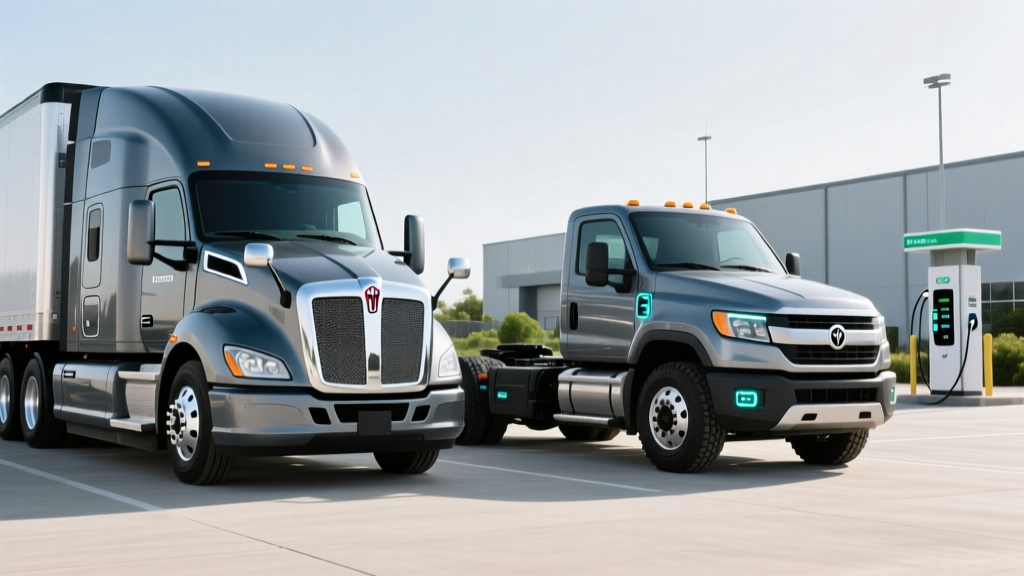
Kenworth's electric portfolio targets two distinct duty cycles. The Class 8 T680E is a battery-electric version of Kenworth's aerodynamic highway tractor, aimed at drayage and regional haul. The medium-duty T270E and heavier T480E serve vocational, delivery, and refuse routes. All share a common architecture: Meritor e-axles or PACCAR electric powertrains paired with modular lithium-ion (NMC chemistry) battery packs.
| Spec | Kenworth T680E (Class 8) | Kenworth T270E (Class 6) |
|---|---|---|
| Battery Capacity | ~282–396 kWh usable (NMC) | ~141–282 kWh usable (NMC) |
| EPA Range (est.) | Up to ~150 mi (loaded, regional) | Up to ~150–200 mi (delivery cycle) |
| Peak DC Fast Charge | ~150–350 kW (CCS1/CCS2) | ~150 kW (CCS1) |
| 10–80% DC Charge | ~60–90 min (at 350 kW capable depot) | ~45–75 min |
| GCWR / GVWR | 82,000 lb GCWR | 26,000–33,000 lb GVWR |
| Motor Output | ~490–670 hp (e-axle dependent) | ~300–350 hp |
| Base MSRP (est.) | ~$350,000–$400,000+ | ~$250,000–$300,000 |
| Warranty | 5 yr / 600,000 mi (battery) | 5 yr / 600,000 mi (battery) |
Real-world range caveat: EPA-equivalent range figures for heavy trucks are less standardized than for passenger cars. The ~150-mile figure for a loaded T680E assumes moderate speeds, flat terrain, and temperate weather. In cold-weather operation (below 32°F) or sustained 65+ mph highway hauling with a full 80,000 lb load, expect effective range to drop to 100–120 miles. Battery thermal management systems mitigate but do not eliminate this loss. Plan routes with a 20–30% range buffer.
Electric vs. Diesel: Total Cost of Ownership Breakdown
The upfront price gap between a Kenworth electric truck and its diesel counterpart is substantial — roughly 2x to 3x higher. But fleet operators evaluating TCO over a 7-year / 700,000-mile duty cycle find the math shifts dramatically when fuel, maintenance, and incentive dollars are factored in.
| Cost Category (7-Year TCO) | Kenworth T680E (Electric) | Kenworth T680 (Diesel) |
|---|---|---|
| Purchase Price (est.) | $375,000 | $160,000 |
| Federal / State Incentives | –$40,000 to –$120,000* | $0 |
| Fuel / Energy (700K mi) | ~$95,000 (depot charging @ $0.12/kWh) | ~$280,000 (diesel @ $4.20/gal, 6.5 mpg) |
| Maintenance (7 yr) | ~$35,000 | ~$85,000 |
| Depot Charging Install (amortized) | ~$50,000–$80,000 | $0 |
| Insurance (7 yr) | ~$42,000 | ~$35,000 |
| Net 7-Year TCO | ~$517,000–$597,000 | ~$560,000 |
*Incentive note: The federal IRC §45W Commercial Clean Vehicle Credit offers up to $40,000 for Class 8 electric trucks (30% of incremental cost over ICE, capped at $40,000). State programs like California's HVIP can stack additional vouchers of $60,000–$120,000+ depending on truck class and fleet location. Always confirm current-year eligibility with your tax advisor and state air-quality board.
The breakeven point for most regional-haul fleets operating a T680E falls between years 4 and 5, assuming depot electricity rates under $0.15/kWh and annual mileage above 80,000 miles. Below 50,000 miles/year, the diesel truck may remain cheaper over its lifetime.
Charging Infrastructure: What Depot Charging Actually Costs
Unlike passenger EVs, commercial electric trucks cannot rely on public charging networks for daily operations. Depot charging is the backbone of fleet electrification, and the infrastructure cost is non-trivial.
For a fleet of five T680E trucks charging overnight, expect the following infrastructure investment:
- DC fast chargers (150–350 kW CCS): $80,000–$150,000 per unit installed (hardware + trenching + switchgear)
- Electrical service upgrade: $50,000–$200,000+ if a new transformer or panel upgrade to 480V 3-phase is needed
- Utility demand charges: $10–$25/kW/month peak demand — this can add $3,000–$8,000/month for a 5-truck depot
- Charge management software: $2,000–$5,000/year for load-balancing and scheduling
Total depot charging setup for 5 trucks: $500,000–$1.2 million, depending on existing electrical service capacity and utility interconnection requirements.
Level 2 overnight charging (19–50 kW AC) is cheaper per stall ($15,000–$40,000 installed) but adds only ~20–40 miles of range per hour — sufficient for trucks with 8–10 hour dwell times and routes under 120 miles. DC fast charging at 350 kW can replenish a T680E from 10–80% in roughly 60–75 minutes, enabling mid-day top-ups for double-shift operations.
Charge Curve Reality: A T680E rated at 350 kW peak DC charging does not sustain that rate for the entire session. Like passenger EVs, heavy trucks experience charge-curve tapering. Peak rates apply between roughly 10–50% State of Charge (SoC). Above 80%, the rate drops sharply to protect NMC battery health. Plan depot schedules around 10–80% windows, not full 0–100% sessions.
Real-World Ownership: Who Should Buy a Kenworth Electric Truck?
Kenworth electric trucks are not a universal replacement for diesel. They excel in specific duty cycles and fall short in others. Here's the decision framework:
Choose Kenworth Electric If:
- Your routes are under 150 miles round-trip with predictable stops (drayage, port operations, regional distribution)
- Trucks return to a single depot nightly with 8+ hours of dwell time
- Your depot has (or can get) 480V 3-phase electrical service from the utility
- You operate in a state with stacking incentives (CA HVIP, NY Voucher, NJ ZIP Fund) that offset 30–50% of purchase cost
- Your fleet faces idling restrictions or operates in zero-emission zones (ports, urban centers)
- You want to lock in energy costs against diesel price volatility
Stick With Diesel (or Wait) If:
- Your routes regularly exceed 200 miles without reliable en-route charging
- Your trucks operate in extreme cold climates (Northern Plains, Mountain West) where range loss compounds
- Your depot is on a rented or temporary site where infrastructure investment is risky
- Annual mileage is below 50,000 miles — the fuel savings won't justify the upfront premium
- You haul heavy/overweight loads near the 82,000 lb GCWR max on hilly terrain — battery weight reduces payload capacity
Common Misconceptions About Electric Commercial Trucks
| Myth | Fact |
|---|---|
| "Electric trucks can't pull heavy loads." | The T680E is rated for 82,000 lb GCWR. Electric motors deliver peak torque at zero RPM, providing strong grade performance. The trade-off is reduced range at max load, not inability to pull. |
| "Batteries won't last the life of the truck." | Kenworth warranties batteries for 5 years / 600,000 miles with a capacity-retention threshold (~70–80% SoH). NMC packs in commercial duty are engineered for 3,000–5,000 charge cycles. Many operators report 85%+ SoH at 400,000 miles with proper thermal management. |
| "Charging takes too long for commercial ops." | Overnight depot charging (8–10 hours on Level 2 or low-power DC) fully replenishes most daily routes. Mid-shift DC fast charging at 350 kW adds ~100 miles in 30 minutes. Fleet scheduling adapts — it's a different model than diesel fueling, not an impossible one. |
| "Electric trucks are worse in winter." | Range does drop 15–30% in sub-freezing temperatures due to battery chemistry and cabin/equipment heating demands. However, electric trucks don't suffer cold-start issues, DEF gelling, or fuel-waxing problems that plague diesel in winter. Preconditioning while plugged in mitigates range loss. |
| "You'll never break even vs. diesel." | Fleets running 80,000+ miles/year in states with incentive stacking consistently report breakeven at years 4–5. The EPA and NREL fleet studies confirm TCO parity is achievable for the right duty cycle. |
First-Time EV Fleet Buyer Checklist
If you're evaluating your first electric commercial truck, here's what to nail down before signing a purchase order:
- Audit your routes. GPS-log 30 days of actual mileage, stops, and idle time. Identify which trucks consistently run under 150 miles/day.
- Contact your utility early. Depot charging for even 3–5 trucks may require a new transformer or feeder line. Utility lead times for service upgrades are 6–18 months in many regions.
- Model your electricity rate structure. Time-of-use (TOU) rates and demand charges dramatically affect operating cost. Charging overnight at $0.08/kWh vs. mid-day at $0.22/kWh is a 175% cost difference.
- Confirm incentive stacking. Federal §45W, state vouchers, and utility make-ready programs can cover 40–60% of total project cost (truck + charger + install). Rules change annually — verify with IRS.gov and your state air board.
- Pilot before scaling. Order 1–2 trucks and one charger first. Run them on your target route for 90 days. Measure actual energy consumption (kWh/mile), charge time, and driver feedback before committing to a full fleet conversion.
- Factor in payload differences. Battery weight (4,000–8,000 lb depending on pack size) reduces available payload. For weight-sensitive freight, calculate revenue impact per trip.
Frequently Asked Questions
How long does a Kenworth electric truck battery last?
Kenworth warranties the NMC battery pack for 5 years or 600,000 miles, whichever comes first, with a guaranteed minimum state of health (typically 70–80% capacity retention). Real-world data from early fleet adopters suggests these packs retain 80–90% SoH at 300,000–400,000 miles when charged primarily at moderate rates and kept within 20–80% SoC for daily use. Full pack replacement, if needed out of warranty, is estimated at $80,000–$140,000 depending on pack size.
Can a Kenworth T680E do long-haul routes?
Not practically with current infrastructure. The T680E's ~150-mile range under load is designed for regional and drayage cycles. Long-haul routes (500+ miles/day) require either en-route DC fast-charging corridors built for Class 8 trucks (still sparse in 2026) or hydrogen fuel-cell alternatives like the Kenworth T680 FCEV. If your routes exceed 250 miles, a battery-electric truck is likely the wrong tool today.
What is the federal tax credit for a Kenworth electric truck?
Commercial fleets are eligible for the IRC §45W Commercial Clean Vehicle Credit, not the consumer §30D credit. For Class 8 trucks, §45W provides 30% of the incremental cost over a comparable ICE vehicle, capped at $40,000 per truck. There are no income caps (it's a business credit), but battery sourcing and domestic-content requirements may apply. Always confirm eligibility with your CPA and reference IRS guidance for the current tax year.
How does cold weather affect electric truck range?
Expect a 15–30% range reduction in sustained sub-freezing temperatures. A T680E rated at ~150 miles may deliver 105–125 miles in winter conditions. Battery preconditioning while plugged in at the depot recovers some of this loss. Electric cabin heaters and battery thermal management draw from the traction battery, compounding the effect. Fleets in Minnesota, North Dakota, and similar climates should size routes conservatively — plan for 100-mile winter max and add depot top-up capacity.
What maintenance does an electric Kenworth truck require?
Significantly less than diesel. There are no oil changes, fuel filters, DEF fluid, DPF regenerations, turbocharger servicing, or transmission fluid changes (single-speed reductions replace multi-speed transmissions). Maintenance focuses on tire rotation, brake inspection (regenerative braking reduces wear by 40–60%), coolant system checks, cabin air filters, and periodic battery health diagnostics. Fleet operators report maintenance cost reductions of 40–60% versus diesel equivalents.