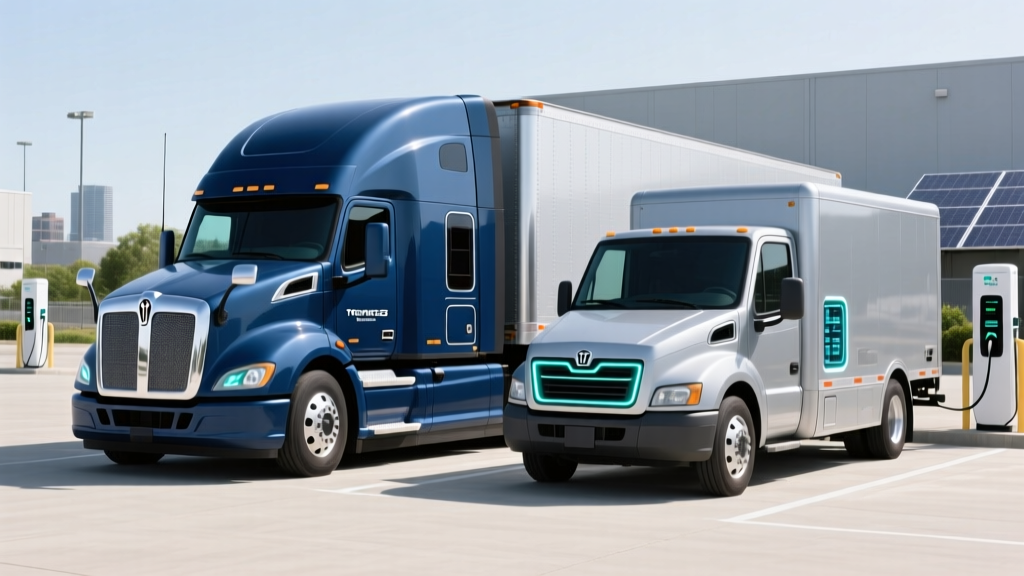
Quick Answer: Kenworth currently offers two primary battery-electric models: the Class 8 T680E (regional haul/drayage) and the Class 6 T270E (urban delivery). The T680E delivers an EPA-estimated range of up to 150 miles with a 396 kWh NMC battery pack, while the T270E covers up to 120 miles on a 169 kWh pack. Base pricing starts around $150,000 for the T270E and exceeds $300,000 for the T680E before federal and state incentives. These trucks are purpose-built for depot-based routes with predictable daily mileage under 150 miles and access to overnight Level 2 or DC fast charging infrastructure.
Kenworth Electric Lineup: What's Available in 2026
Kenworth, a PACCAR subsidiary, has steadily expanded its zero-emission commercial truck portfolio. As of 2026, two battery-electric models are in production and available for order, though lead times remain extended compared to diesel counterparts. Both models share PACCAR's electric powertrain architecture and are designed for return-to-base operations where overnight charging is feasible.
| Spec | T680E (Class 8) | T270E (Class 6) |
|---|---|---|
| GVWR | 82,000 lbs (tractor) | 26,000–33,000 lbs |
| Battery Capacity (usable) | 396 kWh (NMC) | 169 kWh (NMC) |
| EPA Est. Range | Up to 150 miles | Up to 120 miles |
| Motor Output | 670 HP (peak) / 402 HP (continuous) | 350 HP (peak) |
| Peak Torque | ~1,800 lb-ft | ~750 lb-ft |
| DC Fast Charge (peak) | ~150 kW (CCS1) | ~120 kW (CCS1) |
| 10–80% DC Charge Time | ~90 minutes | ~60 minutes |
| Level 2 Charge Rate | ~19.2 kW (AC) | ~19.2 kW (AC) |
| Trans. | 2-speed automated | 2-speed automated |
| Base MSRP (est.) | $300,000–$350,000 | $150,000–$180,000 |
| Battery Warranty | 5 yr / unlimited miles (65% SoH) | 5 yr / unlimited miles (65% SoH) |
Sources: Kenworth T680E specs, Kenworth T270E specs. Pricing varies by dealer, configuration, and battery-pack selection. Confirm exact figures with your Kenworth dealer.
Real-World Range: What the Sticker Doesn't Tell You
The EPA range figures above assume moderate payloads, flat terrain, and temperate conditions. In commercial operations, range varies dramatically based on load weight, route topography, ambient temperature, and auxiliary power demands (HVAC, liftgates, refrigeration units for the T270E).
Real-World Range Expectations:
- T680E (loaded to 80,000 lbs GCW, highway): Expect 100–130 miles. At full payload on hilly routes, range can drop below 100 miles.
- T270E (urban delivery, moderate payload): Expect 85–110 miles. Stop-and-go traffic actually helps through regenerative braking recovery.
- Cold-weather penalty (below 32°F): Plan for 20–35% range reduction depending on battery preconditioning and cab heating demands. NMC chemistry loses more in cold than LFP.
- Reefer unit impact (T270E): An electric transport refrigeration unit (eTRU) can consume 5–15 kWh per hour, cutting effective range by 20–40% on hot or cold days.
For fleet operators, the critical metric is not maximum range but route-energy predictability. Kenworth's SmartCharging software and PACCAR's telematics platform allow dispatchers to model energy consumption per route and flag trucks that will need mid-day top-ups.
Charging Infrastructure: The Hidden Cost
The truck is only half the equation. Depot charging infrastructure for Class 6 and Class 8 electric trucks requires significant electrical upgrades, and this is where many fleet operators encounter budget overruns.
| Component | T270E (Single 19.2 kW L2) | T680E (Single 150 kW DCFC) |
|---|---|---|
| Charger Equipment | $8,000–$15,000 | $60,000–$120,000 |
| Electrical Panel / Transformer Upgrade | $5,000–$25,000 | $30,000–$150,000 |
| Trenching / Conduit | $3,000–$10,000 | $10,000–$50,000 |
| Permits & Utility Interconnection | $2,000–$8,000 | $10,000–$40,000 |
| Electrician Labor | $5,000–$15,000 | $20,000–$60,000 |
| Total per Stall | $23,000–$73,000 | $130,000–$420,000 |
Most fleet depots running multiple trucks need utility-side upgrades: new transformers, switchgear, and potentially a dedicated medium-voltage feed. Utility lead times for these upgrades can stretch 12–24 months. Operators should begin infrastructure planning at least 18 months before truck delivery.
Charging speed reality check: The T680E's 150 kW peak charge rate is not sustained. Like all NMC packs, the charge curve tapers significantly above 80% state of charge (SoC). A 10–80% session takes roughly 90 minutes, but 80–100% can add another 60–90 minutes. For depot operations, most fleets program chargers to stop at 80–90% SoC to avoid taper losses and reduce battery wear.
Electric vs. Diesel: Total Cost of Ownership
The upfront price premium for Kenworth electric trucks is substantial — roughly 2.5–3× the cost of a comparable diesel model. The business case rests on fuel savings, maintenance reduction, incentive stacking, and potential revenue from demand-response programs.
| Cost Factor (5-Year / 500,000 mi) | T680E (Electric) | T680 (Diesel) |
|---|---|---|
| Vehicle Purchase | $325,000 | $140,000 |
| Federal Tax Credit (§45W commercial) | –$40,000 | $0 |
| State/Utility Incentives (varies) | –$50,000 to –$120,000 | $0 |
| Charging Infrastructure (allocated per truck) | $80,000 | $0 |
| Energy / Fuel Cost | $65,000 ($0.13/kWh avg.) | $175,000 ($4.00/gal avg., 6.5 MPG) |
| Maintenance (oil, filters, DEF, brakes) | $18,000 | $55,000 |
| Insurance (est. 10% premium for EV) | $55,000 | $50,000 |
| Net 5-Year Cost | $453,000–$383,000 | $420,000 |
Note: The federal §45W Commercial Clean Vehicle Credit provides up to $40,000 for qualified commercial EVs over 14,000 lbs GVWR. This is distinct from the §30D consumer credit and does not have the same income or MSRP caps, but it does require domestic final assembly and battery-sourcing compliance. State incentives (e.g., California's HVIP, New York's Truck Voucher Incentive) can dramatically improve the equation but vary by jurisdiction and funding availability. Consult a tax professional for eligibility.
The breakeven point depends heavily on local electricity rates, diesel prices, annual mileage, and available incentives. In high-incentive states with low commercial electricity rates (under $0.10/kWh), the T680E can reach cost parity within 3–4 years. In states with no incentives and high electricity costs, parity may not arrive within the vehicle's first life cycle.
Common Misconceptions About Kenworth Electric Trucks
| Myth | Fact |
|---|---|
| "Electric semi trucks can replace diesel on any long-haul route." | With 100–150 real-world miles of range, the T680E is a regional/drayage truck. Long-haul (500+ mi/day) remains diesel or hydrogen fuel-cell territory. |
| "Regenerative braking eliminates brake maintenance." | Regen significantly reduces foundation brake wear, but air system components, slack adjustors, and parking brakes still require inspection and service. |
| "I can plug into any public truck stop charger." | Public CCS1 DCFC infrastructure for Class 8 trucks is still extremely limited. Most Kenworth electric trucks charge exclusively at depot. Public heavy-duty charging corridors (e.g., WattEV, Greenlane) are in early rollout phases. |
| "Battery replacement will bankrupt the fleet." | NMC packs in commercial applications are warrantied to 65% capacity retention at 5 years. Replacement cost is estimated at $50,000–$80,000 for the T680E pack, but most packs are lasting well beyond warranty in real-world data. Second-life applications recover residual value. |
| "Cold weather makes electric trucks unusable." | Cold reduces range 20–35%, but preconditioning and battery thermal management mitigate this. Fleets in Minnesota and Quebec operate electric trucks year-round by adjusting route assignments and charge schedules. |
Who Should Buy a Kenworth Electric Truck?
Choose Kenworth Electric (T680E or T270E) if:
- Your routes are under 120 miles round-trip with predictable daily mileage
- You operate from a depot where overnight charging (8–10 hours) is feasible
- You have access to or can install heavy-duty charging infrastructure (or can partner with a charging provider)
- You operate in a state with significant commercial EV incentives (CA, NY, NJ, WA, OR, CO)
- You face zero-emission truck mandates (e.g., California's Advanced Clean Fleets rule) or have customers requiring emissions-free delivery
- Your fleet's cost-per-mile analysis shows energy and maintenance savings offsetting the purchase premium within your planning horizon
Stick with diesel or consider hydrogen fuel-cell (e.g., Kenworth T680 FCEV) if:
- Your daily routes exceed 200 miles or are highly variable
- You lack depot charging access and cannot secure it within 18 months
- You operate in regions with no state incentives and high commercial electricity rates (above $0.20/kWh)
- Your application requires heavy PTO usage (concrete mixers, heavy wreckers) that drains the traction battery
- You run in extreme cold (below 0°F regularly) without infrastructure for battery preconditioning
First-Time Electric Truck Buyer Checklist
- Audit your routes. Pull GPS telematics data for the past 12 months. Identify trucks running under 150 miles/day with return-to-base patterns — these are your electrification candidates.
- Engage your utility early. Before ordering trucks, contact your electric utility about depot load capacity. Ask about commercial EV rate schedules, demand charges, and make-ready programs. Many utilities offer infrastructure rebates.
- Stack incentives. Federal §45W, state voucher programs (e.g., CARB's HVIP), utility rebates, and EPA Clean School Bus / DERA grants can collectively offset 40–70% of vehicle and infrastructure cost. Funding windows open and close — track deadlines.
- Model energy costs accurately. Don't just look at $/kWh — factor in demand charges, which can add $5–$15/kW per month for unmanaged charging. Smart charging software (e.g., Amply, Zeem, TeraWatt) can shift charging to off-peak windows and reduce demand charges by 30–50%.
- Plan for workforce training. EV truck maintenance requires high-voltage safety certification (NFPA 70E), not traditional diesel wrenches. Budget for technician training or a service contract with Kenworth/PACCAR.
- Start small. Most successful fleet electrifications begin with 1–3 trucks on proven routes, validate the economics, then scale. Avoid committing to a full-fleet conversion before proving depot charging reliability.
Frequently Asked Questions
Can the Kenworth T680E tow a full 80,000 lb load?
Yes, the T680E is rated for 82,000 lbs GCW. However, towing at maximum weight significantly impacts range — expect closer to 80–100 miles at full load on mixed terrain versus the 150-mile EPA estimate at moderate loads. Most drayage operators run at 65,000–75,000 lbs GCW to preserve range margins.
How long do Kenworth electric truck batteries last?
PACCAR warranties the NMC battery packs for 5 years with a 65% state-of-health (SoH) retention threshold. Real-world data from early-adopter fleets suggests these packs retain 80–85% capacity at the 5-year mark under normal depot charging (80% SoC ceiling). Full pack replacement costs $50,000–$80,000 depending on model, but is rarely needed within the first ownership cycle.
Do Kenworth electric trucks qualify for the $7,500 federal tax credit?
No — the §30D consumer credit caps at $7,500 and applies to light-duty vehicles. Kenworth electric trucks qualify for the §45W Commercial Clean Vehicle Credit, which provides up to $40,000 for vehicles over 14,000 lbs GVWR, subject to domestic assembly and battery-component sourcing requirements. Always verify current-year eligibility with the IRS and a qualified tax professional.
What connector do Kenworth electric trucks use?
Both the T680E and T270E use the CCS1 (Combined Charging System Type 1) connector for DC fast charging and a J1772 inlet for Level 2 AC charging. The heavy-duty Megawatt Charging System (MCS) connector, capable of up to 1.2 MW, is in development for future Class 8 models but is not yet available on production trucks.
How does cold weather affect a Kenworth electric truck?
In temperatures below 32°F, NMC battery packs lose 20–35% of usable range due to increased internal resistance and cabin heating demands. Battery preconditioning (warming the pack before charging and before departure) mitigates charge-speed loss and recovers some range. Fleets in cold climates assign shorter routes to electric trucks in winter or add a mid-day DCFC top-up session.
Is maintenance really cheaper on an electric Kenworth?
Yes, substantially. You eliminate engine oil changes, diesel particulate filter (DPF) service, selective catalytic reduction (SCR/DEF) fluid, fuel filters, and most transmission service. Regenerative braking reduces foundation brake wear by 50–70%. However, you gain new maintenance items: coolant system service for battery thermal management, high-voltage cable inspections, and charger maintenance. Net savings typically run 40–60% versus diesel on a per-mile basis.