The Quick Answer: Karmann Ghia Electric Conversions in 2026
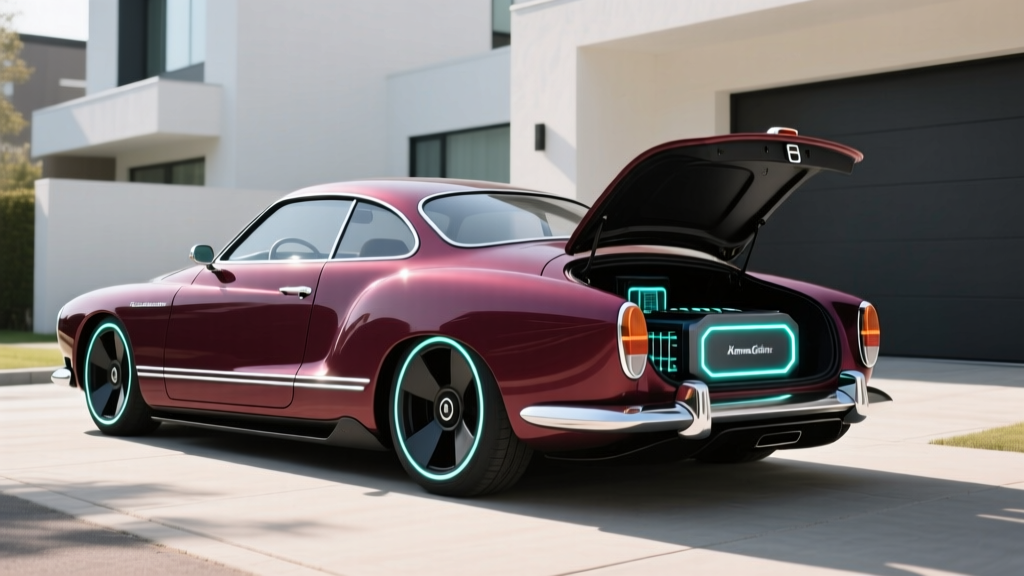
There is no factory-built Karmann Ghia electric car from Volkswagen or any major automaker. Every electric Karmann Ghia on the road today is a custom EV conversion — a classic 1955–1974 chassis retrofitted with an electric motor, battery pack, and modern electronics. In 2026, a professional conversion typically costs $35,000–$65,000 on top of the donor car price ($8,000–$25,000 for a solid candidate), yielding 60–150 miles of real-world range, 80–150 horsepower, and Level 2 charging capability. These are weekend cruisers and showpieces, not daily commuters. If you need practical daily transportation, a new mass-market EV delivers far more range, safety, and warranty for less total spend.
Why the Karmann Ghia Is a Conversion Favorite
The Volkswagen Karmann Ghia — built from 1955 to 1974 on the Beetle platform — has become one of the most popular classic cars for electric conversion. The reasons are mechanical, not sentimental (though the styling certainly helps):
- Lightweight platform: Curb weight around 1,800–2,100 lbs (depending on year and body style), which reduces the battery capacity needed for usable range.
- Rear-engine layout: The original flat-four sat in the back, making it straightforward to mount an electric motor in the same location using adapter plates.
- Simple mechanics: No complex transmission tunnel, power steering pump, or emissions equipment to work around.
- Strong parts ecosystem: Companies like EV West, Electric GT, and Canadian EV have developed bolt-in kits specifically for VW air-cooled platforms.
The result is a car that looks like a 1960s Italian-designed classic but drives with instant torque, zero tailpipe emissions, and none of the carburetor tuning headaches that plague original owners.
What a Karmann Ghia Electric Car Conversion Actually Costs
Budget is where most conversion dreams meet reality. Here's a realistic 2026 cost breakdown for a professionally completed Karmann Ghia EV conversion:
| Cost Category | Budget Build (DIY-heavy) | Professional Conversion | High-End / Show Quality |
|---|---|---|---|
| Donor car (running, solid body) | $8,000–$12,000 | $12,000–$20,000 | $18,000–$30,000+ |
| Motor + controller kit | $4,000–$7,000 | $7,000–$12,000 | $12,000–$18,000 |
| Battery pack (modules + BMS) | $6,000–$12,000 | $12,000–$22,000 | $20,000–$35,000 |
| Charger + DC-DC + wiring | $2,000–$4,000 | $3,500–$6,000 | $5,000–$8,000 |
| Labor (if professional) | $0 (DIY) | $10,000–$20,000 | $20,000–$40,000 |
| Body/paint/restoration | $2,000–$5,000 | $5,000–$15,000 | $15,000–$40,000 |
| Registration, inspection, insurance | $1,000–$2,000 | $1,500–$3,000 | $2,000–$5,000 |
| Total estimated cost | $23,000–$42,000 | $51,000–$98,000 | $92,000–$176,000 |
For context, a well-equipped professional conversion often lands in the $55,000–$75,000 total range. That puts it in direct competition with a new Tesla Model 3 Long Range (~$42,490 MSRP, 341 miles EPA range) or a Hyundai Ioniq 5 (~$42,900, 318 miles EPA range) — both of which come with 8-year/100,000-mile battery warranties, Level 2 ADAS, DC fast charging, and full NHTSA crash testing.
Federal tax credit note: Under IRS §30D rules, the $7,500 new clean vehicle credit applies only to qualifying new EVs from manufacturers — not to custom conversions of classic cars. A converted Karmann Ghia does not qualify. The used EV credit (§25E) of up to $4,000 also requires the vehicle to be sold by a licensed dealer and meet specific criteria that a custom conversion rarely satisfies. Consult a tax professional before assuming any credit applies.
Range, Performance, and Charging: What to Expect
The performance envelope of an electric Karmann Ghia depends entirely on the conversion spec. Here are realistic numbers for common 2026 builds:
| Specification | Original Gas Karmann Ghia (1970) | Budget EV Conversion | Premium EV Conversion |
|---|---|---|---|
| Power | 57 hp (1.6L flat-4) | 80–100 hp | 130–200+ hp |
| Torque | 82 lb-ft | 120–170 lb-ft | 180–280 lb-ft |
| 0–60 mph | ~19 seconds | ~9–12 seconds | ~5–7 seconds |
| Battery capacity | N/A | 15–25 kWh (LFP or salvaged NMC) | 30–50 kWh (new NMC/LFP modules) |
| EPA-equivalent range | ~280 mi (12-gal tank) | 50–80 mi real-world | 100–150 mi real-world |
| Charging (Level 2) | N/A | 3.3 kW (~12 mi/hr) | 6.6–7.2 kW (~25 mi/hr) |
| DC fast charging | N/A | Rare / not available | Available on premium builds (CCS, 25–50 kW peak) |
| Weight (converted) | ~1,950 lbs | ~2,200–2,500 lbs | ~2,400–2,800 lbs |
Real-World Range Reality
Unlike modern production EVs, converted classics don't have EPA-tested range ratings. The figures above are estimates based on battery capacity, vehicle weight, and drivetrain efficiency. Expect 20–35% range reduction in cold weather (below 40°F) due to battery chemistry limitations and cabin heating demands — most conversions use resistive heaters that draw 2–4 kW directly from the pack. Highway driving at 65+ mph also reduces range significantly compared to city use, because these cars lack the aerodynamic efficiency and regenerative braking sophistication of modern EVs.
Charging practicality: Most Karmann Ghia conversions charge via a standard J1772 Level 2 connector at home. A 25 kWh pack on a 6.6 kW onboard charger takes roughly 4 hours from empty to full. DC fast charging is possible on premium builds using CCS adapters, but the small battery packs (relative to modern 75–100 kWh packs) mean charge sessions are short even at modest power levels — a 30 kWh pack at 40 kW charges 10–80% in about 30 minutes.
Electric Karmann Ghia vs. Gas Original vs. Modern EV
The core decision isn't just electric vs. gas — it's whether you want a classic car experience or practical transportation. Let's put numbers to it:
| Factor | Gas Karmann Ghia (Original) | Electric Karmann Ghia (Conversion) | New EV (e.g., 2026 Model 3 LR) |
|---|---|---|---|
| Purchase price | $12,000–$30,000 | $50,000–$80,000 (typical pro build) | $42,490 MSRP |
| Fuel/energy cost per mile | ~$0.18/mi (25 MPG, $3.50/gal) | ~$0.04–$0.06/mi (home charging, $0.14/kWh) | ~$0.04–$0.05/mi |
| Annual maintenance | $1,500–$3,000 (carb, ignition, rust) | $300–$800 (brakes, tires, suspension) | $200–$500 (tires, cabin filter, wipers) |
| Insurance (annual) | $600–$1,200 (classic car policy) | $1,200–$2,500 (agreed-value specialty) | $1,400–$2,200 |
| Range | ~280 mi | 60–150 mi | 341 mi (EPA) |
| Safety features | None (lap belts, no crumple zones) | Minimal (3-point belts, no airbags typical) | Full suite (AEB, lane keep, 8 airbags) |
| Warranty | None | Component warranties only (motor: 1–3 yr) | 8 yr / 100,000 mi battery & drive unit |
The electric conversion saves roughly $0.12–$0.14 per mile on fuel compared to the original gas engine, which translates to about $600–$700/year if you drive 5,000 miles annually (typical for a classic). Maintenance savings are real but modest — you eliminate oil changes, tune-ups, and exhaust work, but you're still maintaining 50-year-old suspension, brakes, and body panels.
Common Misconceptions About Electric Karmann Ghias
| Myth | Fact |
|---|---|
| "VW makes an electric Karmann Ghia." | No manufacturer produces a factory-electric Karmann Ghia. VW's ID.4 and ID.7 are modern EVs with no mechanical or design relation to the Karmann Ghia. Every electric example is a third-party or DIY conversion. |
| "Conversions are cheap — just swap the motor." | A safe, roadworthy conversion with a modern battery pack, proper BMS, onboard charger, and street-legal registration typically exceeds $40,000 in parts and labor — before counting the donor car. |
| "It'll get 200+ miles of range." | Only with a very large (50+ kWh) battery pack, which adds 600–900 lbs to a car originally weighing under 2,000 lbs. This compromises handling, braking, and suspension life. Most builds target 60–120 real-world miles. |
| "I can DC fast charge it anywhere." | Most conversions use Level 2 (J1772) only. DC fast charging requires additional hardware (CCS inlet, high-voltage contactors, compatible BMS) adding $3,000–$6,000 to the build. Even then, small packs limit charge rates to protect cell longevity. |
| "It qualifies for the $7,500 federal tax credit." | Under current IRS §30D rules, custom conversions of vintage vehicles do not meet new clean vehicle credit requirements. The credit applies to qualifying new vehicles from approved manufacturers with specific battery-sourcing and MSRP criteria. |
Real-World Ownership: What First-Time Buyers Must Know
If you're seriously considering an electric Karmann Ghia, these ownership realities will shape your experience far more than the spec sheet:
Home Charging Is Essentially Required
With 60–150 miles of range, public DC fast charging (even when available) is impractical as a primary fueling strategy. You'll need a Level 2 home charger (240V, 30–40 amp circuit) installed by a licensed electrician. Budget $800–$2,500 for a quality Level 2 station and professional installation, potentially more if your electrical panel needs an upgrade to 200A service.
Registration and Insurance Are State-Specific
Many states require converted EVs to pass a special inspection (brake test, weight certification, electrical safety review) before issuing a revised title. Some states classify conversions as "specially constructed vehicles" (SPCNS), which can trigger additional smog-exemption paperwork or equipment requirements. Classic car insurance providers like Hagerty or Grundy may offer agreed-value policies, but premiums are higher than for a stock classic because the conversion adds value and complexity.
Cold Climate Owners: Plan for Range Loss
LFP and NMC battery packs both lose capacity in cold temperatures. A conversion with 100 miles of range at 70°F may deliver only 65–75 miles at 25°F, especially if you're running cabin heat. Garage storage and battery preconditioning (if your BMS supports it) help, but this is a real limitation for year-round use in northern states.
Safety Is a Genuine Concern
The Karmann Ghia was designed in the 1950s. Even with a modern electric drivetrain, you're driving a car with no airbags, no anti-lock brakes (on most years), no crumple zones, and no electronic stability control. The NHTSA has no crash-test data for these vehicles. This matters if you plan to drive in traffic regularly or carry passengers.
Decision Framework: Should You Build or Buy?
Choose an Electric Karmann Ghia Conversion If:
- You want a classic car as a weekend driver, show car, or passion project — and the EV conversion is part of the appeal.
- You have home charging and your typical drives are under 80 miles round-trip.
- You're comfortable spending $50,000–$80,000+ on a vehicle that will not have modern safety features, ADAS, or a manufacturer warranty.
- You value the uniqueness and craftsmanship of a conversion over practical transportation metrics.
- You understand that resale value is speculative — the conversion market is niche, and buyer pools are small.
Choose a Modern Production EV If:
- You need a daily driver with 250+ miles of range, DC fast charging, and all-weather capability.
- You want factory warranty coverage, NHTSA/IIHS safety ratings, and modern ADAS (automatic emergency braking, lane-keeping assist).
- You want to take advantage of the federal §30D tax credit (up to $7,500 for qualifying new EVs, subject to MSRP caps, income limits, and battery-sourcing rules — see IRS guidance).
- Your total budget is under $50,000 and you want maximum range, technology, and safety per dollar.
- You don't have the time, knowledge, or risk tolerance to manage a custom vehicle build.
Frequently Asked Questions
Does Volkswagen sell an electric Karmann Ghia?
No. Volkswagen has never produced a factory-electric Karmann Ghia. The Karmann Ghia was manufactured from 1955 to 1974 with air-cooled gasoline engines. VW's current EV lineup includes the ID.4 and ID.7, which share no platform or design lineage with the Karmann Ghia. Every electric Karmann Ghia you see is a custom conversion performed by a specialty shop or DIY builder.
How much does it cost to convert a Karmann Ghia to electric?
A professional conversion typically costs $50,000–$80,000 total (donor car + parts + labor). Budget DIY builds can come in around $25,000–$40,000 if you source salvaged battery modules and do your own fabrication. High-end restomod conversions with premium paint, upgraded suspension, and large battery packs can exceed $100,000.
What range can I expect from an electric Karmann Ghia?
Most conversions deliver 60–150 miles of real-world range depending on battery pack size (15–50 kWh), driving style, terrain, and temperature. Highway driving and cold weather reduce range by 20–35%. These are not road-trip vehicles — plan for local and regional use with home charging.
Can I fast-charge a converted Karmann Ghia?
DC fast charging (CCS or CHAdeMO) is possible on premium builds but adds $3,000–$6,000 in hardware and integration complexity. Most conversions use Level 2 (J1772) charging only, which fully replenishes a 25 kWh pack in about 4 hours at 6.6 kW. The small battery packs in most builds also limit sustained DC charge rates to protect cell health.
Is an electric Karmann Ghia safe to drive?
It carries the same safety limitations as any 1960s vehicle: no airbags, minimal crumple zones, no ABS or stability control on most examples, and drum brakes on older models. The electric conversion does not improve crash safety. For context, a 2026 Tesla Model 3 earns a 5-star overall NHTSA rating — the Karmann Ghia was never crash-tested to modern standards.
Does an electric car conversion qualify for any tax credits?
Generally, no. The federal §30D new clean vehicle credit requires a qualifying new vehicle from an approved manufacturer meeting battery-sourcing, MSRP, and buyer-income requirements. The §25E used EV credit has its own dealer-sale and price-cap restrictions. A custom conversion of a vintage car does not meet these criteria. Some states offer separate incentives for EV conversions — check your state's energy or DMV website for current programs.
How long will the battery in a conversion last?
It depends on the cells used. Salvaged Tesla or Nissan Leaf modules may have significant prior degradation and offer 5–8 years of usable life. New LFP modules (from suppliers like EVE or CATL) can last 10–15 years with proper thermal management and charge-limit discipline. Unlike production EVs, there is no standardized warranty — your converter's workmanship warranty (typically 1–3 years on labor) is all you have.